
Tips & Tricks for Training Your Dog
Blog
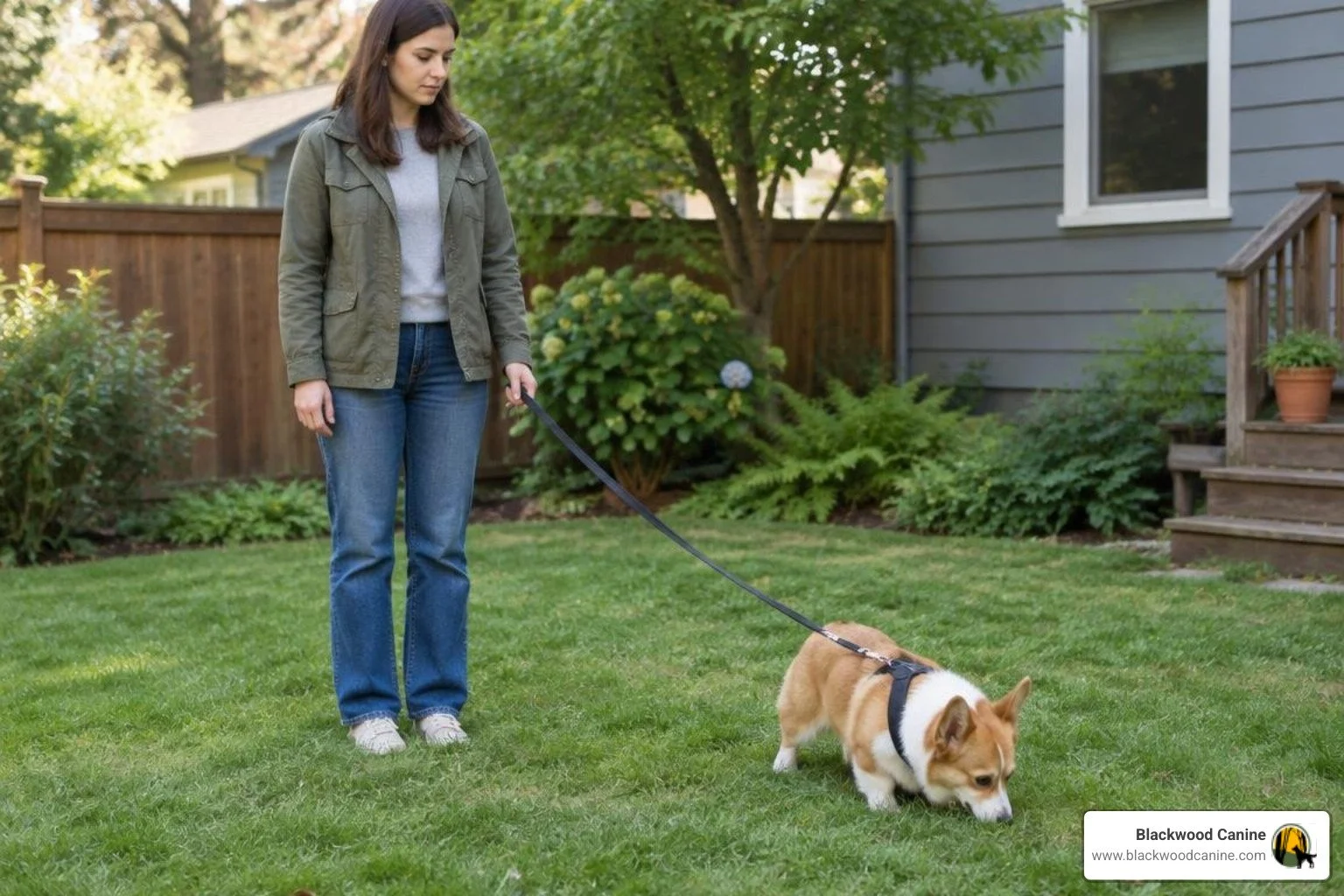
Start Early: Discover the Best Time to Potty Train a Puppy
The Best Time to Potty Train a Puppy by Age and Developmental Stage
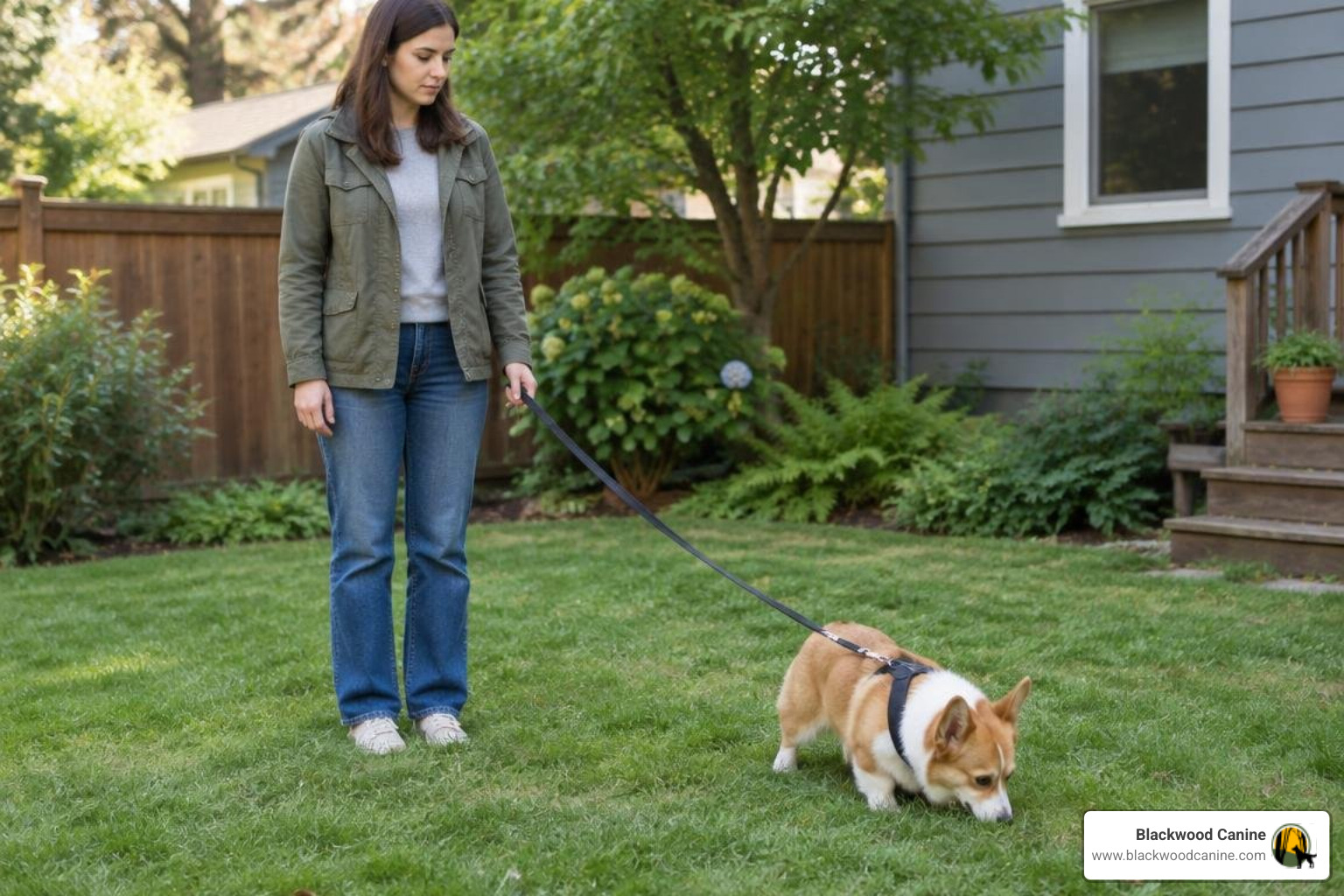
Understanding physical development helps set fair expectations for house training. Young dogs do not have the muscular control to hold their bladder for long stretches. Bladder muscle control develops in stages alongside their nervous system.
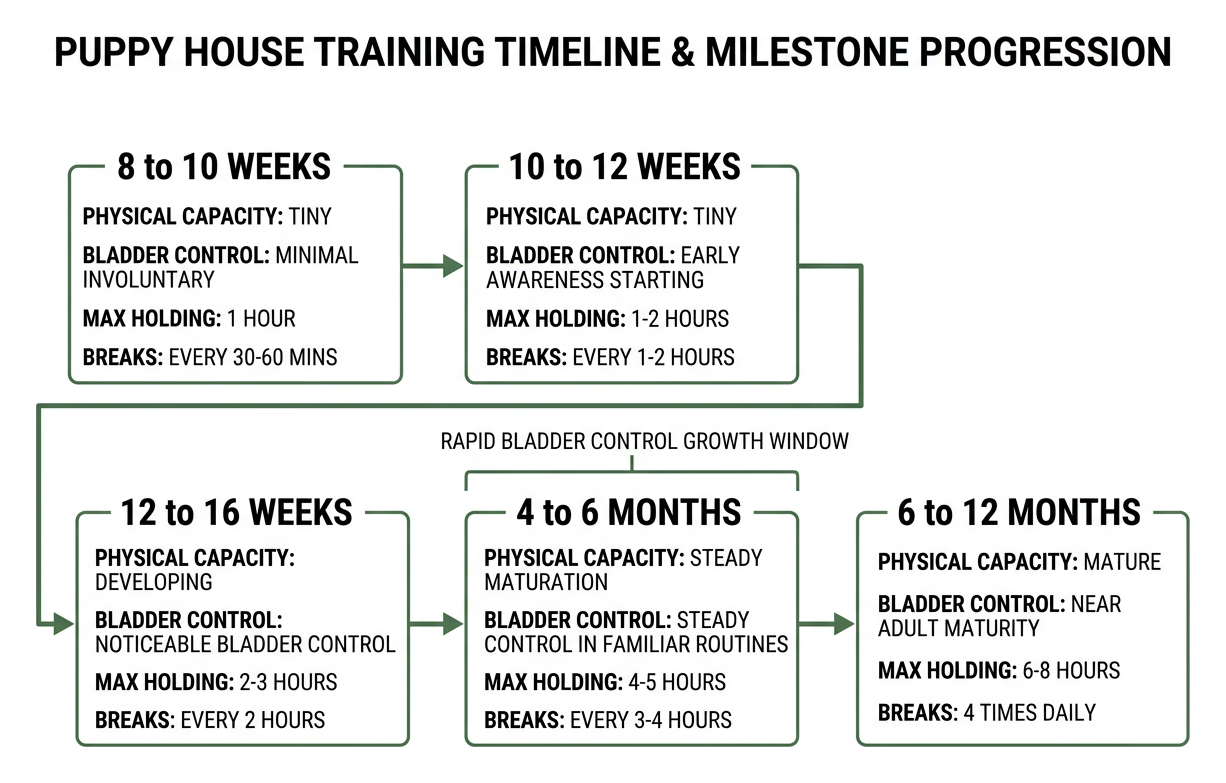
When you bring a puppy home around 8 to 12 weeks old, their physical capacity is tiny. Expecting them to hold it for hours sets everyone up for failure. Professional resources like the AKC puppy house training guide point out that deliberate house training begins the moment your dog arrives, but physical holding ability matures gradually over several months.
| Puppy Age | Estimated Max Holding Time | Recommended Break Frequency | Physical Control Level |
|---|---|---|---|
| 8 to 10 Weeks | 1 hour | Every 30 to 60 minutes | Minimal involuntary control |
| 10 to 12 Weeks | 1 to 2 hours | Every 1 to 2 hours | Early awareness starting |
| 12 to 16 Weeks | 2 to 3 hours | Every 2 hours | Noticeable bladder control developing |
| 4 to 6 Months | 4 to 5 hours | Every 3 to 4 hours | Steady control in familiar routines |
| 6 to 12 Months | 6 to 8 hours | 4 times daily | Near adult bladder maturity |
When Is the Best Time to Potty Train a Puppy for Fast Results?
Foundational habits start the day your puppy steps across your threshold at 8 weeks old. While their bladder cannot hold much liquid, their brain is an active sponge soaking up environmental associations. Starting day one teaches your puppy that outdoor surfaces like grass, dirt, or gravel are the right places to eliminate.
Between 12 and 16 weeks of age, puppies experience rapid growth in physical bladder control. If you have built solid routines between weeks 8 and 12, this stage is where results happen quickly. Scent association, a designated spot, and consistent timing connect smoothly during this window.
Puppy Bladder Capacity and Age Milestones
A reliable guideline for puppy bladder capacity is the month plus one rule. Take your puppy's age in months and add one to estimate the maximum number of hours they can physically hold their urine during daytime rest periods. An 8 week old puppy (2 months) can hold it for roughly 3 hours under resting conditions, while an active 3 month old needs a break every 2 to 3 hours.
Toy breeds often require more frequent outings due to faster metabolisms and smaller bladders compared to larger breeds. Most puppies do not achieve dependable, steady bladder control until around 5 months of age. Dogs reach full bladder capacity and adult physical maturity around 12 months.
How to Build a Predictable Puppy Potty Schedule
A predictable routine prevents accidents before they occur. Dogs thrive on rhythm, and their digestive systems operate on a clock. When meals, water, and outdoor trips happen at set times, bathroom breaks become completely predictable.
Following preventive veterinary advice on puppy potty schedules means removing free feeding habits. Offer food at scheduled times and pick up the bowl after 15 minutes. For nighttime routines, remove water bowls roughly two hours before bedtime to help your puppy sleep through the night without emergency trips.
Recognizing the Best Time to Potty Train a Puppy Throughout the Day
Knowing exactly when to take your puppy outside keeps you ahead of accidents. Take your dog outside during these essential transition moments:
- Immediately when they wake up in the morning
- 10 to 15 minutes after eating a meal
- 10 minutes after vigorous play sessions
- Immediately after waking from any daytime nap
- Right before bedtime confinement
High Priority Bathroom Triggers to Watch
Puppies communicate their physical needs through body language before an accident occurs. Learn to read these subtle behavioral signals:
- Sudden sniffing of the floor or rug
- Abruptly stopping play or walking away from you
- Circling or pacing near doors and gates
- Restless wandering or low whimpering
- Squatting posture or sudden frantic movement
Step-by-Step Guide: How to House Train Your Puppy Successfully

Reliable house training is built on management, clear expectations, repetition, and consistent reinforcement. It is never about quick tricks or extreme training ideologies. Success comes from showing your dog what you want, supervising closely, and following through every day.
Step 1: Designating a Spot and Cue Words
Always take your puppy out on a leash to the exact same outdoor spot. The existing scent tells their brain what to do. Stand calmly in one place without turning the trip into playtime.
As soon as your puppy begins eliminating, say a consistent cue word like "go potty" or "business" in a calm tone. Using the cue while the act is happening helps them associate the phrase with the physical action.
Step 2: Immediate Positive Reinforcement
Timing is everything when rewarding your puppy. Deliver a high value treat and sincere verbal praise within three seconds of them finishing outside. Rewarding them while still outdoors connects the reward to the outdoor location. If you wait until you walk back inside the kitchen, the puppy thinks they are being rewarded for crossing the doorway.
Once they finish and receive their reward, you can offer a minute of free sniffing or play in the yard as an extra bonus before heading indoors.
Step 3: Crate Training vs. Puppy Pads
Crate training uses a dog's natural den instinct to avoid soiling their sleeping quarters. A properly sized crate should only have enough room for the puppy to stand up, turn around, and lie down comfortably. If the crate is too large, the puppy may eliminate in one corner and sleep in the other.
Puppy pads can complicate outdoor house training. They teach puppies that soft, absorbent indoor surfaces are acceptable bathroom areas, which easily leads to confusion with rugs, mats, and carpets. For dog owners in urban apartments without immediate yard access, a dedicated balcony grass patch is a clearer option that maintains the correct outdoor texture preference.
Handling Accidents and Common Training Mistakes
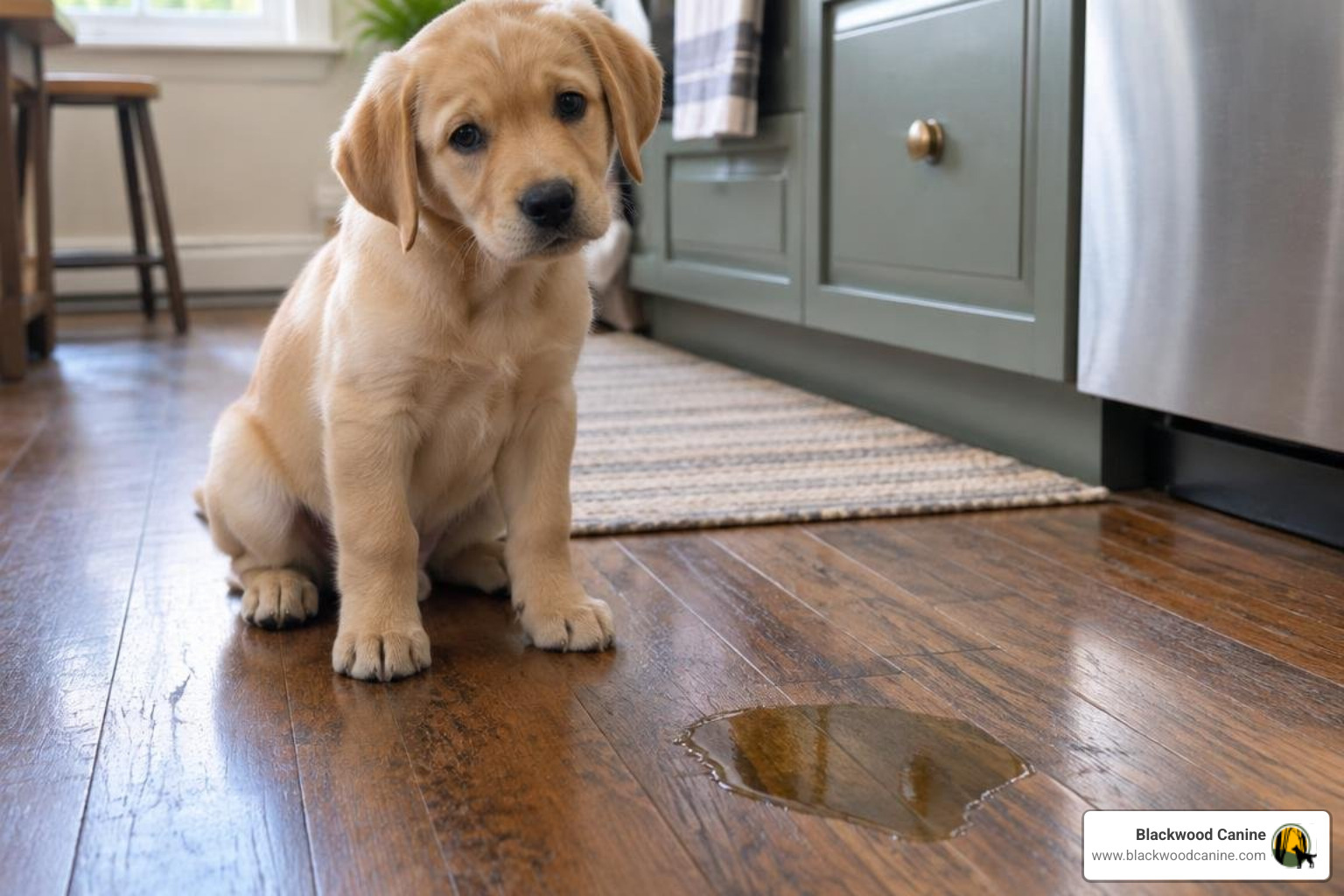
Accidents are a normal part of raising a young dog. How you handle them determines how quickly your puppy learns. Frustration is understandable, but reacting with anger slows down progress and damages trust.
What to Do When Accidents Happen Indoors
If you catch your puppy in the middle of an accident, interrupt them with a calm, neutral sound to pause the behavior. Immediately guide them outside to their designated potty area. If they finish outside, reward them calmly.
When cleaning indoor messes, always use an enzymatic cleaner. Standard household cleaners or ammonia based sprays do not break down the microscopic uric acid crystals. To a puppy's sensitive nose, the spot still smells like a bathroom, triggering repeated accidents in the same location.
Avoiding Costly House Training Errors
Avoid these common pitfalls to keep your training on track:
- Misapplying punishment or corrections: Misusing discipline or yelling out of frustration does not teach a puppy where to go. Improper application creates confusion and leads puppies to hide when eliminating, resulting in covert accidents behind furniture. Disciplinary methods and training tools should always be applied properly and under professional guidance.
- Granting too much unsupervised freedom: Giving a new puppy free run of the house invites hidden accidents. Use baby gates, playpens, or leashes to maintain close supervision.
- Inconsistent feeding schedules: Free feeding creates unpredictable digestion times and random bathroom needs.
- Delayed rewards: Giving treats inside the house after coming in from the yard confuses the association.
- Skipping the potty log: Tracking meal times, sleep cycles, and bathroom breaks helps you spot natural rhythms and adjust intervals before accidents occur.
Frequently Asked Questions About House Training Puppies
How long does it typically take to potty train a puppy?
Most puppies take 4 to 6 months to become dependable in the home, with full maturity settling in around 12 months. Factors like breed size, consistency, and daily routine impact this timeline. Around 6 to 9 months of age, some puppies experience a brief phase of adolescent regression where they test boundaries or have minor setbacks. Sticking to baseline management quickly resolves these phases.
What are the earliest signs that my puppy needs to go potty?
The earliest signs are subtle shifts in focus. A puppy might suddenly drop a toy, break eye contact, begin sniffing the baseboards, or wander toward a doorway. Catching these early cues prevents the circling and squatting that follows seconds later.
When should I consult a veterinarian or professional trainer?
If your puppy urinates very frequently in tiny amounts, strains while eliminating, shows blood in their urine, or experiences sudden regression despite a solid routine, consult your veterinarian for an assessment to rule out urinary tract infections or bladder issues.
For ongoing behavioral challenges, working with a professional trainer provides clarity. Blackwood Canine offers structured basic obedience foundation training starting at 4 weeks, as well as 6 week and 8 plus week programs for complex behavior modification to help families build reliable habits.
Clear Habits for a Clean, Stress Free Home
Raising a puppy takes patience, clear communication, and solid daily management. By matching your expectations to your puppy's physical age, keeping a regular schedule, and rewarding outdoor success, you set your dog up for lifelong house manners.
If you are a busy dog owner in Scappoose, St. Helens, Warren, Bethany, Hillsboro, Beaverton, Portland, Vancouver, or nearby Oregon and Washington communities feeling overwhelmed by the puppy stage, you do not have to figure it out alone. Explore our easy puppy training guide to learn more about our balanced training approach, or reach out to Blackwood Canine to set up a Good Dog Game Plan and build a reliable, enjoyable relationship with your dog.
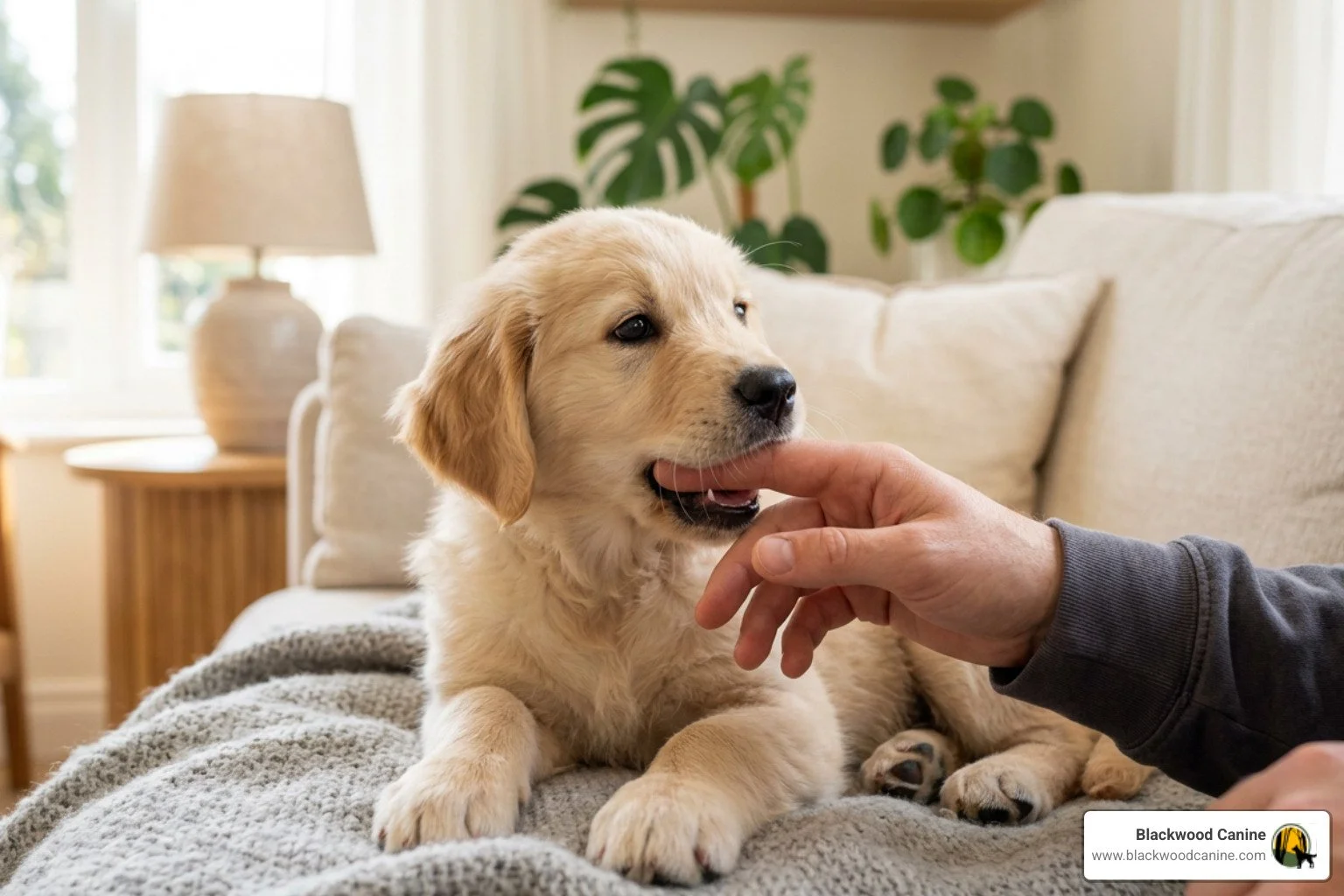
How to Stop Puppy Biting in 3 Simple Steps
Your 3 Month Old Puppy Is Biting Because They Need Clear Rules
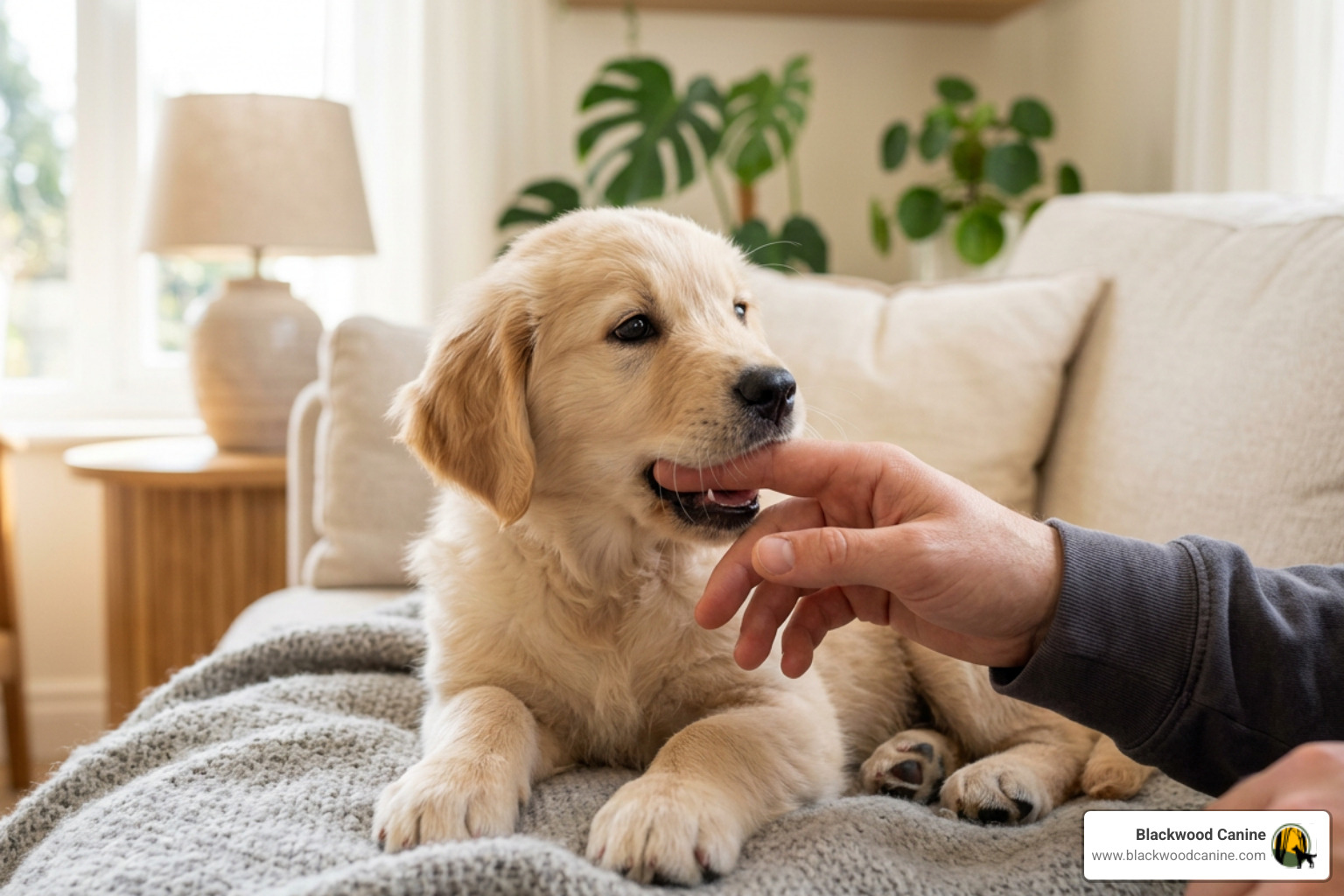
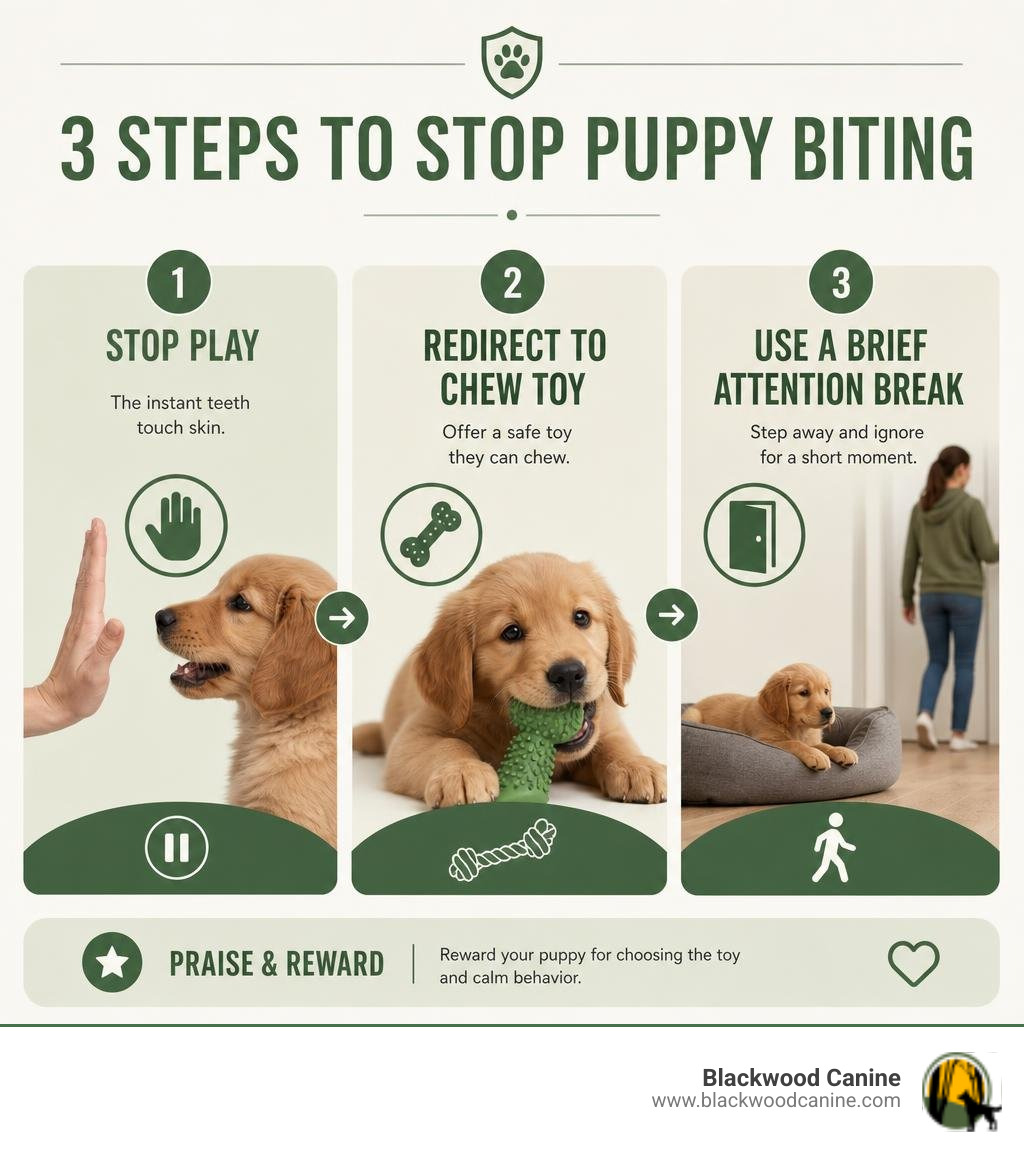
If your 3 month old puppy won't stop biting, start doing the same three things every time: stop play the instant teeth touch skin, offer a safe chew toy, and briefly remove your attention if the biting continues. Keep your hands still rather than pulling away, reward your puppy for choosing the toy, and make sure they get enough sleep.
This is frustrating, but it is usually normal. Puppy biting often peaks around 12 to 13 weeks, when teething, excitement, and weak impulse control collide. Adult teeth also begin coming in around 12 to 16 weeks, which can make sore gums and chewing urges worse.
You are not teaching your puppy to never use their mouth. You are teaching bite inhibition: how to control pressure and choose toys instead of human hands, feet, sleeves, and pant legs. With consistent responses, many owners see clear improvement within two to four weeks.
I am David Wright. After learning how much better clear training can work than guesswork, I have spent years helping owners handle problems like a 3 month old puppy won't stop biting with practical play and obedience skills.
Why Your 3 Month Old Puppy Won't Stop Biting
Puppies explore their environment with their mouths. When a puppy is 12 weeks old, they possess 28 needle sharp baby teeth, and their jaws are learning how pressure works. When puppies wrestle with their littermates, an overly hard nip results in a loud yelp and an abrupt end to play. This natural feedback is how young dogs begin discovering the strength of their bite.
In our homes, however, humans often give mixed signals. Pulling your hands away quickly or squealing can trigger predatory chase drives. To a puppy, sudden movements look like fun prey. Medical insights on veterinary advice on puppy teething confirm that physical development heavily influences oral fixation at this age.
It is helpful to differentiate normal puppy play from potential behavioral concerns:
| Behavioral Signal | Playful Mouthing / Teething | True Aggression / Warning |
|---|---|---|
| Body Posture | Loose, wiggly, bouncing movements | Stiff posture, frozen stance, hard staring |
| Vocalizations | Playful growls, yips, or silence | Deep guttural growling, snarling, snapping |
| Context | During active play, greetings, or fatigue | Guarding food, toys, sleeping spaces, or fear triggers |
| Facial Expression | Soft eyes, open relaxed mouth | Tense muzzle, lip curling, exposed front teeth |
The Peak Teething Window at 12 to 16 Weeks
Puppy biting tends to hit its peak when a pup is about 13 weeks old (around 3 months). During this developmental stage, baby teeth begin loosening to make way for adult teeth.
Adult dog teeth start to grow in when your puppy is 12 to 16 weeks old, and your puppy’s gums may be a bit sore during this time. Chewing creates counter pressure against the gums, which temporarily relieves pain and inflammation. If appropriate chew toys are not readily available, your hands, feet, and baseboards become the default replacements.
Overtiredness and Impulse Control Lapses
A common reason a puppy turns into a relentless biter during the evening is exhaustion. Young dogs require 16 to 18 hours of sleep per day. When they do not get enough rest, their ability to regulate excitement collapses.
When your pup enters hyperactive biting mode, darting across the room and snapping at your clothes, they are rarely displaying dominance. They are typically overtired. Implementing structured naps in a quiet crate or playpen gives their developing nervous system the downtime it needs.
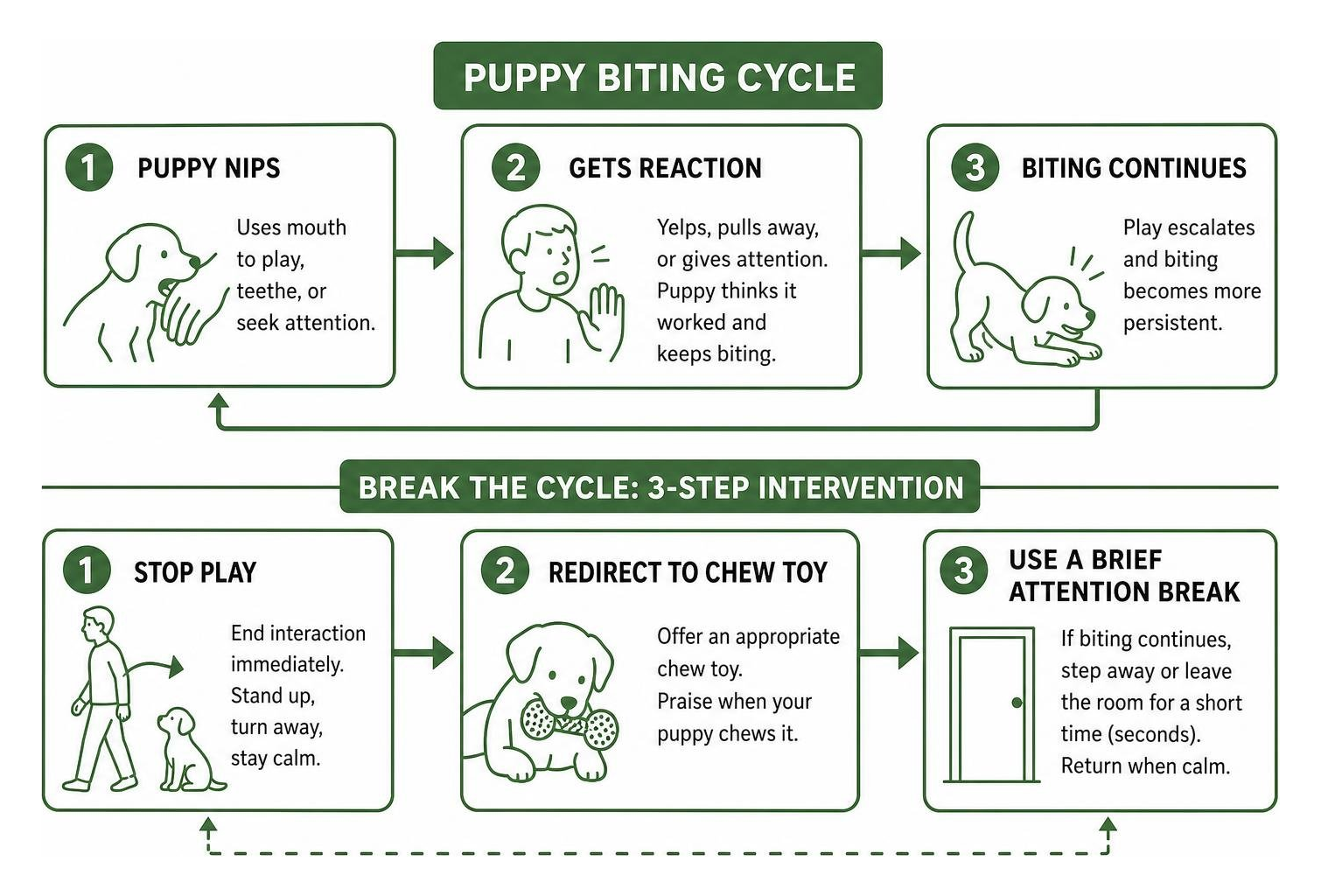
How to Stop Puppy Biting in 3 Simple Steps
Stopping unwanted nipping does not require harsh measures or complex routines. It requires clear communication, immediate feedback, and strict consistency from everyone in your household. If Is Your Pup a Nipper? Try These Puppy Trainer Tips to Stop Biting has shown us anything, it is that clarity and calm structure win every time.
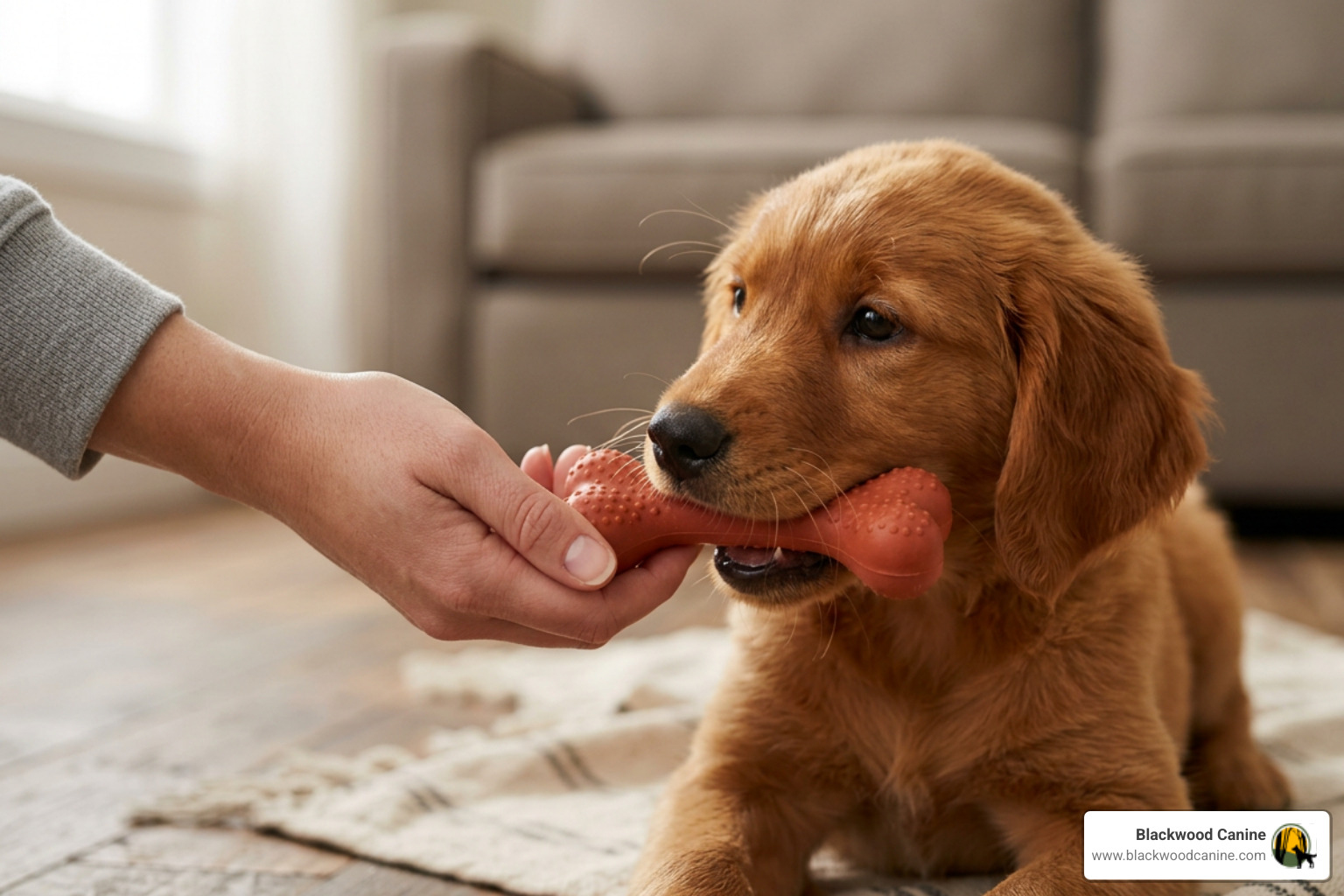
Step 1: Teach Bite Inhibition with Calm Feedback
Bite inhibition is the ability of a dog to control the force of its jaws. We want puppies to learn that human skin is fragile before their adult teeth and stronger jaw muscles fully develop.
When your puppy places their teeth on your skin with uncomfortable pressure:
- Give a brief, high pitched "Ouch!" or a calm verbal marker like "Too bad!"
- Immediately let your hand go limp. Do not jerk away, because sudden movement encourages chasing.
- Pause all interaction for 5 to 10 seconds.
- Resume calm interaction once they relax.
The AKC guide on puppy bite inhibition highlights that teaching pressure limits helps ensure safety as the dog grows. If a high pitched sound makes your specific puppy more excited, use a quiet, calm verbal marker instead.
Step 2: Redirect Immediately to an Appropriate Chew Outlet
Puppies need to bite something, so your job is to direct that physical need toward acceptable objects. Practice proactive redirection during every interaction using principles of Easy Puppy Training.
Keep durable rubber toys, textured chew rings, or frozen washcloths stationed around your living area. When your puppy approaches you for affection or play:
- Present a toy before they target your fingers.
- If teeth touch your skin, pause, then immediately present the toy.
- Praise your pup the second their teeth engage the toy surface.
- Rotate through different textures to keep their interest high and soothe tender gums.
Step 3: Enforce Brief Time-Outs for Escalated Nipping
If your puppy ignores verbal feedback and continues latching onto skin or clothing, end the game entirely. Social isolation for a few seconds communicates that biting makes the fun vanish.
Use a reverse time out:
- Stand up, cross your arms, turn your back, and tuck your hands into your armpits.
- If the puppy continues biting your ankles or pants, step over a baby gate or exit the room for 10 to 20 seconds.
- Return calmly. If the puppy remains overexcited, place them gently into their crate or exercise pen with a chew item for a nap.
- Keep time outs short and neutral. Avoid angry shouting, which adds excitement or confusion.
How to Handle Specific Biting Triggers
Different environments and daily events create specific biting triggers. Managing these moments prevents bad habits from hardening into adult routines. Adding foundational habits like 3 Things You Can Do to Have a Well-Mannered Puppy will keep your household running smoothly.

What to Do When Your 3 Month Old Puppy Won t Stop Biting During Play
Playtime often elevates arousal levels quickly. To prevent games from turning into painful biting matches:
- Use long tug toys rather than small balls to keep a safe distance between tiny teeth and your fingers.
- Keep play sessions short, pausing every 30 to 60 seconds to ask for a basic command like "Sit."
- If teeth graze skin, freeze in place. Moving hands invite predatory lunges.
- Resume play only when all four paws are on the floor and the puppy has stepped back.
Stopping Ankle, Foot, and Pant Leg Attacks
Moving feet and swinging pant legs mimic small animals running along the ground. To manage this behavior:
- Avoid running away or kicking your legs, which turns you into an interactive toy.
- Carry a soft fleece tug toy or pocket treats when walking through high risk zones like hallways.
- Drop a few treats on the floor ahead of you or offer the toy to focus attention away from your shoes.
- Stop walking immediately when teeth grab your clothing; move forward only when the puppy releases.
Common Puppy Biting Mistakes That Make Things Worse
Many well meaning puppy owners inadvertently reward or intensify biting. Reviewing What Dog Trainers Say Not to Do When Training a New Puppy can help prevent typical household missteps.
Key mistakes to avoid include:
- Hand wrestling: Roughhousing with bare hands teaches the pup that human skin is an authorized chew toy.
- Physical corrections: Pinning puppies, squeezing muzzles, or tapping noses creates defensive arousal, fear, or distrust. Proper training tools and consequences have their place in balanced development, but misuse without professional guidance damages the relationship.
- Inconsistent house rules: Letting the puppy mouth your hands on Monday but scolding them on Tuesday causes stress and slows learning.
- Ignoring exhaustion: Trying to train an overtired pup rather than placing them down for a scheduled rest leads to frustration for both of you.
- Overusing sprays without training: Bitter sprays can deter object chewing, but as the ASPCA guide on puppy mouthing notes, deterrents alone do not teach a puppy what behaviors are expected.
Frequently Asked Questions About Puppy Biting
Is It Normal If Your 3 Month Old Puppy Won t Stop Biting Hands and Feet?
Yes, it is completely normal. Around 12 to 13 weeks of age, puppy biting reaches its peak when the puppy is transitioning from baby teeth to adult teeth. They lack impulse control and naturally explore their world using their jaws. Clear boundaries and consistent redirection will systematically reshape the habit.
At what age do puppies naturally grow out of biting?
Puppy mouthing and biting usually begins to naturally subside when they’re around eight to 10 months old. Most puppies significantly reduce biting by 6 to 8 months when teething ends, but consistent training can make big improvements much earlier, often within 2 to 4 weeks. Most puppies show noticeable improvement within 2 to 4 weeks when training remains consistent across all family members.
When does puppy mouthing indicate actual aggression?
True aggression in young puppies is uncommon. However, if biting is accompanied by rigid body posture, sustained growling without play cues, resource guarding over food dishes, or fear driven snapping, an evaluation is warranted. If you notice these warning signs, or if you haven’t been able to moderate the behavior by the time they’re 6 months old, it’s a good idea to consult an experienced dog trainer or animal behavior specialist for an in person assessment.
Moving Forward With a Calm, Well-Mannered Puppy
Living with a mouthy three month old puppy can leave you feeling frustrated, bruised, and exhausted. Teaching jaw control and household manners takes steady repetition, fair consequences, and daily management. When you replace chaotic reactions with clear communication, your puppy learns exactly how to interact safely with the family.
If you are a dog owner in Scappoose, St. Helens, Warren, Bethany, Hillsboro, Beaverton, Portland, Vancouver, or surrounding areas and feel stuck, you do not have to figure it out alone. At Blackwood Canine, we provide structured private lessons and immersion programs designed to build clear communication and reliable habits from the ground up. Our basic obedience foundation training starts at 4 weeks, with 6 week and 8 plus week timelines for complex behavior modification.
Take a look at our professional dog training services to explore how our Good Dog Game Plan can help you guide your pup into a calm, reliable companion.
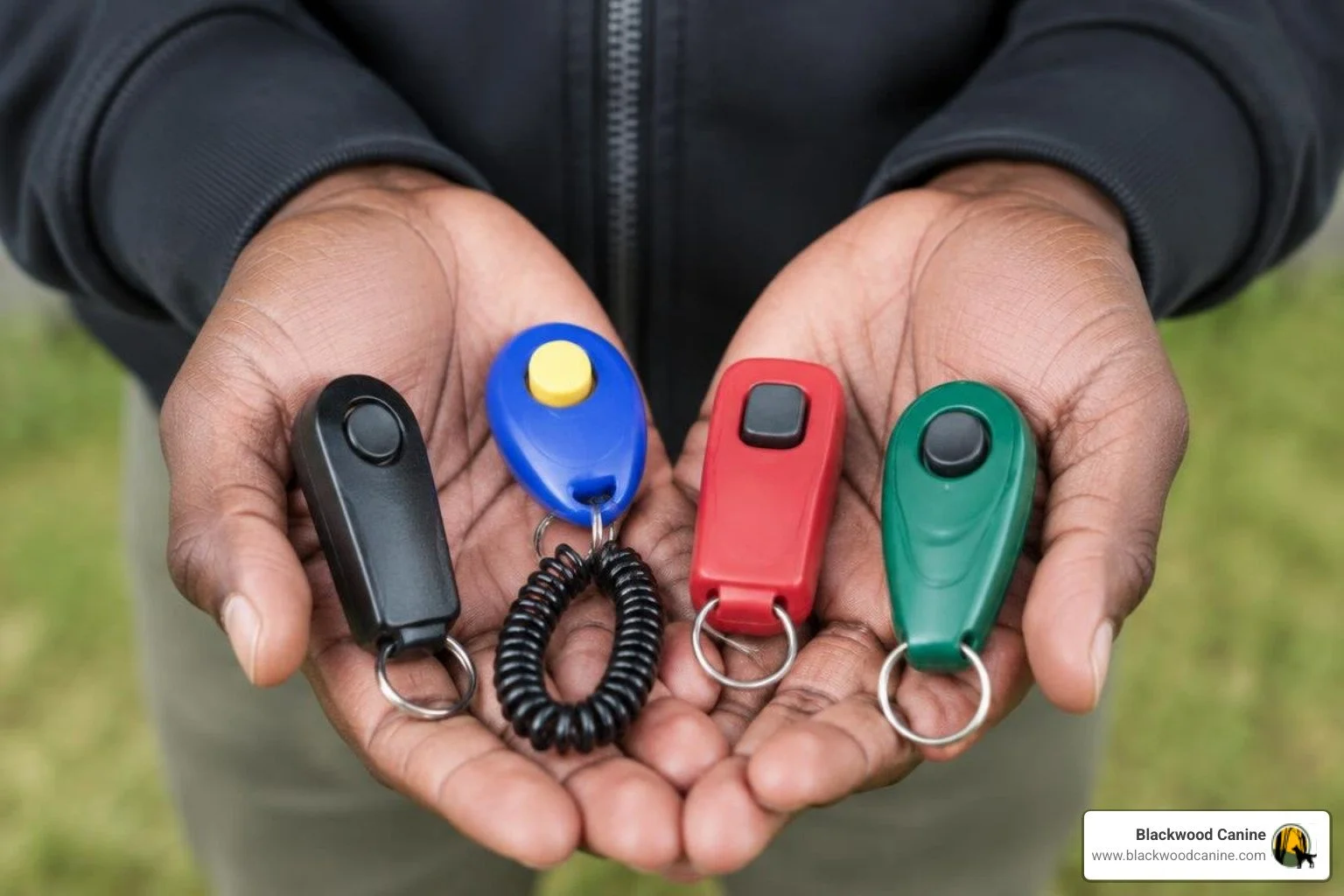
A Comprehensive Guide to Dog Clicker Training for Beginners
Dog Clicker Training for Beginners: A Clear Way to Mark Good Choices
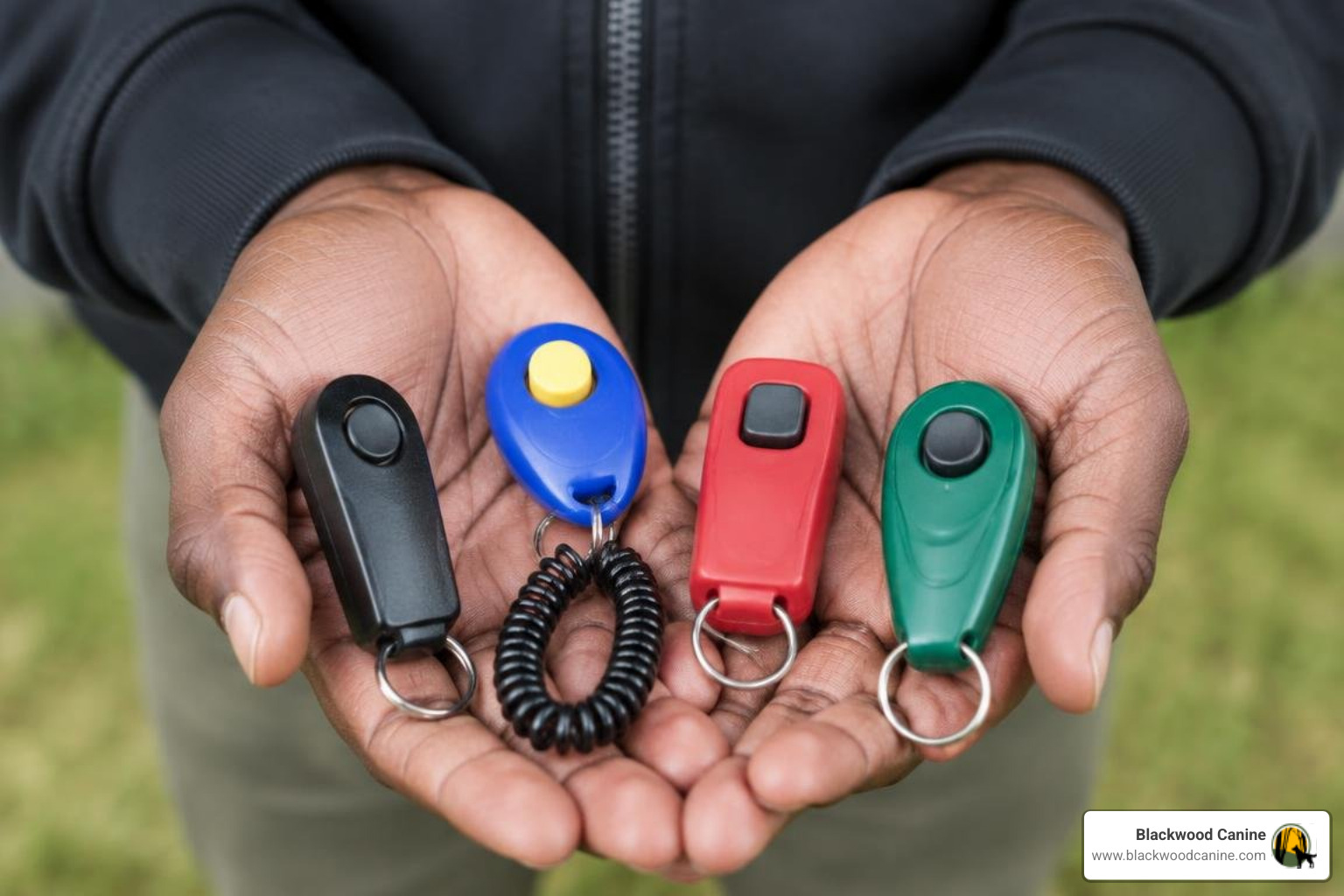
Dog clicker training for beginners gives you a simple way to tell your dog, "That exact choice earned a reward." The click marks the right moment, then a treat, toy, or other reward follows. It is useful when your timing matters, such as rewarding calm behavior at the door, a sit before greeting guests, or a loose leash check in on a stressful walk.
Here is the quick version:
- Get a clicker and small, easy to eat rewards.
- Click once, then immediately give a reward 10 to 15 times so the sound predicts something good.
- Click the instant your dog does the behavior you want.
- Give a reward after every click.
- Keep practice short, clear, and low pressure.
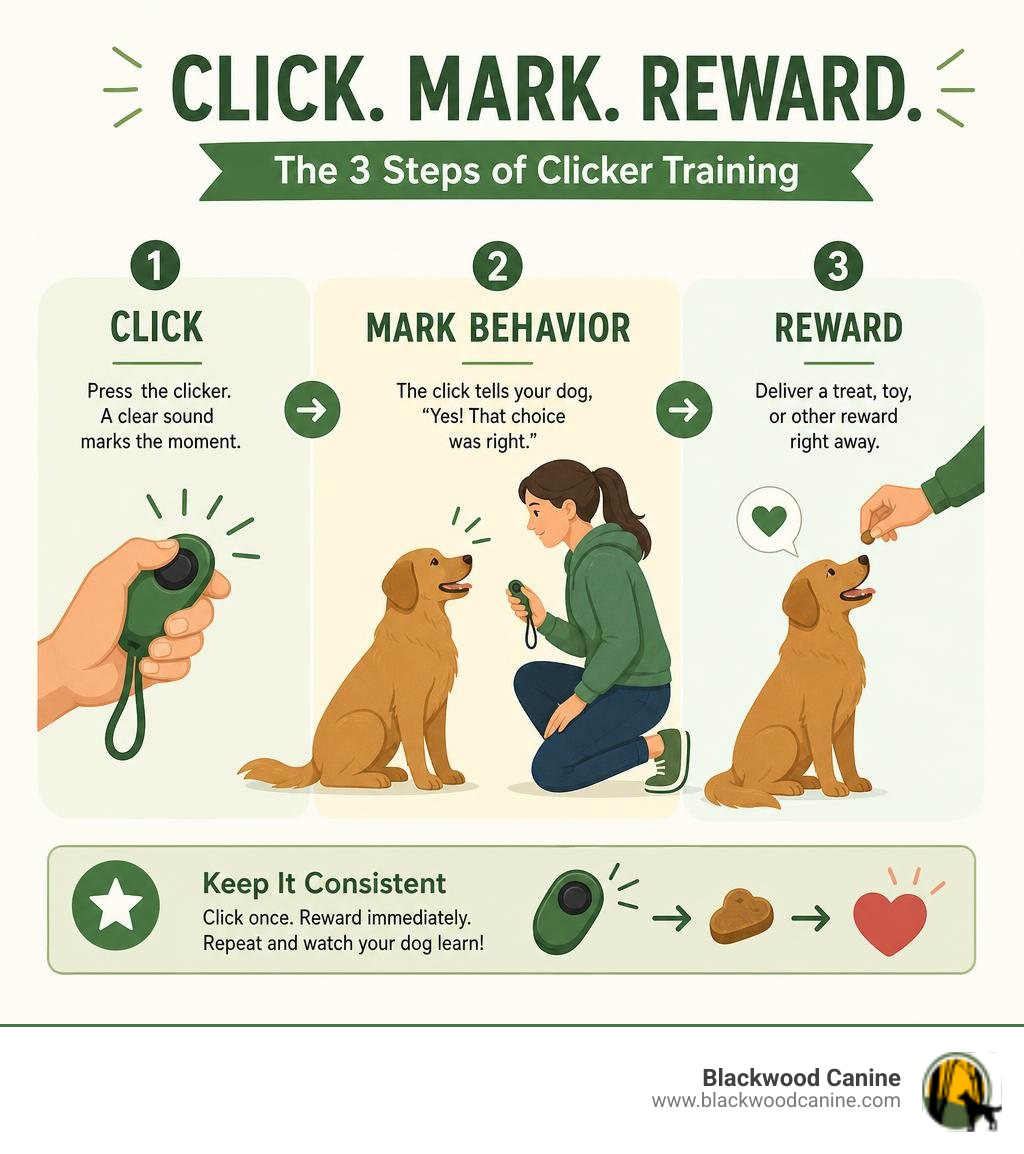
The click is not a command, a correction, or a way to get your dog's attention. It is a precise marker that bridges the gap between the behavior and the reward. That precision can make training less frustrating for owners in Portland, Vancouver, Scappoose, and nearby communities who are tired of repeated cues, tense walks, or embarrassing guest visits.
I am David Wright. After learning that many of my own early training habits were not helping my dog, I spent five years apprenticing under an experienced trainer and built my work around practical play and obedience skills, including dog clicker training for beginners.
What Is Clicker Training and How Does It Work?
At its core, clicker training is an event marking system. It relies on principles of operant conditioning, a scientific concept demonstrating that animals naturally repeat behaviors that lead to desirable outcomes. When your dog performs a clear action, you press a mechanical device that makes a sharp, distinct clicking sound. That click marks the exact millisecond the good choice happens.
In training terminology, the treat or play is a primary reinforcer because your dog inherently wants it. The clicker starts as a neutral sound, but once paired repeatedly with food, it becomes a secondary reinforcer or conditioned reinforcer. It acts as an event bridge between the moment your dog performs an action and the moment you hand over the reward.
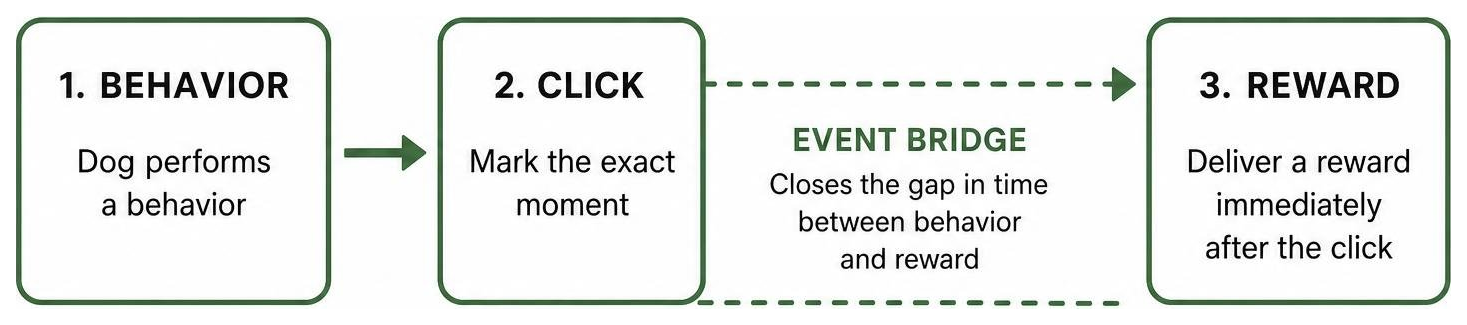
While rewards build motivation, effective dog training involves more than treats alone. Real world reliability requires clear expectations, practical management, routine consistency, structured boundaries, and appropriate follow through. Marker training gives us the surgical precision needed to communicate those expectations without confusion.
For a deeper look into balanced marker frameworks, check out our guide on Dog Training Methods: Positive Reinforcement vs. Dominance Training.
The Science of Dog Clicker Training for Beginners
The scientific foundations of clicker training trace back to psychologist B.F. Skinner in the 1960s. Skinner showed how animals learn through consequences in controlled environments. Marine mammal trainers later adopted sound markers using whistles because handlers could not physically reach or correct a dolphin in open water. In the 1990s, dog trainers adapted these whistle techniques for house pets using hand held mechanical clickers.
Research and field studies show that roughly 80% of active handlers employ clicker tools or marker systems during foundational work. The reason is simple: reward prediction. When a dog hears the click, their brain recognizes that a reward is guaranteed. This turns training into an active problem solving game where your dog enthusiastically tries to figure out which movement triggers the marker.
Clickers vs. Verbal Praise and Treat-Only Methods
Many handlers ask why they should bother carrying a plastic tool when they can just say "Good boy!" or hand over a piece of meat.
The main issue with human speech is vocal variation. Our voices change in pitch, volume, and emotional tone depending on our mood, energy, or frustration. Furthermore, dogs hear us speak thousands of filler words every day that carry zero real consequences. A mechanical clicker makes the exact same neutral sound every single time.
Treat only methods without a marker also introduce a timing delay. If you reach into your pocket for a treat while your dog sits, your dog might stand up or step forward before the food touches their mouth. Without a marker, your dog thinks they got rewarded for standing up instead of sitting down. The clicker solves this by taking a mental snapshot of the correct moment.
According to a guide on How to Clicker Train Your Dog: Basics & Vet-Verified Guide — Dogster, secondary reinforcers allow handlers to communicate instant feedback across a room before a treat can be physically handed over.
Step-by-Step Dog Clicker Training for Beginners
Getting started with dog clicker training for beginners requires minimal gear and a structured plan. We want to set up our environment for quick wins before introducing complex commands.
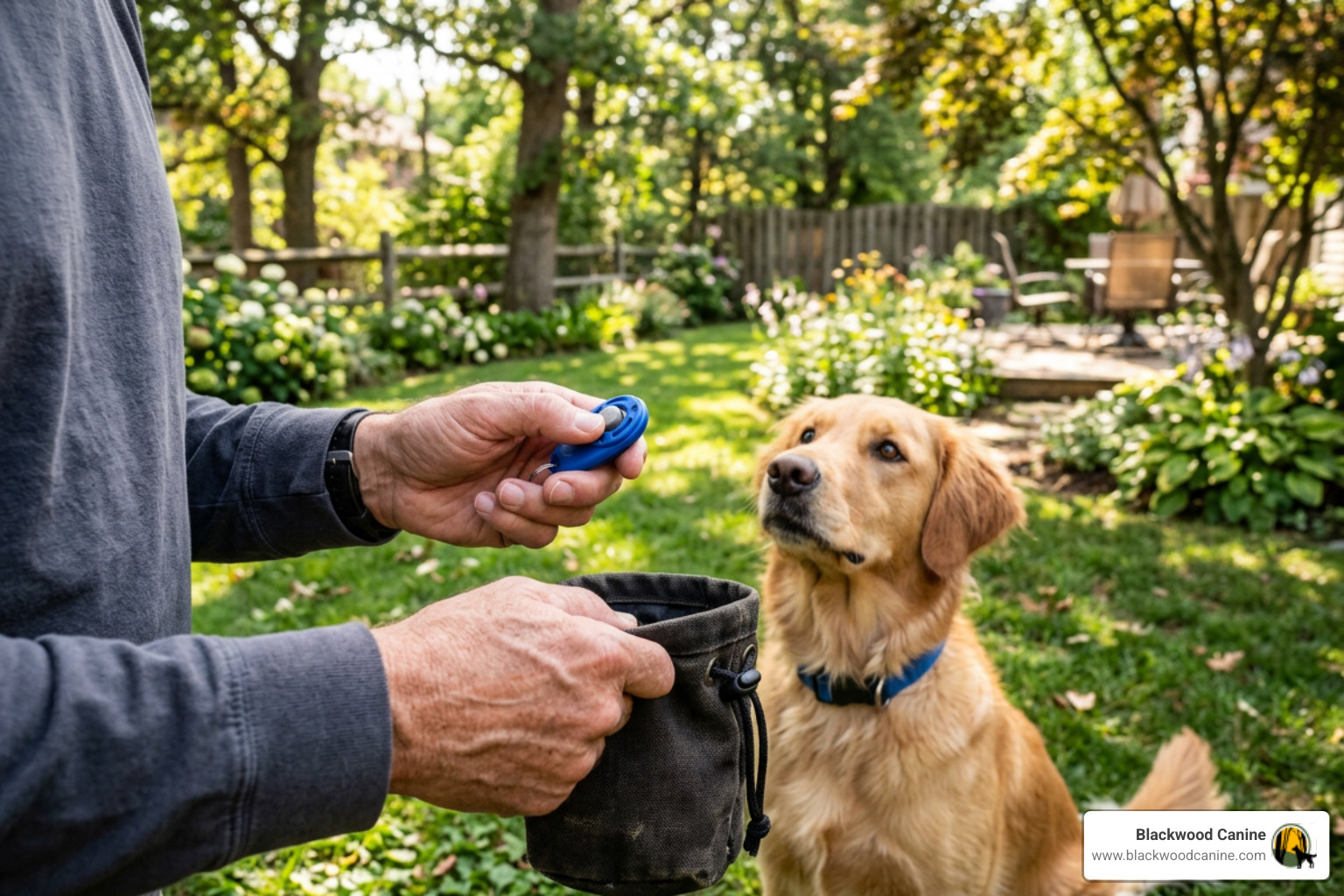
Gear Setup and Treat Selection
You do not need expensive equipment to start marker work. A full setup costs very little and includes three simple tools:
- The Clicker: Choose a standard box clicker for maximum clarity or an ergonomic button clicker with a wrist lanyard. Button clickers are slightly quieter, making them ideal for indoor practice.
- High Value Rewards: Use soft, pea sized treats like diced turkey sausage, cooked chicken breast, or commercial training bites. Small rewards allow your dog to swallow instantly without chewing, keeping the momentum going.
- A Treat Pouch: Clip a treat pouch to your waist so your hands remain free and your treat delivery is swift.
Using daily meal kibble works well for low distraction indoor practice, but higher distraction environments in places like Beaverton or Hillsboro require higher value options. For strategies on maximizing food drive, read our article on Dog Training Strategies: Building Engagement with Food.
How to Charge the Clicker in One Session
Before you can use the clicker to teach commands, you must teach your dog what the click sound actually means. This process is called "charging" or "loading" the clicker.
- Find a quiet, distraction free room inside your home.
- Hold the clicker in one hand at your side and keep treats ready in your pouch.
- Press the clicker once.
- Within one to two seconds, hand your dog a single treat.
- Pause for three seconds, then repeat the sequence.
Do not ask your dog to sit, lie down, or pay attention during this initial setup. Simply click and feed. Repeat this 10 to 15 times over a quick two minute session.
To test if your clicker is charged, wait until your dog is looking away or casually sniffing the floor. Press the clicker once. If your dog immediately whips their head around toward you expecting food, the sound has acquired its meaning. Most dogs make this connection within a single session, a process outlined in detail in Clicker Training for Dogs: A Complete Beginner's Guide - The Best of Breeds.
Core Training Techniques: Luring, Capturing, and Shaping
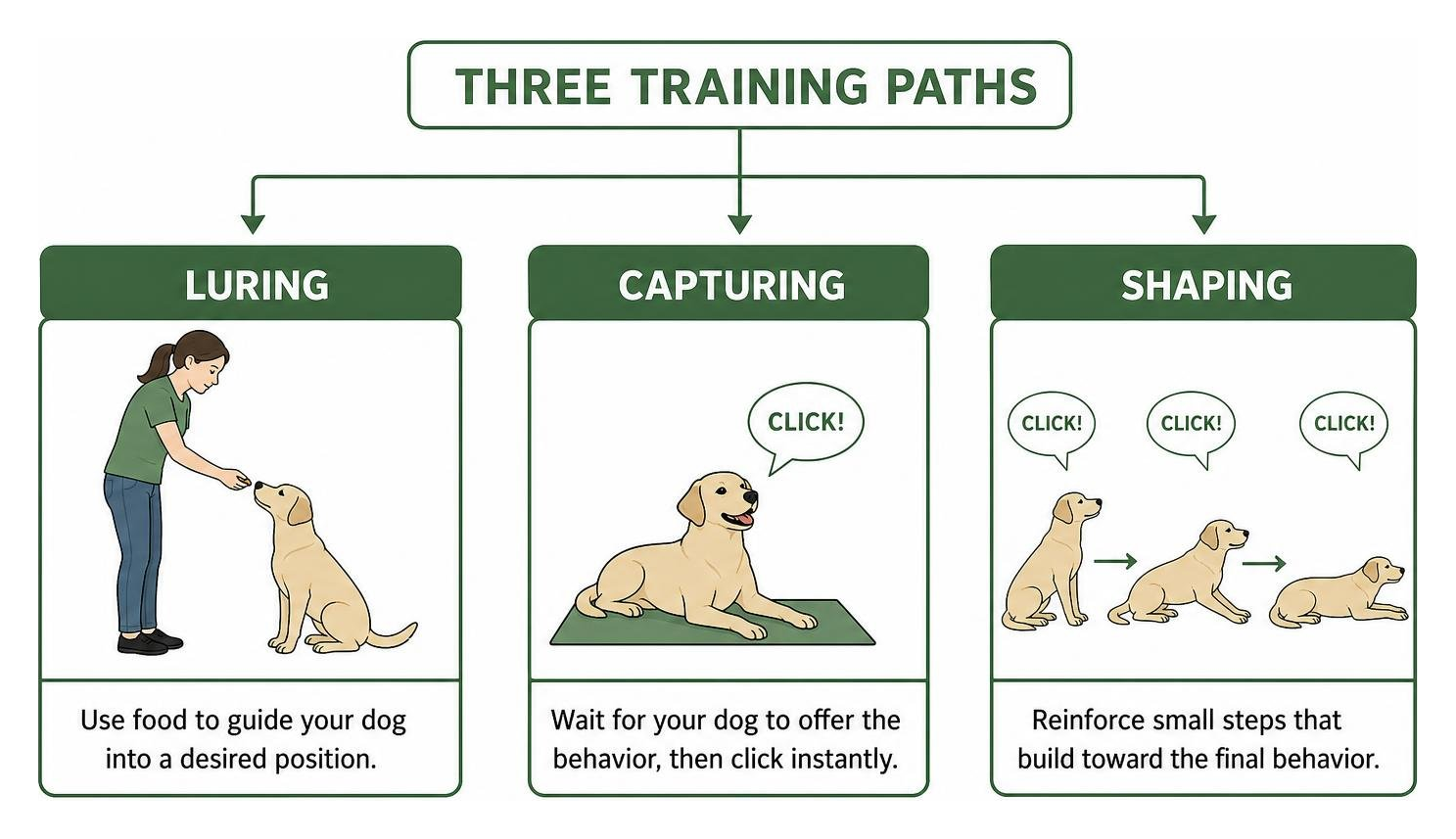
Once the marker is loaded, you can apply three primary techniques to teach physical movements:
- Luring: Using a piece of food held near your dog's nose to guide their body into a target posture like a sit or down.
- Capturing: Waiting quietly for your dog to naturally perform a desirable choice on their own (like lying down on a rug) and clicking the exact second it occurs.
- Shaping: Breaking a complex behavior down into tiny incremental steps, marking each small movement toward the final goal.
Teaching First Cues and Fading the Marker

Now that your dog understands the marker, you can begin teaching foundational obedience movements.
Teaching First Behaviors: Sit and Lie Down
Teaching a reliable sit is the easiest starting point for beginner handlers.
- Hold a small treat between your thumb and fingers right in front of your dog's nose.
- Slowly move your hand backward over your dog's head. As their nose tilts up to follow the food, their bottom will naturally touch the floor.
- The exact millisecond their rear end touches the ground, click once.
- Deliver the treat directly to their mouth.
To teach a lie down (or "drop"), start from a sitting position:
- Hold a treat at your dog's nose and move your hand straight down toward the floor between their front paws.
- Pull your hand slightly forward along the ground in an "L" shape.
- The instant their elbows and belly flatly touch the floor, click once and feed.
Do not say verbal cue words like "Sit" or "Down" initially. First, build the physical mechanics. Once your dog predictably follows the hand motion eight out of ten times, start saying the verbal cue one second before moving your hand. Step by step instructions for these introductory movements are also detailed in How to Clicker Train Your Dog: 8 Steps (with Pictures) - wikiHow.
Session Duration and Practice Frequency
Keep beginner practice sessions short and focused. Working for 3 to 5 minutes, two to three times per day, yields significantly better results than an overwhelming 30 minute marathon. Young puppies have brief attention spans, so 1 to 2 minute sessions work best for them.
Ending a session while your dog is still eager leaves them excited for the next practice round. Always follow training sessions with a fun game of tug or a short walk around your neighborhood in Scappoose or Warren to let your dog decompress.
Fading the Clicker and Food Rewards
The clicker is a teaching tool, not a permanent lifestyle crutch. You do not need to carry a clicker in your hand for the rest of your dog's life.
Once your dog performs a cue reliably across different environments, fade the clicker out and replace it with a simple verbal marker word like "Yes!" or standard verbal praise. Simultaneously transition from rewarding every single rep to an intermittent reinforcement schedule, rewarding every second, third, or fifth successful execution.
| Training Stage | Marker Tool Used | Reward Frequency | Practice Focus |
|---|---|---|---|
| Initial Learning | Mechanical Clicker | 100% (Every Rep) | Teaching new movement mechanics |
| Cue Association | Mechanical Clicker or Word | 100% (Every Rep) | Pairing verbal word with action |
| Generalization | Verbal Marker ("Yes!") | Intermittent (Variable) | Working near outdoor distractions |
| Mastered Behavior | Verbal Praise / Life Rewards | Periodic / Random | Maintaining daily lifestyle bounds |
For a comprehensive guide on transitioning off food lures, read Fading the Lure: How to Fade the Food Lure.
Overcoming Setup Challenges and Sound Sensitivity
While marker training is straightforward, handlers often run into physical setup mistakes or working hurdles.
Common Pitfalls in Dog Clicker Training for Beginners
Avoid these standard mistakes when starting out:
- Late Clicks: Clicking after your dog has already completed the movement and moved on to something else. Late clicks mark the wrong action.
- Pointing the Clicker: Do not point the clicker at your dog like a television remote control. Keep your hands naturally down at your sides.
- Clicking as a Recall: Never press the clicker to get your dog to look at you or come when called. The click is a marker, not an attention getter.
- Clicking Without Treating: Every click is an absolute promise of a reward. Even if you press the clicker by accident, deliver a treat anyway to preserve the integrity of the mark.
If you struggle with mechanical clicker timing, try practicing without your dog first. Drop a tennis ball onto a hard floor and practice clicking the exact instant the ball impacts the surface, a exercise highlighted in Clicker Training for Dogs: Beginner Guide.
Managing Sound-Sensitive Dogs and Verbal Alternatives
Some dogs, especially rescue animals or sensitive breeds, may flinch at the metallic snap of a traditional box clicker. If your dog backs away or shows signs of fear:
- Muffle the clicker by wrapping a layer of duct tape over the metal tongue.
- Operate the clicker inside your coat pocket or behind your back to dull the sound volume.
- Use a soft clicking alternative, such as pressing the top button of a standard ballpoint pen.
If your dog remains uncomfortable with mechanical noises, drop the clicker entirely and use a crisp, single syllable verbal marker like "Yes!" spoken in a neutral tone. Additional safety guidelines for young dogs can be found at Puppy Clicker Training Step-by-Step Guide | Purina US.
Frequently Asked Questions About Beginner Clicker Training
At What Age Can I Start Clicker Training My Puppy?
You can start clicker training a puppy as early as eight weeks old, as soon as they arrive at your home. Keep sessions limited to 60 to 90 seconds, use soft, moist treats, and keep all mechanical interactions light and positive. Early foundational work builds focus that pays off throughout adulthood.
Must Every Click Always Be Followed by a Treat?
Yes. To maintain the psychological power of the marker, every click must guarantee a reward. If you click, you feed. If you accidentally click when your dog jumps up or does something incorrect, feed them anyway, then adjust your physical timing on the next repetition.
What Should I Do If My Dog Does Not Respond to the Clicker?
If your dog ignores the clicker sound, evaluate three main factors:
- Hunger Drive: Practice right before regular mealtimes rather than directly after your dog has consumed a full bowl of food.
- Reward Value: Low value dry biscuits may not hold your dog's interest. Upgrade to high value options like freeze dried liver, hot dogs, or real chicken.
- Distraction Level: Move your practice from a busy yard in Bethany or Portland to a quiet indoor hallway with zero competing environmental distractions.
If your dog continues to display severe disinterest, persistent anxiety, or sudden behavioral shifts, consult a qualified veterinarian to rule out underlying joint discomfort or medical conditions.
Start Building Clear Communication With Your Dog
Mastering dog clicker training for beginners provides a direct line of communication between you and your dog. By marking exact moments of good choices, you reduce confusion, speed up learning, and make daily obedience practice enjoyable for both ends of the leash.
However, marker precision is only one piece of a successful long term training plan. Lasting obedience requires real world management, consistent house rules, structured boundaries, and clear follow through.
If you live in Scappoose, St. Helens, Warren, Bethany, Hillsboro, Beaverton, Portland, or Vancouver and feel frustrated or stuck with your dog's behavior, you do not have to figure it out alone.
At Blackwood Canine, our foundational basic obedience training starts at 4 weeks, establishing clear communication and practical control. For complex behavioral concerns or reactive habits, we utilize comprehensive 6 week and 8 plus week training timelines to build reliable real world manners. We do not offer training programs shorter than 4 weeks because real behavior change takes time, practice, and consistency.
To read more about our foundational approach, explore Curious About Clicker Training? Dog Trainers Explain the Basics.
Ready to get a clear, step by step roadmap tailored specifically to your household? Reach out to us today to set up your Good Dog Game Plan and build a calm, reliable relationship with your dog.
A Practical Guide to Finding a Reliable Dog Trainer in Beaverton
Core Standards for Reliable Dog Training Beaverton Families Rely On

Reliable dog training in Beaverton comes down to balanced communication, hands on owner coaching, and realistic timelines that start at four weeks. You need a trainer who shows you how to reward good choices and correct bad ones without drama. Clear boundaries, consistent daily management, and honest explanations matter more than catchy promises. That is the standard we hold at Blackwood Canine.
According to the American Pet Products Association, about 67 percent of US households share life with a pet. In busy neighborhoods across Beaverton, Bethany, and Aloha, that means thousands of dogs share close sidewalks, busy parks, and apartment hallways. When training fails, daily life becomes stressful. An American Veterinary Medical Association study notes that 44 percent of pet parents seek professional training due to behavioral challenges. Clear standards keep you from wasting time and money on quick fixes that collapse under real world pressure.
Proven Signs of Reliable Dog Training Beaverton Pet Parents Trust
A solid program does not rely on mystery or vague promises. Dependable training is built on practical handling, clear structure, and mutual trust between you and your dog.
Look for these essential markers:
- Clear explanations of both rewards and corrections without emotional hype.
- A heavy emphasis on showing owners how to maintain daily rules at home.
- Realistic timelines that do not promise overnight transformations.
- Safe, gradual exposure to everyday triggers like joggers, bikes, and other dogs.
If you are sorting through your local options, check out our guide on how to find the right local dog trainer to help evaluate your choices before making a commitment. The scientific guidelines on veterinary behavior and animal welfare stress that training should support the animal's physical and emotional health. That means practical management, not punishment theater.
Balanced Training Methods and Clear Communication
True behavioral balance requires complete communication. Dogs need to know when they are right, but they also need fair, understandable information when a choice is unacceptable. Balanced training uses high value reinforcement to teach new patterns while incorporating fair, clear boundaries to stop unwanted habits like lunging, jumping, or resource guarding.
Tools like slip leads, prong collars, or e collars are not shortcuts or instruments of intimidation. Misuse is the actual problem. When introduced properly under professional guidance, training tools give subtle, clear guidance that lowers frustration for both dog and handler.

Whether you are working with an excitable puppy or rehabilitating an anxious rescue from a local shelter, clear expectations create confidence. When a dog knows exactly what is expected, the anxiety of guessing disappears.
Choosing the Best Program Format and Timeline
Every dog comes with a unique background, drive level, and living environment. Choosing the right format depends on your lifestyle, your schedule, and the severity of your dog's behavioral challenges.
| Program Type | Best Suited For | Minimum Timeline | Key Owner Commitment |
|---|---|---|---|
| In Home Private Lessons | Hands on owners, mild leash pulling, basic manners | 4 Weeks | Daily homework and consistency |
| Immersion Training | Reactivity, severe anxiety, busy household schedules | 4 to 8+ Weeks | Following post program transition rules |
To explore all the ways we structure our hands on programs, review our comprehensive dog training services tailored for local households.
In Home Private Lessons vs. Immersion Programs

In home coaching is ideal for pet parents who want direct, step by step instruction. We work right alongside you in your living room, yard, and neighborhood streets. You learn how to read body language, time your markers, and handle leash pressure in real time. For motivated owners, in home private coaching sessions build lasting daily habits. You can also explore the benefits of dedicated private training lessons to see if this hands on path fits your schedule.
Immersion programs, often called board and train programs, provide daily reps with a professional. This format is great for busy owners or dogs dealing with ingrained behavioral problems. In our full immersion board and train programs, your dog builds strong foundational habits in a controlled environment before we coach you through maintaining those results at home.
Realistic Program Timelines and Long Term Results
Behavior change takes repetition and neurological adaptation. That is why our basic obedience foundation training starts at four weeks. We do not offer programs shorter than four weeks because superficial training fades the moment real world distractions appear.
- 4 Weeks: Foundational obedience, loose leash walking, impulse control, basic manners.
- 6 Weeks: Moderate reactivity, fear based avoidance, intense jumping, counter surfing.
- 8+ Weeks: Complex behavior modification, aggression cases, deep rooted anxiety.
Before investing in any program, read our transparent private dog training cost guide and check out our practical private training tips to get the most value out of your sessions. Six and eight plus week timelines exist because complex behavior change takes time, not because trainers want to drag things out. Leash reactivity and deep rooted anxiety need repetition and new emotional responses before they become lasting habits.
Navigating Public Spaces and Distractions in Washington County
Training inside your living room is only step one. Reliable behavior means your dog can remain calm when another dog walks by on the sidewalk or when kids run past at a park.
Park Guidelines and Leash Etiquette in Beaverton
The Tualatin Hills Park and Recreation District manages dozens of wonderful green spaces throughout Beaverton. However, local ordinances require all dogs to remain on a standard physical leash unless inside designated off leash dog parks. Leash laws are not just a legal box to check. They are a safety net for dogs still learning to handle the chaos of public spaces.
Keeping your dog leashed protects everyone, especially dogs in training or rescues recovering from past trauma. A dog that bolts after a squirrel near a busy road creates danger for itself and everyone nearby. For pet parents living near neighboring communities, our training programs available in Hillsboro offer the same focus on leash manners and public safety.
Selecting Reliable Dog Training Beaverton Services for Public Distraction Work
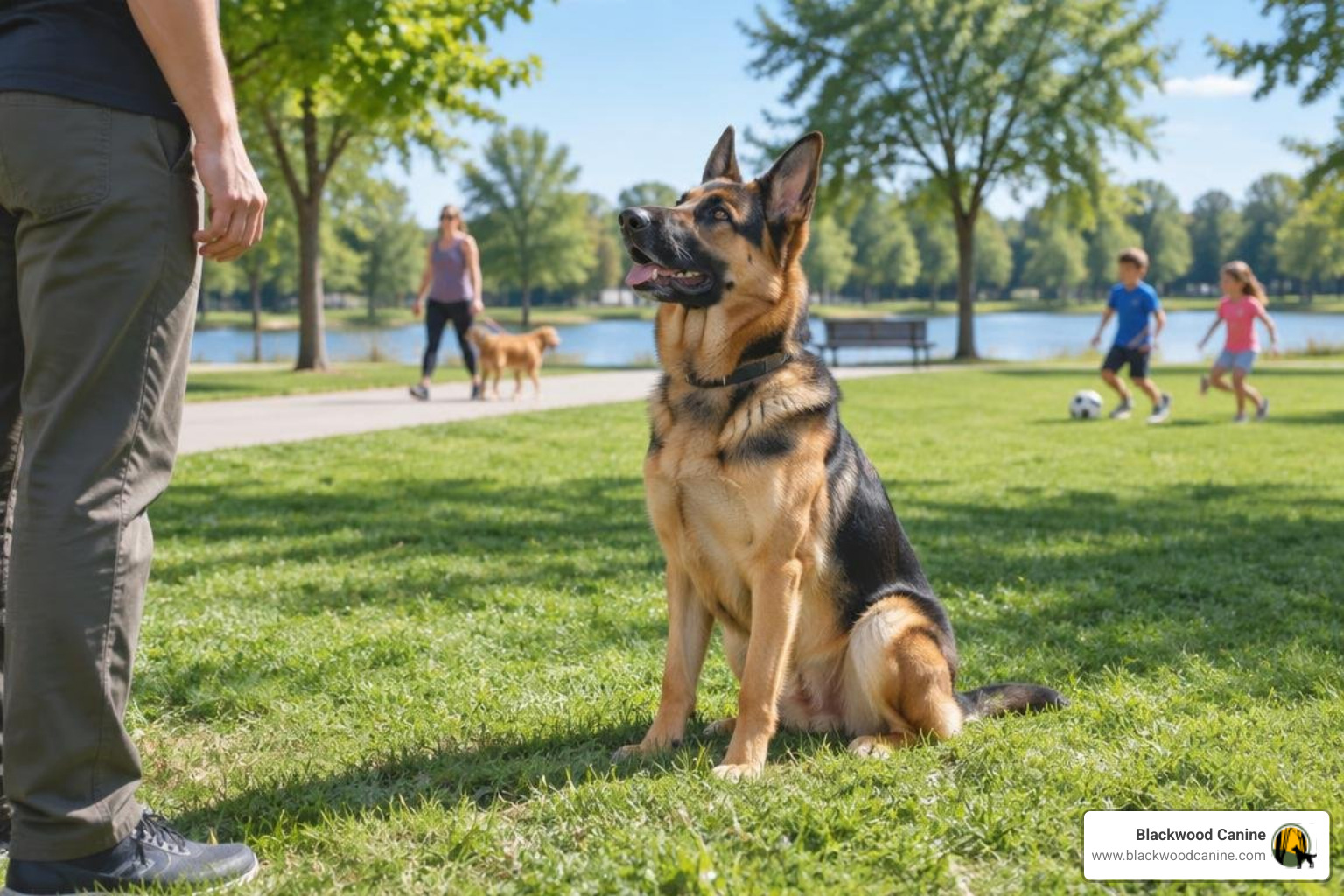
Public neutrality is the real goal of reliable training. Your dog does not need to greet every strange human or dog they see. In fact, forcing social interactions often creates excitement reactivity or defensive aggression. A calm dog that ignores distractions and checks in with you is the real badge of success.
A dependable trainer will take you out into public spaces to proof focus around real world distractions. Sitting in a quiet living room is easy. Staying in a down stay while a skateboard rattles past and a strange dog barks across the street is an entirely different skill. That is why public practice matters. If you are located slightly further east, we offer identical expert dog training solutions across Portland and surrounding areas to help you build reliable impulse control anywhere you walk.
Frequently Asked Questions About Beaverton Dog Training
How long does a comprehensive dog training program take to see results?
Sustainable behavior change requires consistent practice over time. Basic obedience foundation training starts at a minimum of four weeks, while moderate behavioral issues require six weeks. Severe fear, reactivity, or aggression cases need eight weeks or more. Quick weekend bootcamps do not give dogs enough time to build genuine muscle memory or emotional stability. Your dog needs repeated practice in the places where problems actually happen, not just in a controlled training room.
What should I look for during an initial trainer consultation?
Look for clear communication, practical steps, and honest timelines. A reliable trainer asks detailed questions about your daily routine, boundaries, crate use, and physical handling. They should clearly explain how they handle both motivation and rule enforcement without dodging questions or relying on heavy industry jargon. Ask how they involve you in the process. If the trainer plans to handle your dog without teaching you how to maintain the results, that is a red flag. Owner involvement matters just as much as the training itself.
Can rescue dogs with anxiety or reactivity be rehabilitated?
Yes. Rescue dogs thrive when given predictable boundaries and calm leadership. Many shelter dogs develop nervous habits simply because they lack clarity about their role in the household. With a structured six to eight plus week program focused on clear communication and consistent management, rescue dogs can learn to navigate the world calmly. The process takes time, but the payoff is a dog that no longer panics at everyday triggers like strangers, other dogs, or sudden noises.
Building a Calm, Confident Life With Your Dog
Living with a dog should bring joy, not daily stress and embarrassed apologies to your neighbors. Lasting progress does not come from a bag of treats or a secret trick. It comes from setting clear rules, maintaining daily follow through, and giving your dog the clarity they need to succeed in our human world.
The next step is simpler than most people expect. We call it the Good Dog Game Plan. It starts with an honest conversation about your dog, your household, and the specific problems you are dealing with. From there, we put together a clear, practical plan that fits your schedule and your neighborhood. No guesswork, no vague promises, just a straight path from frustrated to functional.
If you are ready to stop feeling frustrated and start enjoying peaceful walks, reach out to learn more about our reliable dog training programs in Beaverton. Let us help you put together a clear, practical plan that brings peace back to your home.
Hillsboro Dog Training 101: Finding a Local Dog Trainer That's the Right Fit
Find Hillsboro Dog Training That Fits Your Real Life

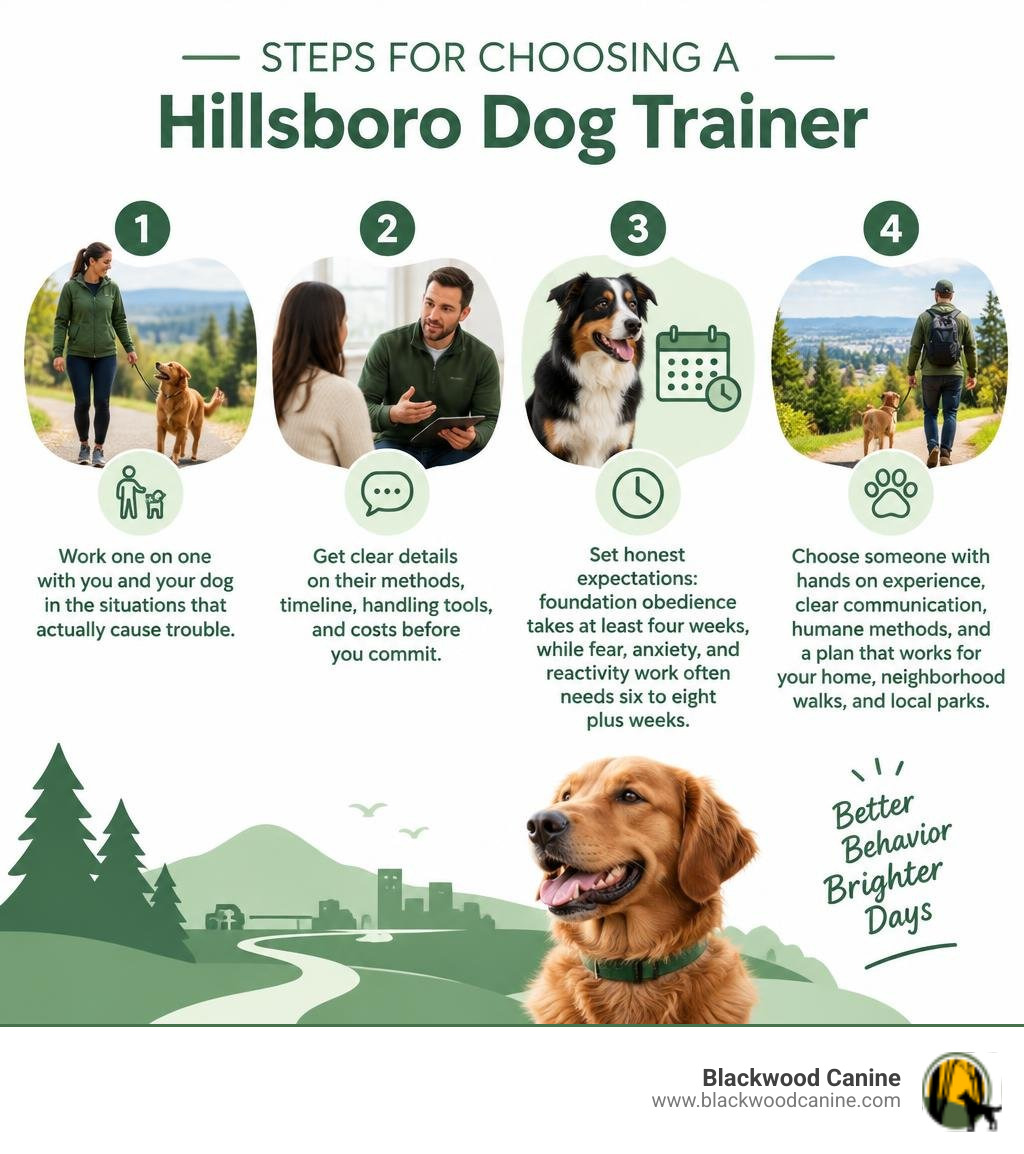
A stressful walk, nonstop barking at guests, or a dog that melts down near other dogs is not a problem you fix with a random tip and a bag of treats. For Hillsboro dog training, look for a trainer who will:
- Work one on one with you and your dog in the situations that actually cause trouble.
- Explain their methods, timeline, handling tools, and costs before you commit.
- Set honest expectations: foundation obedience takes at least four weeks, while fear, anxiety, and reactivity work often needs six to eight plus weeks.
The right fit is not the trainer with the loudest promises. It is someone with hands on experience, clear communication, humane methods, and a plan that works around your household, neighborhood walks, and Hillsboro's busy parks. According to the American Veterinary Medical Association, dog ownership keeps climbing across the country, which means more families are looking for practical help with everyday behavior.
I am David Wright, and my Hillsboro dog training perspective comes from years of apprenticeship and hands on work helping owners build practical obedience and address dog to dog and people related behavior issues. Next, we will break down the local training options, questions to ask, and what a realistic plan should look like.
Why Hillsboro Dog Training Matters for Local Families and Parks
Living in Oregon means sharing our lives with dogs. In fact, pet ownership in Oregon sits at 63 percent, well above the national average. Across the country, over 69 million households own a dog, and around 60 percent of those owners invest in training services. It is easy to see why. Data from the Association of Professional Dog Trainers shows that 94 percent of owners feel training improves behavior and strengthens the bond they share with their dog.
In Washington County, our daily routines are packed with community activities. Whether you are walking through the Orenco Station neighborhood, visiting the farmer market, or taking an afternoon trip to Rood Bridge Park, your dog encounters heavy distractions.
A quiet living room does not test a dog the way a busy park trail does. When a runner zooms past on the Rock Creek Trail, or another leashed dog rounds a blind corner at Orenco Woods Nature Park, polite household manners can fly out the window. Without clear boundaries and reliable obedience, walks turn into arm pulling contests or stressful shouting matches.
Teaching proper manners for public spaces is about building neutral focus. You do not need your dog to greet every stranger or play with every passing pet. You need them to listen, look to you for direction, and ignore the noise. Mastering basic obedience dog training allows your dog to navigate high traffic suburban settings without panic or outbursts.
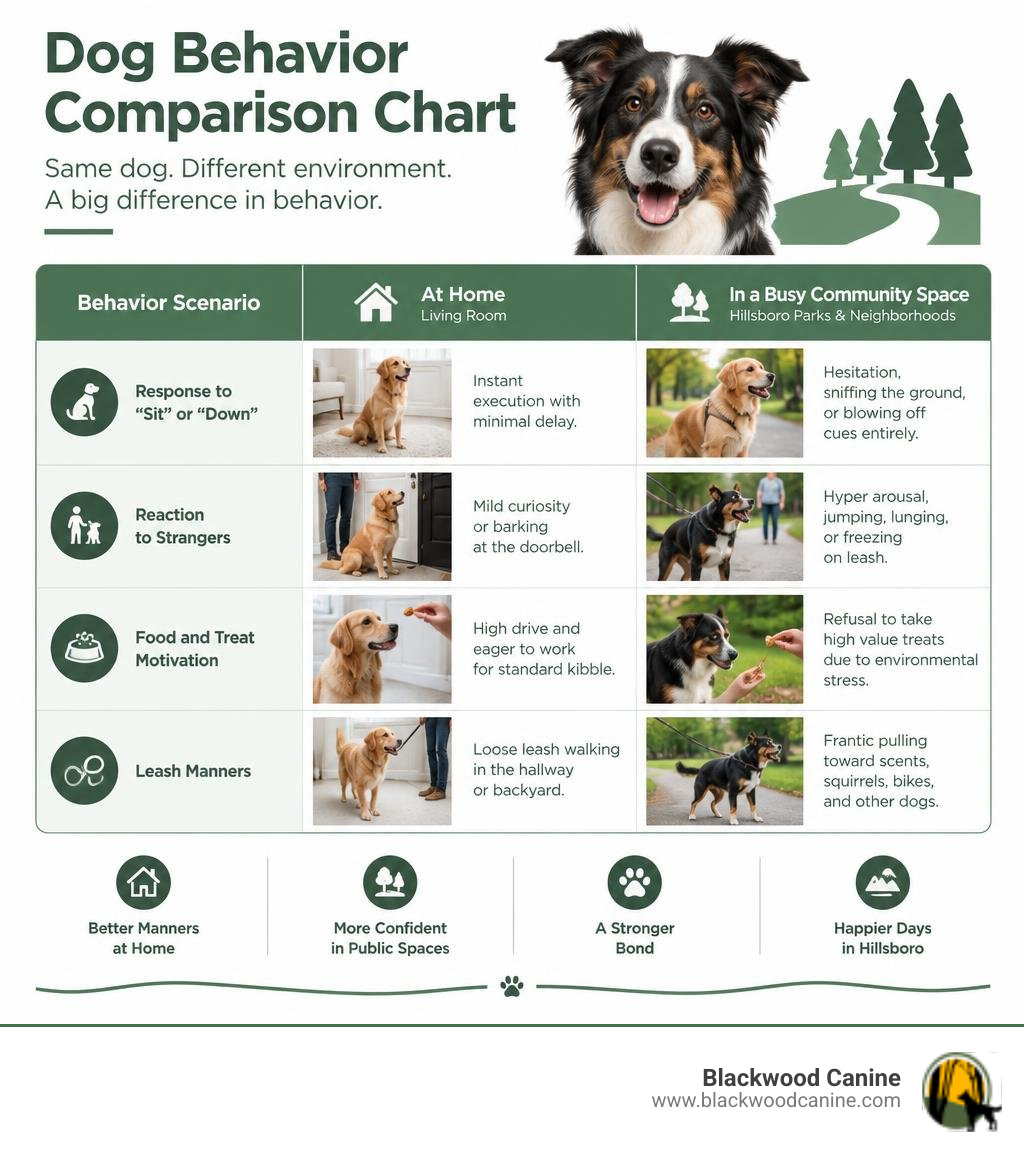
| Behavior Scenario | At Home in the Living Room | In a Busy Hillsboro Community Space |
|---|---|---|
| Response to "Sit" or "Down" | Instant execution with minimal delay. | Hesitation, sniffing the ground, or blowing off cues entirely. |
| Reaction to Strangers | Mild curiosity or barking at the doorbell. | Hyper arousal, jumping, lunging, or freezing on leash. |
| Food and Treat Motivation | High drive and eager to work for standard kibble. | Refusal to take high value treats due to environmental stress. |
| Leash Manners | Loose leash walking in the hallway or backyard. | Frantic pulling toward scents, squirrels, bikes, and other dogs. |
Comparing Dog Training Services and Formats in Washington County

When your dog's behavior causes stress, you need practical instruction tailored to your real life. While some people look for quick fixes, real behavioral change requires deliberate practice in the places where your dog actually struggles.
Private In Home Instruction vs. Immersion Programs
Every family operates differently. The layout of your home, your work schedule, and your neighborhood dynamic all play a role in how your dog learns.
With in home private lessons, a professional coach comes directly to you. We look at your daily setup, front door greeting habits, yard boundaries, and neighborhood walking routes. This direct setup lets us coach you in real time so you understand the mechanics of handling your dog. Exploring private lessons dog training gives you dedicated attention without the distractions of a chaotic classroom. To understand why so many local owners prefer individualized coaching, review the top benefits of private dog training lessons.
Immersion programs, on the other hand, provide a comprehensive jumpstart. In an immersion setup, a professional trainer handles the heavy lifting of establishing initial obedience, handling clarity, and structure before transitioning those skills back into your hands.
Setting Realistic Timelines for Hillsboro Dog Training Success
Real learning takes time and repetition. Anyone promising to fix severe behavioral issues over a weekend is selling wishful thinking. At Blackwood Canine, we do not offer programs shorter than 4 weeks because dogs need time to build muscle memory, generalize commands, and form lasting habits.

Foundational obedience starts at 4 weeks. During this month of work, your dog learns foundational commands, leash pressure communication, impulse control, and basic household manners. We guide you through handler mechanics so you can reinforce these routines daily. For actionable advice on maximizing your practice between sessions, our private dog training tips guide outlines the daily homework that creates lasting reliability.
Tackling Complex Behavioral Issues in Suburban Environments

Suburban life comes with unique pressures. Tight property lines, delivery drivers walking up the driveway, barking neighborhood dogs behind fences, and crowded sidewalks create a gauntlet of triggers.
When dogs act out, pet owners often feel embarrassed or frustrated. We see well meaning owners fall into extreme training camps. Some try purely treat based approaches that fall apart the moment a squirrel runs past. Others resort to heavy handed dominance tactics that create confusion and fear.
Effective training avoids both extremes. Balanced, modern training relies on clear communication, healthy boundaries, solid reinforcement, and fair, humane guidance. Training tools are not evil, nor are they magical solutions. Misuse is where problems happen. When used properly under professional supervision, tools like slip leads, prong collars, or long lines provide clear communication so your dog understands what is expected. To see how these balanced principles create clarity, check out our guide on positive reinforcement versus dominance dog training methods.
Managing Reactivity and Hillsboro Dog Training for Fear
Fear and reactivity are among the most common reasons owners seek help. A dog barking wildly at the end of the leash is rarely trying to be a bully. In most cases, they are experiencing fear, insecurity, or massive frustration.
When a dog encounters repeated triggers without guidance, stress builds up. This process, known as trigger stacking, pushes a dog past their ability to think. They explode on leash because they feel trapped and do not know how else to create space.
Addressing severe fear and reactivity requires an extended timeline. Complex behavior modification takes 6 week to 8 plus week timelines. We must carefully peel back layers of fear, build confidence, teach emotional neutrality, and change your dog's response to everyday triggers. If your dog panics or cowers around new stimuli, our focused resources on fearful dog training in Hillsboro and broader fearful dog rehabilitation strategies provide clear paths forward.
Breed Specific Drives and Foundation Building
Hillsboro neighborhoods are full of high energy working breeds, herding dogs, and retrievers. An Australian Shepherd, German Shepherd, or Belgian Malinois has different instinctual drives than a companion breed.
When high drive dogs do not have a job, they invent their own. That often looks like chasing bicycles, nipping heels, fence fighting, or guarding resources. We work with your dog's genetics rather than fighting against them. By teaching impulse control and channeling energy into structured work, problem behaviors fade.
If you feel like your dog is ignoring you on purpose, learning how to handle dog training for stubborn dogs can turn things around. Often, the missing link is building motivation. By building engagement with food, you teach your dog that paying attention to you is far more rewarding than scanning the horizon for trouble.
Key Credentials and Questions to Ask Before Hiring a Trainer
The dog training industry is largely unregulated, which means anyone can print business cards and call themselves a dog behavior specialist. Finding the right professional for your family takes some homework.
Look for hands on experience, transparent methods, and someone who can clearly explain the why behind their program. Avoid trainers who make wild guarantees or claim they can solve multi year aggression issues in a single hour. A good trainer acts as your coach, guiding you through the messy process of behavior modification with honesty and support. Learn more about how to find the right trainer and review our trainer backgrounds and experience to see what professional standards look like.
Before hiring a trainer in Hillsboro or the greater Portland metro area, ask these essential questions:
- What is your direct hands on experience with dogs displaying my dog's specific behavioral challenges?
- What does your complete training system look like, including how you motivate good choices and address unwanted behavior?
- What tools do you utilize, and will you teach me how to handle them safely and humanely?
- How long are your programs, and what level of daily commitment is required from my household?
- How do you help transfer the training back into our normal home routine and public environments?
Frequently Asked Questions About Training Your Dog in Hillsboro
How much does professional dog training typically cost in Hillsboro?
Professional training costs vary depending on the severity of the issue, the format of instruction, and the duration of the program. Quality private coaching and comprehensive immersion programs represent an investment in your household peace of mind. For an in depth breakdown of local pricing structures, review our private dog training cost guide and learn how to weigh the long term value by evaluating your dog training investment.
How long does it take to resolve severe behavioral issues?
Complex behavioral problems like human aggression, intense dog reactivity, and severe separation anxiety cannot be resolved overnight. Meaningful rehabilitation requires 6 week or 8 plus week programs. This allows enough time to break ingrained behavioral patterns, build confidence, establish neutral coping mechanisms, and coach owners on consistent long term management.
Can older dogs benefit from one on one training programs?
Yes. While puppies absorb new information rapidly, adult and senior dogs are fully capable of learning new routines, boundaries, and communication systems. In fact, older dogs often have longer attention spans than energetic puppies. To understand how we adjust our handling for mature pets, check out our complete guide to adult dog training.
Next Steps for a Calm, Well Behaved Dog in Hillsboro
You do not have to spend your walks dreading other dogs, hiding behind parked cars, or feeling embarrassed when company comes over. Living with a dog should bring joy to your life, not daily frustration and stress.
At Blackwood Canine, we provide the structure, clear communication, and practical management tools you need to succeed. We help owners across Hillsboro, Beaverton, Bethany, Portland, Scappoose, and surrounding communities build reliable, real world obedience.
If you are ready to stop guessing and start making real progress, reach out today to build your custom Good Dog Game Plan through our Hillsboro dog training services.
5 Practical Ways to Solve Your Dog’s Car Anxiety Problems for Good
Car Anxiety vs. Motion Sickness: How to Identify Your Dog’s Stress Signals
Before starting any training plan, you need to figure out what is driving your dog's distress. Dogs usually fall into two main categories: physical motion sickness or behavioral car anxiety. In many cases, these two issues feed off each other.
Motion sickness is a physiological issue. It is especially common in puppies and young dogs because their inner ear balance structures are not fully developed. Many puppies outgrow physical motion sickness by 12 to 14 months of age as their vestibular system matures. However, if a puppy vomits every time they ride in a car, they quickly learn to predict that the car makes them feel terrible. That physical nausea turns into conditioned behavioral fear over time.
Behavioral anxiety is driven by anticipation, negative associations, or sensory overload. Dogs who are transported exclusively to stressful destinations like the vet or groomer show negative responses at more than double the rate (46.4%) of dogs transported to varied or fun locations (22.7%).
To understand which issue primary drives your dog's distress, check the Canine Car Anxiety: Vestibular vs Behavioral guide. You can also watch for these distinct signs:
| Stress Signal Category | Motion Sickness (Vestibular) | Behavioral Car Anxiety (Psychological) |
|---|---|---|
| Onset | Begins after the vehicle starts moving. | Starts before entering the car (at the sight of keys, leash, or car). |
| Physical Symptoms | Heavy, excessive drooling, lip smacking, dry heaving, vomiting. | Trembling, rapid panting, dilated pupils, whale eye, pacing, whining. |
| Appetite | Refuses treats only after vehicle motion begins due to nausea. | Refuses high value treats on approach or while sitting in a parked car. |
| Post Trip Recovery | Dog stays lethargic or nauseous after exiting the vehicle. | Immediate relief, decompression sniffing, and energy rebound upon stepping out. |
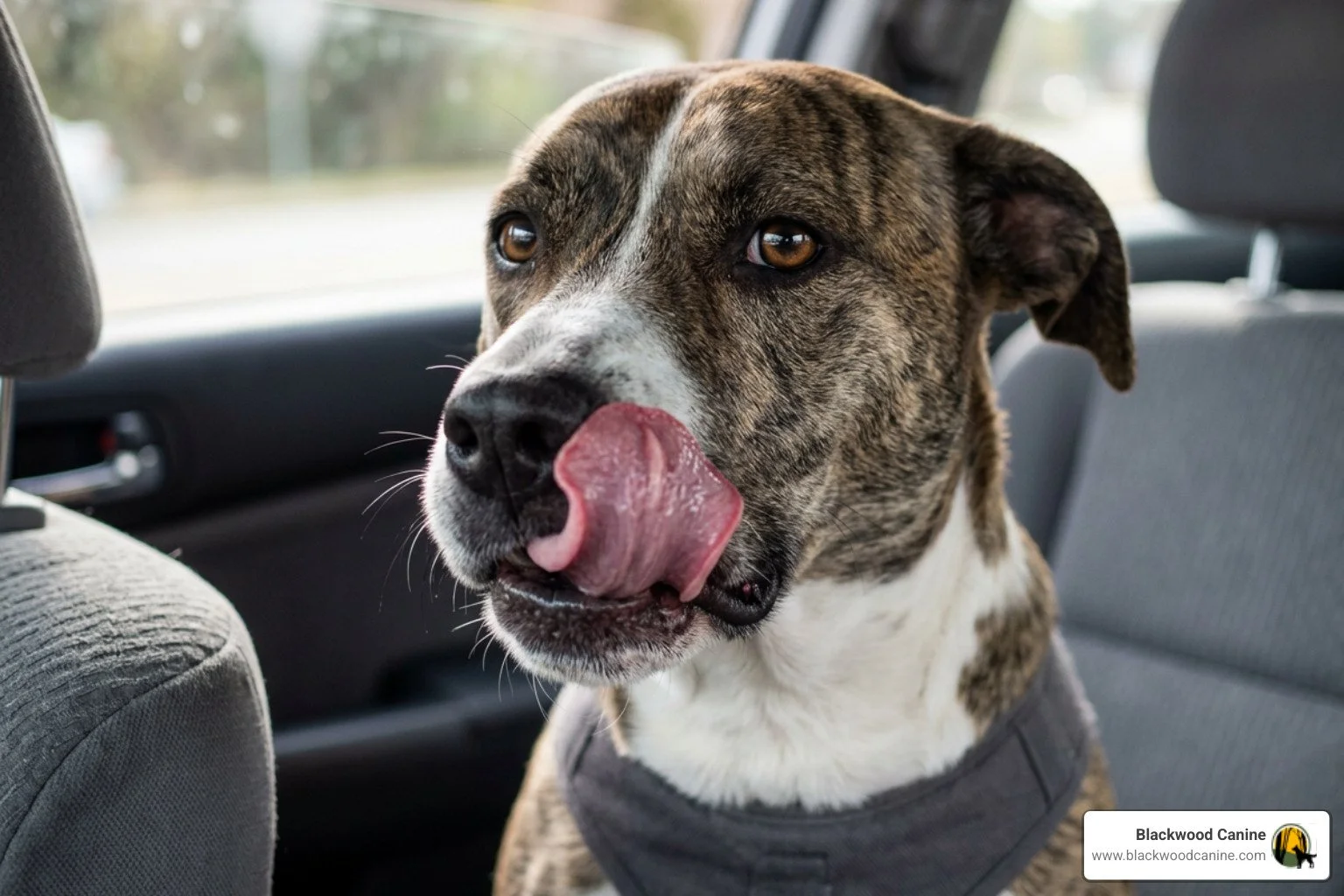
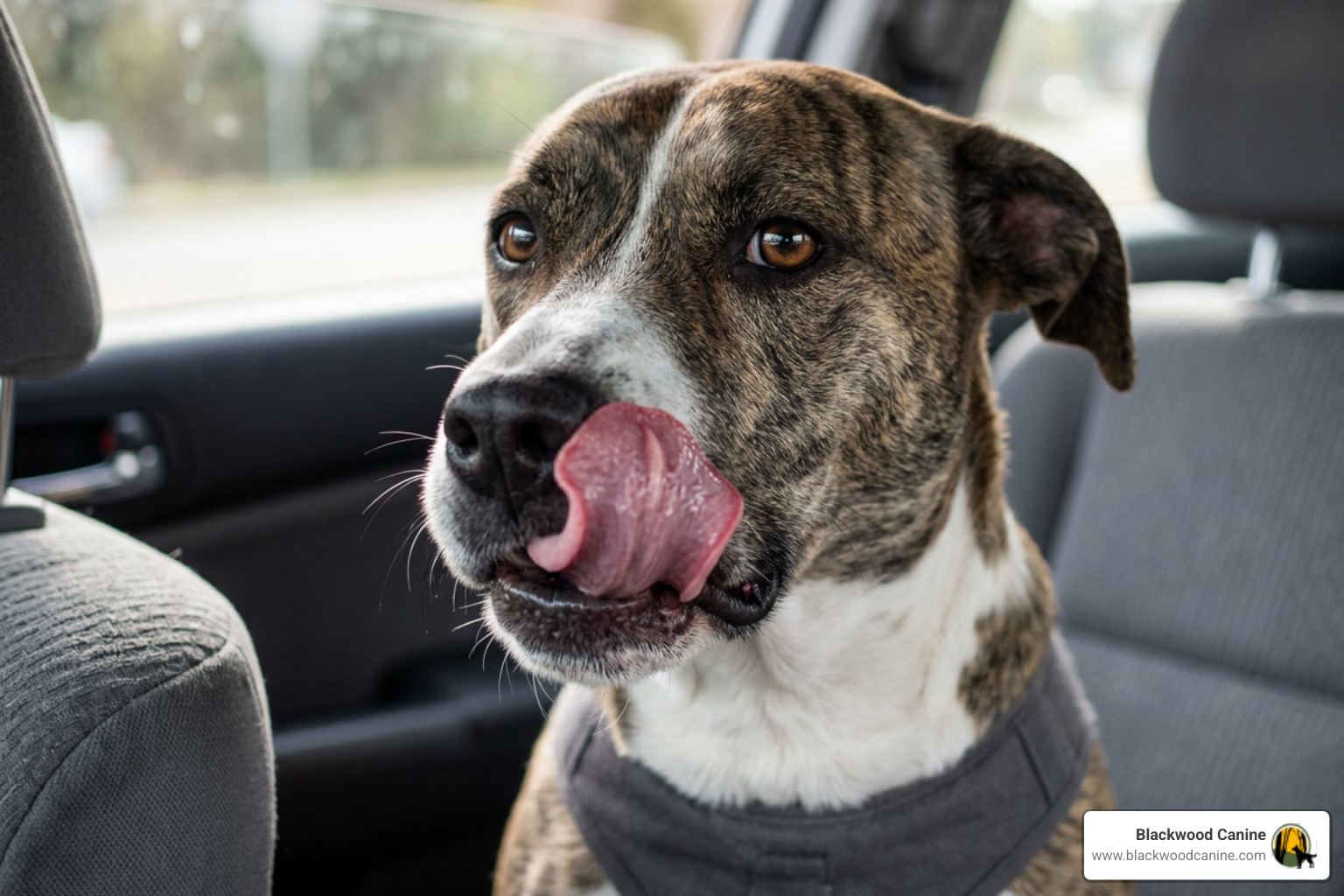
Recognizing subtle stress signals early prevents you from accidentally pushing your dog past their coping limit. Watch for early stress cues such as repeated yawning, lip licking, turned-away head posture, and rigid body posture before overt distress like howling or scratching at windows takes over.
5 Effective Dog Car Anxiety Exercises using the Calm Car Ladder
Systematic desensitization works by breaking a scary experience into tiny, manageable steps. By keeping your dog below their stress threshold (the point where they stop taking food, freeze, or panic), you change their emotional response.
Combining gradual exposure with clear management, rules, and boundaries creates a solid foundation for stress-free travel. Check out our detailed Dog Trainer Advice on Dealing with Car Anxiety for extra background on resetting travel habits.
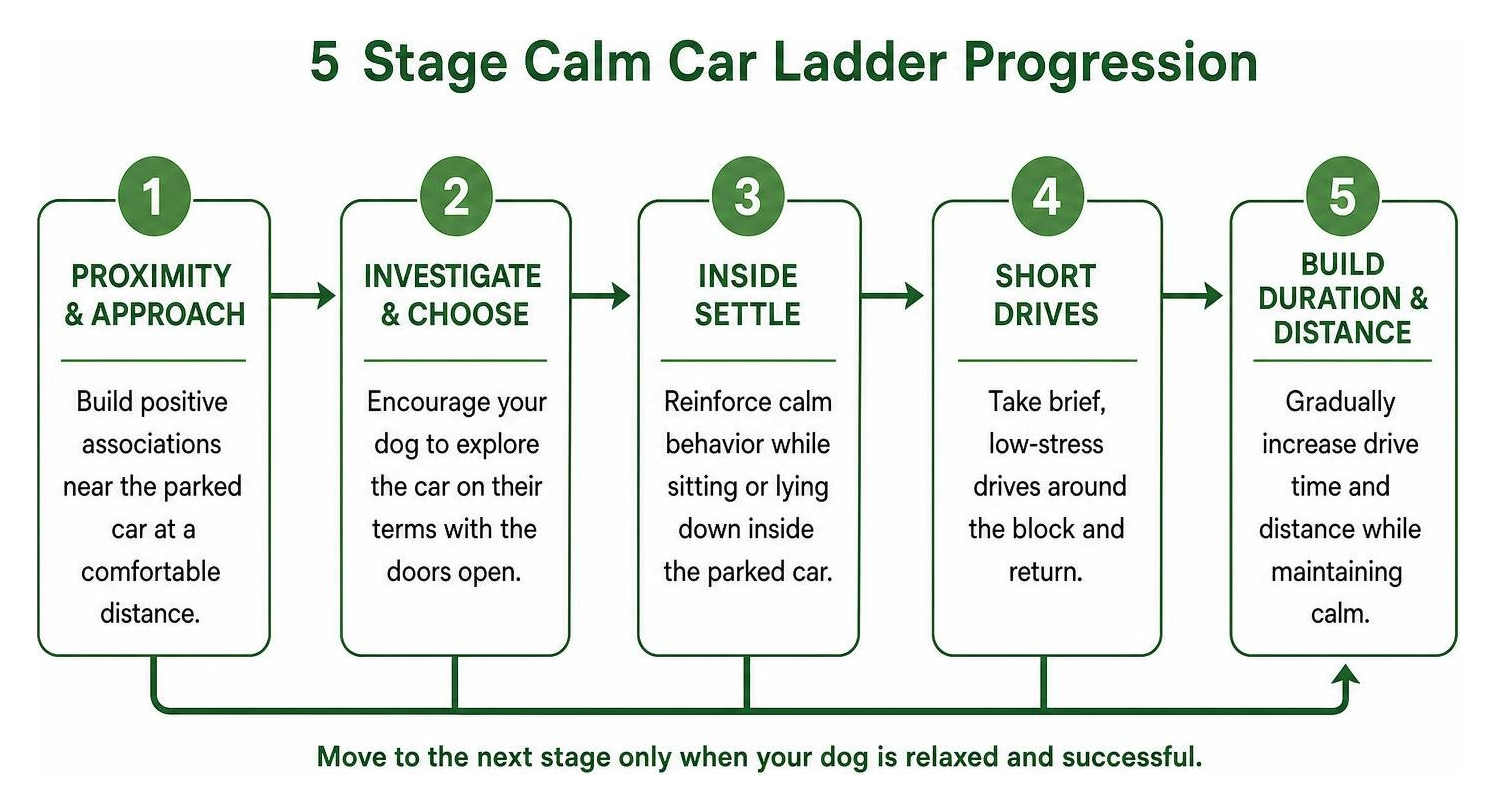
Exercise 1: Proximity and Approach Dog Car Anxiety Exercises
If your dog digs their heels in at the driveway, asking them to get inside the vehicle is a step too far. Start by working outside the car.
- Walk your dog on a leash toward the parked car, keeping enough distance that your dog stays relaxed.
- Scatter high value treats on the ground a few feet away from the car.
- Allow your dog to choose to walk closer to sniff the car on their own terms. Never drag or force them.
- If your dog hesitates, step back two paces, ask for a simple sit or eye contact, reward, and end the session.
If you are struggling to get your dog anywhere near the vehicle, review these helpful tips on How to Relieve Dog Car Anxiety to build low pressure driveway routines.
Exercise 2: Stationary Car Habituation Dog Car Anxiety Exercises
Once your dog happily approaches the parked car, move to working at the threshold of the open doors.
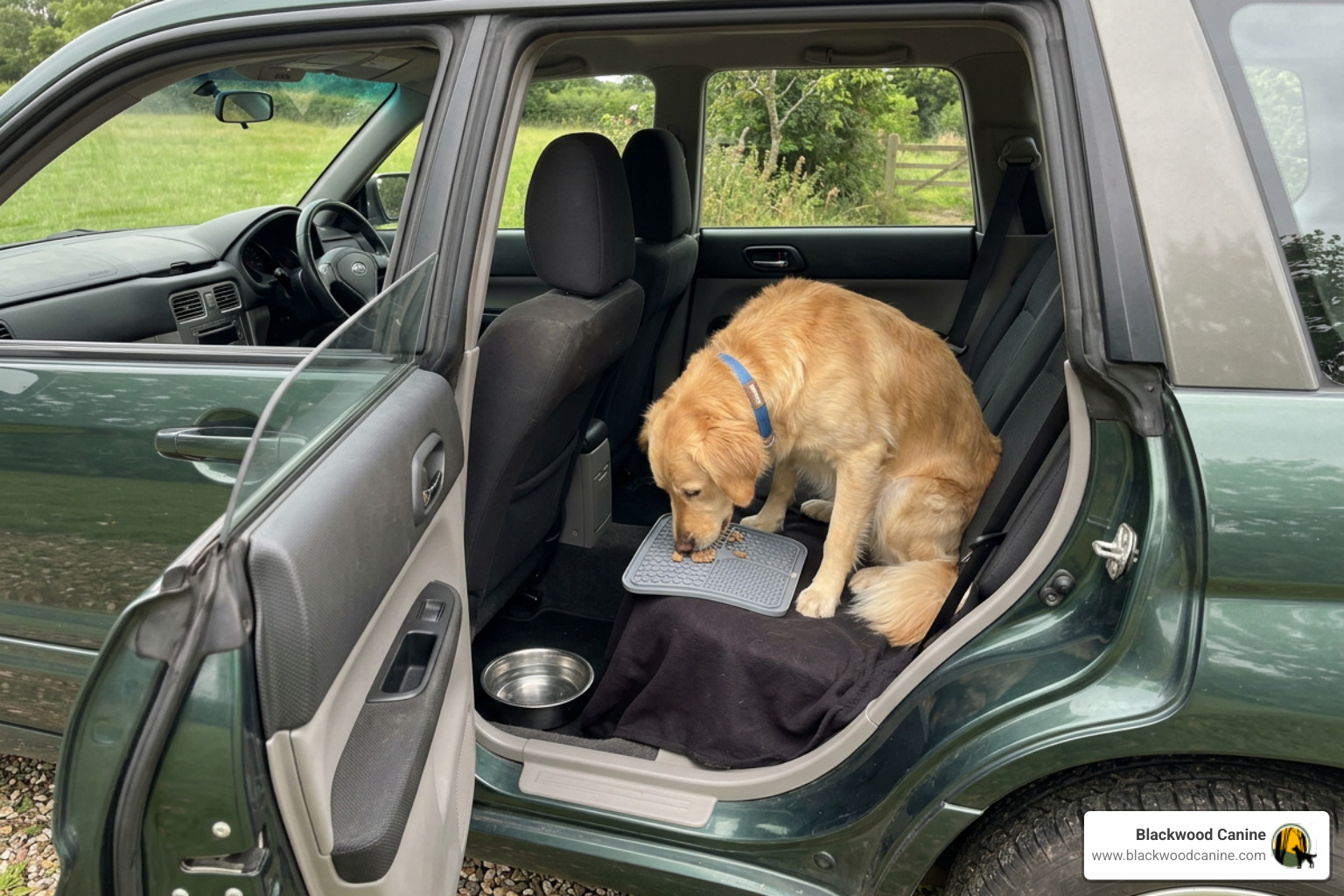
- Open the car doors wide with the engine completely off.
- Place a non-slip mat or rubber mat on the car seat or floor so your dog feels physically secure stepping up.
- Toss treats onto the floorboard or back seat. Let your dog put just two paws inside to grab the reward and step back out if they choose.
- Once your dog comfortably hops inside, sit on the back seat with them.
- Feed your dog their regular scheduled meal inside the parked car, or offer a lick mat smeared with wet food or peanut butter. Licking and chewing release soothing neurochemicals that naturally lower stress levels.
Exercise 3: Engine Vibration and Sound Exposure
Many dogs handle a parked car fine, but freeze the moment the motor starts. The transition from silence to engine noise, mechanical vibration, and exhaust notes can trigger panic.
- Place your dog in the car with a high value reward (like a stuffed Kong or lick mat).
- Have a family member start the engine while you stay next to your dog in the vehicle.
- Keep the car in park. Allow the engine to run for 30 to 60 seconds while your dog licks their treat.
- Shut the engine off before your dog finishes their food reward.
- Immediately exit the vehicle and take a brief 2 minute walk around the yard to reward calm behavior.
Exercise 4: Micro-Drive Reversals and Neighborhood Loops
The jump from a parked car to a 20 minute drive is too large for an anxious dog. Micro-movements let you introduce motion without causing panic.
- Secure your dog safely, start the engine, and slowly back up 5 to 10 feet down the driveway.
- Put the car back in park, turn off the engine, and reward your dog generously.
- Graduate to driving down to the end of your street and returning immediately.
- Pay attention to drive-day stress stacking. Multiple minor triggers (heat, noise, restraint, quick acceleration) accumulate during a ride. Keep early drives under 2 minutes so your dog stays calm.
For additional step-by-step guidance on breaking down driving milestones, consult this guide on How to Train a Dog With Car Anxiety.
Exercise 5: Destination Pairing and Decompression Walks
If 100% of your dog's car rides end at the vet clinic or groomer, their travel fear is logical. You must break that negative feedback loop.
- Drive 2 minutes to a quiet, local green space or neighborhood trail.
- Unload your dog and immediately go for a decompression sniffari walk (a slow walk on a long line where your dog leads the way by sniffing).
- Avoid taking your dog to overcrowded dog parks where high arousal levels can cause overstimulation.
- Practice mock trips where you drive to a quiet park parking lot, feed a meal or treat in the car, and return straight home without even getting out.
For more insights on building positive destination habits, read our guide on Calming Car Rides Dogs.
Creating a Safe Vehicle Environment and Calming Tools That Work
Your dog's physical setup inside the car directly impacts their emotional state. A dog sliding across slick leather seats or bracing against turns cannot relax.
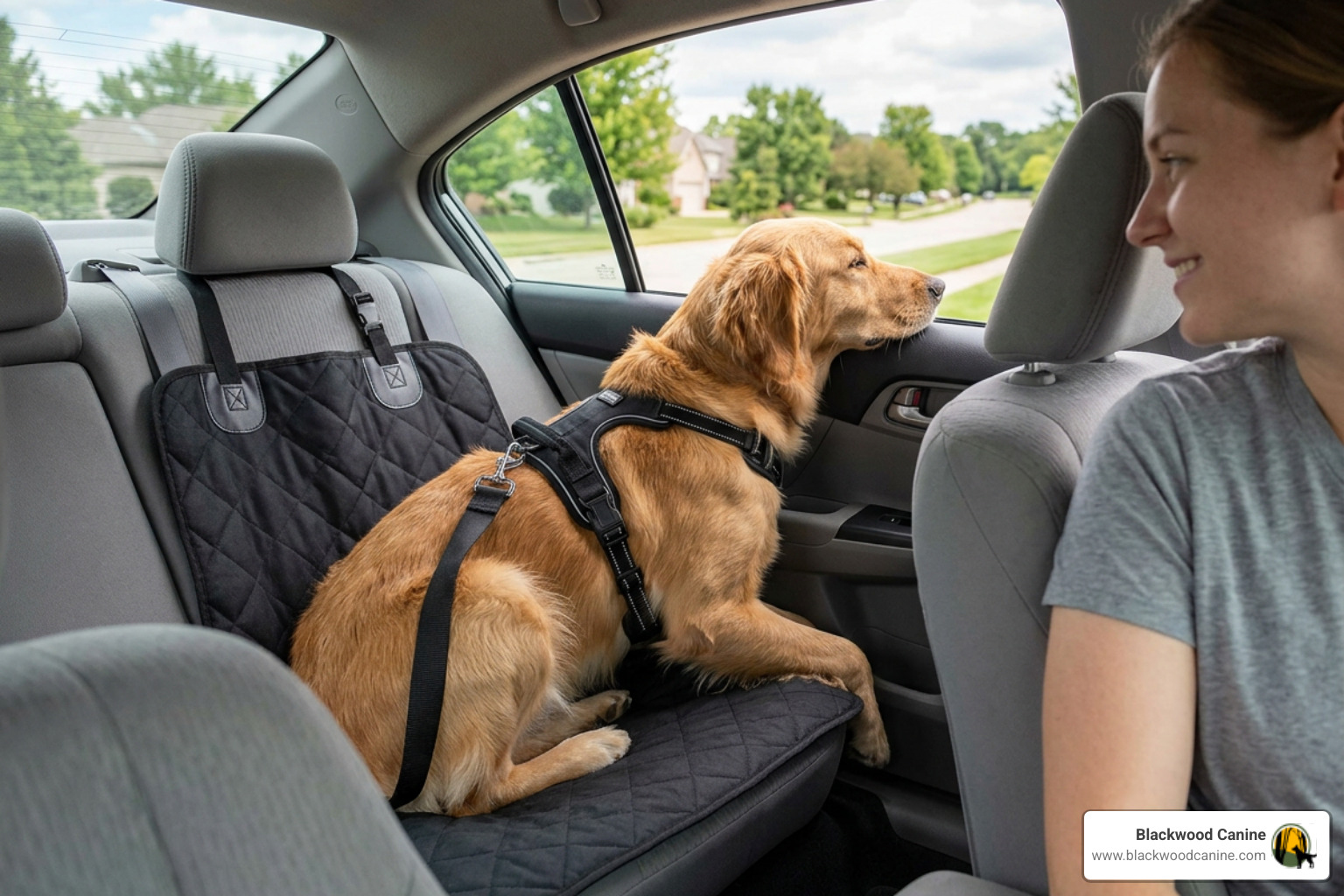
Vehicle Setup and Restraints
- Crash Tested Harnesses: Securing your dog with a crash tested seatbelt harness prevents them from pacing, tumbling during sudden stops, or interfering with the driver.
- Anchored Travel Crates: For dogs with severe visual reactivity (dogs that bark at passing cars or scenery), an anchored crate in the cargo area works best. Covering the sides of the crate with a light sheet blocks visually overwhelming movement outside the window.
- Footwell Blockers and Non-Slip Mats: Fill the floorboard gaps behind the front seats with travel cushions so your dog has a wide, flat platform to rest on.
Calming Aids and Products
- Pressure Wraps (ThunderShirt): Torso pressure wraps apply gentle, constant pressure around the dog's chest and midsection. Over 85% of owners report noticeable anxiety reduction when using pressure wraps during travel.
- Pheromone Therapy (Adaptil): Synthetic dog appeasing pheromone sprays mimic the calming scents produced by a nursing mother dog. Spray Adaptil on your dog's travel bedding or car seats 10 to 15 minutes before loading your dog into the car.
- THC-Free CBD Oil: A 2023 study found that THC-free CBD (administered at 4 mg/kg) significantly reduced serum cortisol levels and stress-related behaviors like whining in dogs during car trips.
Medical and Veterinary Interventions
When behavioral training alone is not enough, medical support can make desensitization possible.
- Maropitant Citrate (Cerenia): An FDA approved anti-nausea medication that targets the emetic center in the brain. Cerenia boasts success rates exceeding 85% in preventing motion sickness vomiting in dogs 16 weeks of age and older.
- Prescription Anxiolytics: Short term situational medications such as trazodone or gabapentin can lower baseline panic so your dog can actually learn during training sessions.
If your dog displays extreme panic, aggression, or unmanageable fear during travel, explore our dedicated Behavior Modification Training programs to work through complex behavioral stress safely.
Frequently Asked Questions About Dog Car Anxiety
How long does it take to see progress with dog car anxiety training?
Most dogs show noticeable improvement within two to six weeks of consistent practice. Mild cases may resolve faster, while dogs with long standing trauma or severe vestibular issues may require several months. Progress depends on keeping every session short, staying below your dog's stress threshold, and practicing daily.
What if my dog refuses to even approach the car?
Do not force, lure, or drag them. Start your training at a greater distance. If your dog stops moving 20 feet away from the vehicle, move back to 25 feet where they feel safe. Feed high value treats like boiled chicken or freeze dried liver at that safe distance. Gradually move closer over several days as your dog begins looking at the car with calm curiosity.
When should I consider medication or consult a veterinarian?
You should consult a veterinarian if your dog vomits every time the vehicle moves, displays extreme panic (such as chewing through seatbelts, frantic vocalizing, or trying to escape window openings), or remains completely shut down and unable to eat treats. Prescription anti-nausea medication like Cerenia or situational anti-anxiety medications can lower your dog's physiological distress so behavioral training can take hold.
Hit the Road with Confidence in the Pacific Northwest
Solving car travel issues requires patience, structural management, and fair, clear communication. Whether you are taking quick trips around Scappoose, St. Helens, and Warren, or commuting through Bethany, Hillsboro, Beaverton, Portland, and Vancouver, having a calm travel companion makes everyday life much easier.
At Blackwood Canine, we help owners replace chaos and frustration with reliable behavior habits. Real behavior modification for complex issues like severe car anxiety typically takes structured 6 week to 8 plus week timelines, while our foundational obedience work starts at 4 weeks minimum to build lasting habits.
If you are ready to stop guessing and start making real progress with your dog, check out our Reactive Dog Training page or reach out to set up your Good Dog Game Plan today.
The 5 Best Dog Day Camp Training Programs Near You
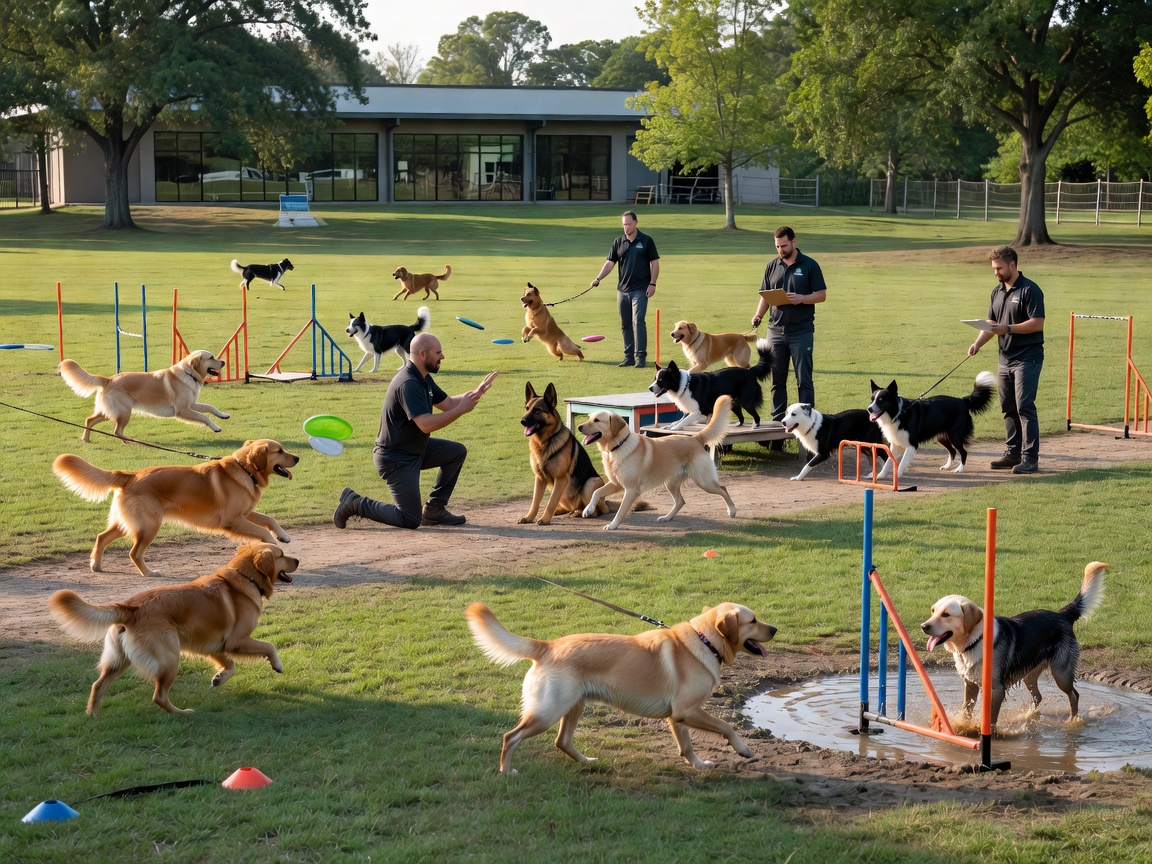
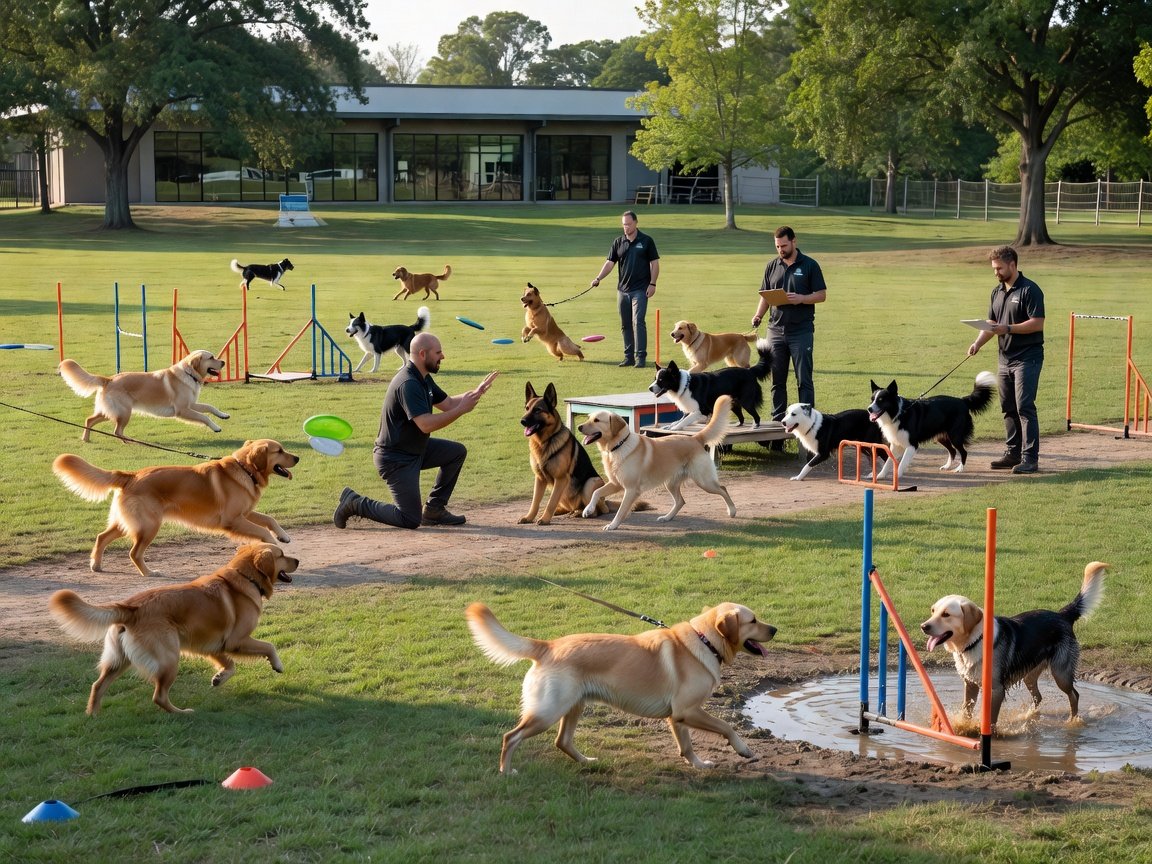
Dog day camp training is a hybrid approach to pet care. Instead of leaving your dog in an open room to play all day without guidance, day training blends regular care with structured skill building. You drop your dog off in the morning, professional trainers work on specific goals throughout the day, and you pick up your dog in the evening.
Unlike standard daycare options that focus mostly on free play, day camp training builds useful real world habits. Dogs practice essential skills such as:
- Loose leash walking without pulling
- Impassioned impulse control around distractions
- Reliable recall and basic obedience commands
- Calm greetings with humans and other dogs
- Settling quietly when nothing is happening
A traditional daycare often involves large, cage free play yards where dogs run continuously. While this wears out physical energy, it can sometimes reinforce bad habits like demand barking, jumping, or overstimulation.
Day camp training fixes this issue by mixing short, focused learning lessons with supervised rest and structured social time. Your dog gets mental exercise alongside physical activity. Many facilities also require or recommend starting with private dog training lessons to establish a baseline of focus before adding the high distraction environment of group play.
What to Look for in Dog Day Camp Training Near Me
Finding the right local day camp training program requires looking beyond flashy websites and fancy facilities. You want a safe environment where qualified trainers prioritize your dog's mental state and physical well being.
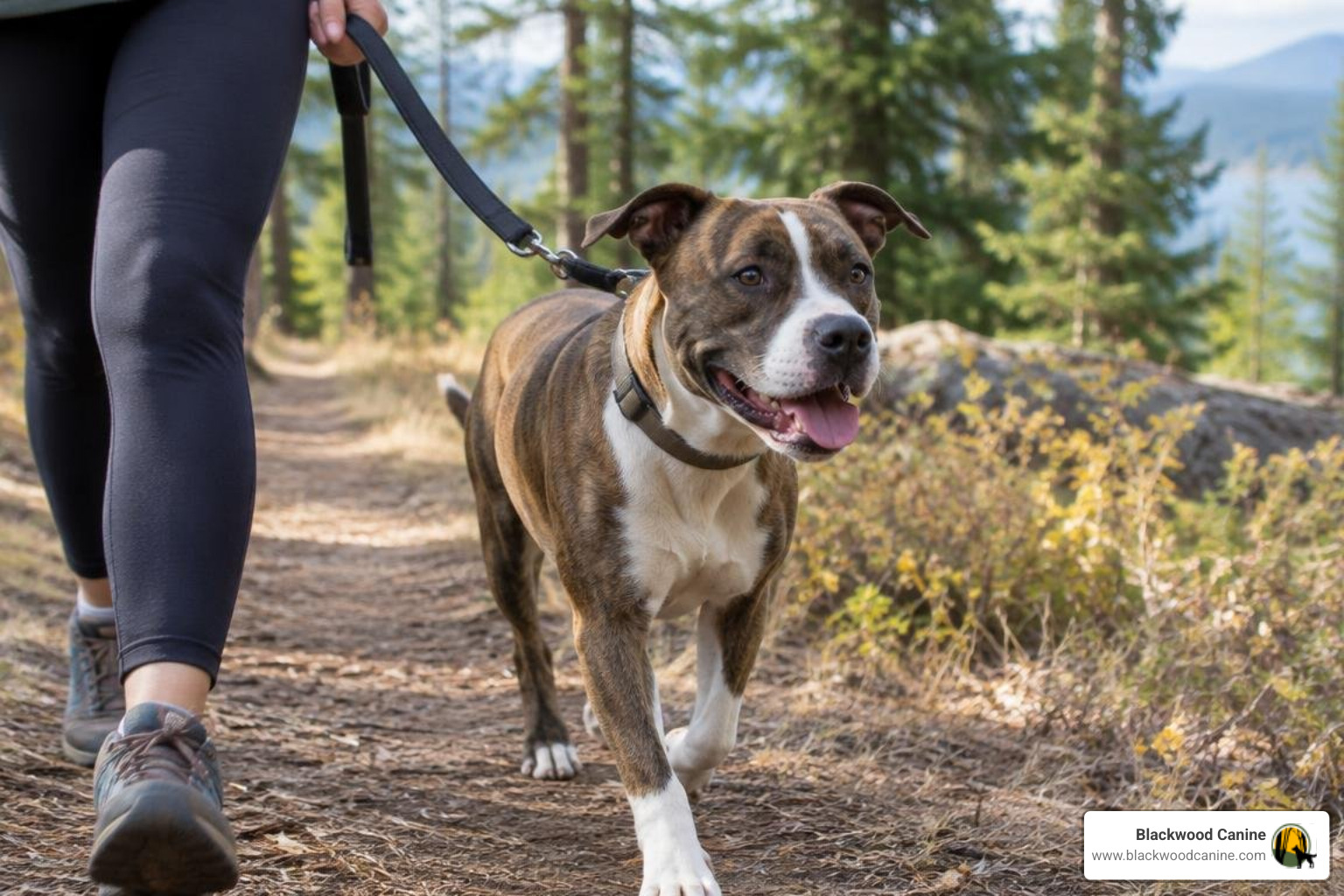
When researching options nearby, look closely at these key markers:
- Trainer Qualifications: Check if staff members have actual hands on experience with behavior management, or if they are simply daycare attendants monitoring play.
- Facility Cleanliness: Yards and indoor spaces should be sanitized regularly, free of standing waste, and properly ventilated.
- Climate Control: Indoor play areas and rest rooms must be climate controlled to keep dogs safe during freezing winter mornings or summer heatwaves.
- Emergency Safety Protocols: Staff should have clear plans for medical emergencies, weather alerts, and managing unexpected dog conflicts.
- Transparent Updates: Top programs provide daily report cards, pictures, or written notes outlining what skills your dog practiced that day.
Key Benefits of Day Camp Training vs Traditional Daycare
Combining daytime care with structured learning gives busy dog owners several distinct advantages over standard dog drop off services.
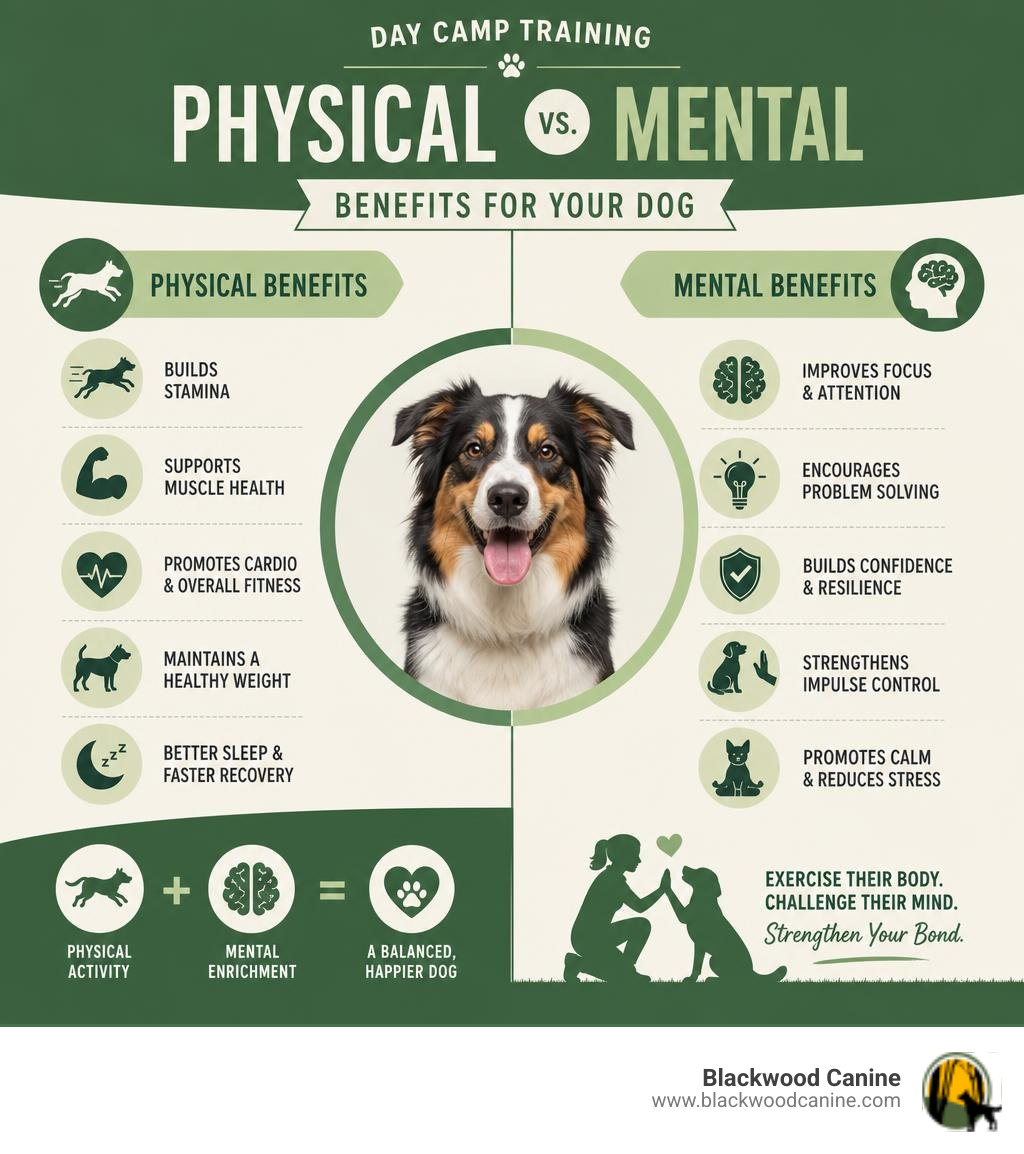
First, day camp training helps prevent problem behaviors before they start. Unsupervised group play can teach dogs to react impulsively around other animals. Structured day camps teach your dog how to focus on a handler even when other dogs are running around nearby.
Second, it provides balanced mental enrichment. Physical exercise alone will not calm a high drive working breed or anxious young dog. Brain games, obedience drills, and impulse control practice tire dogs out in a balanced, healthy way. Best of all, your dog returns home with you every night, so you do not have to give up your evening routine or miss spending time with them.
Structured Schedules and Safety Evaluations in Dog Day Camp Training Near Me
A quality day camp training center operates on a clear schedule designed to prevent overstimulation and fatigue. Dogs do not learn well when they are exhausted or overwhelmed, which is why balance is critical.
A typical day camp schedule includes structured morning play, individual training sessions, mandatory midday rest, and brief afternoon reviews.
Safety begins before a dog ever steps into a play yard. Reputable facilities require a formal temperament evaluation. Staff members introduce the new dog to established, neutral dogs in a controlled area to assess body language, confidence, and play style.
Instead of grouping dogs purely by size, high quality facilities group dogs by play style and energy level. A timid large dog might do much better with gentle, calm playmates than with an assertive, high energy puppy of the same weight.
Comparing Top Day Camp Options and Board and Train Alternatives
When evaluating local options for your dog, you will likely choose between local day camp training options, group classes, or full overnight programs. Each format serves a different purpose depending on your schedule and your dog's current behavior.
| Feature | Dog Day Camp Training | Traditional Daycare | Board and Train Program |
|---|---|---|---|
| Daily Schedule | Drop off AM, pick up PM | Drop off AM, pick up PM | Overnight stay for several weeks |
| Focus Area | Play plus structured obedience | Free play and energy burn | Intensive behavior and foundation training |
| Owner Involvement | Daily follow through at home | Minimal | End of program transfer lessons |
| Ideal Dog Type | Dogs needing manners & mental exercise | Social, highly friendly dogs | Dogs needing serious structure or fast progress |
| Minimum Duration | Day to day or multi week packages | Flexible drop off | Minimum 4 to 8+ weeks depending on goals |
Facilities that host specialized summer camps or seasonal events often add fun extras like agility equipment, swimming pools, splash pads, scent games, and pack walks. These extra activities keep dogs engaged, build confidence, and make learning enjoyable.
Selecting Dog Day Camp Training Near Me for Socialization and Agility
For social dogs who love learning new things, day camps that include confidence building activities like agility obstacles or scent games offer a great output.
Scent work encourages dogs to use their noses to locate specific scents or hidden items, which naturally lowers stress and promotes calm focus. Agility work, like climbing over low platforms or navigating tunnels, builds physical coordination and trust in the handler. These activities turn basic obedience into fun games that dogs look forward to every day.
When Overnight Immersion or Boot Camp Is Better Than Day Training
Day camp training works wonderfully for basic manners, leash skills, and light social adjustment. However, it is not always the best fit for every dog. If your dog struggles with severe leash reactivity, intense resource guarding, or deep rooted anxiety, taking them back and forth from home every day can slow down progress.

In those situations, an immersive Portland dog board and train program or specialized reactive dog boot camp provides the round the clock consistency needed for real change.
Overnight programs allow professional trainers to manage every aspect of the dog's environment, routines, and learning triggers without daily disruptions. This creates a clear, stress free structure where the dog can learn new response habits much faster.
Health Requirements and What Pet Parents Say in Reviews
Keeping every dog safe requires strict health protocols. Reliable day camp facilities maintain clear medical standards before allowing any dog into group play or shared training rooms.
You will need to provide documentation from your veterinarian showing your dog is current on key vaccinations:
- Rabies: Required by law across Oregon and Washington.
- DHPP (Distemper, Hepatitis, Parvovirus, Parainfluenza): Standard core vaccine.
- Bordetella: Protects against kennel cough. Many active day camp facilities require this booster every six months due to close contact between dogs.
- Canine Influenza: Strongly recommended or required by facilities to prevent respiratory outbreaks.
Beyond vaccines, check online reviews to see what actual clients experience. Look for mentions of staff communication, dog safety, facility cleanliness, and whether the training results transferred well to the owner's home routine.
Questions to Ask Before Choosing a Facility
Before signing your enrollment paperwork, ask the staff these direct questions:
- How do you handle a dog that gets overwhelmed or overstimulated during play?
- What training methods and tools do your staff use during daily lessons?
- How many staff members are present in the play yard per dog?
- What happens if a dog gets hurt or shows unexpected aggression?
- How do you teach owners to maintain the training progress at home?
Frequently Asked Questions About Day Camp Training
What vaccinations are required before joining a day camp training facility?
Most facilities require Rabies, DHPP, and Bordetella vaccinations. Because dogs interact closely during play and group lessons, many centers require the Bordetella vaccine every six months instead of annually. Canine Influenza is also commonly requested alongside a general veterinary health release.
How are dogs evaluated and grouped for safe play?
Facilities conduct a hands on temperament assessment before a dog's first full day. Staff members observe the dog's body language around neutral dogs. Dogs are then grouped based on play style, energy level, and social confidence rather than just age or breed size.
How do I choose between day camp training and private lesson programs?
Day camp training is ideal if you need daytime care while you work and want your dog to get structured practice in group settings. Private lessons are better if you want direct, hands on coaching from the start, or if your dog struggles with severe behavior issues at home. Many owners choose a combined path, using private coaching to build a baseline before enrolling in group programs or specialized behavior modification training.
Finding Peace of Mind and the Right Program for Your Dog
Searching for dog day camp training near me is ultimately about finding balance. You want a safe place where your dog can spend their day learning good habits, building social confidence, and burning off excess energy in a constructive way.
Successful training requires clear expectations, practical management, fair consequences, and consistent follow through. While day training gives your dog a head start, long term results always depend on how well those habits are maintained in your home environment.
At Blackwood Canine, we guide dog owners across Scappoose, St. Helens, Warren, Bethany, Hillsboro, Beaverton, Portland, and Vancouver toward reliable, stress free relationships with their dogs. We focus on clear communication and practical management tools that fit seamlessly into busy family routines.
We know that deep behavioral change takes time and clear structure:
- Our basic obedience foundation training starts at a minimum of 4 weeks.
- Complex behavior modification programs run on 6 week timelines.
- Advanced reconditioning for severe behavior cases spans 8 plus weeks.
We do not offer quick fixes or training programs shorter than 4 weeks, because building real reliability takes consistency and step by step practice.
If you are ready to stop struggling with pushy behavior or stressful daily walks, check out our Dog Day Camp Training and immersion programs to discover how clear structure can bring peace back to your home.
How to Choose the Best Gear to Reduce Dog Anxiety in Car
Why So Many Dogs Struggle with Car Rides (And What Actually Helps)

The good news: there are proven ways to reduce dog anxiety in car rides, and the right gear is a big part of the solution.
Here is a quick overview of the most effective options:
| Approach | Best For | Example |
|---|---|---|
| Crash tested harness | Dogs who feel calmer with freedom of movement | Sleepypod Clickit Sport |
| Secured travel crate | Dogs who do better with less visual stimulation | Gunner Kennel G1 |
| Pressure wrap | Mild to moderate anxiety | ThunderShirt |
| Pheromone spray | Layered calming support | Adaptil spray |
| Calming chews | Pre trip anxiety edge | L theanine or L tryptophan blends |
| Vet prescribed medication | Severe anxiety or motion sickness | Trazodone, Cerenia |
Roughly 1 in 4 dogs experience some form of car or travel anxiety. That means if your dog shakes, drools, or refuses to get in the vehicle, you are far from alone.
Car anxiety can show up in different ways. Some dogs panic before the engine even starts. Others seem fine at first, then spiral during a long drive. A few vomit every single trip. And many owners try calming gummies or a pre walk and still end up with a stressed out dog on an 8 hour road trip, wondering what they are missing.
The answer is usually a combination of things: the right physical setup in the car, a gradual training approach, and sometimes targeted calming support. This guide covers all of it, starting with the gear that makes the biggest difference.
I'm David Wright, dog trainer and founder of Blackwood Canine, and over my career working with dogs of all temperaments, including fearful and reactive cases, I've seen how the right car setup can dramatically reduce dog anxiety in car travel before a single training session even begins. We will walk through every option so you can find what fits your dog.
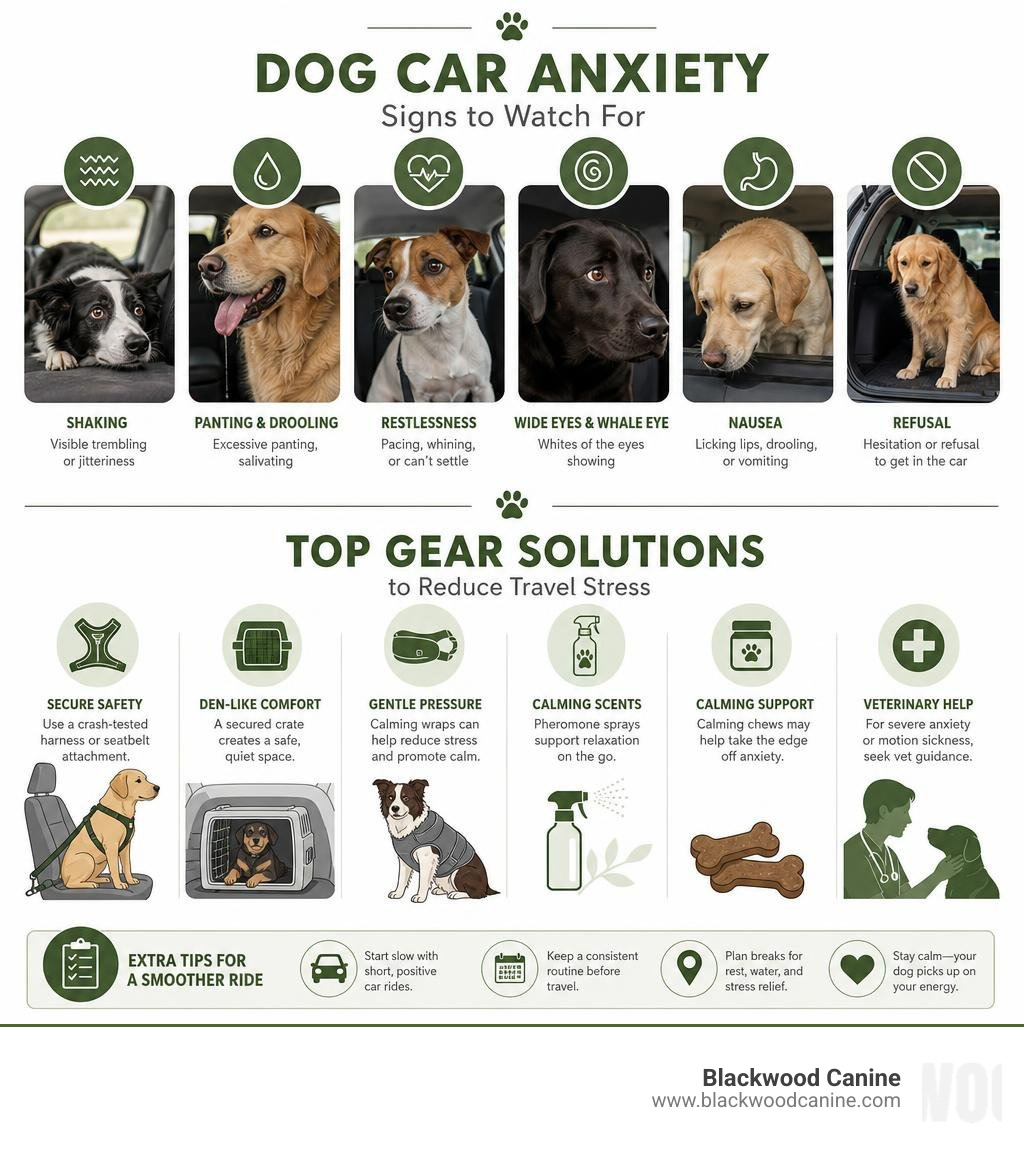
Understanding Travel Distress and Motion Sickness
To effectively reduce dog anxiety in car rides, we first have to understand what is actually happening to our dogs when they travel. Many owners look at a panting, shaking dog and assume it is purely a mental panic. However, physical discomfort and psychological fear are deeply linked.
A major culprit behind travel distress is the canine vestibular system. This delicate system, located in the inner ear, controls balance and spatial orientation. In young puppies, these inner ear structures are still developing. Because of this, puppies are highly prone to true motion sickness.
While many dogs outgrow this physical imbalance as their vestibular system matures, usually between 12 and 18 months of age, the early memory of feeling nauseous can leave a lasting impression. If a puppy repeatedly gets sick in the car, they learn to associate the vehicle with feeling terrible. By the time they are an adult, the motion sickness might have resolved, but the anticipatory anxiety remains.
To read more about how physical discomfort translates into behavioral fear, check out the Pawxiety Guide on Dog Car Anxiety, which explores these physiological connections in detail.
Distinguishing Motion Sickness from Anticipatory Anxiety
How do you know if your dog is suffering from actual nausea or if they are just terrified of the ride? Distinguishing between the two is vital because the treatment plans are very different.
If your dog has motion sickness, you will typically see physical signs of nausea that start once the car is in motion. These include:
- Excessive, thick drool that hangs from their lips
- Frequent swallowing or lip licking
- Repeated yawning
- Dry heaving or vomiting
If your dog has anticipatory anxiety, the stress signals often start before the car even moves. Your dog might tremble when you pick up your car keys, refuse to walk down the driveway, or freeze at the car door. Once inside, they might pant heavily, pace restlessly, whine, bark, or look around with wide eyes.
Of course, many dogs suffer from both. A simple self check is to observe when the behavior starts. If your dog happily jumps into the car but begins drooling and vomiting ten minutes into the drive, motion sickness is the primary trigger. If they act like they are walking to the gallows before you even open the garage door, you are dealing with a heavy dose of behavioral anxiety.
Identifying Environmental and Sensory Triggers
Beyond physical motion, a car is a sensory overload machine for a dog. Understanding these triggers allows us to modify the environment to help them relax.
- Visual Overstimulation: Fast moving scenery, passing headlights, and flashing signs can overstimulate a dog. Their predatory instincts or fear responses can be triggered by seeing cars or objects whiz by at 60 miles per hour.
- Engine Vibration and Noise: The low frequency hum and vibration of the engine can feel unsettling under a dog's paws, especially if they do not have secure footing.
- Negative Associations: If the only time your dog gets in the car is to go to the vet clinic or the groomer, they quickly learn that the car is a portal to uncomfortable experiences.
- The Drive Day Stacking Problem: This happens when small stressors pile up. A rushed morning, a missed breakfast, a loud garbage truck outside, and then a sudden car ride can push an already sensitive dog over their stress threshold before you even pull out of the driveway.
Essential Gear to Reduce Dog Anxiety in Car
When we look at how to reduce dog anxiety in car environments, safety gear is not just about crash protection, though that is incredibly important. The right restraint actually reduces physical stress by providing stability.
When a dog is loose in a moving vehicle, they have to constantly tense their muscles to stay upright. Every turn, stop, and acceleration forces them to slide on the seats. This lack of secure footing makes them feel incredibly vulnerable and worsens both motion sickness and anxiety.
From a physics perspective, an unrestrained pet is also a major hazard. At just 30 miles per hour, a 30 pound dog generates roughly 600 pounds of force during a sudden stop. Securing your dog keeps them safe and keeps you focused on driving.
For a deep dive into choosing the right setup for your vehicle, you can read the Healers PetCare Restraint and Motion Sickness Strategies guide, which outlines how to match your dog's specific triggers to the right travel gear.
Selecting the Right Restraint for Your Dog
There is no one size fits all solution for car restraints. You will need to choose based on your dog's size, temperament, and primary anxiety triggers.
| Restraint Type | Pros | Cons | Best For |
|---|---|---|---|
| Crash Tested Harness | Allows dog to sit or lie down comfortably; keeps them securely in place on the seat. | Requires a high quality, certified harness; cheap tethers can fail. | Dogs who want to look out the window or feel close to you. |
| Secured Travel Crate | Blocks out visual triggers; provides a cozy, den like space; maximum safety. | Takes up a lot of cargo space; some dogs panic if they dislike confinement. | High anxiety dogs, escape artists, and dogs easily overstimulated by passing cars. |
| Booster Seat | Elevates small dogs so they can see out; keeps them secure. | Only suitable for small breeds; must be paired with a harness. | Small dogs who get restless when they cannot see their surroundings. |
If you choose a harness, look for options that have been independently certified by the Center for Pet Safety. Many standard car harnesses fail at low speeds, so investing in a high quality, crash tested harness is essential.

Optimizing Airflow and Cabin Temperature
Dogs run hotter than humans, and stress makes them even warmer. A panting, anxious dog generates a massive amount of heat, which can quickly lead to nausea and increased panic.
To keep the cabin comfortable:
- Max out the Air Conditioning: Keep the car cooler than you normally would. Ensure vents are pointed directly at your dog, especially if they are in the back seat or inside a crate.
- Use Window Shades: Block direct sunlight with mesh shades to prevent your dog from overheating.
- Add a Cooling Mat: A pressure activated cooling mat placed in their crate or on the seat can help lower their body temperature.
- Crack the Windows: Fresh, moving air can do wonders to reduce nausea. A slight breeze helps clear out any stuffy, anxiety inducing odors.
Behavioral Training and Calming Protocols
No piece of gear can completely solve car anxiety if your dog has a deep, emotional fear of the vehicle. To achieve lasting success, we must combine the right gear with behavioral training.
At Blackwood Canine, we focus on practical management and clear communication to help families build reliable, stress free relationships with their dogs. You can read our expert Dog Trainer Advice on Dealing with Car Anxiety to learn more about our approach to rebuilding confidence in fearful dogs.
Step by Step Training to Reduce Dog Anxiety in Car
Desensitization and counter conditioning are the gold standards of behavior modification. The goal is to slowly introduce your dog to the car at a pace they can handle, always pairing the experience with high value rewards like chicken, cheese, or their favorite toy.
Never rush this process. If your dog shows signs of stress, you have gone too fast. Simply take a step back and try again tomorrow.
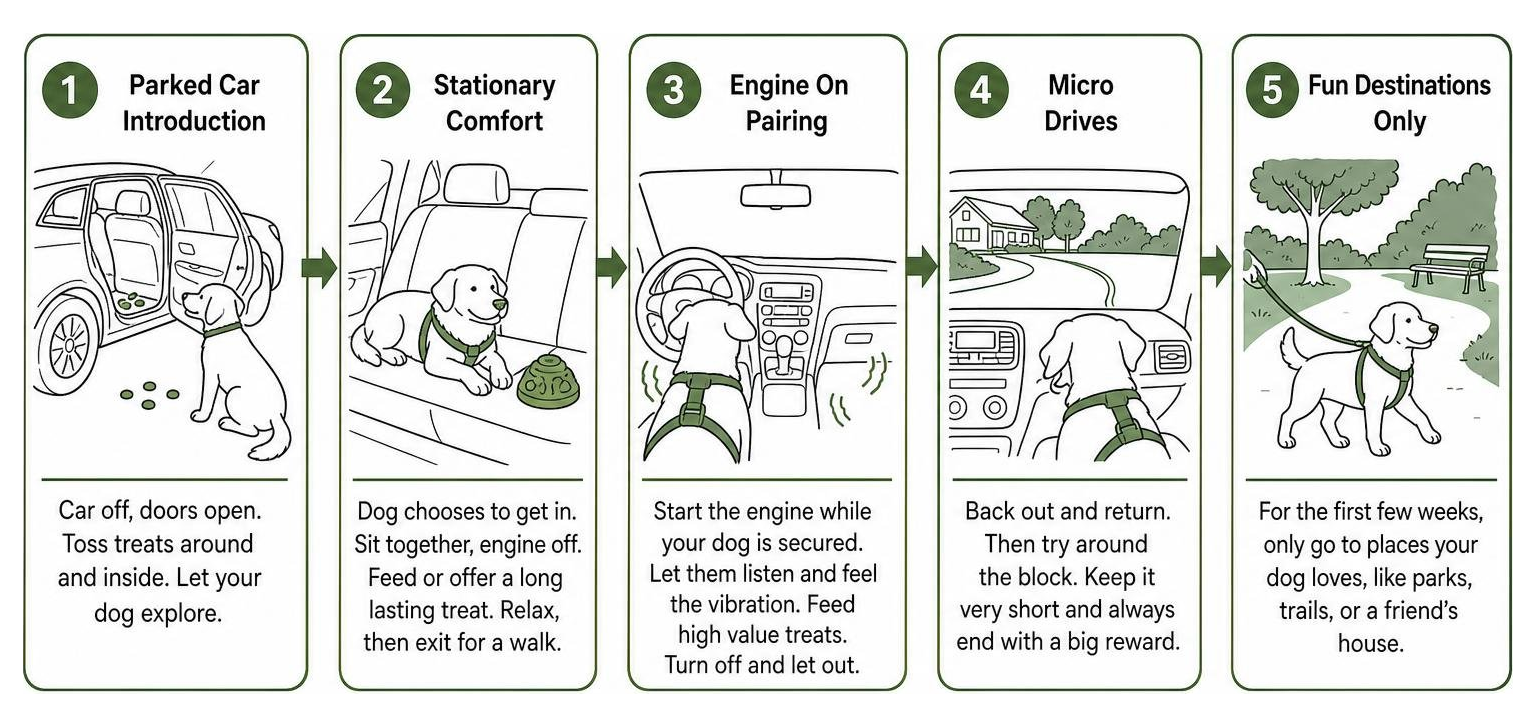
- The Parked Car Introduction: Start with the car turned off and the doors wide open. Walk your dog near the vehicle. Toss high value treats around and inside the car. Let them explore at their own pace without forcing them inside.
- Stationary Comfort: Once your dog voluntarily climbs into the car, get in with them. Sit together with the engine off. Feed them their regular meals or a long lasting treat like a stuffed Kong. Spend five minutes just relaxing, then exit and go for a fun walk.
- Engine On Pairing: With your dog secured in their harness or crate, start the engine. Do not drive anywhere. Simply let them listen to the sound and feel the vibration while you feed them high value treats. Turn the engine off and let them out.
- Micro Drives: Back out of your driveway and pull right back in. That is it. If your dog remains calm, progress to driving around the block. Always end the ride with a massive reward, like a game of fetch or a special treat.
- Fun Destinations Only: For the first few weeks of driving, only go to places your dog loves, like a quiet park, a trail, or a friend's house. Break the association that the car only leads to the vet.
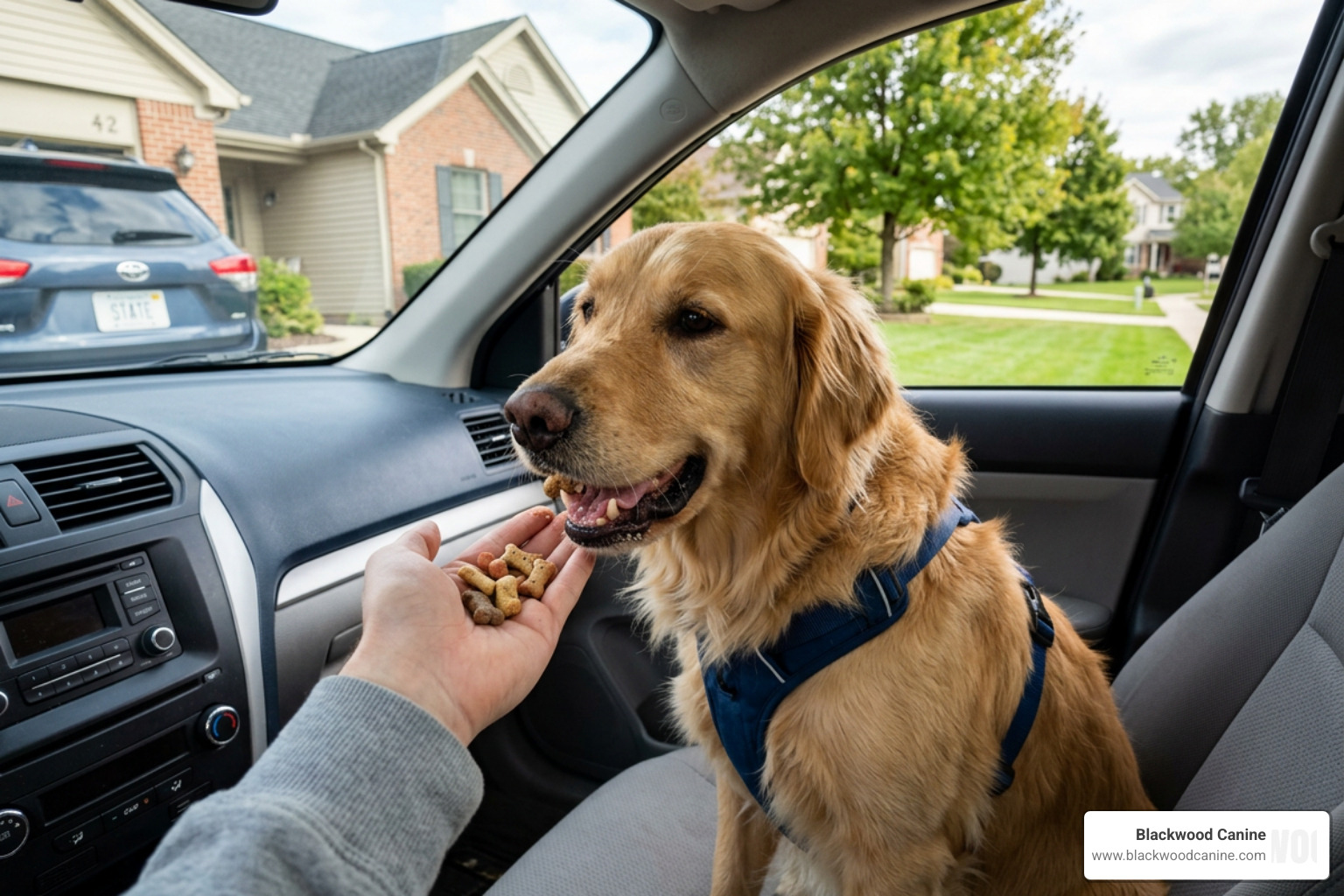
Using Calming Aids to Reduce Dog Anxiety in Car
While you are working through your training plan, non medication calming tools can help lower your dog's stress levels.
- Pressure Wraps: Products like the ThunderShirt apply constant, gentle pressure to your dog's torso, which has a calming effect on their nervous system. Test surveys show that over 85% of owners see improvement when using a pressure wrap.
- Pheromone Sprays and Collars: Dog appeasing pheromones mimic the natural calming scents produced by mother dogs. Spraying this on your dog's bedding or inside their travel crate 15 minutes before departure can help soothe their nerves.
- Calming Chews: Supplements containing L theanine, L tryptophan, chamomile, or melatonin can help take the edge off their anxiety. Always give these 30 to 90 minutes before your trip so they have time to kick in.
- Familiar Bedding: Bring along a blanket or dog bed that smells like home. Having a familiar scent in an unfamiliar environment provides immediate comfort.
- Soft Music or White Noise: Playing classical music or calming reggae can drown out scary road noises and help your dog settle.
When to Consult Your Veterinarian for Prescription Medications
For some dogs, the fear of the car is so severe that they enter a state of full panic. They might try to escape, claw at the windows, bark non stop, or injure themselves. In these cases, behavioral training alone is incredibly difficult because the dog's brain is too flooded with stress hormones to learn.
This is when you should consult your veterinarian. Fast acting, situational medications can be a game changer.
- Trazodone: A highly effective serotonin antagonist and reuptake inhibitor. A controlled Frontiers Study on Trazodone for Travel Anxiety demonstrated that a single dose of trazodone significantly reduced cortisol levels, lip licking, and overall anxiety scores in dogs during road travel.
- Gabapentin: Often paired with trazodone, this medication helps with situational anxiety and provides mild sedation to help your dog relax.
- Cerenia: If motion sickness is the primary trigger, Cerenia is an outstanding, FDA approved medication designed specifically to prevent vomiting. A single dose typically prevents vomiting for 24 hours without causing drowsiness.
A quick note on Acepromazine: While historically prescribed for travel, many modern vets discourage using acepromazine as a standalone treatment for anxiety. It is a tranquilizer that physically sedates the dog but does not reduce their internal fear. Your dog may look calm because they cannot move, but they are still terrified inside. Always ask your vet for anxiolytic medications rather than simple sedatives.
Frequently Asked Questions about Car Anxiety
How long does it take to desensitize a dog to car rides
There is no fixed timeline. For mild cases, you might see significant improvement in two to four weeks of consistent, daily training. For dogs with deep seated trauma or severe motion sickness, it can take several months.
Patience is key. Track your progress in a journal so you can celebrate the small wins, like your dog sniffing the car door without shaking.
Should my dog eat before a car ride
If your dog is prone to motion sickness, it is best to withhold food for three to four hours before your trip. Having an empty stomach greatly reduces the likelihood of vomiting. However, always ensure they have access to fresh water. If you are doing short training sessions, you can use high value treats, but keep the portions small.
Is a crate or a harness better for an anxious dog
It depends entirely on your dog's specific triggers.
A crate is often best for dogs who are easily overstimulated by visual triggers, such as passing cars or changing light patterns. It provides a secure, den like environment where they can curl up and sleep.
A crash tested harness is better for dogs who feel panicked when confined in small spaces or those who feel calmer when they can see you and adjust their position on the seat.
Helping Your Dog Feel Safer on Every Ride
Helping your dog overcome travel anxiety is a journey that requires patience, consistency, and the right approach. By combining proper safety gear, environmental management, and a gradual training protocol, you can transform the car from a place of terror into a gateway for fun adventures.
At Blackwood Canine, we are dedicated to helping families build strong, stress free relationships with their dogs. If you live in the Pacific Northwest, including Portland, OR, Vancouver, WA, Beaverton, OR, Hillsboro, OR, Tigard, OR, or Lake Oswego, OR, and need professional help with your dog's behavior, we are here for you.
Explore our Professional reactive dog training programs today, and let us help you turn stressful car rides into enjoyable, peaceful journeys for both you and your dog.
The Ultimate Guide to Dog Car Anxiety Solutions
Stop the Car From Becoming Your Dog's Worst Place

If your dog shakes, drools, refuses to jump in, or turns every drive into a backseat meltdown, do not force longer rides. Start smaller: make the parked car rewarding, add the engine only when your dog stays calm, then build up to very short trips to places they enjoy. Use a secure crate or crash tested harness, keep the cabin cool and quiet, and ask your vet about nausea or anxiety support if your dog panics or vomits.
This is the core of dog trainer advice on dealing with car anxiety: find out whether the problem starts before the car moves, which points to fear, or after movement begins, which may point to motion sickness. Many dogs have both, because repeated nausea can teach a dog that the car predicts feeling awful. About 24% of dogs show problem behaviors during travel, so this is common, frustrating, and very fixable with the right plan.
At Blackwood Canine, our work focuses on practical management, clear communication, and obedience skills, including dog trainer advice on dealing with car anxiety without pushing dogs past their limit.
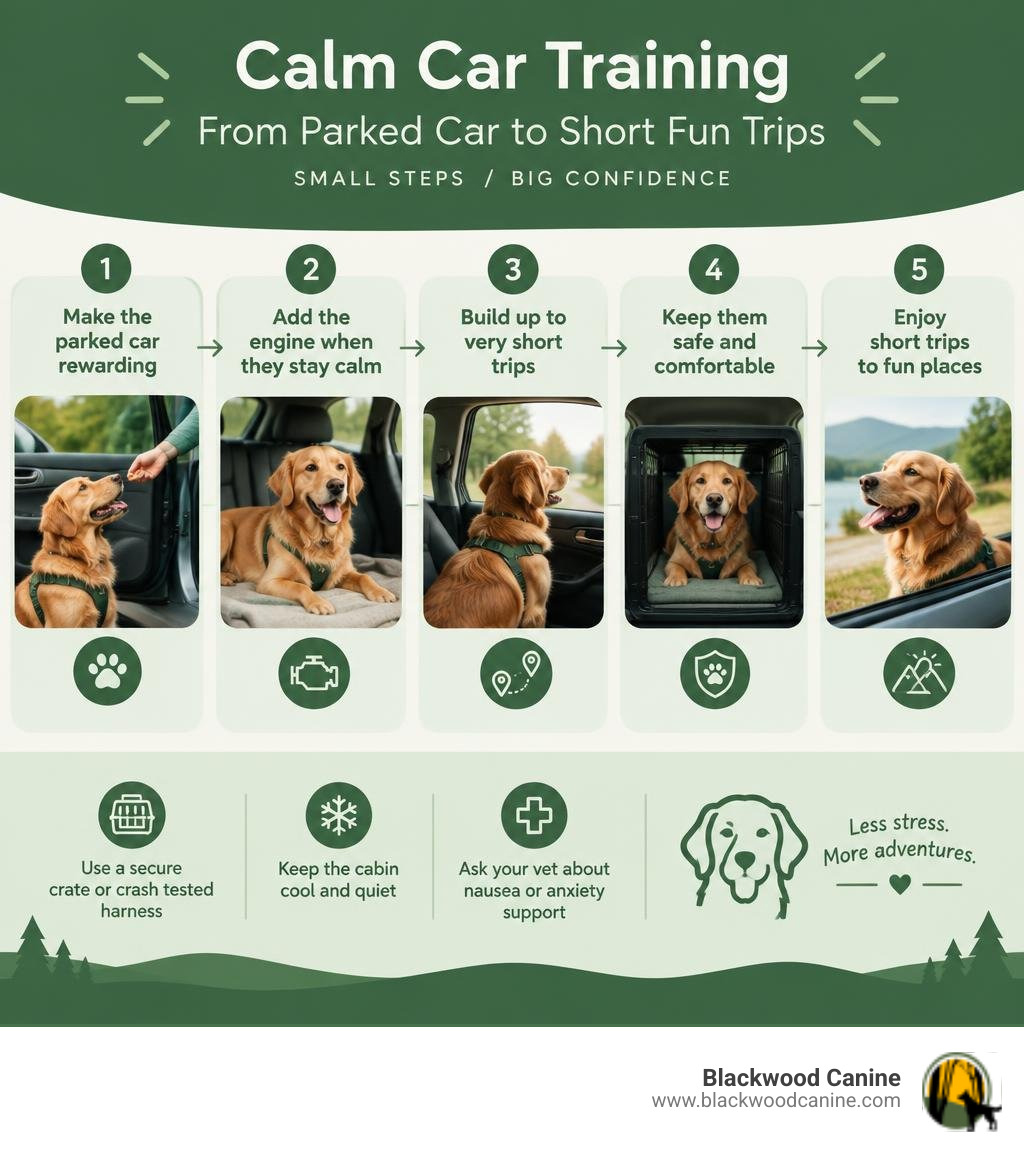
Understanding the Root Causes: Dog Car Anxiety vs Motion Sickness
When a dog hates the vehicle, owners often assume their pet is simply stubborn or nervous. In reality, travel distress usually splits into two separate issues: vestibular motion sickness and psychological fear. Treating one while ignoring the other is why so many quick fixes fail.
Vestibular motion sickness is a physical reaction. The inner ear balance center senses movement that does not match what the eyes see or what the body feels. This sensory mismatch causes dizziness and nausea. Puppies are especially vulnerable because their inner ear structures are still developing. While many young dogs outgrow physical sickness around twelve to fourteen months of age, the memory of nausea lingers. A puppy that feels sick on early rides quickly learns that the car makes them feel terrible.
That physical discomfort turns into conditioned fear. Even after the inner ear matures, the sight of your keys, the sound of the garage door, or the smell of the upholstery triggers a fight or flight response. Research on motion sickness in dogs shows that dogs lacking early positive car exposure develop travel distress at a rate of 24.1%, compared to only 6.3% of dogs habituated early.
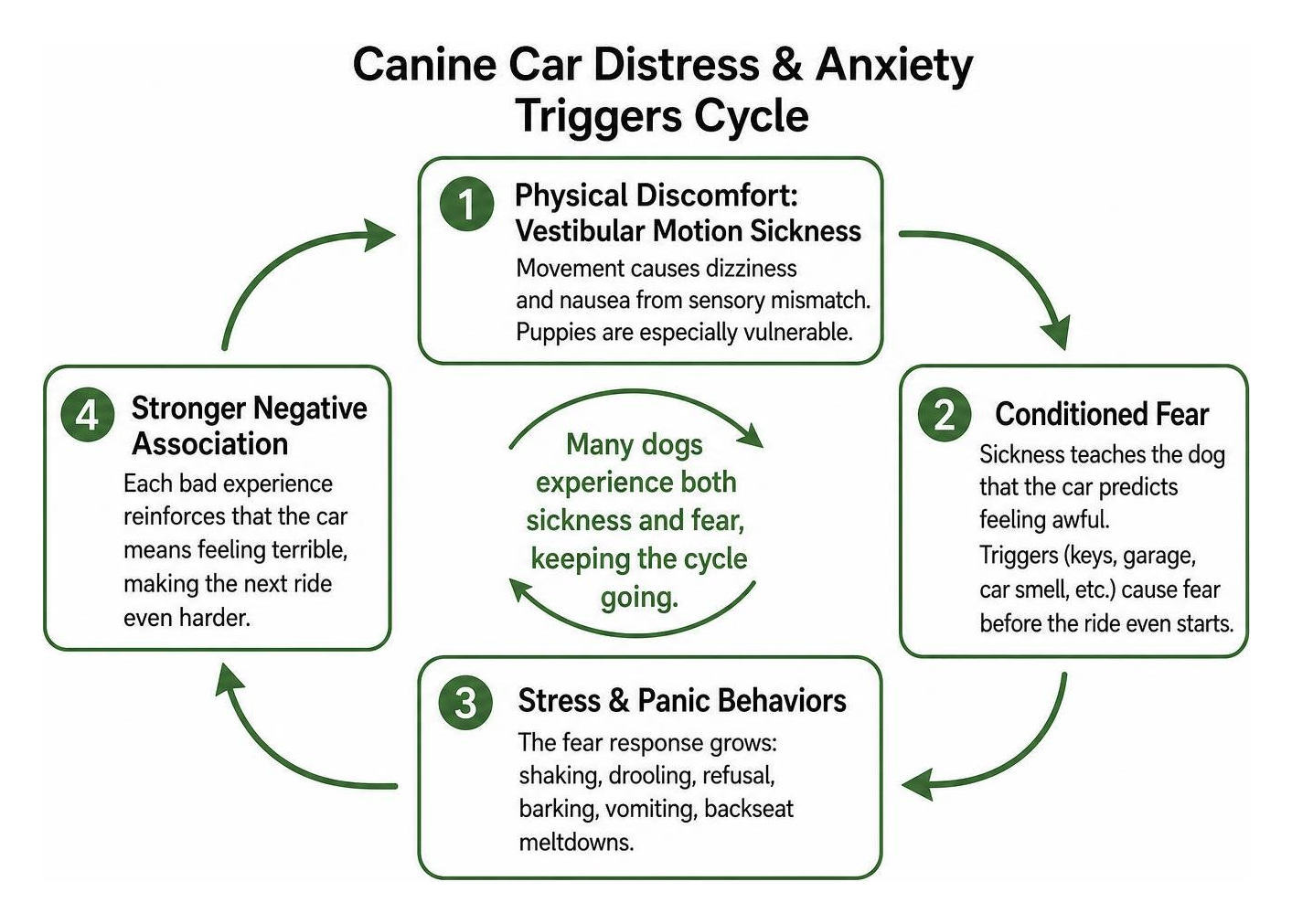
To create a real fix, you must identify what starts the problem. Does your dog panic while standing in the driveway, or do they only start panting and drooling after ten minutes on the highway? Answering this helps us build a plan for calming car rides for dogs that targets the exact root cause.
Early Stress Signs vs Severe Car Panic
Dogs rarely jump straight from calm to full blown panic. They offer subtle warning signals long before they start barking or vomiting. Recognizing these early tells allows you to intervene before your dog crosses their stress threshold.
| Category | Mild Car Stress Signs | Severe Motion Sickness & Panic Signs |
|---|---|---|
| Onset Timing | Driveway, parked car, or first 2 minutes | Mid drive, high speeds, or winding roads |
| Physical Signals | Lip licking, excessive yawning, head turning away | Heavy puddle drooling, dry heaving, vomiting |
| Postural Signs | Stiff body, whale eye, low tail carriage | Whole body trembling, frantic pacing, immobility |
| Behavioral Signals | Hesitation to load, mild whining, ignoring treats | Screaming, clawing at doors, bladder accidents |
| Primary Root Cause | Anticipatory fear, learned negative association | Vestibular mismatch, overwhelming motion nausea |
When stress goes unmanaged, dogs push past their coping limits. If your dog refuses high value food or freezes completely, they are no longer learning. Pushing forward during a panic state only deepens the negative association.
Professional Dog Trainer Advice on Dealing with Car Anxiety
Fixing car fear requires more than just forcing your dog into the back seat and hoping they get used to it. Flooding a dog with overwhelming fear makes the phobia worse. Instead, professional behavior modification relies on clear communication, strong management, structured desensitization, and counter conditioning.
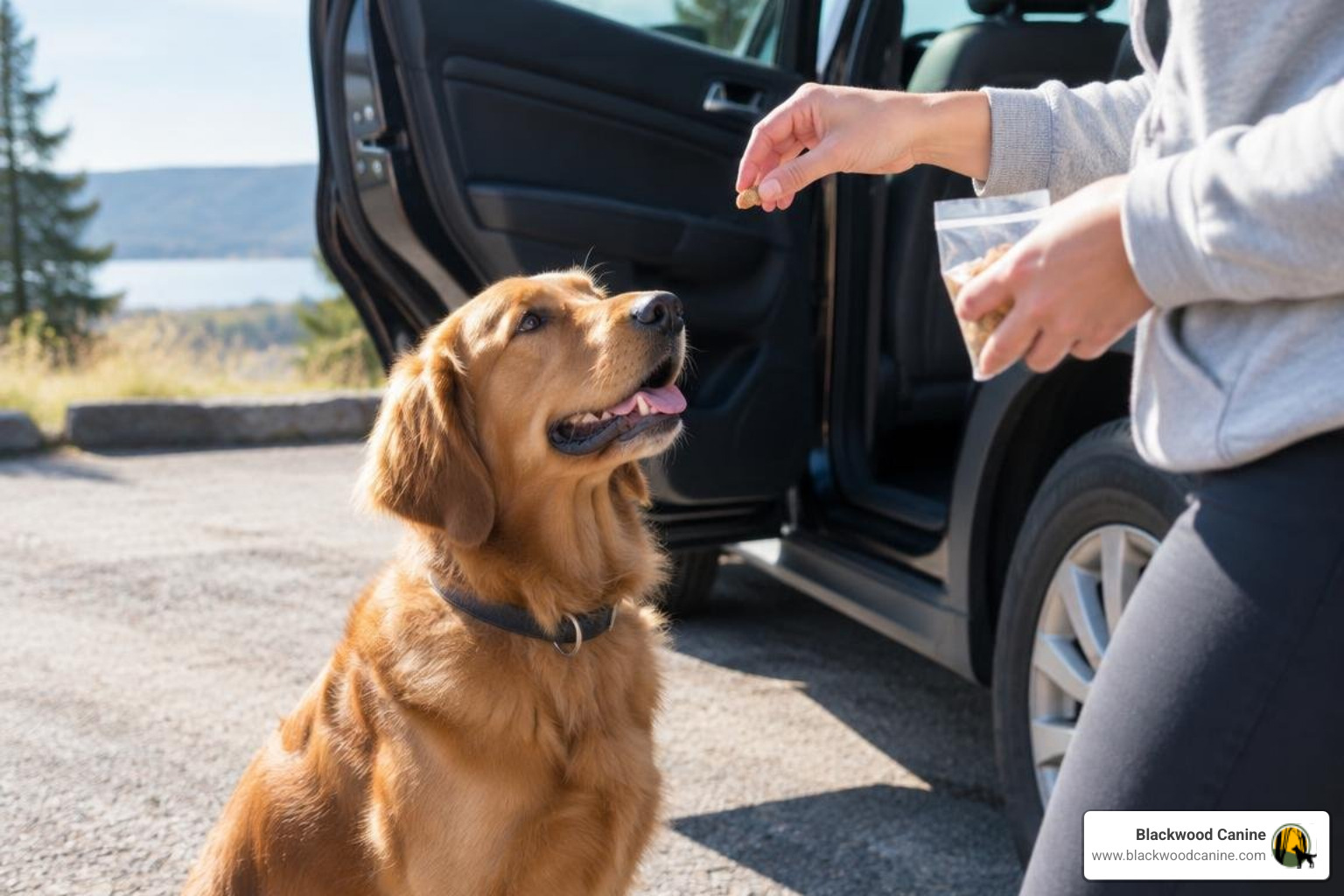
Successful training requires clear expectations, boundaries, consistent management, fair consequences, and owner follow through. We do not rely on purely positive bribing, nor do we use senseless punishment. Tools and corrections have a place in balanced training when used properly under professional guidance, but fear must be reshaped through progressive success. When teaching dog training for fearful dogs, we break large, overwhelming environments into small, manageable pieces.
Dog Trainer Advice on Dealing with Car Anxiety Through Step by Step Desensitization
Desensitization means exposing your dog to the vehicle at an intensity so low that it does not trigger fear. Counter conditioning means changing the emotional response by pairing that low level exposure with high value rewards.
- Approach and Proximity: Walk your dog toward the parked car with the engine off. Stop ten feet away. Reward calm engagement, loose body language, and eye contact. If your dog stays relaxed, feed their regular meals next to the vehicle over several days.
- Stationary Car Habituation: Open the car doors wide. Encourage your dog to hop in freely without closing the doors. Scatter premium treats on the floorboard or seats. Spend five minutes hanging out with the engine completely off, then let the dog exit calmly.
- Engine and Vibration Exposure: Load your dog into their travel spot, secure them, and start the engine without putting the car in gear. The goal is habituating them to the rumble, cabin air flow, and mechanical noise. Offer high value rewards, praise calm breathing, turn the vehicle off, and unload.
- Short Driveway Rollouts: Put the car in gear and roll down the driveway at five miles per hour. Stop, shift to park, reward your dog, and walk back inside.
- Graduated Low Stress Travel: Drive around the block once. Keep the route flat, avoid sudden braking, and return home immediately. Slowly extend your driving radius over multiple weeks as your dog shows zero signs of anxiety.
Applying Dog Trainer Advice on Dealing with Car Anxiety for Visual Overstimulation
Many dogs do not fear the car itself. Instead, they suffer from barrier frustration and sensory overload. Watching cars whiz past at sixty miles per hour or spotting pedestrians they cannot reach sends their arousal through the roof.
You can stop this reaction by managing dog anxiety from car windows through visual management. Use window static cling shades, position crates below window level, or use solid side travel crates to block outside sightlines. If your dog barks aggressively at passing vehicles, explore understanding and transforming reactive dog behavior to address barrier frustration directly. Pair visual barriers with structured boundary work so your dog learns that the vehicle cabin is a resting zone, not an observation deck.
Management Tools and Travel Setup for Anxious Dogs
Letting an anxious dog pace freely across the back seat is dangerous and increases stress. Unstable footing makes motion sickness worse because the dog constantly fights for balance.

A proper travel setup provides physical stability and safety:
- Crash Tested Crates: A durable travel kennel strapped down in an SUV cargo area or across the back seat offers the highest level of physical protection. Crates provide a den like environment that reduces visual triggers and movement sway.
- Crash Tested Harnesses: If a crate does not fit your vehicle, a certified safety harness attached to the seatbelt system keeps your dog secure. Position your dog in the middle of the back seat facing forward, where vehicle sway is minimized.
- Cabin Airflow and Temperature: Stress panting causes dogs to run five to eight degrees hotter than the cabin air. Keep the air conditioning running cool and crack windows slightly to equalize cabin pressure.
- Pheromones and Pressure Wraps: Calming sprays like dog appeasing pheromones and snug pressure shirts can take the edge off mild jitters when combined with training.
- Calming Aids and Supplements: Natural chews containing L theanine, chamomile, or vet approved CBD can lower baseline arousal.
Structured behavior modification training ensures your dog accepts these containment tools without stress. Clear boundaries combined with reliable gear keep everyone safe on the road.
Changing What the Car Predicts: Destination Conditioning
What does your car predict to your dog? For many family pets, getting into the vehicle happens only for vet exams, nail trims, or grooming appointments.
Research reveals that dogs driven exclusively to stressful locations show anxiety at more than double the rate (46.4%) of dogs driven to varied or fun spots (22.7%). When the car always leads to something unpleasant, the ride becomes a trigger.
To break this pattern, take low stress trips that build good memories instead of dread:
- Drive two blocks down the road, let your dog sniff a quiet grassy patch for three minutes, and drive home.
- Take a quick ride to a local drive thru window for a tiny piece of unseasoned plain meat or dog friendly treat.
- Park at a scenic overlook, sit together quietly for five minutes, and return without any high stress events.
By making at least four out of every five trips uneventful or enjoyable, you break the cycle of dread.
Veterinary Support and Medication for Travel Distress
Behavior modification takes time and repetition. If your dog suffers from severe vestibular nausea or reaches extreme panic, training alone cannot fix the issue. A dog in active panic or physical sickness cannot process new learning.
Veterinary intervention can bridge this gap:
- Maropitant Citrate (Cerenia): This prescription medication targets the vomiting center in the brain. It stops motion sickness nausea without causing sedation, making it the top choice for dogs with physical travel sickness.
- Situational Anxiolytics: Medications such as trazodone, gabapentin, or dexmedetomidine oromucosal gel (Sileo) help lower severe panic and anticipatory dread. They allow the dog to stay under their panic threshold during training rides.
- Multi Modal Treatment: Combining anti nausea medication, short term anxiolytics, and gradual desensitization produces the fastest, most reliable long term results.
Talk to your veterinarian if your dog vomits regularly, harms themselves trying to escape, or shows extreme distress. Using temporary medication is not a failure. It is a humane tool that creates a workable baseline for training.
Frequently Asked Questions About Dog Car Anxiety
How long does it take to resolve car anxiety in a dog?
Resolving car anxiety depends on whether the issue is mild nervousness or a severe phobia. Mild jitters often improve in four to six weeks of daily five minute sessions. Severe panic or deep seated trauma can take several months of consistent management, veterinary support, and step by step counter conditioning.
Should I withhold food before taking my dog in the car?
Yes, withholding full meals for two to three hours before travel reduces nausea and vomiting for dogs prone to motion sickness. However, you can still use small, high value training treats during your desensitization exercises if your dog is comfortable enough to eat.
Can puppies naturally outgrow motion sickness and car nervousness?
Many puppies outgrow physical motion sickness by twelve to fourteen months of age as their inner ear structures fully develop. However, they do not automatically outgrow the learned fear caused by early sick rides. You must actively rebuild positive car associations to prevent early nausea from turning into lifelong anxiety.
Next Steps for Peaceful and Safe Travel with Your Dog
Living with a dog that hates the car is stressful. Whether you are driving past Forest Grove, commuting through Beaverton, or taking a weekend trip out to the Oregon coast, car rides should not feel like an emotional battle.
Fixing travel distress requires patience, structure, and consistency. Training is more than just running through commands. It requires clear boundaries, reliable management, fair consequences, and consistent follow through from the owners. When you balance physical comfort with behavioral training, your dog learns that the vehicle is a safe, calm space.
If you are dealing with persistent travel panic, reactivity, or complex behavioral roadblocks, our in home private lessons and structured programs provide the step by step guidance your family needs. Blackwood Canine offers foundational training starting at 4 weeks, with dedicated 6 week and 8 plus week programs for complex behavior modification. We work with dog owners across Scappoose, St. Helens, Warren, Bethany, Hillsboro, Beaverton, Portland, Vancouver, and nearby communities to build reliable, real world clarity.
Take the next step with our Good Dog Game Plan to turn stressful travel into calm, confident adventures. Learn more by exploring our professional reactive dog training and start building a relaxed travel routine today.
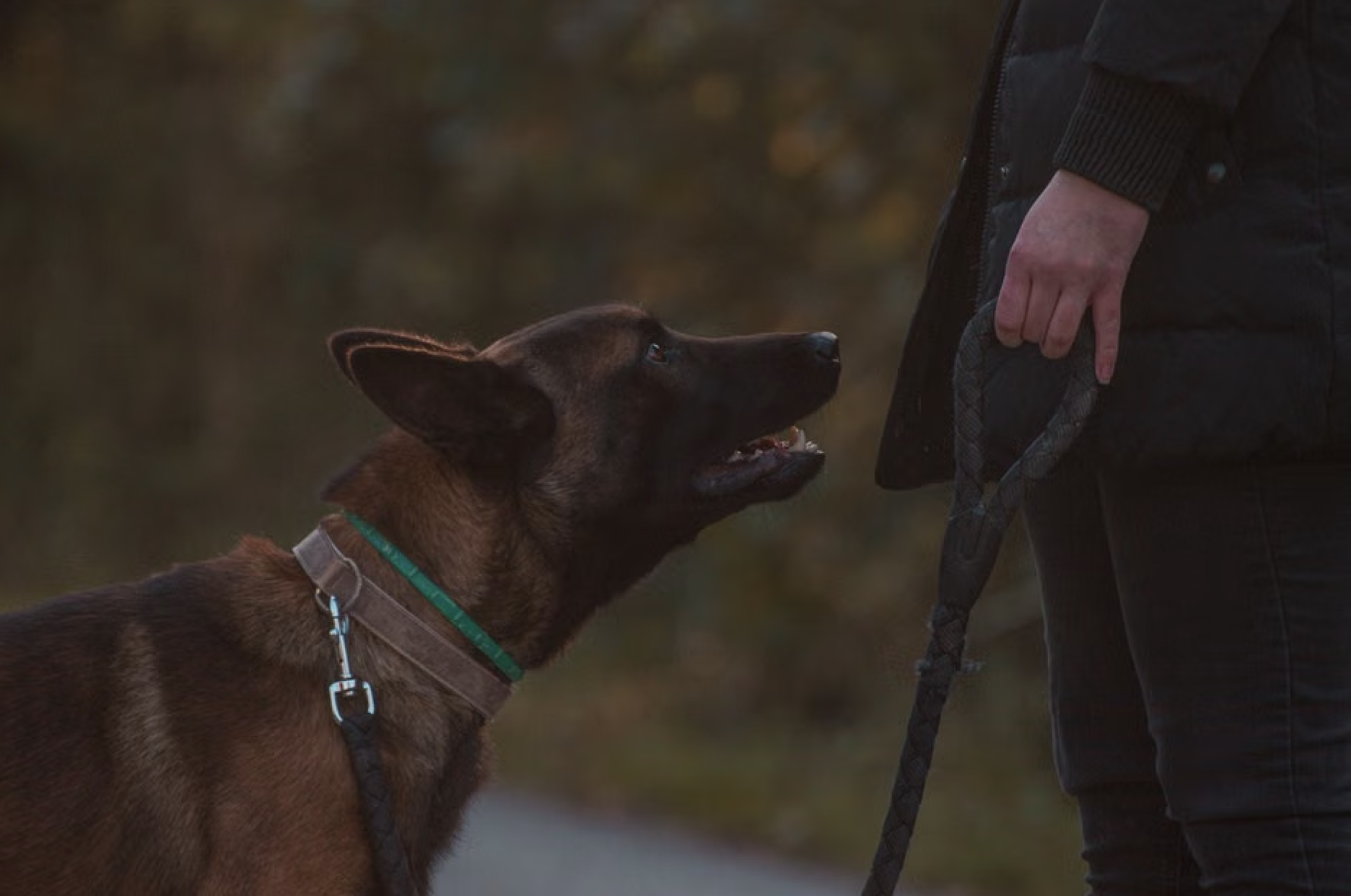
How to Fix the Most Common Dog Behavior Issues
The 3 Pillars of Dog Behavior Problems Solutions

When dogs struggle with big feelings, owners often try random tips they saw online. True progress requires a structured, multi modal framework. According to resources like the Treatment of Behavior Problems in Animals MSD Veterinary Manual, resolving behavior issues relies on three integrated pillars: management, behavior modification, and medical support.
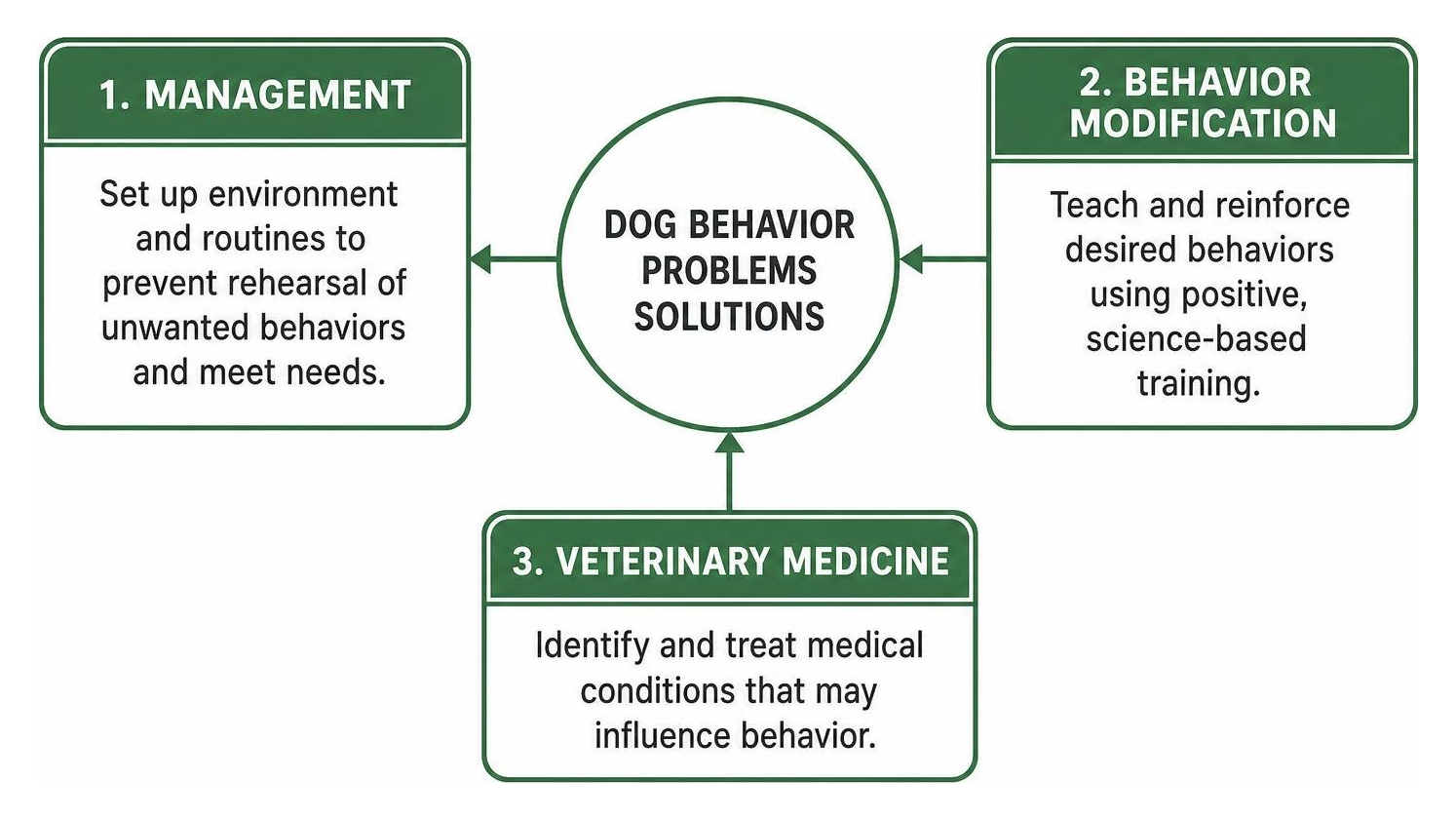
Pillar 1: Environmental Management and Behavioral Needs
Management means setting up your home and daily routine so your dog cannot keep practicing the bad behavior. Every time a dog barks out the window at delivery drivers, lunges on leash, or raids the trash, that neural pathway gets stronger.
Practical management includes:
- Installing window film or closing blinds to block visual triggers.
- Setting up baby gates and exercise pens to prevent door dashing or kitchen counter surfing.
- Creating a quiet safe haven room with white noise for high stress events.
- Meeting biological needs through physical exercise, sniffing walks, and chewing enrichment.
Management does not teach new skills, but it prevents accidents, protects safety, and stops unwanted habits from getting worse while training takes place.
Pillar 2: Evidence Based Behavior Modification Principles
Behavior modification changes how a dog feels about a trigger and teaches them what to do instead. We cover foundational concepts in our dog behavior guide 2026.
Key learning principles include:
- Systematic Desensitization: Exposing your dog to a trigger at a low intensity where they remain relaxed and sub threshold.
- Classical Counterconditioning: Pairing the presence of a trigger with high value rewards so the emotional association changes from scary to positive.
- Response Substitution: Teaching an incompatible behavior, like sitting quietly on a mat instead of jumping on guests.
- Shaping: Rewarding small, progressive steps toward a final target behavior.
- The Premack Principle: Using a high probability behavior, like sniffing a bush or greeting a friend, to reinforce a low probability behavior, like sitting calmly on a loose leash.
Pillar 3: Veterinary Medication as Part of Dog Behavior Problems Solutions
Medication is not a sedative or a shortcut. When a dog lives in a constant state of panic or arousal, their brain cannot process learning. Behavioral pharmacotherapy brings their baseline stress down so behavior modification can take hold, as detailed in the Behavior Problems in Dogs Merck Veterinary Manual.
Veterinarians classify behavior medications into two main categories:
- Baseline Daily Medications: Psychotropic drugs such as Selective Serotonin Reuptake Inhibitors like fluoxetine (FDA approved at 1 to 2 mg per kg once daily) or Tricyclic Antidepressants like clomipramine (FDA approved at 2 to 4 mg per kg once daily) help balance brain chemistry over weeks of consistent use.
- Situational Fast Acting Agents: Medications like dexmedetomidine oral transmucosal gel (FDA approved for noise aversion at 125 mcg per square meter), gabapentin, or clonidine provide rapid support for thunderstorms, vet visits, or specific high stress events.
Adjunctive therapies like dog appeasing pheromone diffusers, L theanine supplements, and alpha casozepine can also provide mild calming support alongside veterinary care.
Proven Solutions for the 6 Most Common Dog Behavior Issues
Every behavior serves a function for the dog. When you understand the underlying cause, you can apply clear expectations, management, reinforcement, and fair consequences.
| Behavior Problem | Common Root Cause | Primary Intervention Strategy |
|---|---|---|
| Leash Reactivity | Fear, frustration, lack of distance | Desensitization, counterconditioning, loose leash focus |
| Separation Distress | Panic over isolation, barrier frustration | Graduated departure training, baseline veterinary medication |
| Resource Guarding | Fear of losing valuable items | Trade up games, low conflict feeding zones |
| Doorbell Barking | Territorial alertness, excitement arousal | Place mat stationing, auditory volume desensitization |
| Jumping on Guests | Overexcitement, reinforced social greeting | Four on the floor rule, sit replacement cue |
| Destructive Chewing | Boredom, teething, isolation stress | Confinement management, redirection to durable chew items |
1. Fear Based Aggression and Leash Reactivity
Aggression accounts for roughly 70 percent of caseloads in veterinary behavior practices. Most leash reactivity stems from fear rather than a desire to dominate. When a dog feels trapped on a six foot leash, barking and lunging are distance increasing behaviors meant to make the scary thing go away.
To resolve leash reactivity, start by identifying your dog's distance threshold. Find the distance where they notice another dog but can still eat treats and look back at you. Pair the sight of other dogs with high value food. Work on loose leash walking mechanics and focus games in low distraction areas before testing public spaces. If you need specialized help, explore reactive dog training and review our guide on what to do when your dog shows aggression to family members or strangers.
2. Separation Anxiety and Isolation Distress
Separation distress involves genuine panic when left alone. Dogs may vocalize, eliminate indoors, or chew doors and window frames.
Addressing isolation distress requires graduated departure training:
- Identify pre departure cues that trigger early anxiety, such as picking up keys, putting on shoes, or grabbing a jacket. Practice these actions repeatedly without leaving the home.
- Keep absences strictly under your dog's panic threshold. Begin with five second departures outside the door and build duration incrementally over time.
- Use remote cameras to monitor body language, watching for pacing, lip licking, and heavy panting.
- Consult your vet early about baseline medications like fluoxetine or clomipramine to reduce panic thresholds, and review Common Dog Behavior Issues for standard behavioral protocols.
3. Resource Guarding and Possessive Aggression
Resource guarding is a natural survival instinct where dogs protect items they find valuable, including food bowls, rawhides, stolen socks, or resting spots.
Never forcibly snatch items from your dog's mouth or punish a warning growl. Punishing a growl teaches a dog not to warn before biting. Instead, practice the trade up game. Approach with a treat that is much more valuable than what the dog currently holds, toss the treat a few feet away, and let them return to their original item after they finish. Feed meals in quiet locations where nobody walks past, and teach a reliable drop cue using positive reinforcement.
4. Excessive Barking and Doorbell Reactivity
Barking at exterior noises or doorbells is reinforced every time the visitor walks away, because the dog assumes their barking chased the intruder off.
Fix this by setting up clear stimulus control:
- Teach a solid stationing cue where the dog runs to a designated place mat and lies down.
- Practice with recorded doorbell sounds played at low volume while feeding treats on the mat.
- Gradually increase the volume over multiple sessions before introducing real door knocks.
- Use positive interruption cues, like an upbeat kiss noise or hand touch, to redirect your dog before their arousal spikes out of control.
5. Inappropriate Jumping and Hyperarousal
Dogs jump to get closer to our faces and because greeting humans is naturally reinforcing. Pushing them away, kneeing them, or yelling often feels like playful attention to an excited dog.
Use the four on the floor rule. All attention, eye contact, and physical touch stop the moment paws leave the ground. Turn your body away and stand neutral. Teach a default sit behavior for greetings. Visitors should only offer affection when the dog has four paws firmly planted. For practical steps on building greeting impulse control, read our advice on dog obedience teaching your dog not to jump up on people.
6. Destructive Chewing and Inappropriate Elimination
Destructive habits often happen when young or bored dogs are given too much freedom too soon. Dogs naturally explore the world with their mouths and need appropriate outlets.
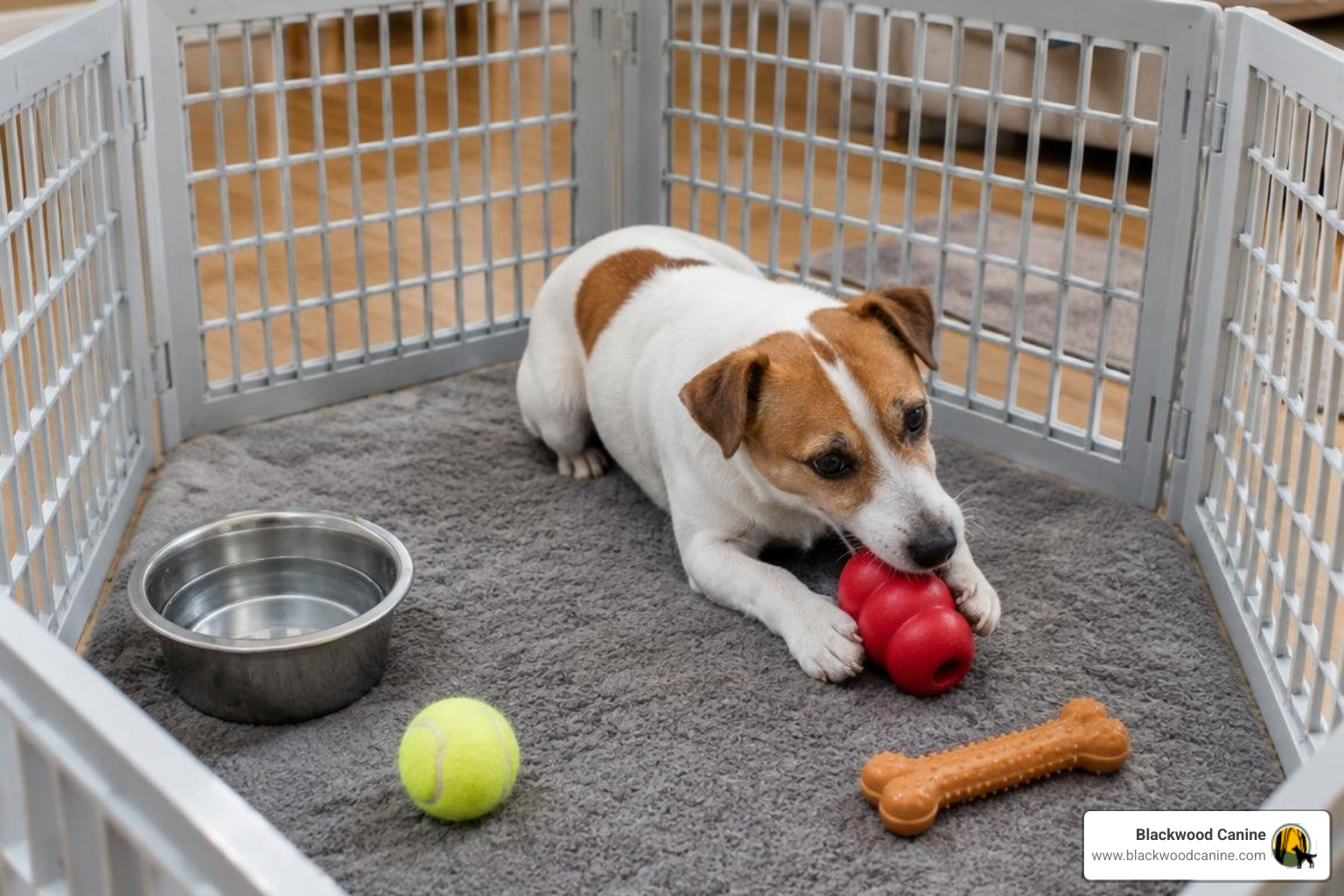
Keep your dog in safe confinement areas or a crate when you cannot actively supervise them. When you catch chewing in real time, calmly interrupt and redirect them to a long lasting chew item or rubber toy. For puppy mouthing protocols, check our tips if is your pup a nipper try these puppy trainer tips to stop biting.
For housetraining, keep a strict schedule for feeding, outdoor potty breaks, and rest. Dogs develop voluntary bladder control around eight and a half weeks of age, but reliable habits require months of consistent supervision. Clean indoor accidents with enzymatic cleaners to remove scent markers, and rule out urinary tract infections or anxiety related elimination with your vet.
Why Punishment and Flooding Worsen Problem Behaviors
Training is not a battle of pure positive against harsh corrections. Balanced training uses clear communication, boundaries, and fair guidance. However, the misuse of intense positive punishment and flooding creates severe fallout.
Flooding forces a dog into direct contact with an overwhelming trigger with no way to escape, hoping they will just get used to it. In reality, flooding often causes learned helplessness or triggers sudden defensive aggression.
Studies show that dogs trained with reward heavy frameworks display significantly fewer behavior problems, less fear, and lower rates of avoidance. Misapplied physical corrections can suppress outward warning signs like growling while leaving the underlying fear untouched, dramatically raising the risk of severe bites. For a deeper breakdown of methodologies, see our guide on dog training methods positive reinforcement vs dominance training. When tools or consequences are used, they must be applied with fair timing, clear criteria, and professional guidance.
Ruling Out Hidden Pain and Medical Causes of Behavior Issues
You cannot train away a medical problem. Clinical studies among veterinary behaviorists show that between 28 percent and 82 percent of patients evaluated for behavior issues demonstrate underlying signs of pain.
Common medical contributors to behavior problems include:
- Orthopedic conditions like hip dysplasia, cruciate tears, and osteoarthritis.
- Spinal discomfort and intervertebral disc disease.
- Endocrine disorders such as hypothyroidism or Cushing's disease.
- Dental pain, ear infections, and gastrointestinal irritation.
- Sensory loss, including progressive blindness or hearing loss in aging dogs.
- Canine Cognitive Dysfunction Syndrome, which causes disorientation, sleep changes, and house soiling in senior pets.
Before assuming a dog is willful or stubborn, schedule a comprehensive physical exam with your veterinarian. If complex aggression, severe phobias, or compulsive stereotypies persist, seek a referral to a board certified veterinary behaviorist as outlined in the Behavior Modification in Dogs MSD Veterinary Manual.
Frequently Asked Questions About Canine Behavior
What Are the Most Effective Dog Behavior Problems Solutions for Fearful Dogs?
The most effective approach for fearful dogs involves sub threshold exposure, predictable routines, and high value reinforcement. Never force a scared dog toward a trigger. Give them space to retreat, reward voluntary curiosity, and let them decompress at their own pace. Review our specialized guide on dog training for fearful dogs to help timid dogs gain confidence.
How can owners distinguish normal undesirable habits from abnormal disorders?
Normal undesirable behaviors are natural canine habits like barking at a cat or chewing a cardboard box that happen at inconvenient times but can be easily redirected. Abnormal disorders involve extreme emotional distress, dangerous escalation, long recovery times after a trigger, compulsive behaviors, or intense panic that prevents the dog from eating and resting.
Can adult and senior dogs overcome severe behavioral challenges?
Yes. Dogs retain neural plasticity throughout their lives. Older dogs can learn new coping mechanisms and routines when given consistent expectations, patience, and appropriate medical support for joint discomfort or cognitive decline.
Rebuilding Peace and Confidence with Your Dog
Living with a reactive, anxious, or destructive dog can leave you feeling exhausted and embarrassed. Real progress does not happen through quick fixes or confusing internet debates. It happens through clear communication, solid management, structured boundaries, fair consequences, and owner consistency.
At Blackwood Canine, we provide hands on coaching and immersion programs for owners across Portland, Hillsboro, Beaverton, Scappoose, St. Helens, and Vancouver. Our basic obedience foundation training starts at 4 weeks, and we offer 6 week and 8 plus week timelines for complex behavior modification. We do not offer training programs shorter than 4 weeks because building real habits takes dedicated repetition and follow through.
If you are ready to stop managing daily stress and start making measurable progress, explore our behavior modification training programs and schedule your Good Dog Game Plan consultation today.

The Foolproof Potty Schedule for a 6-Month-Old Puppy
A Practical 6 Month Old Puppy Potty Schedule That Prevents Accidents

If your six month old puppy is still leaving surprise puddles on the rug, the fix is usually not more scolding. It is tighter timing and less unsupervised freedom. A solid 6 month old puppy potty schedule means taking your puppy out 4 to 6 times daily, plus immediately after waking, meals, naps, big drinks, crate time, and hard play.
A simple daily rhythm looks like this:
- First thing in the morning
- After breakfast
- Midday
- Late afternoon
- After dinner or evening activity
- Right before bed
Most healthy puppies this age can physically hold it about 5 to 7 hours, but that is a limit, not a target. During the day, offer a potty trip every 3 to 5 hours while you rebuild reliable habits. At six months, adolescence can make a puppy suddenly forget what they seemed to know. Very convenient. Very puppy.
I am David Wright. After years of hands on dog training and an apprenticeship under an experienced trainer, I have helped owners simplify the routines behind a reliable 6 month old puppy potty schedule so their dogs can succeed at home, not just during training.
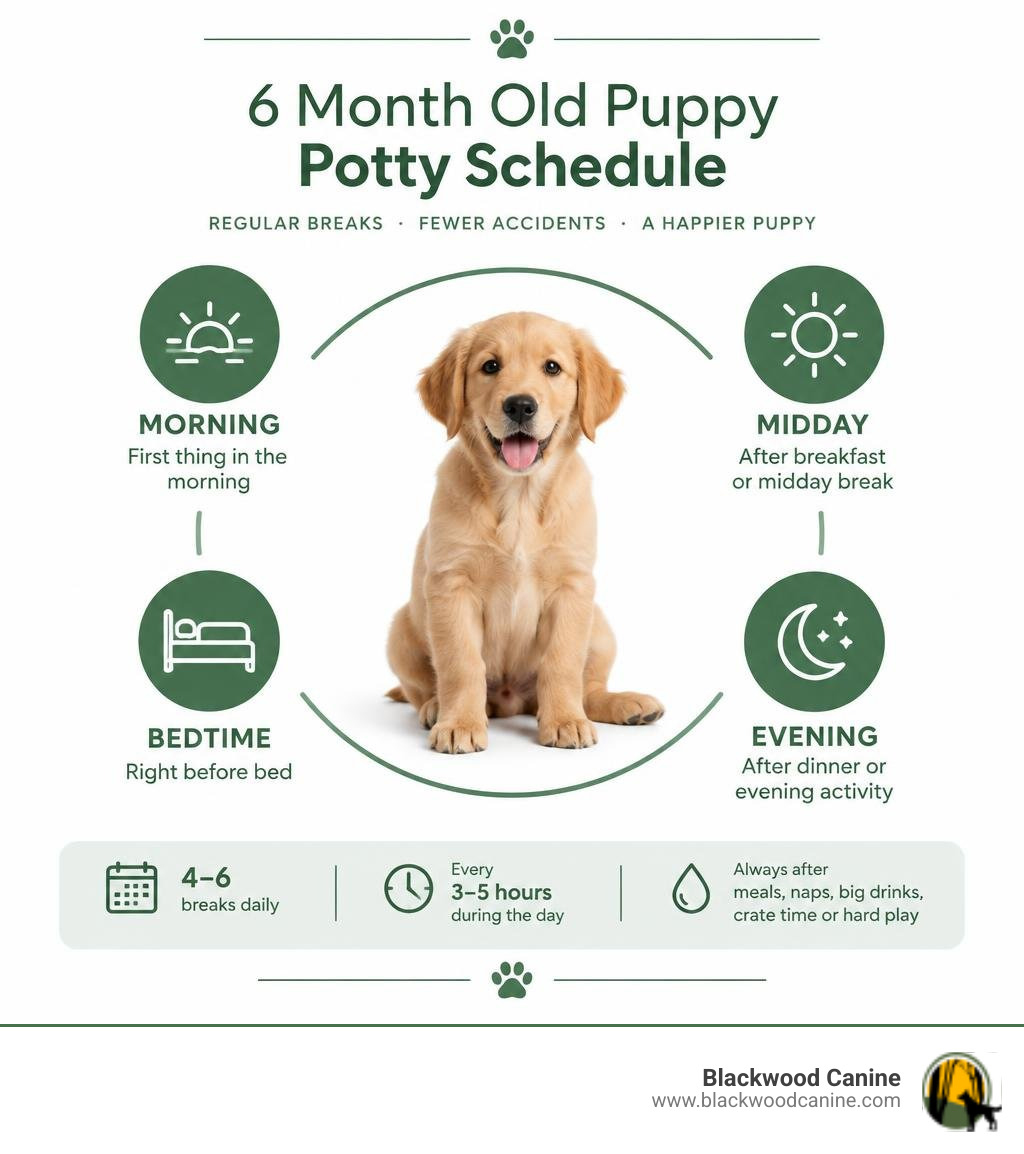
How Puppy Bladder Capacity Works at 6 Months
By half a year of life, your puppy is undergoing massive physical changes. The tiny bladder that could barely hold water for an hour during early puppyhood is now backed by stronger sphincter muscles and greater biological maturity.
Physiological control during the daytime is vastly different from nighttime rest. When a dog sleeps, their metabolic rate slows down, meaning urine production drops and holding urine for seven or eight hours overnight becomes routine. Daytime holding capacity depends directly on movement, excitement, water intake, and mental focus. If an adolescent pup is zooming around the living room, their system produces waste far faster than when they are resting.
Understanding Bladder Biology and the Month Plus One Rule
A common formula used by dog professionals is the month plus one rule. This simple guideline calculates a puppy's maximum holding window by taking their age in months and adding one. According to this math, a six month old pup can physically manage around seven hours under quiet conditions. In real world terms, most veterinarians and trainers cap waking daytime holding capacity between five and seven hours.
Understanding a true schedule helps dog owners realize that holding capacity represents a physical ceiling, never an everyday goal. While your dog might be biologically capable of holding urine for six hours, asking them to do so regularly while awake invites failure. Keeping daytime outings spaced every three to five hours protects muscle tone, prevents discomfort, and removes the pressure that leads to indoor mistakes.
Evolution from a 3 Month to a 6 Month Old Puppy Potty Schedule
Reflecting on your dog's growth shows just how far their physical stamina has advanced. When looking back at progressing from a 3 month old puppy schedule, a young puppy needed immediate relief every two to three hours and had zero margin for delay.
As your dog matured through sixteen weeks, you were likely comparing milestones with a 4 month puppy schedule guide, where bathroom trips dropped to roughly six to eight times per day. By nine months, most canines settle into their adult groove of three to four daily outdoor breaks.
| Age | Daytime Potty Frequency | Max Awake Bladder Capacity | Typical Overnight Sleep |
|---|---|---|---|
| 3 Months | Every 2 to 3 hours (8-10 trips/day) | 3 to 4 hours | 6 to 7 hours (possible night break) |
| 6 Months | Every 3 to 5 hours (4-6 trips/day) | 5 to 7 hours | 8 hours (fully through the night) |
| 9 Months | Every 4 to 6 hours (3-4 trips/day) | 7 to 8 hours | 8+ hours (adult baseline) |
The Ultimate Daily 6 Month Old Puppy Potty Schedule
A predictable framework creates reliable house habits. When your dog knows exactly when their next opportunity to eliminate outside is coming, their internal clock stabilizes.
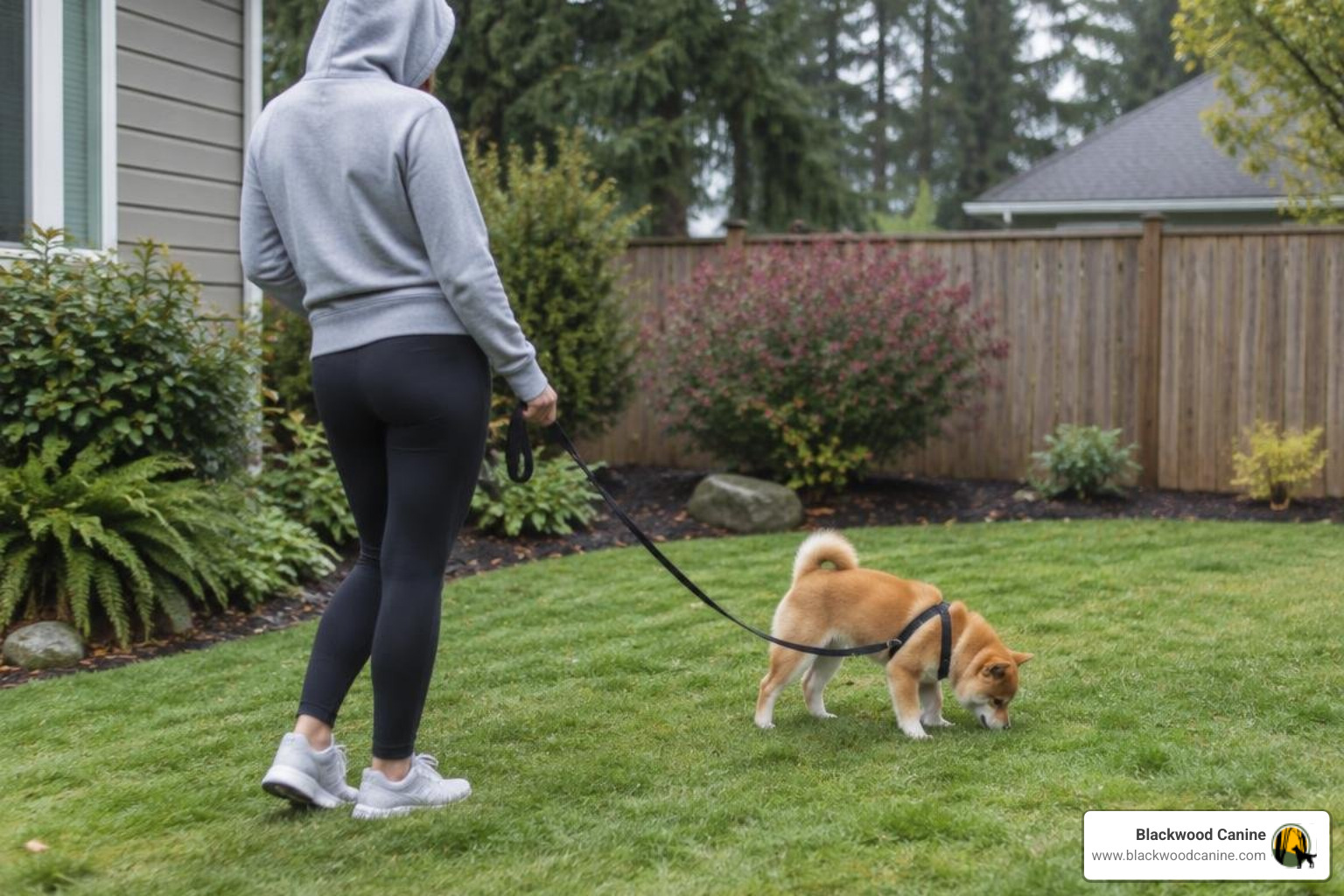
Morning, Midday, and Evening Potty Routines
Here is an effective daily template built for busy households that balances potty outings, feeding windows, and mental structure:
- 6:30 AM – Morning Wake Up Outing: Straight out of the crate or sleeping area to the designated outdoor potty spot on a leash. Give clear praise and immediate reward once they finish.
- 7:00 AM – Breakfast: Serve morning meal. Allow moderate access to water.
- 7:30 AM – Post Breakfast Outing: Take the pup outside roughly twenty to thirty minutes after eating to account for natural gastrointestinal activation.
- 8:00 AM to 12:00 PM – Rest or Structured Downtime: Pup rests in their crate or a secure indoor pen while you work or handle morning tasks.
- 12:00 PM – Midday Relief and Walk: A solid thirty minute outdoor break including a dedicated potty trip and structured leash walking.
- 12:45 PM to 4:30 PM – Afternoon Rest: Supervised rest period or quiet chew time.
- 4:30 PM – Late Afternoon Outing: Quick relief trip before evening household activity ramps up.
- 5:30 PM – Dinner: Evening meal served on a clean, predictable schedule.
- 6:00 PM – Post Dinner Outing: Outdoor potty break to clear digestion from the evening meal.
- 6:30 PM to 9:30 PM – Supervised Family Time: Supervised free time in active living areas. Keep eyes on your pup or use a drag leash to prevent sneaking off into quiet bedrooms.
- 10:00 PM – Final Bedtime Potty: Final leash trip to empty the bladder completely before lights out.
If you want a customized setup tailored around your family's exact work hours, building routines with a housebreaking schedule generator is a great way to map out specific daily checkpoints.
Transitioning Meals and Adjusting the 6 Month Old Puppy Potty Schedule
Around six months of age, most puppies are ready to transition from three daily meals down to two. Dropping the midday lunch simplifies your daily schedule and makes bowel movements significantly more predictable.
Eating triggers the gastrocolic reflex, an automatic physiological response where filling the stomach stimulates contractions in the lower digestive tract. By feeding exclusively at morning and evening intervals, you create two distinct, predictable digestion windows.
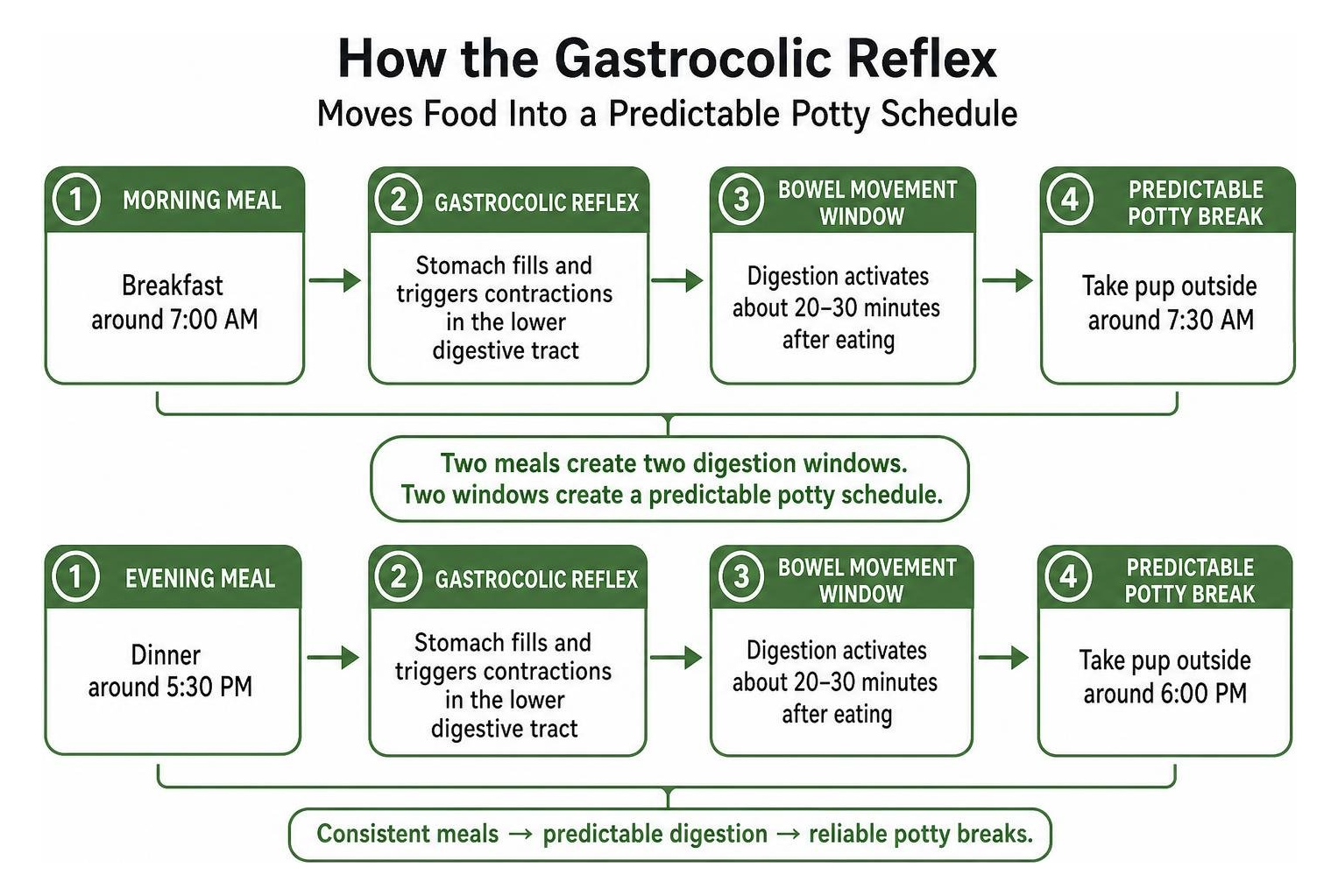
Water management is equally vital in the evening hours. Keep water freely accessible throughout the active day, but consider picking up the water bowl about two hours before the final bedtime trip. This allows your pup to fully process fluids, aligning their night habits with a healthy 5 month old puppy sleep guide routine so everyone sleeps soundly until morning.
Recognizing Potty Cues and Crate Training at 6 Months
Even with a steady clock schedule, your dog will occasionally have to eliminate off rhythm. Catching these moments requires reading subtle body language before an accident starts.
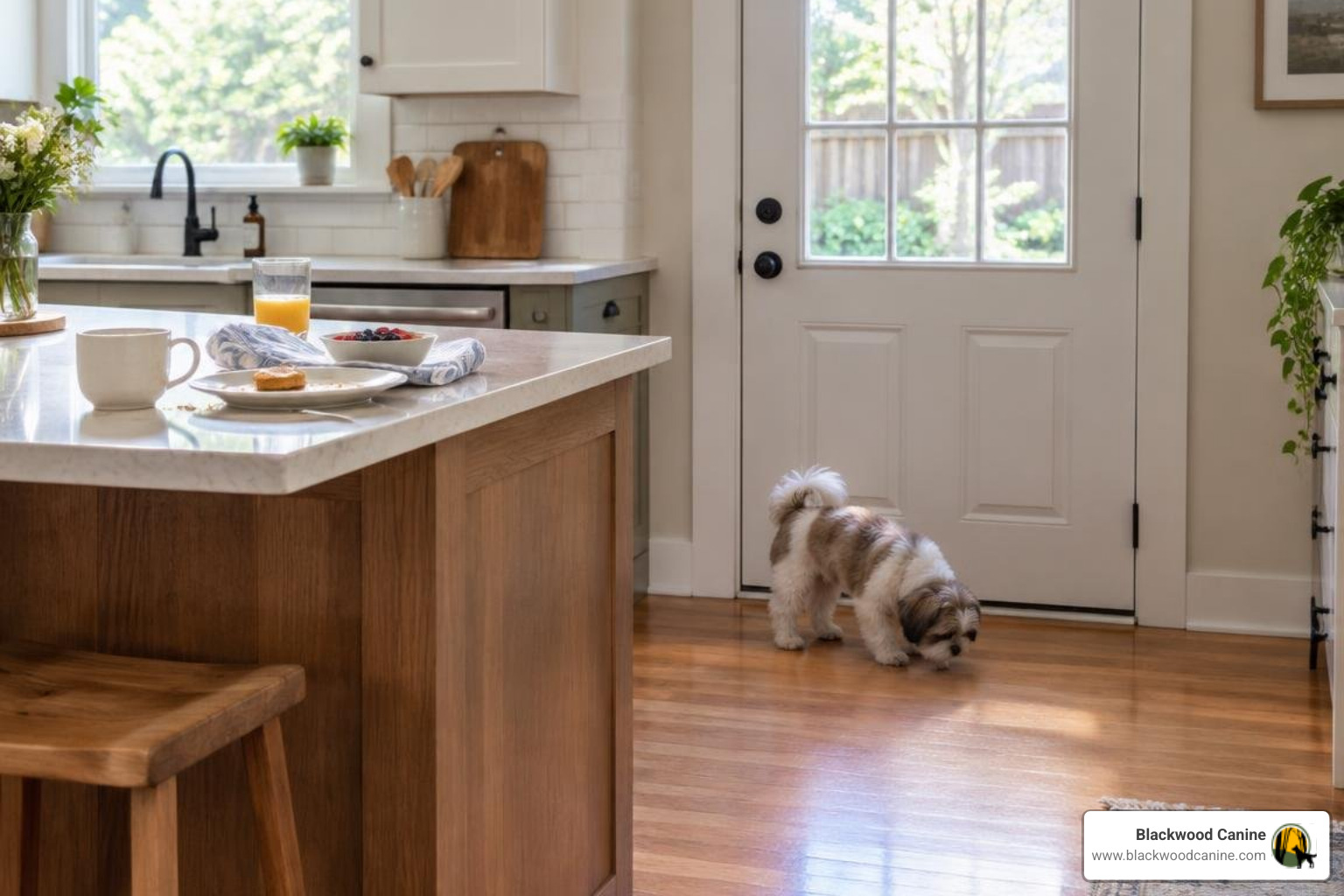
Subtle Body Language and Elimination Signs
Younger puppies tend to drop and go without warning. Six month old adolescent dogs give clearer body language clues if you know what to watch for:
- Sudden Sniffing: Abruptly dropping their nose to the floor and investigating rugs or baseboards with intense focus.
- Tight Circling: Walking in small, tight loops in corners or behind furniture.
- Disengaging from Play: Suddenly abandoning a favorite toy or wrestling match to wander away silently into another room.
- Door Guarding: Standing stiffly by back doors or pacing near exit points.
- Restless Vocalization: Low whining or pacing while looking between you and the hallway.
Many owners choose to pair these natural alerts with door bells or simple cues. If you want a straightforward blueprint for setting up these habits, review these proven steps for an easy way to potty train a puppy.
Smart Crate Routines and Safe Holding Limits
A crate is an essential management tool that relies on a dog's instinctive desire to keep their resting space clean. At six months old, a crate provides a safe holding zone for four to six hours during the day.
Proper sizing is critical. If a crate is too large, a puppy will happily soil one corner and sleep soundly in the other. The crate should offer just enough space for your dog to stand up, turn around naturally, and lie flat on their side.
Never use crate confinement as an emotional punishment. It should always remain a calm resting den where your dog receives tasty long lasting chews and peaceful downtime. Misuse of training tools is where problems start, which is why confinement spaces should always be used thoughtfully and paired with adequate exercise and fair bathroom breaks. Training methods and tools should always be used under professional guidance.
Troubleshooting Accidents and Adolescent Setbacks
Just when everything seems to be running on cruise control, the six month mark hits, bringing teenage rebellion right along with it.
Handling the 6 Month Teenage Regression
Adolescence causes a surge of reproductive hormones and rapid mental shifts. Puppies that were dependable at five months might suddenly stare at you blankly when asked to go outside, or lose focus entirely because an interesting bird flew past the fence.
This regression is not spite; it is simply developmental brain fog. When training stalls, avoid turning routines into emotional battles. Owners often fall into traps like scolding past mistakes or offering excessive unearned freedom. Checking what dog trainers say not to do when training a new puppy can keep your responses productive. If you are navigating life in the Pacific Northwest, these tips on bringing home a puppy in Portland offer realistic perspective on seasonal management and outdoor routines.
Cleaning Mistakes and Resetting House Rules
When indoor accidents happen, how you respond determines how fast your puppy recovers reliability:
- Clean with Enzymatic Cleaners: Standard household soaps leave behind microscopic urea crystals. To a dog's sharp nose, that spot remains a designated bathroom. Use a true enzymatic cleaner to eliminate the scent markers completely.
- Apply the Three Second Reward Window: Deliver high value rewards and calm praise outside within three seconds of your dog finishing their business on the grass. Rewarding them after you walk back into the kitchen only rewards them for walking through the doorway.
- Tighten Indoor Supervision: If accidents pop up, temporarily reduce unsupervised roaming. Keep your dog in the same room with you, use baby gates, or tether them nearby on a light leash.
Establishing reliable household harmony means reinforcing clear communication and consistent boundaries. You can easily reset daily expectations using 3 things you can do to have a well mannered puppy.
Frequently Asked Questions About 6 Month Old Puppy Housebreaking
How long can a 6 month old puppy hold its bladder during the day?
Most healthy six month old puppies can hold their bladder for five to seven hours under calm, restful conditions. When your pup is awake, playing, or drinking heavily, provide outdoor relief every three to five hours to ensure success.
What should I do if my 6 month old puppy suddenly starts having accidents?
First, rule out physical medical issues with your veterinarian, such as urinary tract infections or digestive bugs. If health is clear, treat the setback as an adolescent regression. Restrict unsupervised house roaming, return to a strict feeding and water schedule, and supervise them closely until outdoor consistency returns.
Should a 6 month old puppy still be crated overnight for potty training?
If your dog is fully accident free and settles quietly without wandering or chewing furniture, you can slowly test giving them access to a secure dog bed in your bedroom. If they still pace, chew, or have nighttime accidents, crating overnight provides clear boundaries that prevent mistakes while you sleep.
Building Lasting Habits for a Clean and Calm Home
Potty training an adolescent dog is less about tricky secrets and far more about daily consistency, clear communication, and solid management. A great routine eliminates guesswork for your dog, while fair boundaries and immediate rewards show them exactly how to succeed in your home.
If you are a busy dog owner in Scappoose, St. Helens, Warren, Bethany, Hillsboro, Beaverton, Portland, or Vancouver feeling frustrated by teenage setbacks, you do not have to figure it out alone. At Blackwood Canine, we believe successful training is built on practical routines, clear expectations, fair consequences, and follow through.
Our basic obedience foundation training starts at four weeks of dedicated work, and we use six week and eight plus week timelines for complex behavior modification to help you establish dependable, real world reliability.
When you are ready to stop cleaning up messes and start enjoying a confident, well mannered companion, getting your personalized Good Dog Game Plan through our puppy jump start program is the best next step. Reach out to our team today, and let us help you build a clean, calm daily routine that works for your whole household.
Finding the Best Overnight and Long Term Dog Boarding in Portland
Understanding Private Dog Boarding Portland Options vs Traditional Kennels

Finding safe overnight lodging for your dog can feel stressful when your pup has specific quirks, high arousal levels, or social sensitivities. The right environment makes all the difference. In Portland, pet parents have access to standard commercial facilities, group play settings, and dedicated private suites. For a broader look at how boarding fits into your dog's overall routine, the American Kennel Club offers practical guidance on preparing for a boarding stay.
| Feature | Standard Commercial Kennels | Cage Free Group Lodging | Private Suites / Solo Care |
|---|---|---|---|
| Nightly Rates | $45 to $65 | $70 to $90 | $90 to $120+ |
| Living Space | Chain link or glass run | Open common rooms | Private individual suite or crate |
| Noise Levels | High, frequent barking | Moderate to high activity | Low to soundproofed zones |
| Social Structure | Rotational yard turns | Continuous pack interaction | Solo playtime and one on one staff care |
| Best For | Confident, easygoing dogs | Highly social, playful dogs | Anxious, reactive, intact, or senior dogs |
Understanding these categories helps you protect your dog from sensory overload while you travel.
Traditional Facilities vs Private Dog Boarding Portland
Traditional facilities often rely on rows of adjacent runs. While this model works for easygoing dogs, the close proximity to unfamiliar dogs can trigger barrier frustration, fence fighting, and nonstop vocalization.
Private boarding removes the chaotic communal energy. Instead of facing a row of barking neighbors, dogs rest inside individual rooms or crates with solid walls, visual barriers, and dedicated climate control. This sense of security drastically reduces kennel stress. Dogs receive one on one attention from handlers during bathroom breaks, meals, and solo yard time rather than navigating complex group dynamics.
Cage Free and Home Style Boarding Environments
Cage free facilities let dogs mingle in open indoor and outdoor spaces throughout the day. Some operate in large commercial buildings, while others offer home style lodging in residential properties.
While free roam setups sound appealing, they are not suitable for every dog. Constant multi dog dynamics require exceptional social tolerance. A good cage free facility maintains round the clock staffing, strictly enforces clear boundaries, and provides designated rest zones so dogs do not become overtired or reactive.
Key Benefits of Individualized Care for Anxious and Special Needs Dogs
Dogs dealing with fear or chronic stress often unravel in high volume facilities. Anxious dogs thrive on predictable schedules, low noise, and minimal visual triggers. When dogs receive individualized handling, caretakers can focus entirely on reading subtle stress signals, monitoring food intake, and providing calm companionship. Pet parents working through fear issues often integrate dog training for fearful dogs at home to build baseline confidence before planning an extended boarding stay.
Accommodations for Reactive or High Drive Dogs
High drive working dogs and reactive pups struggle when forced to look at strange dogs all day. A private suite creates a safe spatial buffer. Handlers can route the dog through private hallways directly to solo exercise yards, preventing unexpected hallway encounters.

When boarding a dog with intense reactions, pairing your management plan with structured reactive dog training ensures your dog understands fundamental leash handling and handler focus when navigating new facilities.
Senior Dogs and Medical Support
Aging dogs need physical comfort and quiet rest. Private boarding suites frequently offer orthopedic bedding, traction flooring for arthritic joints, and climate controlled rooms that shield older dogs from excessive drafts.
Facilities offering dedicated private services can easily manage strict medication schedules, including insulin injections, heart medications, and joint supplements. Handlers monitor senior water consumption and mobility daily, coordinating directly with local veterinary clinics if an older dog shows signs of distress.
Typical Costs, Requirements, and Policies in the Portland Metro Area
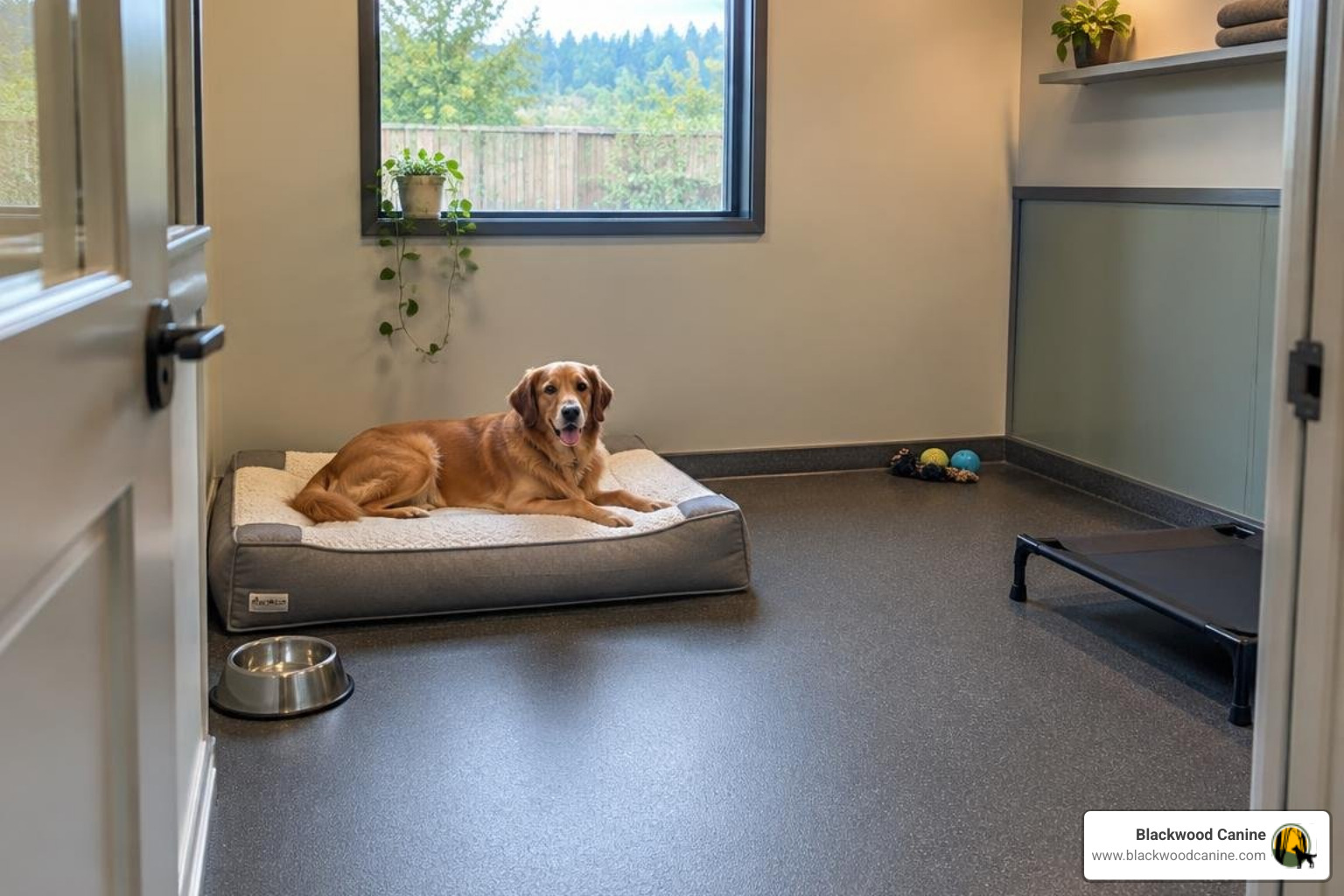
Pricing and availability across the Pacific Northwest reflect the high demand for specialized pet care. Pet owners in Beaverton and Hillsboro will find similar pricing structures to downtown Portland facilities, with slight adjustments based on suite size and included amenities.
Average Pricing for Private Dog Boarding Portland
Nightly base rates for standard boarding in the area start around $60 to $70. Upgrading to a private suite with extra square footage, sound dampening, or webcam access typically pushes the cost to $90 to $120 per night.
Facilities often charge extra for customized add ons:
- Daily photo updates: $8 per day
- One on one play sessions: $18 per session
- Medication administration: Complimentary for basic pills up to two doses, or $8 per day for complex regimens
- Orthopedic bed rental: $12 per night
- Holiday surcharges: $10 per night
Many providers require a 50 percent deposit upon booking and enforce two to three night minimums during peak holiday periods. Some businesses offer a 10 percent discount for stays exceeding five nights or for first responders, teachers, and military personnel.
Vaccination Protocols and Temperament Evaluations
Reputable facilities enforce strict medical standards to protect all guests. You must provide official veterinary records confirming:
- Rabies vaccination
- DHPP (Distemper, Hepatitis, Parvovirus, Parainfluenza)
- Bordetella (often required within the last six to twelve months)
- Active flea and tick preventative coverage
Before booking an extended private stay, facilities usually schedule a mandatory meet and greet or trial day. This visit allows staff to evaluate how your dog handles being handled by strangers, entering a suite, and resting quietly without exhibiting extreme panic or destructive behaviors.
Preparing Your Pup: What to Pack and What to Expect for Check In
Proper preparation prevents digestive upset and helps your dog settle into their temporary routine quickly. Bring clearly labeled items and keep personal belongings focused on essential needs:
- Enough dog food for their stay, plus a bit more for just in case.
- Clear written instructions detailing meal times and exact medication dosages
- A secure, flat collar or slip lead and an up to date identification tag
- Any required veterinary contact details and emergency contact authorizations
Drop Off and Pick Up Logistics
Most facilities operate structured check in windows between 7:00 AM and noon on weekdays, with shortened weekend hours. Checking your dog in during the morning gives them ample time to explore their suite, complete an initial potty turn, and decompress before nighttime lights out.
Late checkouts past noon usually trigger a day care fee or a flat late fee around $20 to $25. Make sure to confirm whether curbside drop off is available if your dog struggles with excitement or reactivity in busy lobby areas.
Emergency Preparedness and On Site Safety
A quality facility maintains rigorous safety standards. Ask if the facility has 24/7 on site staffing or relies on remote camera monitoring after hours. Commercial grade smoke detectors, backup power generators, secure perimeter fencing, and established evacuation plans are essential. The staff should have clear protocols for transporting a sick or injured dog to an emergency veterinary hospital immediately if urgent care is required.
Frequently Asked Questions About Overnight Dog Care
What is the cancellation policy for holiday boarding reservations in 2026?
Holiday boarding fills months in advance. Most facilities require cancellations at least ten days prior to the reservation date to receive a full refund of your deposit. Cancellations made within two to nine days often forfeit the deposit or incur a single night charge, while cancellations within 48 hours are charged the full reservation balance.
How do private facilities handle dogs with severe separation anxiety?
Private facilities manage separation distress by pairing dogs with calm, confident handlers for one on one exercise, providing enrichment toys like frozen stuffed Kongs, and housing them in quiet, low traffic rooms.
Can intact dogs or dogs requiring specialized care be accommodated in private boarding?
Yes. Intact males and females are generally accepted in private boarding suites because they do not participate in group play. Intact dogs over seven months must remain on solo exercise schedules. If a female enters her heat cycle during a stay, facilities typically apply an additional daily sanitation fee to manage the extra cleaning requirements.
Choosing the Right Care for Your Dog’s Peace of Mind
Selecting the right boarding setup comes down to knowing your dog's true behavioral baseline and social tolerance. If your dog gets overwhelmed by noise, guards resources, or struggles around strange dogs, placing them in a crowded group room is a recipe for regression. A private suite provides the quiet sanctuary they need to rest safely while you are away.
If you find that your dog's reactivity, anxiety, or lack of basic manners makes travel and boarding a recurring headache, boarding alone will not fix the underlying communication gaps. A reliable boarding stay relies on clear expectations, reliable impulse control, and mutual trust. When you are ready to build real stability and confidence in your dog, an immersion dog training program can lay the structural groundwork your dog needs to navigate new environments calmly and successfully.

How to Master Your 5-Month-Old Puppy's Sleep and Crate Schedule
How Sleep Needs Change: The 5 Month Old Puppy Sleep Schedule Explained

Puppies at five months sit in a unique developmental pocket. They are no longer the sleepy babies who crashed after twenty minutes of sniffing grass, but they are not adult dogs either. A typical five month old puppy needs roughly 15 to 17 hours of sleep every 24 hours to support rapid bone growth, muscle repair, and central nervous system development.
During deep sleep, the canine brain releases vital growth hormones and organizes new memories from training sessions. Without enough deep rest, your puppy cannot properly process what they learned earlier in the day. Understanding how puppy sleep patterns and hours change across developmental phases helps you set realistic expectations for their daily stamina.
| Age Stage | Total Daily Sleep Needed | Average Wake Window | Typical Nap Frequency |
|---|---|---|---|
| 8 to 10 Weeks | 18 to 20 Hours | 45 to 60 Minutes | 4 to 6 Naps Daily |
| 10 to 12 Weeks | 18 to 19 Hours | 60 to 75 Minutes | 4 to 5 Naps Daily |
| 3 to 4 Months | 16 to 18 Hours | 1.5 to 2 Hours | 3 to 4 Naps Daily |
| 5 to 6 Months | 15 to 17 Hours | 2 to 3 Hours | 2 to 3 Naps Daily |
| Adult (1+ Years) | 12 to 14 Hours | Variable | Natural Rest Cycles |
Adult dogs thrive on 12 to 14 hours of rest, while your five month old still requires several dedicated daytime sleep blocks to prevent physical and mental burnout.
Awake Windows vs. Nap Length in a 5 Month Old Puppy Sleep Schedule
The biggest change from our earlier 4 month puppy schedule guide is the expansion of the awake window. At five months, most pups can stay happily awake for 2 to 3 hours at a time.
During these awake windows, your pup gets fed, goes outside to relieve themselves, works through obedience drills, and engages in physical play. Once that two to three hour mark hits, their nervous system begins to fatigue. Naps should ideally run for 1.5 to 2 hours in an area free from foot traffic so your pup enters deep, restorative rapid eye movement sleep.
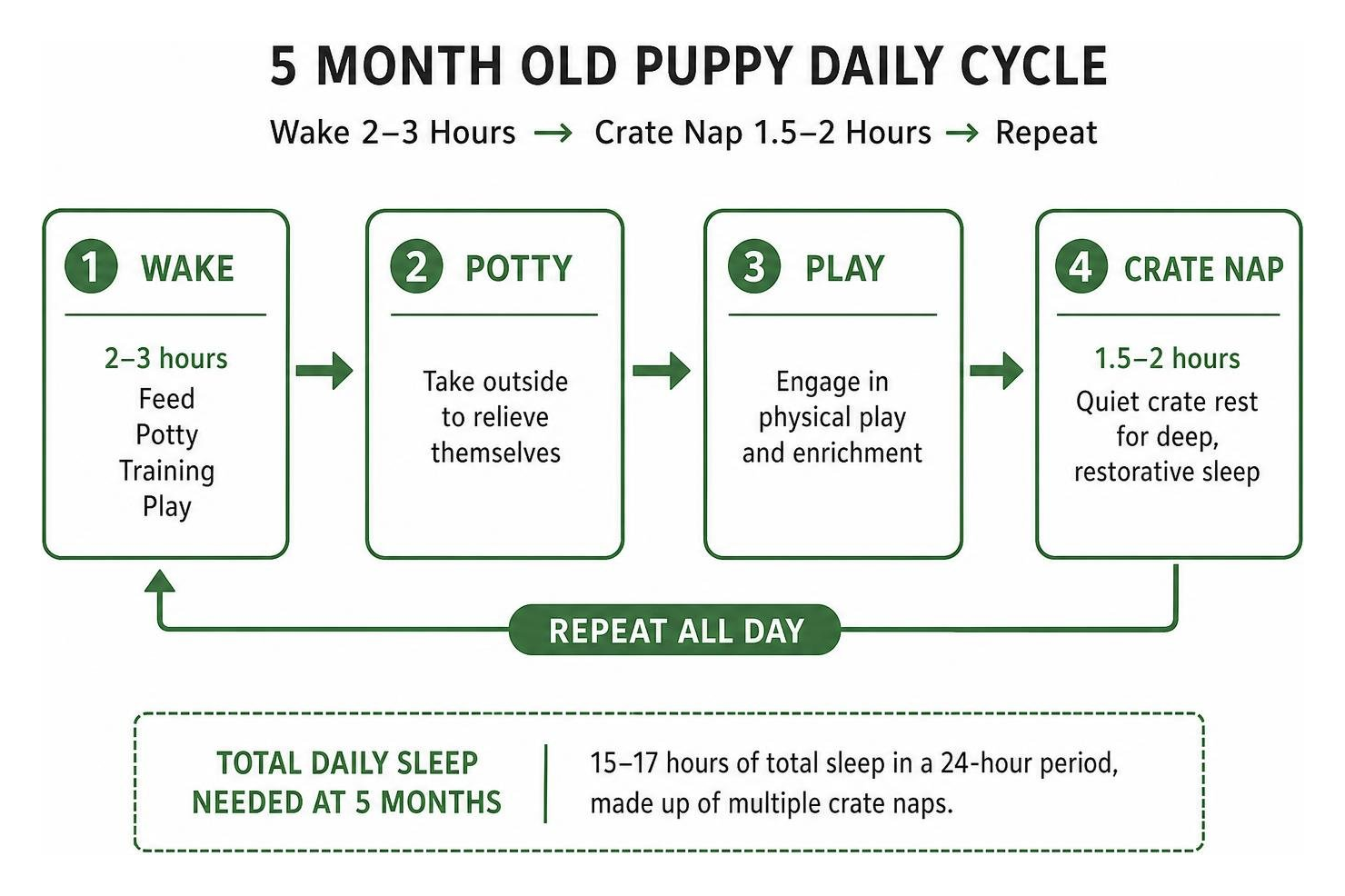
Why Teething and Adolescence Disrupt Sleep
Just when you think you have a solid routine, biology throws a wrench into the works. Five months marks the peak of adult tooth eruption. As large molars push through sensitive gum tissue, the resulting mouth pain can cause nighttime restlessness, whining, and pacing.
This discomfort often manifests as sudden destructive chewing or renewed nipping. Using targeted tips to stop puppy biting alongside soothing aids like frozen rubber toys, chilled carrots, or safe chew items helps relieve oral pressure before you put your pup down for a nap.
Early hormonal shifts also start around this age, making puppies more reactive to novel sounds and environmental changes.
Designing a Predictable Daily Routine for Daytime and Nighttime Rest
Canine biology runs on rhythm. Establishing consistent wake times, meal slots, and potty breaks sets your puppy's internal clock for smooth transitions. If you need a customized bathroom framework to pair with your sleep plan, using our housebreaking schedule generator helps eliminate guesswork between nap windows.
Sample Hour by Hour 5 Month Old Puppy Sleep Schedule
Here is a practical, structured daytime and nighttime plan designed for real households:
- 6:30 AM – Wake Up and Potty: Immediate trip outside on leash to empty bladder and bowels.
- 7:00 AM – Breakfast and Training: Morning meal worked into hand feeding for basic engagement and manners.
- 7:30 AM – Structured Walk or Yard Play: A 20 to 30 minute walk around your neighborhood to explore and sniff.
- 8:30 AM to 11:30 AM – Morning Crate Nap (Nap 1): Uninterrupted deep rest in a quiet, darkened space.
- 11:30 AM – Potty Break and Free Play: Quick relief outside, followed by supervised indoor freedom.
- 12:30 PM – Lunch or Enrichment Chew: Light midday meal or a durable chew item.
- 1:30 PM to 4:00 PM – Afternoon Crate Nap (Nap 2): Second major sleep block of the day.
- 4:00 PM – Potty Break and Training Session: Bathroom trip, followed by basic obedience practice and handling drills.
- 5:30 PM – Dinner: Evening meal served in a bowl or puzzle feeder.
- 6:30 PM to 7:30 PM – Evening Catnap (Optional Nap 3): A quick rest to bridge the gap if your pup seems worn down.
- 7:30 PM – Low Stimulation Social Time: Hanging out calmly with the family in the living room.
- 9:30 PM – Final Potty and Bedtime: Final outdoor relief trip, then straight into the crate for the night.
Managing Nighttime Sleep and Potty Breaks
By five months, most healthy puppies possess the physical bladder capacity to sleep 8 to 10 hours overnight without an emergency bathroom run. However, if your pup does wake up whining in the middle of the night, keep the interaction entirely functional.
Carry or walk them directly outside on leash to their designated spot, wait three minutes for them to go, praise softly without excitement, and place them immediately back into the crate. Implementing an easy way to potty train a puppy relies on keeping night trips dull and business focused so your dog does not view midnight barking as a way to start playtime.
How to Set Up the Ideal Crate and Sleep Environment
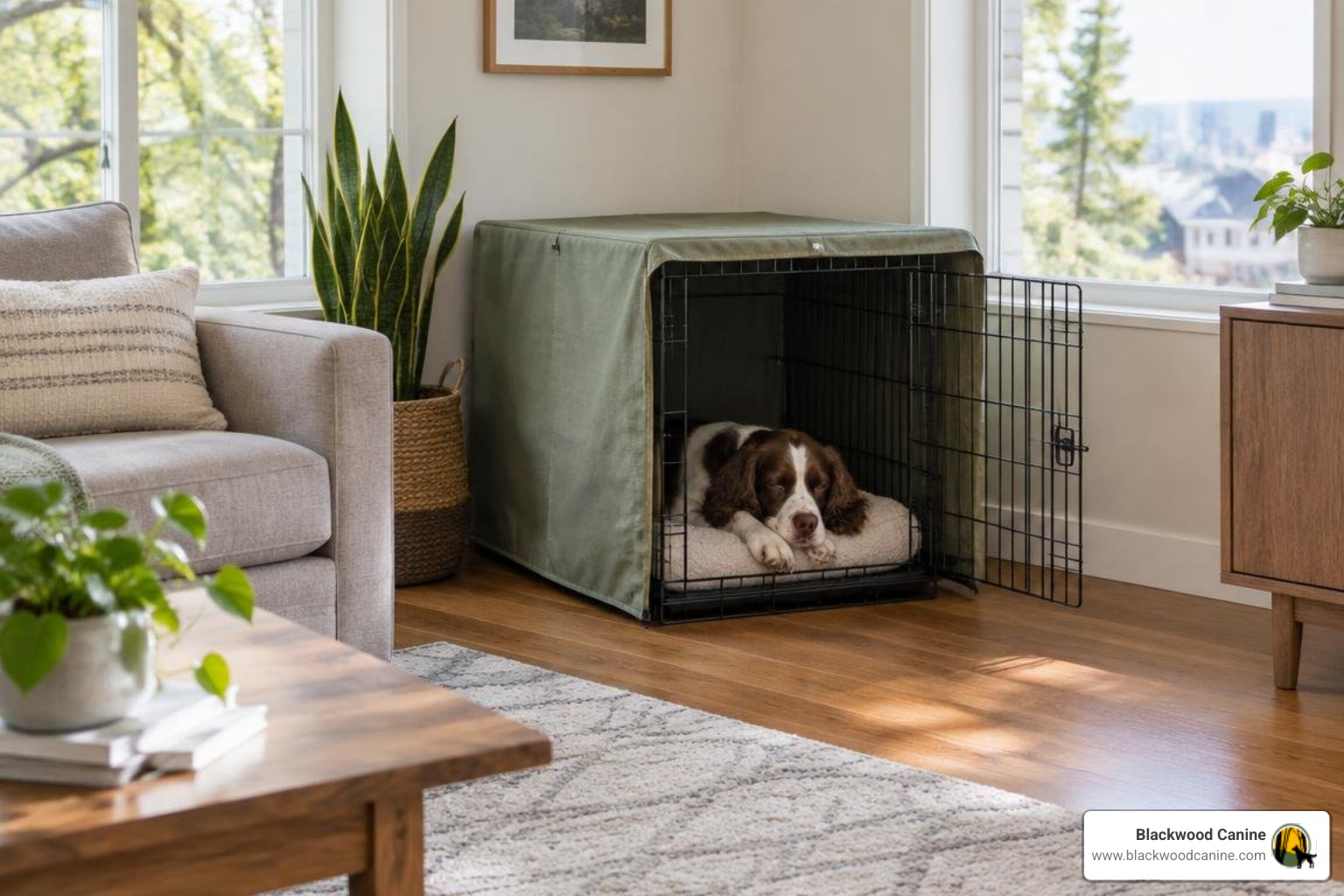
A five month old puppy easily gets distracted by everyday household movement. Setting up a dedicated rest cave removes environmental triggers that keep their brain fired up.
- Proper Crate Sizing: The crate must allow your pup to stand up, turn around easily, and stretch out on their side, without offering enough excess floor space to soil one corner and sleep in the other.
- Temperature Control: Keep the room between 65 and 72 degrees Fahrenheit. Puppies run hot and will fuss if they cannot find a cool resting posture.
- Blackout Covers: Use a fitted, breathable crate cover or a dark sheet over three sides of the crate to block out visual stimuli.
- Sound Masking: A simple box fan or white noise machine drowns out sudden door slams, street traffic, and television noise.
While self settling is a skill we build over time, most five month olds still lack the impulse control to choose sleep over household action. Enforced crate naps provide the structure they need to power down.
Identifying and Fixing Sleep Regression and Overtired Meltdowns
When a five month old misses their naps, they do not simply yawn and go to sleep on the rug. Instead, their system floods with adrenaline and cortisol.
The signs of an overtired five month old puppy include:
- Sudden, frantic zoomies through the house with hard banking off furniture.
- Hard, painful biting on hands, pant legs, and leashes.
- Complete inability to listen to familiar cues.
- Excessive demand barking, whining, and barrier frustration.
- Hyper fixation on forbidden items like shoes, baseboards, or rugs.
When this meltdown occurs, do not add more exercise. More physical activity on an overtired puppy simply adds fuel to the fire. Reviewing developmental sleep research and wake windows confirms that sleep deprivation directly worsens behavioral stability. Guide your puppy to their crate with a calm demeanor, shut the door, and let them rest.
Training tools and corrections, when used appropriately under professional guidance, give clear feedback, but you should never correct a puppy for behavior driven purely by exhaustion. Successful training requires clear expectations, sensible boundaries, proactive management, reinforcement, fair consequences, repetition, follow through, and unwavering owner consistency.
Frequently Asked Questions About 5 Month Old Puppy Sleep
Is it normal for a 5 month old puppy to sleep 18 hours a day?
Yes. While the average is 15 to 17 hours, larger breeds and highly active working lines often need up to 18 hours to recover from physical growth spurts and mental exertion.
The key is evaluating their behavior during wake windows. If your puppy is bright, hungry, interactive, and enthusiastic when awake, longer sleep duration is simply healthy recovery. If they seem weak, disoriented, or refuse meals, consult your veterinarian to rule out medical concerns.
Should I still enforce crate naps at 5 months?
Yes. Most five month old dogs do not possess the self regulation required to settle independently when interesting family activity is happening around them.
Enforced crate naps remove the burden of decision making from the puppy. It ensures they get the continuous, deep sleep cycles necessary for emotional stability and physical health.
How do I handle a 5 month puppy sleep regression?
Sleep regressions at this age typically last one to three weeks. They are usually triggered by teething pain or adolescent boundary testing.
Do not overhaul your entire daily routine or abandon crate rules. Check that their physical needs are met, offer a frozen chew toy to numb tender gums before crate time, and maintain your regular schedule. Consistency provides the security your pup needs to work through the phase.
Building Calm and Reliable Rest for Your Growing Pup
Raising a puppy in the Pacific Northwest means balancing wet outdoor trail adventures with calm indoor manners. A structured rest schedule is the quiet engine behind reliable obedience, clean house manners, and a relaxed home environment.
When you give your dog predictable rest, you protect your own sanity while setting your puppy up for long term success. If you live in Scappoose, St. Helens, Warren, Portland, Vancouver, Beaverton, Hillsboro, or Bethany and find yourself stuck with stubborn crate protests, frantic evening meltdowns, or boundary struggles, you do not have to figure it out alone.
Our team at Blackwood Canine provides real world, practical guidance to help you build reliable habits. The best way to get personalized coaching tailored to your pup is through our puppy jump start program. Reach out today, get a clear Good Dog Game Plan in place, and enjoy a well rested, well mannered companion.

4 to 6 Weeks to a Better Pup: Finding the Best Immersion Dog Training
Why Choose an Immersion Program Over Weekly Lessons?
A 4 to 6 week immersion dog training program delivers a reliable obedience foundation through daily professional handling, clear expectations, and hundreds of clean repetitions. Your dog learns loose leash walking, calm crate behavior, a solid place command, and polite home manners before you step in for handler coaching.
Weekly private lessons give you homework, but real life gets in the way. Between work, kids, commute traffic, and daily chores across Portland, Beaverton, or Lake Oswego, finding two uninterrupted hours every single evening to drill leash handling mechanics can feel impossible. When you fall behind, your dog falls behind, and everyone ends up frustrated.
An immersion board and train program changes the entire dynamic. Instead of you fumbling through leash mechanics while your dog lunges toward a squirrel in Tigard or Cedar Mills, an experienced trainer sets clear expectations from day one. Your dog stays with professional trainers who provide hundreds of clean, structured repetitions every single day. You can explore our immersion dog training benefits guide to see how daily consistency accelerates learning without the usual household friction.
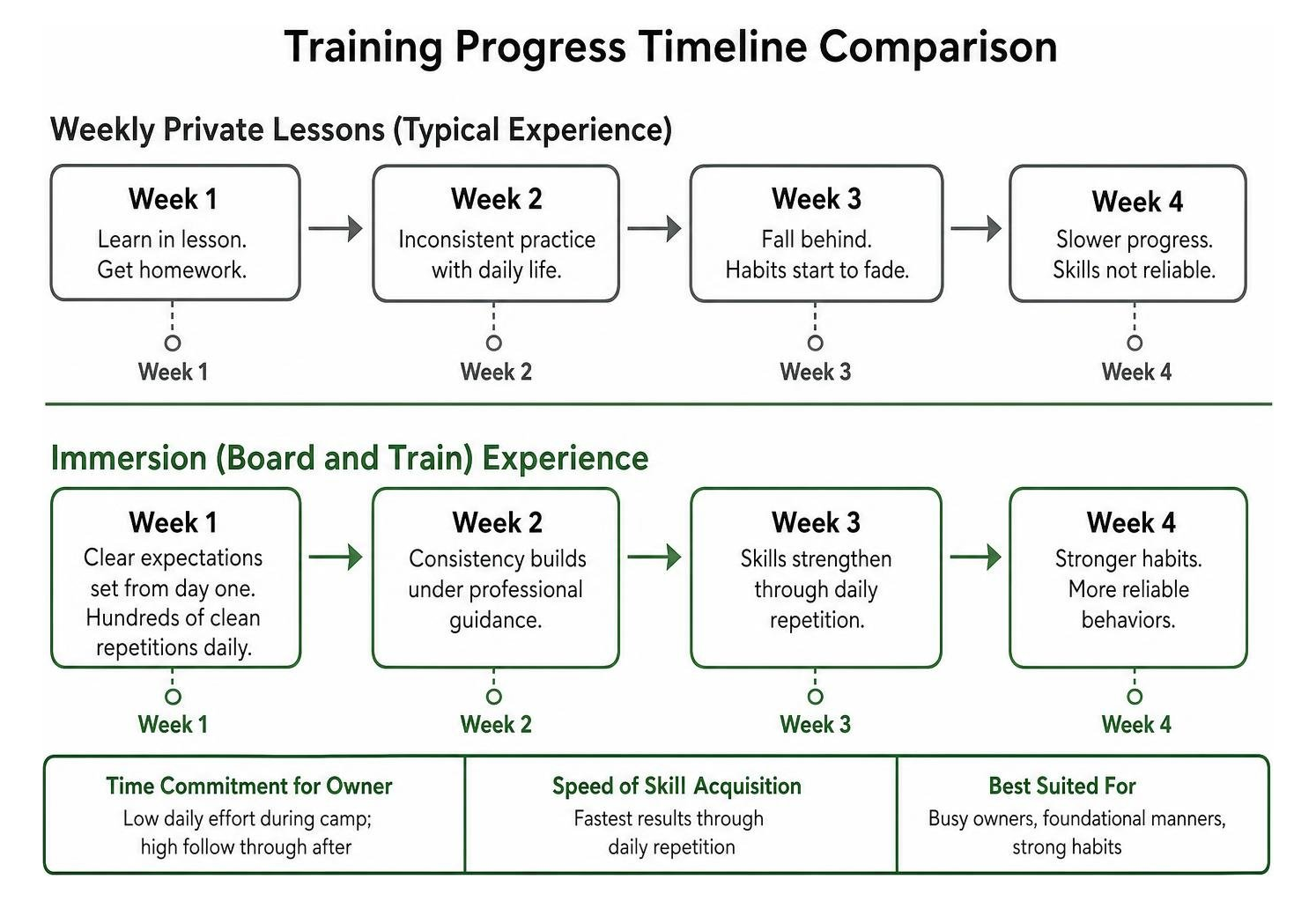
Here is how different training formats stack up for busy owners:
| Training Format | Time Commitment for Owner | Speed of Skill Acquisition | Best Suited For |
|---|---|---|---|
| Immersion (Board and Train) | Low daily effort during camp; high follow through after | Fastest results through daily professional repetition | Busy owners, foundational manners, building solid habits |
| Private Lessons | Moderate; requires 30 to 60 minutes of daily homework | Steady, depends directly on owner execution | Hands on handlers, minor adjustments, specific skills |
| Owner Only DIY Practice | Very high; requires constant self education and trial | Slowest, high risk of inconsistent reinforcement | Dedicated hobbyists with extensive free time |
Professional handling removes the common frustration loop. Your dog learns the mechanics cleanly in a structured setting before you step in for dedicated handler coaching.
What Skills Are Covered in a 4 to 6 Week Foundation Program?
Basic Obedience and Home Manners
A proper four to six week foundation covers practical life skills, not party tricks. At Blackwood Canine, our basic obedience foundation starts at 4 weeks. We focus on habits that make living with your dog enjoyable whether you are walking around Scappoose, Hillsboro, Bethany, or St Johns.
Key foundational skills include:
- Loose leash walking without pulling your arm out of its socket
- Reliable recall so you can call your dog back safely in open spaces
- Impulse control around food bowls, dropped snacks, open front doors, and exciting distractions
- Polite greetings that focus on stopping jumping on guests when visitors arrive at your home
- Crate calmness and settling quietly when asked to rest
- A solid place command where your dog relaxes on an elevated bed until released, even when dinner is cooking or delivery drivers ring the bell
- Polite threshold manners so your dog waits patiently at doorways rather than barging through
Understanding Realistic Timelines for Behavior Modification
Four to six weeks builds a dependable obedience baseline and solid daily manners. However, deep behavioral issues like severe fear, resource guarding, or intense dog reactivity require more time. If your dog suffers from serious distress or unpredictable outbursts, our approach to fear and reactivity rehab involves systematic desensitization, careful environmental control, and customized handling.
Real behavior modification cannot be rushed into an arbitrary quick fix. That is why Blackwood Canine uses 6 week and 8 plus week timelines for complex behavior modification. We want permanent lifestyle changes and emotional stability, not temporary suppression. To maintain our high standard of reliability, Blackwood Canine does not offer training programs shorter than 4 weeks. Quick fix one week boot camps simply do not provide the repetition needed to create lasting habits in the real world.
How to Evaluate 4 Week Dog Training Near Me Options
Searching for 4 week dog training near me in the Pacific Northwest can feel overwhelming. Do not rely solely on polished social media clips or marketing buzzwords. You need to verify hands on experience, safety standards, transparent facilities, and practical training philosophies.
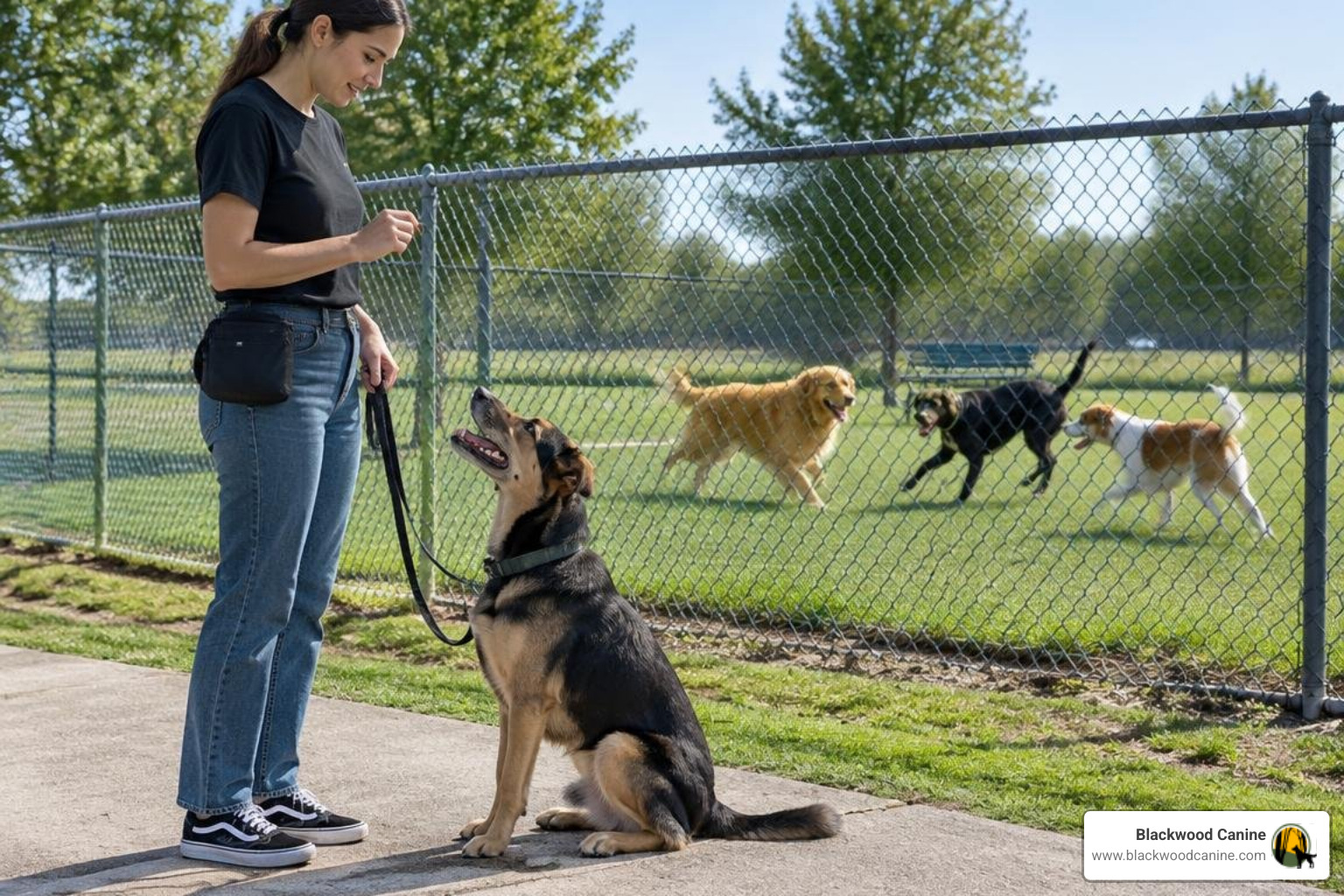
When researching local options across Oregon and Washington, evaluate:
- Facility Safety and Cleanliness: Ensure the environment is secure, clean, climate controlled, and properly sanitized to keep dogs safe and comfortable.
- Clear Philosophy: Look for balanced communication that combines clear markers, rewards, and fair boundaries. Avoid extreme ideologies that rely solely on constant bribery or lean exclusively on harsh corrections.
- Owner Coaching: A great trainer teaches the human handler just as thoroughly as the dog. Ensure the program includes detailed handover lessons and structured follow up support.
- Local Reviews: Look for genuine feedback from dog owners in areas like Vancouver, St Helens, Warren, Sherwood, and Cornelius.
Essential Questions Before Booking 4 to 6 Week Dog Training Near Me
Before enrolling your dog, ask the trainer these direct questions:
- What training tools do you use, and how do you introduce them to a dog for the first time?
- How do you balance fair consequences and clear boundaries with positive reinforcement strategies?
- What is the daily training schedule and routine for dogs staying in your care?
- What protocols do you follow if a dog becomes sick, stressed, or injured during their stay?
- What are your specific cancellation, rescheduling, and refund policies?
Training tools like slip leads, prong collars, or e collars are not inherently good or bad. Misuse is the real problem. These tools must always be introduced fairly, with clear guidance, minimal pressure, and under professional supervision.
Preparing Your Household for 4 to 6 Week Dog Training Near Me
Getting ready for an immersion program requires thoughtful home preparation:
- Vaccination Records: Confirm rabies, distemper, and bordetella vaccinations are completely up to date with your local vet.
- Routine Handover: Write down your dog feeding schedule, dietary restrictions, medications, and specific quirks so the trainer has full context.
- Family Alignment: Every family member must agree to use the same command words, daily routines, and home boundaries once your dog returns home.
- Crate and Place Setup: Have a clean crate and elevated place cot set up in your main living space in Rainier, Aloha, or Raleigh Hills before graduation day.
Community Support and Budget Resources
Quality training is a significant investment in your peace of mind and your dog safety. For families looking to understand regional pricing structures and evaluate options, reviewing our private lesson cost breakdown can clarify what goes into professional service rates and long term value.
If you recently adopted a rescue pup and want to connect with local animal welfare resources in the Pacific Northwest, community organizations provide valuable pet ownership support and adoption information:
- Humane Society for Southwest Washington
- Washington County Animal Services
- Multnomah County Animal Services
- Columbia County Animal Services
Taking advantage of community resources, establishing consistent household structure, and pairing clear expectations with professional instruction ensures your dog develops into a calm, confident companion.
Frequently Asked Questions About 4 Week Dog Training
How much does a typical 4 to 6 week immersion training program cost?
In the greater Portland, Beaverton, Hillsboro, and Vancouver areas, a high quality 4 week immersion program typically ranges from $2,500 to $4,500. This investment covers round the clock care, daily professional handling, structured boarding, customized training equipment, and extensive handler coaching sessions.
Can a 4 to 6 week program fix severe dog reactivity or aggression?
No. A 4 to 6 week program establishes an obedience baseline, leash manners, and basic impulse control. However, complex aggression, severe fear, or deep rooted reactivity requires 6 week or 8 plus week timelines. True behavior modification requires extended time, systematic desensitization, and careful environmental management.
How do I maintain results after my dog returns home?
Follow the clear structure provided during your handover lesson. Maintain daily boundaries, use crate rest appropriately, enforce polite threshold manners at doors, reward good choices, and hold your dog accountable to known commands consistently.
What happens if I do not keep up the training at home?
Dogs are contextual learners. If you drop all rules and let your dog pull on leash or jump on guests as soon as they get home, old bad habits will resurface. Immersion training gives you a clean slate, but your follow through keeps the skills sharp.
Transform Your Pup with Dedicated Immersion Training
A great dog is not created by luck or wishful thinking. Reliable behavior is built through clear communication, hundreds of daily repetitions, fair management, and consistent owner follow through.
If you are tired of chaotic walks, embarrassing barking episodes, or stressful living room dynamics in Portland, Scappoose, Hillsboro, Beaverton, King City, Forest Grove, or Vancouver, explore our comprehensive immersion dog training programs. We help pet parents build practical, stress free relationships with their dogs. Your usual next step is to schedule a consultation so we can build a customized Good Dog Game Plan tailored specifically to your home and lifestyle.
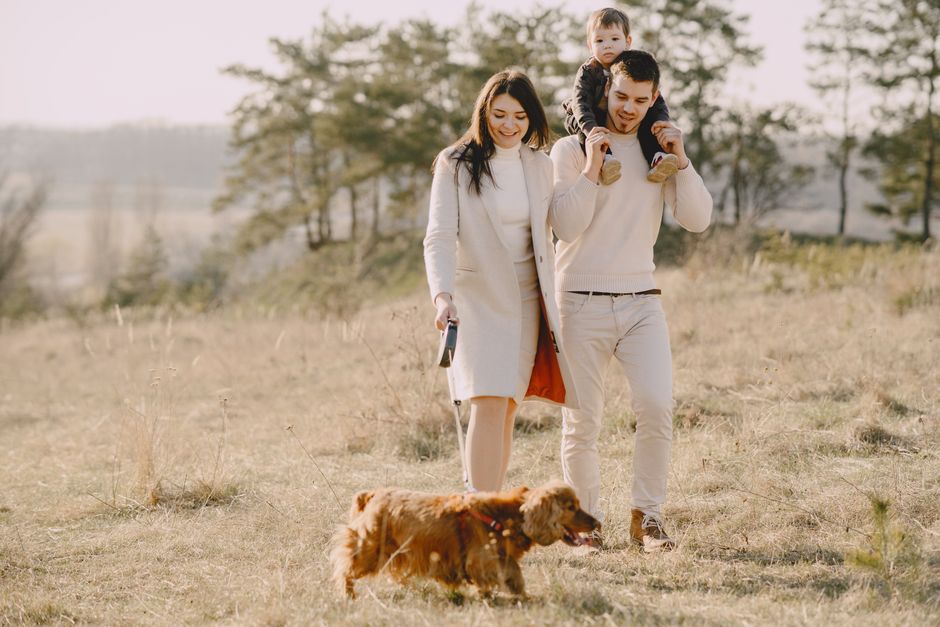
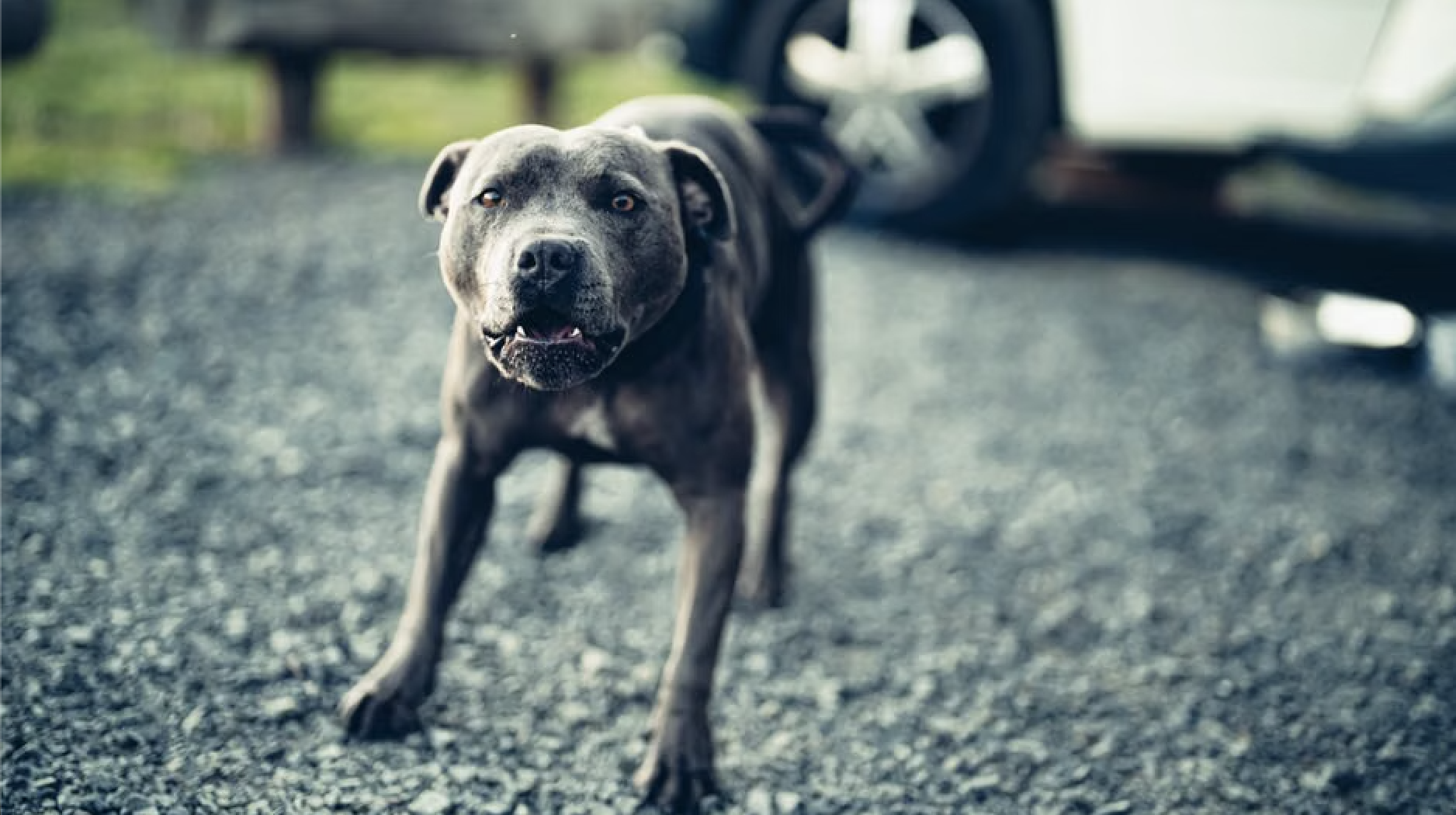
Car Anxiety Training Checklist for Calmer Rides
Car Anxiety vs. Motion Sickness: Identifying the Real Culprit
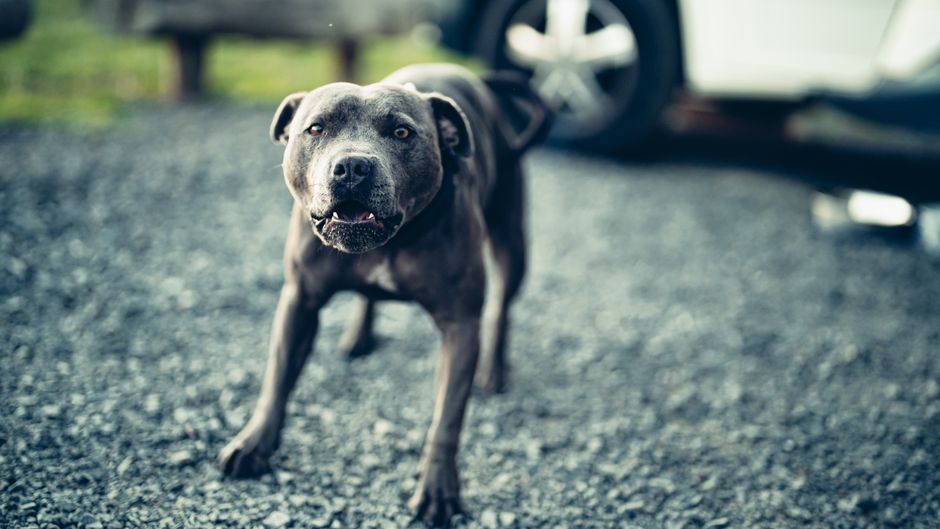
A practical car anxiety training checklist starts with short, parked hangs near the car, moves to letting the engine idle, graduates to slow driveway rolls, and wraps up with quick spins to fun spots. You have to move at your dog's pace and reward calm vibes every step of the way. But before you dive into practice runs, you need to know what is actually going on inside your dog. Car dread and plain old car sickness look almost identical on the surface. Both bring on waterfall drool, pitiful whining, and a dog that looks like they are deeply questioning every life choice you have ever made for them.
Trying to fix tummy trouble with training drills will not settle an upset stomach. On the flip side, shoving motion sickness pills down your dog's throat will not cure pure panic about the car itself.
| Symptom or Behavior | Car Anxiety (Fear Based) | Motion Sickness (Tummy and Ear Based) |
|---|---|---|
| When drama starts | Inside the house, walking to the car, or opening doors | A few minutes after the wheels start rolling |
| Panting and pacing | Heavy panting, constant shifting, scanning windows | Sluggish, heavy drooling, glued to one spot |
| Snack interest | Snubs hot dogs near or inside the car | Munches happily while parked, snubs snacks once dizzy |
| Puking | Rare, usually comes after wild panic or nonstop barking | Very common, usually starts with nonstop lip smacking |
| Post ride bounce back | Bounces back the second four paws hit the ground | Stays sluggish or sour stomached for half an hour |
A lot of puppies get car sick simply because their inner ear balance system is still under construction. If a puppy gets sick every single time they ride, they quickly decide that cars are rolling torture chambers. Even after their inner ears grow up around their first birthday, that learned dread sticks around.
Spotting the Scared Dog Red Flags
Pure car anxiety is all about dreading what comes next. If your dog starts lip licking, yawning like they missed a night of sleep, whining, or moonwalking away the second you pick up your car keys, you are dealing with genuine fear.
Look at their eyes and posture. A nervous dog gives you whale eye, where the whites of their eyes bug out. Their ears flatten back, their tail glues itself between their legs, and their muscles turn to stone. Other dogs lose their minds at outside movement, barking like maniacs at every passing truck or neighbor on a jog. Learning how to handle dog anxiety car windows helps you cut down on outside triggers before your dog completely boils over.
Motion Sickness Clues and Puppy Ear Woes
Physical car sickness is purely mechanical. It happens when your dog's eyes and their inner ear balance fluid cannot agree on whether they are sitting still or flying down the road. Puppies get the worst of it, but plenty of adult dogs get carsick too.
Real motion sickness shows up as thick, ropey slime hanging from their jowls, endless lip smacking, and dry heaving on twisty turns or stop and go traffic. If you suspect ear issues or real nausea, check out the VCA Animal Hospitals guide on pet travel and loop in your vet before you start training.
Essential Gear and Calming Aids Before You Begin
You cannot train a dog who is skating across slick leather seats or ping ponging off your center console. Physical stability brings physical safety, and physical safety keeps brains from melting.
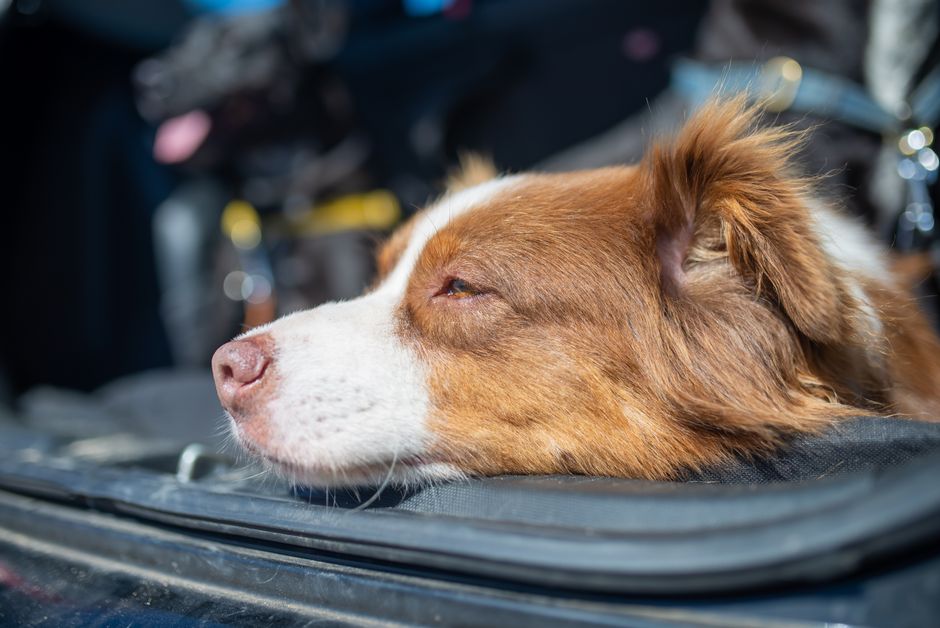
Travel Restraints and Setting Up the Cab
Loose dogs in cars are distracted, wobbly, and totally unprotected during hard stops. Unstable footing causes instant freakouts. The moment paws start slipping, adrenaline surges.
- Crash tested harness or sturdy crate: Use a solid harness clicked straight into the seatbelt system, or a secure, strapped down crate.
- Non slip seat covers: Throw a rubber backed hammock style cover across the back seat so your pup has real grip under their paws.
- Window shades and cool breezes: Simple stick on sunshades block out big semi trucks that scare dogs. Point the air vents right at your pup to keep the cabin cool and fresh.
Browsing handy tips for calming car rides dogs and checking out preventing travel anxiety tips from AKC will give you plenty of great setups for your vehicle interior.
Calming Aids, Goodies, and Vet Support
Calming aids are just helper tools to bring baseline stress down so your dog can actually learn something. They are not magic wands that erase big feelings overnight.
Everyday helpers like snug wraps, soothing pheromones, or natural chews with chamomile can help take the edge off mild jitters. For serious car panic or real tummy sickness, talk with your vet about prescription help. Medications like Cerenia stop motion sickness puking cold, while situational meds like gabapentin or trazodone help terrified dogs chill out enough to make training possible.
The Step by Step Car Anxiety Training Checklist
Solid training needs clear communication, fair boundaries, and realistic pacing. Do not rush the steps. If your dog gets overwhelmed, hit pause and meet them where they are comfortable.

Phase 1 of Your Car Anxiety Training Checklist: Driveway Hangs
Phase 1 takes place entirely with the car turned off in park. Your only job is making the parked car feel like a normal, boring, treat filled spot to hang out.
- [ ] Walk your pup on a loose leash around the parked car without asking them to climb in.
- [ ] Scatter some high value treats on the ground nearby and let your dog sniff around happily.
- [ ] Open up the car doors so it feels like an open, breezy space instead of an enclosed box.
- [ ] Feed regular meals a few feet from the open car doors, moving the bowl a bit closer each day.
- [ ] Invite your dog to pop their front paws in voluntarily. Mark the move with a quick verbal yes and pay out with tasty rewards.
- [ ] Hang out quietly inside the parked car with the doors open for two or three minutes while sharing a chew or steady treats.
Phase 2 of Your Car Anxiety Training Checklist: Engine Rumbles and Baby Rolls
Once your dog hops into a parked car without giving you side eye, you can introduce engine sounds and tiny movements.
- [ ] Buckle your dog into their safety harness or crate inside the car.
- [ ] Close the doors for thirty seconds while feeding yummy treats, then open up and hop out.
- [ ] Turn the ignition on while staying in park. Feed treats while the engine idles for a minute or two, then shut it off.
- [ ] Repeat the idling drill until your dog stops caring about dashboard beeps or engine noises.
- [ ] Shift into gear and roll smoothly down the driveway at walking speed, stopping before the road.
- [ ] Take one quick loop around the block for a minute or two, keeping your turns wide, acceleration smooth, and braking super gentle.
Phase 3: Building Ride Time with Fun Spots
Time to break the myth that getting into the car means a direct trip to the vet or groomer.
- [ ] Map out five minute cruising routes on quiet neighborhood roads.
- [ ] Drive straight to a fun hangout spot: a quiet park, an open field, or a peaceful sniff spot.
- [ ] Let your dog out for a quick five minute sniff stroll before loading back up for the short drive home.
- [ ] Slowly bump your drive times up from five minutes to ten, fifteen, and twenty minutes over a few weeks.
- [ ] Hit busier roads and highway on ramps only after your pup is totally relaxed on neighborhood streets.
- [ ] Check how fast your dog recovers after the ride. A great trip ends with your dog stepping out, doing a happy shake off, and exploring with loose body language.
Common Roadblocks, Regression, and Training Pitfalls
Progress with car work is rarely a smooth, straight line. The classic rookie mistake is flooding: shoving a terrified dog into the back seat, driving forty minutes to a crowded trail, and hoping they magically figure it out. Flooding fries their brain, doubles their fear, and wrecks trust.
Another trap is trying to soothe panic with high pitched baby talk and smothering pets. You should never punish fear, but freaking out alongside your dog just tells them there really is something to be terrified of. Stay cool, neutral, and relaxed.
Training tools and structured management are not mean when used properly. Misuse is the real problem. Any training gear or corrections should always be used with clear, professional guidance so everything stays clear and fair. If your dog is dealing with big world fears, checking out behavior modification training or reactive dog training will help you build solid daily routines and focus before you tackle tricky travel triggers.
The Trigger Stacking Pile Up and Stress Overload
Stress builds up quietly in the background. Trainers call this trigger stacking.
Your dog might handle the engine firing up, the garage door squeaking open, and the first ten minutes of road vibration like a champ. But by minute twenty, cabin warmth, a loud Harley zooming past, and a sharp freeway turn all pile on at once. Suddenly, the dog who seemed fine starts crying, pacing, or chewing on their seatbelt.
Keep an eye out for shutting down. An anxious dog does not always throw a loud tantrum. Plenty of dogs freeze: they sit stiff as a board, turn their nose up at fresh roast beef, stare blankly ahead, and refuse to look at you. Owners love to mistake this quiet statue act for good behavior. If your dog will not eat, take a breath, or look at you, they are over their stress limit and merely surviving the ride instead of learning.
How to Reset After a Rough Ride
Bad rides happen to everyone. You might get stuck in awful traffic, get cut off by a semi, or simply ask for too much too fast.
When a bad ride happens, do not stress. Give your dog a two day break from all car practice. When you start back up, jump down the checklist by a couple of steps. If your pup melted down on a ten minute trip, go back to easy two minute engine idle hangs in the driveway. Bank some quick wins and rebuild their mojo before trying real road movement again.
Frequently Asked Questions About Dog Car Anxiety
How long does car desensitization typically take?
Most dogs with everyday travel jitters show great progress within two to six weeks of steady, daily practice. Deep seated car phobias that have been brewing for years will take more time. Real change comes down to clear expectations, solid management, repetition, and follow through.
Should I feed my dog right before a training drive?
Nope. Give your pup a light meal about three or four hours before any driving practice. An empty belly cuts down on sickness, but starving them all day can cause sour stomach acid. Keep them hungry enough to get excited about yummy treats during your driveway and neighborhood practice reps.
When is it time to call in the pros?
If your dog tries to chew out of crates, panics violently, loses control of their bladder or bowels in the car, or shows zero progress after six weeks of work, bring in a pro trainer or your vet. Serious panic calls for an evaluation to check for hidden pain, inner ear troubles, or the need for temporary calming medication.
Hit the Open Road with Confidence
Living in the Pacific Northwest means adventure is always right down the road, whether you are rolling out from Portland, Beaverton, Hillsboro, or Scappoose toward the coast or up to the mountains. You should not have to leave your buddy at home or white knuckle your steering wheel on every trip.
Raising a chill travel buddy comes down to clear communication, fair boundaries, and steady consistency. For hands on help, check out our dog trainer advice on dealing with car anxiety. We work side by side with dog owners across Oregon and Washington through private lessons dog training and in home private lessons to turn stressful car trips into calm, easy everyday habits.
If you feel stuck, annoyed, or tired of dealing with car panic all by yourself, reach out to set up a Good Dog Game Plan session. We will help you pinpoint your dog's triggers, sharpen your handling skills, and build a stress free travel routine that works.
What to Do When Your Dog Shows Aggression to Family Members or Strangers
Understanding Dog Aggression Toward People and Its Root Causes
To address dog aggression toward people, start by creating immediate physical safety through leashes, gates, or a basket muzzle, ruling out medical pain with a vet, and managing trigger distances to prevent escalation. Pairing sub-threshold human exposure with structured rewards and clear boundaries helps rebuild safe habits. Living with an aggressive dog is exhausting, but understanding root causes is the first step toward regaining safety and trust.
Aggression is an outward behavioral symptom of an underlying emotional state or physical issue. According to a systematic review on risk factors for human directed aggression, human directed aggression stems from a complex mix of early handling, owner experience, environment, and communication breakdowns. When a dog displays aggression toward humans, they are usually trying to create space, protect a valuable item, or express pain or intense conflict.
Why Dogs Show Aggression: Fear, Pain, and Frustration
Fear is the single most common cause of aggression toward people. When a dog feels threatened, their sympathetic nervous system activates a fight or flight response. If fleeing is not an option because of a tight leash, a corner, or a closed room, fighting becomes their remaining defensive strategy. Misusing corrections or punishment without professional guidance can increase anxiety and conflict, whereas balanced training tools and techniques should always be applied under qualified professional supervision. If you are struggling with these emotions, stop feeling guilty about your reactive dog because guilt only distracts from clear, practical leadership.
Underlying medical conditions and physical discomfort are major hidden triggers for aggressive outbursts. Issues like osteoarthritis, dental disease, ear infections, cervical disc disease, and thyroid dysfunction can make a dog irritable or sensitive to handling. A sudden behavior change in an adult dog warrants a complete veterinary exam to rule out hidden pain or metabolic issues before starting behavior training.
Frustration also plays a substantial role. Barrier frustration occurs when a dog wants to interact with, chase, or escape a person but cannot due to a leash, window, or fence. Over time, that blocked arousal boils over into reactive lunging, snapping, or redirected bites toward whoever is closest.
The Critical Role of Early Socialization and Genetics
A dog's behavioral foundation is heavily shaped during their early development. Research on puppy early experiences and aggression demonstrates that experiences during the first six months of life, as highlighted in research on puppy early experiences and aggression, directly impact adult temperament and human directed bite risks. Puppies sourced from commercial breeding operations or pet shops often miss critical early handling, resulting in poorer coping mechanisms when faced with novel stimuli.
Genetics establish baseline traits like nerve stability, environmental sensitivity, and prey drive, while early socialization teaches a young dog how to process the world. When puppies are isolated from varied, positive human interactions during their primary socialization period, or when they experience traumatic handling, their threat detection system remains hyperactive into adulthood.
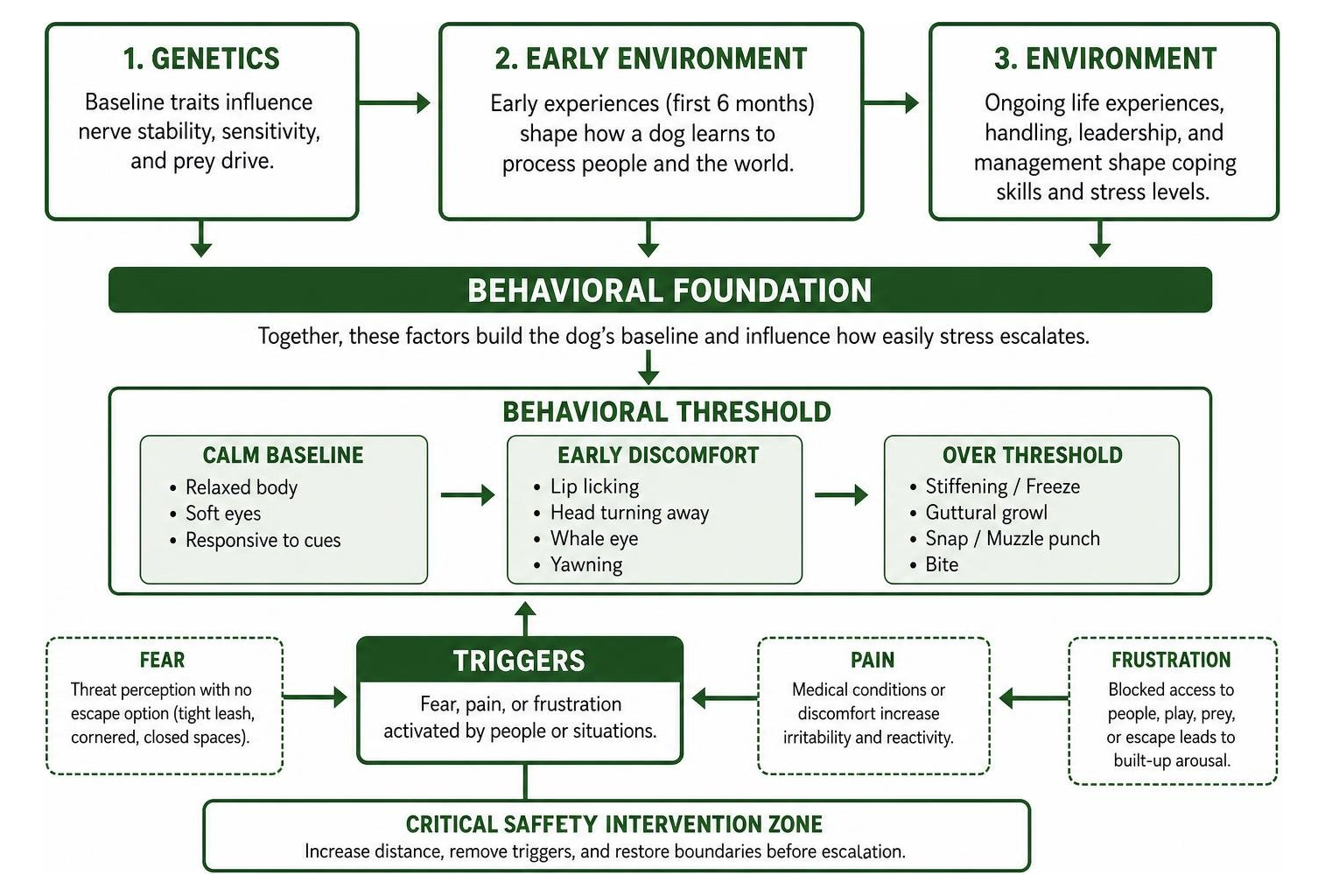
Types and Triggers: Recognizing Warning Signs Before a Bite
A dog rarely bites out of the blue. Dogs communicate their discomfort long before they resort to physical contact, as detailed in this clinical guide to canine aggression. The challenge is that human owners often miss subtle appeasement signals, only noticing the behavior when it escalates into a bark, growl, or snap.
| Aggression Type | Primary Motivation | Common Triggers | Typical Warning Behaviors |
|---|---|---|---|
| Fear Aggression | Self preservation and creating distance | Cornering, unfamiliar people, reaching hands, direct eye contact | Cowering, lip licking, whale eye, low growl, snapping upon retreat |
| Territorial Aggression | Defending perceived property or space | Mail carriers, visitors entering the home, people walking along the fence | Fence running, deep barking, charging the front door, rigid stance |
| Possessive Aggression (Resource Guarding) | Protecting high value items or resting spots | Approaching while eating, taking away chew toys, moving a resting dog | Freezing over item, hard staring, showing teeth, rapid muzzle punch |
Classifying Types of Dog Aggression Toward People
Canine aggression takes several distinct forms based on motivation and context, as outlined in the ASPCA aggression classifications:
- Territorial and Protective Aggression: Emerging during social maturity between one and three years of age, this involves defending property, vehicles, or handlers from approaching strangers.
- Possessive Aggression (Resource Guarding): Defensive behavior surrounding food, high value bones, toys, stolen trash, or specific resting spaces on furniture.
- Conflict Aggression: Stress reactions arising when handling, restraint, or grooming pushes a dog past their comfort zone, often worsened by confrontational training methods.
- Redirected Aggression: When an aroused dog is blocked from reaching their primary target (like a person across the street) and turns to bite the leash or the handler holding them.
The Ladder of Aggression and Subtle Body Language Clues
The canine ladder of aggression illustrates how dogs escalate their signals when lower level warnings are ignored. Recognizing early discomfort helps you de-escalate situations before they reach physical danger. For more guidance on reading these subtle shifts, check our guide on understanding and transforming reactive dog behavior.
A 7-Day Safety and Reset Plan for Aggressive Behavior
If you are dealing with aggressive outbursts, you need an immediate plan to halt bite risks, reduce household stress, and set clear boundaries. This seven day reset framework establishes environmental control, stabilizes your daily routine, and creates a clean baseline for long term training.
The 7-Day Reset Protocol
Step-by-Step Management: Tools, Space, and Routine
- Implement Secure Physical Barriers: Use sturdy baby gates, closed doors, and crates to isolate your dog from front doors, entryways, and meal areas.
- Condition a Basket Muzzle: A properly fitted basket muzzle that allows full panting, drinking, and treat acceptance provides safety without distress.
- Establish Indoor Leash Control: A lightweight leash attached to a flat collar or harness inside the home prevents you from needing to grab the dog's collar during tense moments.
- Manage Outdoor Distance: Avoid crowded sidewalks. Walk during quiet hours and cross the street well before your dog spots an approaching pedestrian. For structured leash support, explore our options for reactive dog training.
- Avoid Misuse of Corrections: Untrained physical confrontations, alpha rolls, or screaming when your dog growls escalate stress and confusion. Misuse of corrections is where problems arise; all training methods, tools, and consequences should always be introduced under professional guidance.
Assessing Risk Factors and Bite Predictability
Evaluating the long term safety of living with an aggressive dog requires looking at objective risk factors:
- Severity of Bite History: A dog that air snaps or delivers shallow nips exhibits bite inhibition. A dog that bites repeatedly, causes deep punctures, or clamps down carries a much higher safety liability.
- Predictability of Triggers: A dog that reacts reliably only when someone touches their food bowl is far easier to manage safely than a dog that explodes unpredictably with little contextual warning.
- Dog Size and Household Demographics: A fifty pound dog presents greater physical bite severity than an eight pound dog. Homes with young children, elderly family members, or active visitors face higher day to day risk.
Proven Behavior Modification and Long-Term Rehabilitation
Real, lasting behavioral change requires more than quick tips or basic obedience cues like sit and stay. Modifying aggression requires changing your dog's underlying emotional response to triggers while establishing clear communication, consistent management, and reliable boundaries.
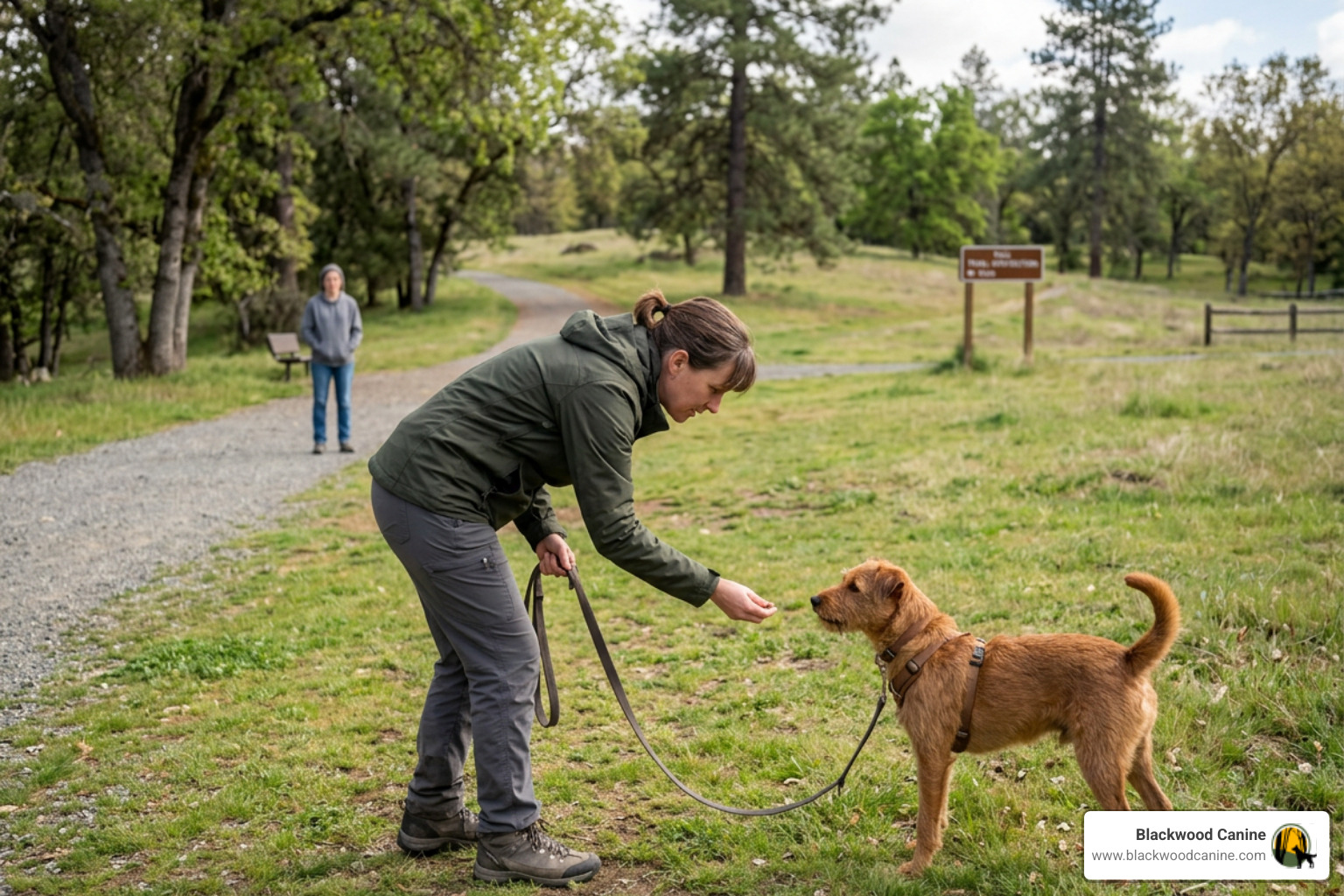
Transforming Dog Aggression Toward People with Counter-Conditioning
Systematic desensitization and classical counter-conditioning form the foundation of clinical behavior modification. We expose the dog to the trigger (such as a stranger at a distance) strictly below their reactive threshold—the distance at which they notice the person but remain calm and responsive.
By pairing the sight of a person at a safe distance with high value rewards, the dog's emotional state shifts from defensive fear to positive anticipation. Over time, we gradually close the distance while teaching alternative behaviors through advanced re conditioning. For complex behavioral cases, training is never about purely force free bribery or harsh corrections. Successful resolution relies on clear expectations, reliable boundaries, management, reinforcement, fair consequences, and owner consistency.
Professional Immersion vs. In-Home Training Timelines
Rehabilitating severe aggression is a long process that requires time, structure, and professional guidance. Basic obedience foundation training starts at four weeks, but complex behavior modification requires six week and eight plus week timelines to establish real, lasting reliability.
Shortcuts and quick fixes do not resolve ingrained aggression. Programs like our dog behavior camp and reactive dog boot camp provide structured immersion to reset dangerous patterns, build impulse control, and lay the foundation before transferring those critical handling skills back to the owner at home.
Frequently Asked Questions About Canine Aggression
Can an aggressive dog ever be 100% cured?
In behavioral medicine, responsible professionals avoid using the word cured. While a dog's frequency, intensity, and threshold of aggression can improve dramatically with structured training, their underlying genetic tendencies and learned bite history remain part of their behavioral makeup. Owners must maintain lifelong management, clear communication, and reasonable expectations to prevent regression during high stress situations.
Are certain dog breeds naturally more aggressive to people?
While working drives, guarding instincts, and bite power vary across breeds due to selective breeding, breed alone does not determine whether an individual dog will become human aggressive. Individual temperament, early socialization history, health status, and owner handling are far more reliable indicators of aggression risk.
When is it time to seek professional behavioral help?
You should seek professional support immediately if your dog has broken skin, displayed muzzle punches, stiffened over resources, or shown lunging behavior that you cannot comfortably control. Trying to manage serious aggression alone without structured professional guidance puts your family, the public, and your dog at risk.
Finding Peace and Moving Forward with Your Dog
Managing human directed aggression can feel isolating, but you do not have to handle it alone. Living with an unpredictable dog wears on your household, yet with clear communication, consistent environmental management, and structured training, you can regain control of your daily routine.
At Blackwood Canine, we work with dog owners across Scappoose, St. Helens, Warren, Bethany, Hillsboro, Beaverton, Portland, and Vancouver who feel stuck, stressed, or overwhelmed. We provide private coaching and structured immersion programs built around clear handling, reliable management, and long term owner support.
Whether your dog needs four week foundation training or six week and eight plus week timelines for complex behavior modification, our behavior modification training gives you the tools, clarity, and safety plan you need to move forward. Reach out today to schedule your evaluation and build your practical path forward.
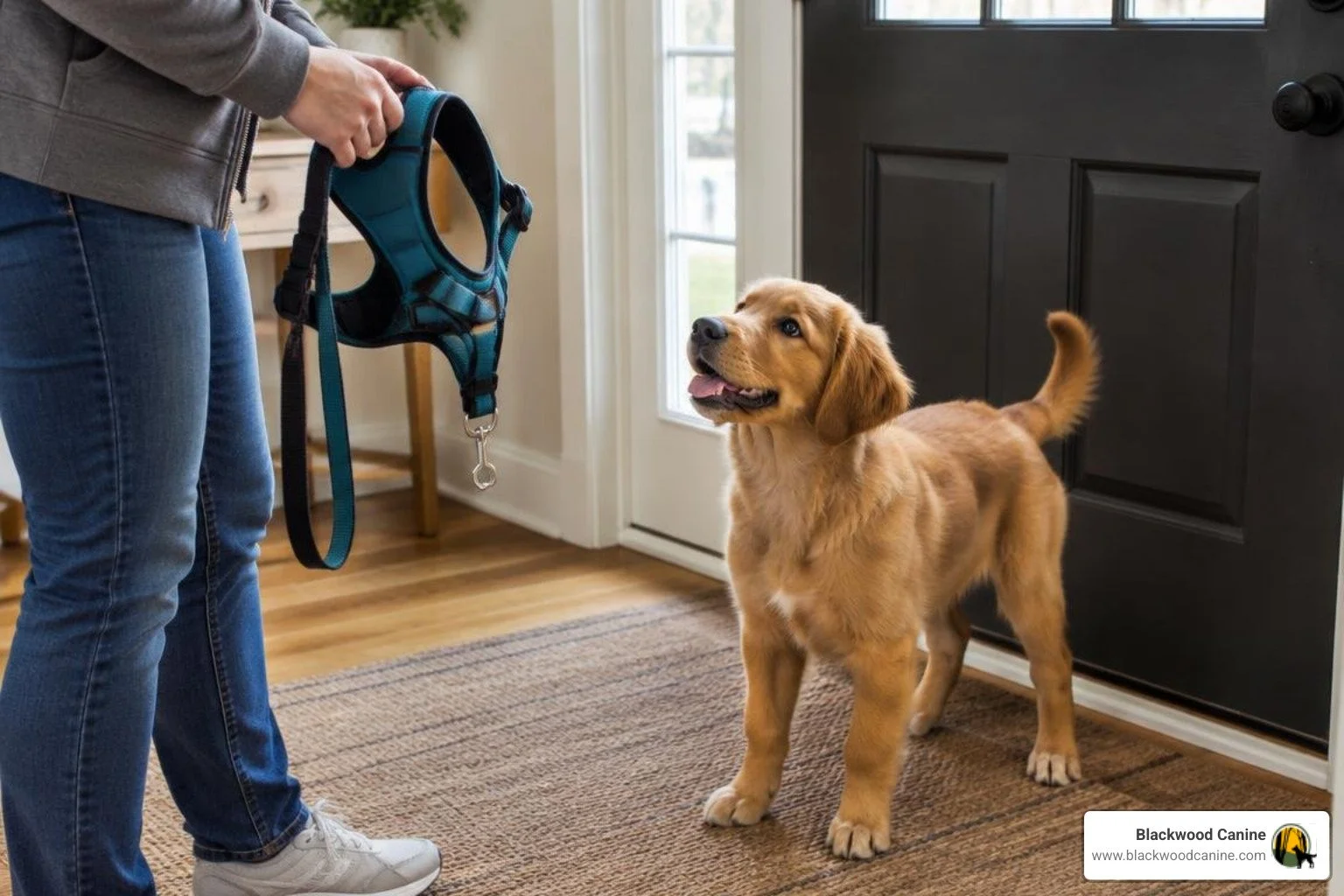
How to Structure Your 4-Month-Old Puppy's Day
Development Milestones at 16 Weeks: Sleep, Bladder, and Growth
An effective 4 month old puppy schedule balances 4-hour daytime potty intervals (4 to 8 daily bathroom outings), 11 to 12 hours of total sleep, short 5-to-10-minute training blocks, and structured crate naps between wake windows. For busy dog owners in Portland, Beaverton, Hillsboro, and across Oregon and Washington, establishing this predictable rhythm prevents overtired zoomies, reinforces house manners, and curbs destructive chewing before it starts.
Reaching four months is a major turning point. Your puppy is developing rapidly, both mentally and physically. At 16 weeks, their brain is already near 90 percent of its adult size, meaning they process complex environmental cues faster than ever before. This rapid brain development means your puppy notices every household movement, hears every outside noise, and quickly forms lifelong habits based on how you guide them.
Along with mental growth comes improved physical control. A healthy four month old puppy generally has a bladder capacity that allows them to hold their urine for roughly four hours during active daytime hours. That translates to an average of 4 to 8 potty breaks per day. While this offers much more breathing room than the frantic 8 week stage, your pup cannot hold it indefinitely when awake, running around, or drinking water.
Physical discomfort also peaks right now. At four months old, adult incisor teeth and premolars begin to push through the gums, replacing needle sharp baby teeth. This teething phase causes sore gums, excess drooling, and a sudden urge to gnaw on anything in sight. Setting up a reliable bathroom rhythm helps prevent setbacks, and reviewing an easy way to potty train a puppy can keep your house training solid during this developmental shift.
Why Nap Windows Shape Your 4 Month Old Puppy Schedule
Many owners assume that because their puppy is bigger and faster, they need constant exercise. In reality, a four month old puppy needs around 11 to 12 hours of sleep per day to properly recover, regulate emotions, and process learning.
When puppies miss their necessary nap windows, they do not just get sleepy. They become overtired, frantic, nippy, and unable to focus. These frantic zoomies and sudden biting episodes are classic signs of exhaustion rather than excess energy. Following a structured Age-Appropriate Puppy Training Schedule helps you balance active wake windows with predictable crate rest.
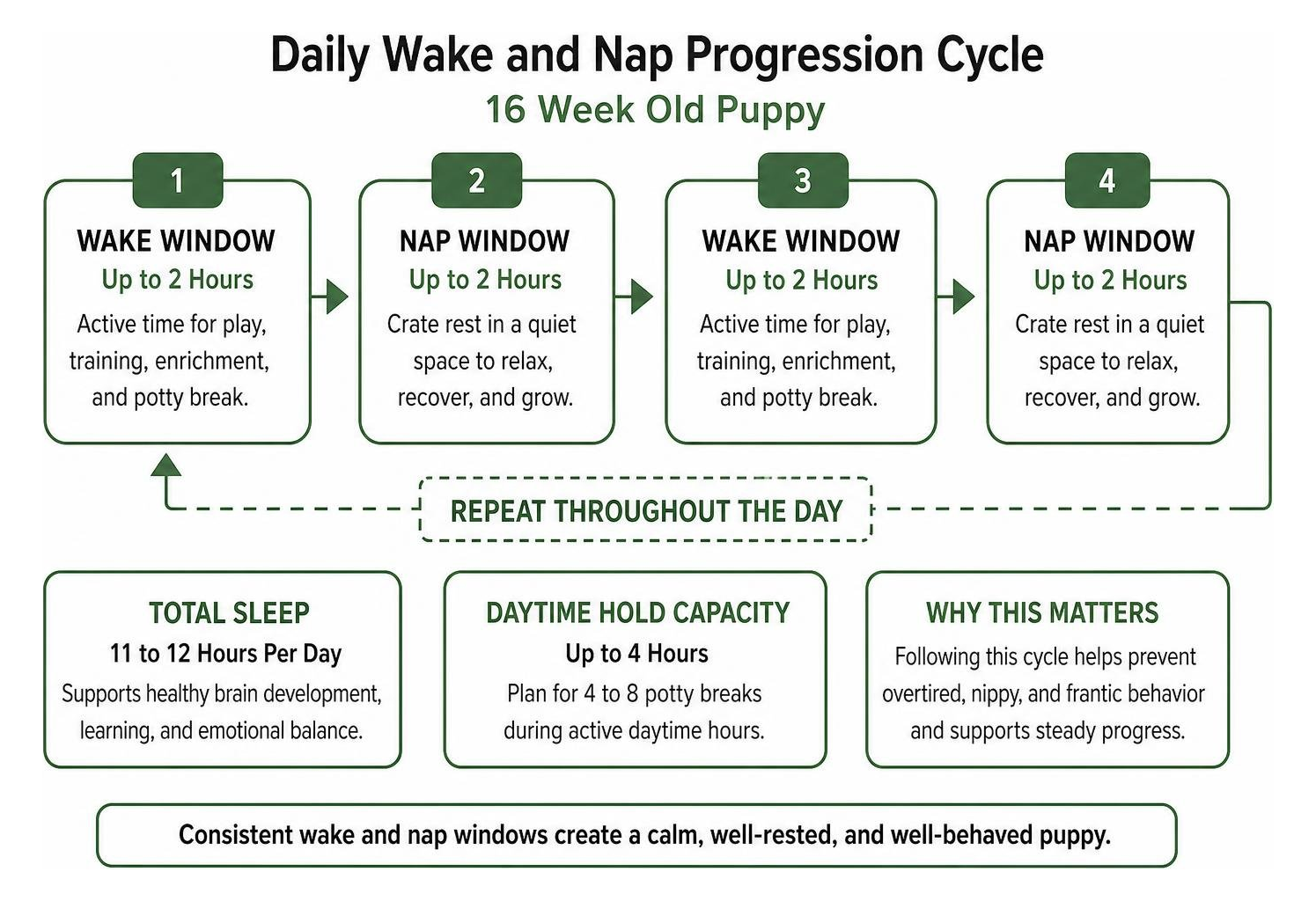
Structured crate rest is essential. Crates should serve as safe, quiet dens where your pup can switch off without household distractions. Keep training sessions short, around five to ten minutes, and follow active sessions with immediate rest to keep your pup emotionally balanced and receptive to daily guidance.
The Complete 4 Month Old Puppy Schedule: A Realistic Daily Routine
Puppies thrive on a predictable sequence of events rather than strict calendar precision. At 16 weeks, your pup is showing more independent exploratory behaviors. If you do not give them structure, they will invent their own entertainment, which usually involves chewing baseboards, chasing household pets, or digging in the yard.

A solid daily schedule balances physical relief, proper nutrition, mental stimulation, clear boundaries, and structured downtime. Having consistent morning, midday, and evening blocks prevents confusion and makes household management straightforward. If you need a customized framework based on your exact work hours, our housebreaking schedule generator is a great tool to map out your day.
Step-by-Step Breakdown of a 4 Month Old Puppy Schedule
Here is a practical schedule outline designed for real life:
| Time Block | Primary Activity | Focus & Details |
|---|---|---|
| 7:00 AM | Wake Up & Potty | Immediate outdoor relief, light praise, fresh water. |
| 7:30 AM | Breakfast & Training | Mealtime combined with 5 minutes of basic impulse control. |
| 8:00 AM | Potty & Short Walk | Bathroom trip, structured leash walk around the block. |
| 9:00 AM – 12:00 PM | Morning Nap | Structured rest in a quiet crate or exercise pen. |
| 12:00 PM | Midday Potty & Play | Bathroom trip, active play, midday meal (if on 3 meals). |
| 1:00 PM – 4:00 PM | Afternoon Nap | Uninterrupted quiet rest window. |
| 4:00 PM | Potty & Mental Work | Quick relief, short obedience practice, chew toy session. |
| 6:00 PM | Dinner & Evening Relief | Evening meal, outdoor bathroom break, calm family time. |
| 7:30 PM | Low Key Play & Settle | Gentle interaction, redirecting chewing to safe toys. |
| 9:30 PM | Final Nighttime Outing | Quiet, business only bathroom trip right before bed. |
Feeding, Training, and Safe Socialization Priorities
Nutrition needs shift at four months based on size. Small breed dogs can often decrease meals from three times daily to two times daily at this age. Medium, large, and giant breed dogs still need meals three times a day to support rapid skeletal growth and steady blood sugar.
Rapid eaters present a different challenge. If your dog inhales food in seconds, it can cause digestive upset or gas. Implementing strategies from does your pup eat too fast? Puppy training methods for speed eaters helps slow intake and provides mental exercise through slow feeders or training games.
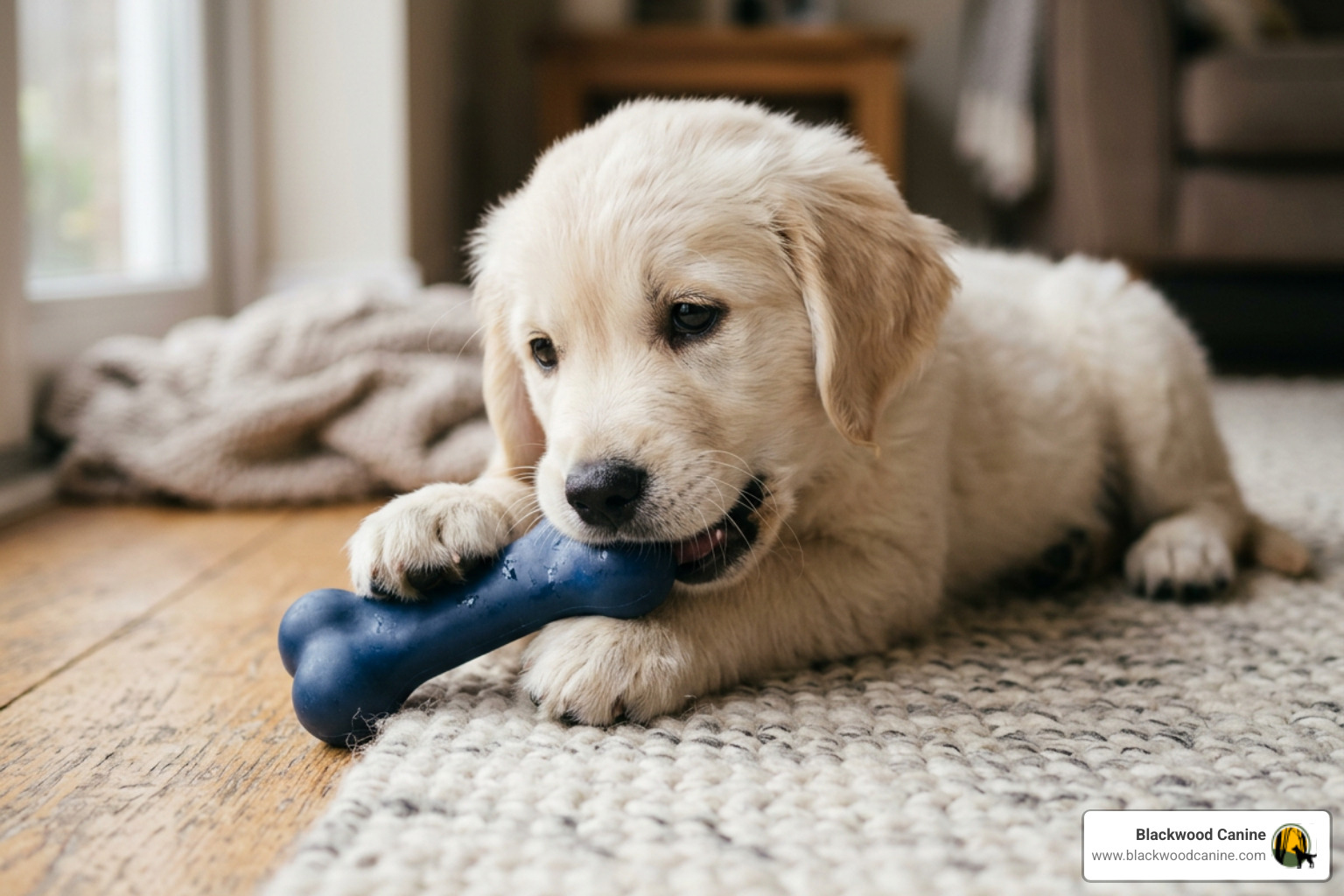
Teething management also directly affects daily behavior. With adult incisors coming in, puppies experience mouth pain that drives intense chewing. Over 80 percent of dogs develop dental disease before three years old, so this is the ideal window to introduce gentle handling and tooth brushing. If sore gums lead to mouthy behavior on your arms, check out is your pup a nipper? Try these puppy trainer tips to stop biting for clear redirection techniques. Four months is also a common time to complete microchipping and ensure collar identification is secure.
Post-Vaccination Socialization and Basic Manners
The 16 week mark typically coincides with the final round of core puppy vaccinations (DA2PP and rabies). Once your veterinarian gives the all clear, you can expand your puppy's world.
Socialization at this stage is not about letting your dog greet every person and dog they see. True socialization means teaching your puppy to remain neutral, calm, and attentive in novel environments.
Key priorities right now include:
- Leash Manners: Walking politely without pulling toward distractions.
- Impulse Control: Waiting at open doorways and sitting calmly before meals.
- Clear Boundaries: Rewarding calm behavior and stepping in with fair management when the pup gets unruly.
- Bite Inhibition: Teaching soft mouth pressure and redirecting to acceptable chew toys.
Building reliable responses requires real structure. Reviewing the essentials of basic obedience dog training will help you establish consistent communication, clear expectations, and effective management every day.
Frequently Asked Questions About 4-Month-Old Puppies
How long can a 4-month-old puppy hold their bladder?
A common guideline is one hour per month of age. At four months old, most puppies can hold their bladder for roughly four hours while awake, provided they are not actively exercising or drinking excessive water. During overnight sleep, their metabolic rate slows down, allowing many 16 week old puppies to sleep six to eight hours without needing a bathroom break.
How many meals should a 4-month-old puppy eat each day?
Meal frequency depends heavily on your puppy's breed and mature size:
- Small breeds: Can often transition from three meals to two meals per day at four months.
- Medium, large, and giant breeds: Should remain on three meals per day until roughly six months old to ensure steady nutrient absorption and avoid overburdening their digestive tracts.
Always check with your veterinarian to verify proper caloric intake for your puppy's growth rate.
Why is my 4-month-old puppy suddenly chewing everything?
Sudden, intense chewing at 16 weeks is usually caused by the eruption of adult incisors and premolars. The pressure of adult teeth pushing through sore gums creates a strong urge to bite hard surfaces. Provide durable rubber chew toys, frozen washcloths, or chilled safe chews to give relief, and manage their access to shoes, cords, and furniture.
Practical Steps for a Confident, Well Mannered Companion
Raising a four month old puppy takes patience, clarity, and real follow through. Training is far more than teaching a couple of tricks. It requires clear expectations, fair boundaries, consistent management, and steady repetition across your entire household. When you give your puppy a reliable daily rhythm, you eliminate confusion and set them up to thrive.
If you are dealing with persistent schedule disruptions, potty regression, or mounting frustration, having professional support makes all the difference. Our basic obedience foundation training starts at 4 weeks of structured work, giving you the practical tools and management strategies needed for long term success. For complex behavioral challenges, we provide comprehensive 6 week and 8 plus week programs.
Ready to replace stress with reliable teamwork? Take the next step with our Puppy Jump Start Program and build a solid foundation that lasts a lifetime.
The Definitive Guide to Aggressive Dog Training in Portland, Oregon
Identifying Causes and Triggers of Canine Aggression

Understanding why your dog acts out is the first step toward fixing the problem. Aggression does not happen in a vacuum. It is usually an emotional reaction to an internal or external trigger. When a dog feels threatened, cornered, or overwhelmed, their natural survival instinct kicks in.
Common root causes include:
- Fear and anxiety: Dogs that feel unsafe often use aggression as a preemptive strike to make the scary thing go away. We often see this when owners seek dog training for fearful dogs after early nervousness turns into defensive snapping.
- Medical issues and physical pain: Underlying issues like hip dysplasia, dental infections, arthritis, or thyroid imbalances can drastically lower a dog's tolerance. For any sudden behavioral shift, a comprehensive veterinary exam is essential to rule out hidden discomfort before adjusting your training plan.
- Resource guarding: A dog may feel compelled to protect high value items such as food, chew toys, favorite resting spots, or even specific family members.
- Territorial behavior: Barking, charging, or fence fighting triggered by people or animals approaching the home, yard, or vehicle.
- Genetic predispositions and past trauma: While genetics provide a baseline for drive and sensitivity, early socialization gaps or past negative experiences can intensify defensive reactions.
Warning Signs Versus Typical Reactivity
Owners frequently confuse leash reactivity with true aggression, though the two require different handling approaches. Reactivity is often an overreaction to normal stimuli, usually driven by barrier frustration, excitement, or mild social uncertainty. True aggression involves the intent to do harm or force another individual away through physical threats.
Learning to read the canine ladder of aggression helps you step in before a situation boils over. Watch for these progressive warning signs:
- Yawning, lip licking, and turning the head away
- Stiffening of the body and sudden stillness (the freeze response)
- A hard, fixed stare with dilated pupils
- Low growling and showing front teeth
- Snapping, air biting, lunging, and direct contact bites
Recognizing these cues early is crucial. By understanding and transforming reactive dog behavior, you can manage your dog's distance before their stress levels spike out of control.
High Density Urban Stressors in the Pacific Northwest
Living in the Pacific Northwest presents specific behavioral hurdles. In neighborhoods throughout Portland, close quarters make it difficult for sensitive dogs to decompress. Narrow walking paths, crowded apartment corridors, coffee shop patios, and popular green spaces put dogs face to face with unexpected triggers daily.
Uncontrolled, off leash dogs in public parks are a primary source of stress for reactive pets. When an off leash dog runs up to a leashed, insecure dog, the leashed animal feels trapped and defenseless. Over time, these repeated surprise interactions teach the dog that they must defend themselves before the other animal gets too close.
Proven Protocols for Aggressive Dog Training Portland Oregon
Standard obedience work like teaching basic sits and downs is not enough to resolve aggression. While obedience gives you functional control, it does not alter how your dog emotionally interprets a scary situation. Modifying deep seated behavioral issues requires a comprehensive, balanced framework.
| Training Element | Standard Obedience Training | Behavioral Modification Protocol |
|---|---|---|
| Primary Focus | Teaching specific physical positions | Altering underlying emotional states and impulse control |
| Environmental Setup | Low distraction, controlled spaces | Strict threshold management in real world environments |
| Handling Mechanics | Basic leash manners and cue delivery | Spatial awareness, defensive handling, and clear communication |
| Core Method | Repetition and simple reward schedules | Desensitization, counter conditioning, and neural resetting |
| Owner Involvement | Practicing daily cues | Overhauling home structure, boundaries, and daily routines |
To reshape dangerous habits, our specialized behavior modification training addresses the root emotional triggers rather than just masking the symptoms.
Behavior Modification and Neural Resetting
When a dog constantly encounters triggers, their body remains flooded with stress hormones like cortisol and adrenaline. This phenomenon, known as trigger stacking, means small events accumulate throughout the day until the dog explodes over a minor stimulus.

Breaking this cycle requires systematic desensitization and counter conditioning. We expose the dog to their trigger at a safe distance where they remain calm, then build positive associations using high value rewards. Over time, advanced re conditioning shifts the dog's conditioned emotional response from panic or defense to neutral engagement with the handler. Our behavior modification guide 2026 explains how consistent routines help clear chronic stress from the nervous system.
Core Methods in Aggressive Dog Training Portland Oregon
Sustainable behavior modification relies on four core pillars:
- Threshold Management: Working strictly at distances where the dog can process information without panic.
- Clear Leash Communication: Using directional leash pressure to guide and support the dog rather than relying on frantic pulling or shouting.
- Structured Obedience with Boundaries: Implementing fair expectations, clear rules, and consistent follow through at home to establish security.
- Balanced Reinforcement and Fair Consequences: Rewarding calm choices generously while using clear, humane boundaries to stop dangerous behaviors from rehearsing. Training tools are never about punishment; when used properly under professional guidance, they offer clear feedback that keeps everyone safe.
Through structured reactive dog training, dogs learn how to check in with their owners instead of making poor, fear driven decisions.
Legal Guidelines, Safety Protocols, and Program Structures
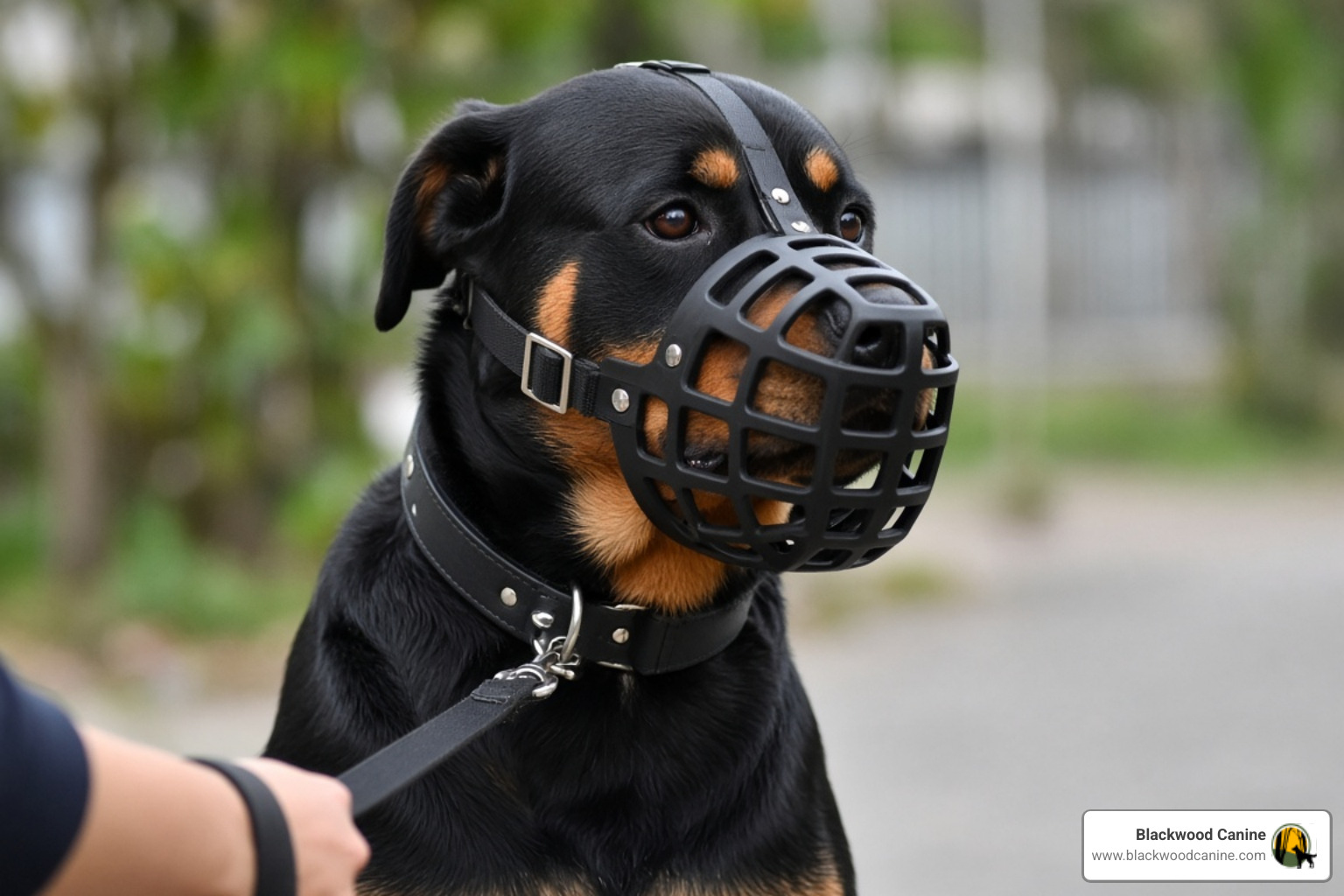
Handling an aggressive dog comes with legal obligations. Under local ordinances across Multnomah, Washington, and Clackamas counties, dog owners are strictly liable for injuries or property damage caused by their pets.
Local regulations dictate that:
- Dogs must remain on a secure leash in all non designated public areas.
- If a dog bites and breaks skin, a mandatory ten day quarantine period is enforced by Multnomah County Animal Services to monitor for rabies.
- Dogs involved in repeated or severe aggressive incidents may be formally classified as potentially dangerous or dangerous, requiring specific insurance policies, posted warning signs, and mandatory muzzling in public.
Community Safety Measures and Essential Gear
Keeping the community safe while rehabilitating a dog is non negotiable. You should never feel embarrassed about using safety tools that prevent accidents.
- Baskerville or Wire Basket Muzzles: A properly fitted basket muzzle allows the dog to pant, drink water, and take treats while eliminating the risk of a bite.
- Double Leash Systems: Attaching one leash to a flat collar and a secondary line to a sturdy harness or backup collar prevents accidental escapes if a clip fails.
- Visual Identifiers: Bright leashes or vests labeled "Needs Space" help alert other pedestrians to give you a wide berth.
- Defensive Walking Strategies: Always scan ahead, use parked cars or hedges as visual barriers, and do not hesitate to turn around to avoid an approaching off leash animal.
Program Timelines for Aggressive Dog Training Portland Oregon
Rehabilitating defensive habits takes dedicated time and real repetition. There are no safe overnight fixes for complex behavioral problems.
Our programs are built on realistic, tested timelines:
- Foundation Programs (4 Weeks Minimum): Our basic obedience foundation starts at four weeks. We do not offer programs shorter than four weeks because establishing baseline focus, reliable communication, and impulse control requires steady repetition.
- Moderate Behavior Modification (6 Weeks): Ideal for dogs with severe leash reactivity, mild resource guarding, or moderate fear issues that need systematic counter conditioning.
- Complex Rehabilitation (8+ Weeks): Reserved for dogs with known bite histories, severe territorial aggression, or deep seated trauma requiring intensive behavioral overhauls.
For dedicated immersion away from daily household triggers, our comprehensive dog behavior camp provides structured daily routines and steady environmental exposure.
Frequently Asked Questions About Canine Aggression
What is the difference between reactivity and true aggression?
Reactivity is an exaggerated reaction to an everyday stimulus, often fueled by frustration, barrier restriction, or overexcitement. A reactive dog may bark and lunge while on leash, but if given off leash freedom, they often lack the intent to harm. True aggression is marked by offensive posturing, calculated lunging, stiff freezes, and deliberate attempts to bite or drive the threat away through physical force.
How much time does it take to rehabilitate an aggressive dog?
Rehabilitation timelines depend on the dog's bite history, genetics, age, and owner consistency. Real progress usually begins within four to six weeks of steady, structured work. However, complex cases often require eight or more weeks of intensive work, followed by months of consistent at home reinforcement to solidify reliable habits.
Can an aggressive dog ever be completely cured?
Aggression is managed and modified rather than cured like an infection. With consistent training, proper boundaries, and clear communication, the vast majority of dogs can live safe, balanced, and stress free lives. However, handlers must remain mindful of their dog's thresholds, maintain daily management routines, and avoid putting their dog into overwhelming situations without support.
Restoring Peace and Rebuilding Trust with Your Dog
Living with an aggressive dog can feel isolating. It is normal to feel frustrated, embarrassed, or anxious every time you clip on the leash or open your front door. You do not have to navigate this process alone, and you do not have to accept a life of constant tension.
Successful rehabilitation comes down to three elements: clear communication, practical management, and persistent follow through. When you replace guesswork with a structured plan, your dog learns they no longer need to defend their space, and you regain peace of mind.
For families in Scappoose, St. Helens, Warren, Bethany, Hillsboro, Beaverton, Portland, and Vancouver who are ready for dependable, hands on support, our immersion dog training programs offer a clear path forward. Let us help you build a safe, reliable relationship with your dog. Reach out today to set up your Good Dog Game Plan and take the first step toward lasting change.
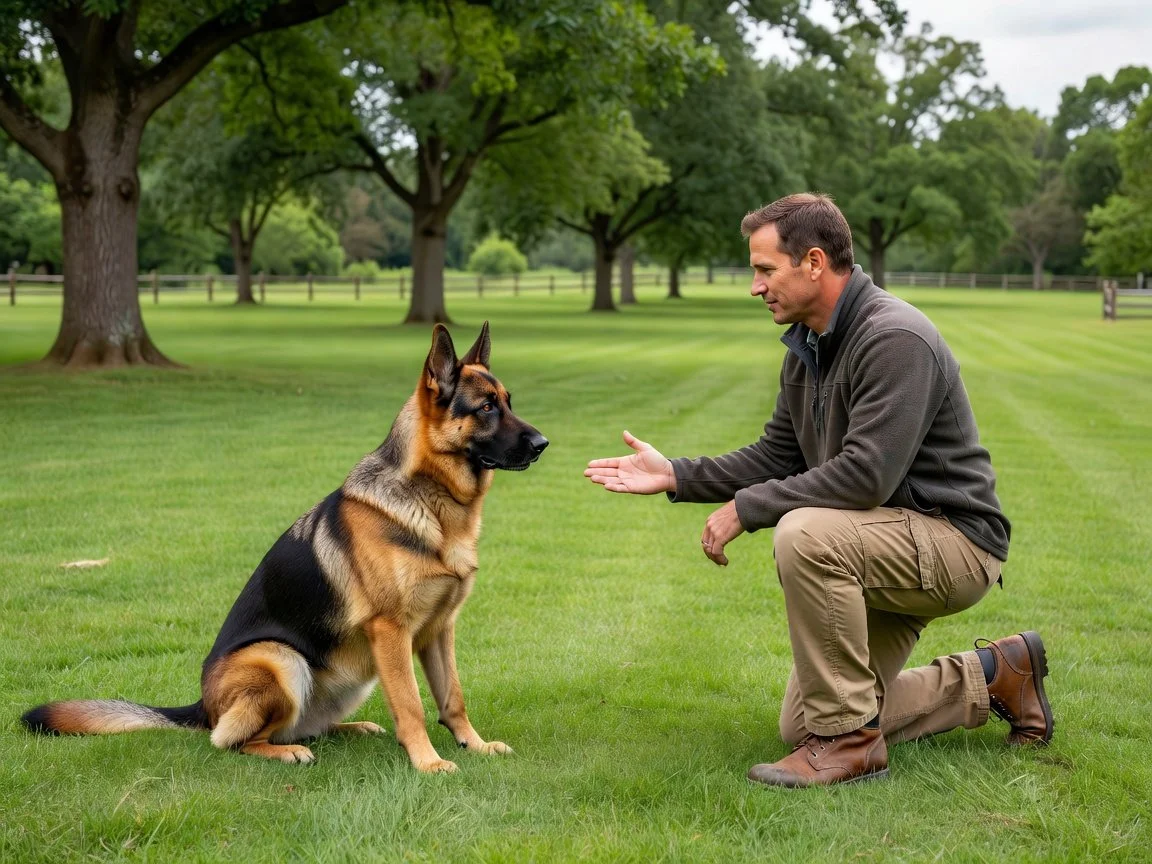
The Definitive Guide to a Dog Behavior Modification Program
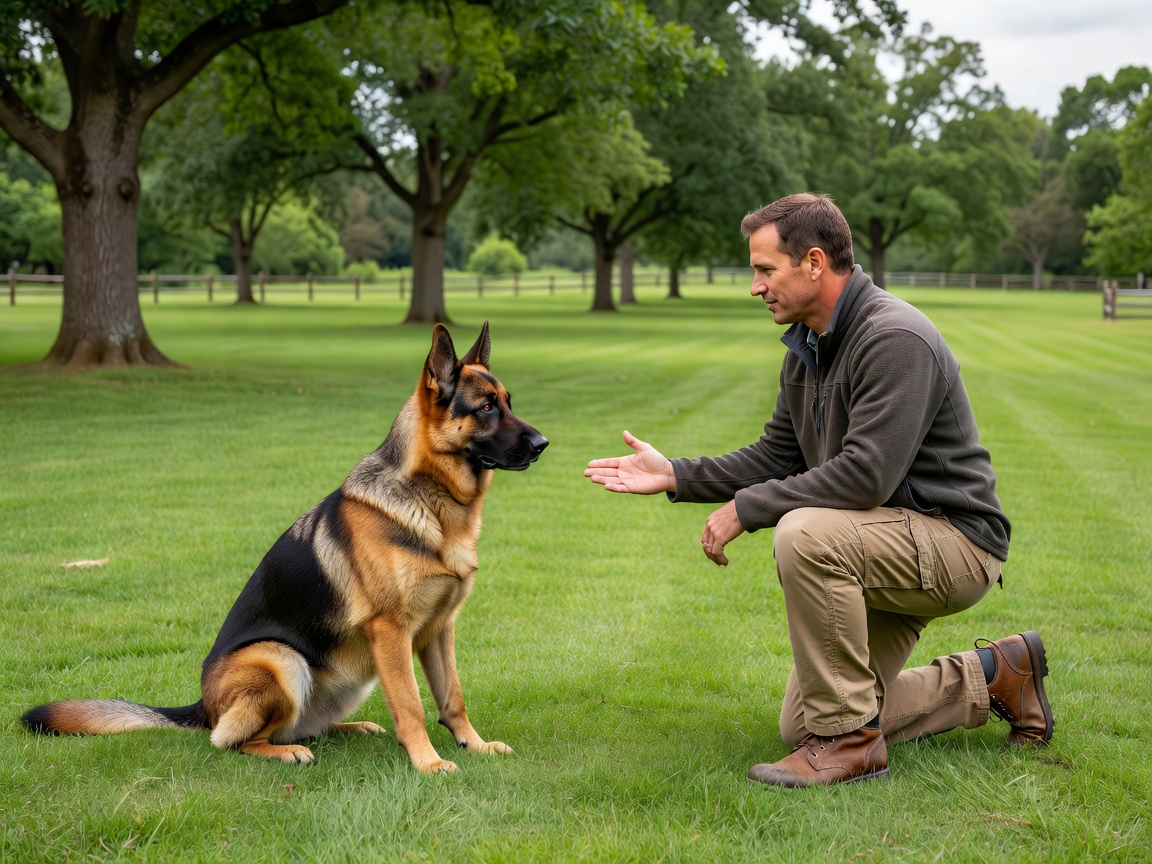
Obedience Training vs. a Dog Behavior Modification Program
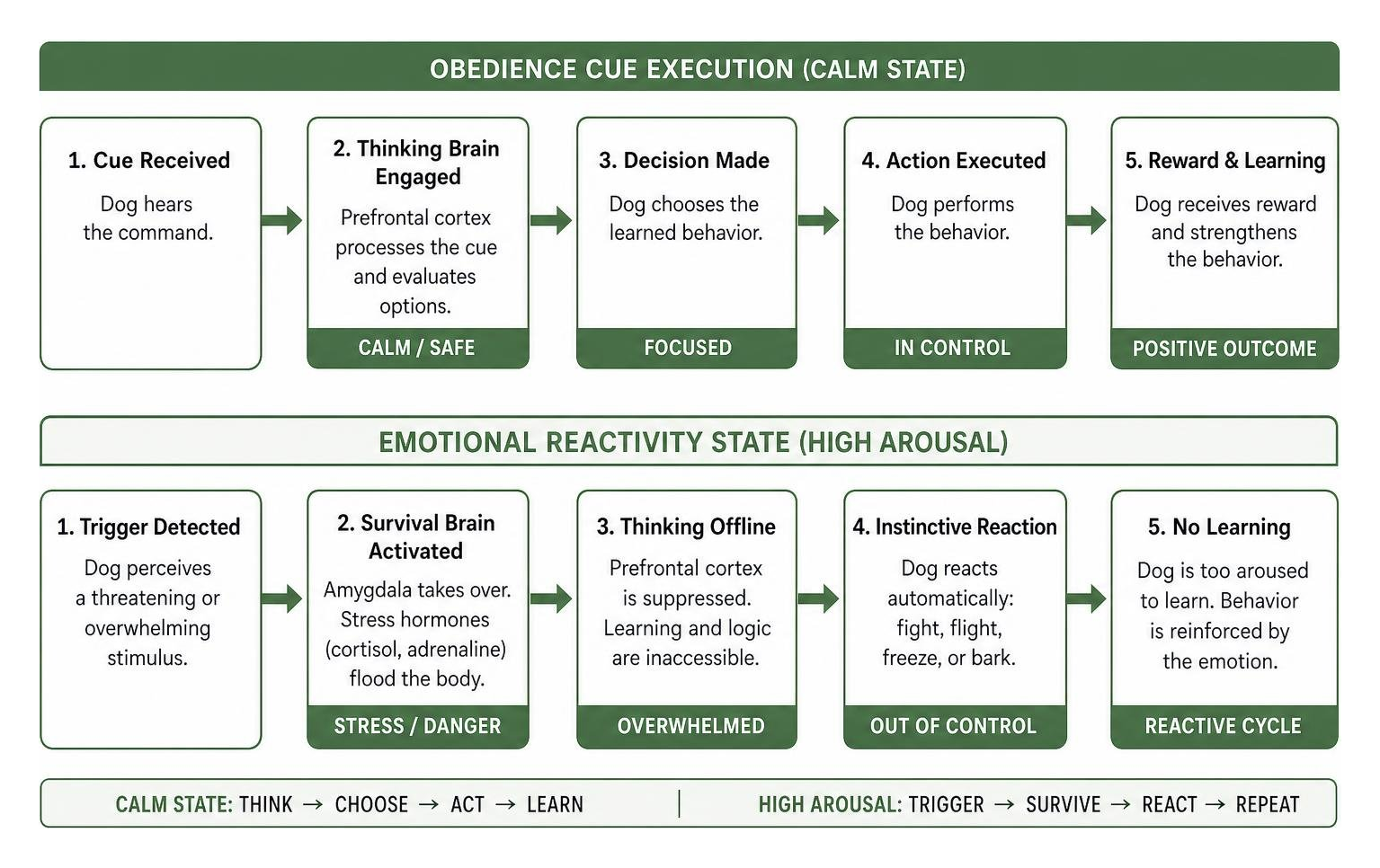
Many dog owners assume that if their dog acts out, they just need more obedience lessons. They practice sit, down, and heel in the living room until the dog is perfect. Then they step outside, see a trigger, and watch the training vanish.
Obedience training focuses on skill acquisition. You give a verbal cue, the dog performs a physical action, and you reward them. This works great when a dog is calm and capable of thinking through their choices.
However, a dog behavior modification program targets the root cause of panic responses and deep seated reactivity. When a dog lunges at a passing car or snarls at a stranger, they are not acting out because they forgot the sit cue. They are reacting to an intense emotional state like fear, frustration, or guard drive. Asking a terrified or over aroused dog to focus on a sit command is like asking a human to solve a algebra problem while running from a bear.
Understanding these emotional drivers is crucial for lasting change. You can read more about these underlying dynamics in our guide on understanding and transforming reactive dog behavior.
How Skill Training Differs from Emotional Reconditioning
When a dog experiences fear or reactivity, their brain releases stress hormones like cortisol and adrenaline. Their heart rate spikes, pupils dilate, and their central nervous system shifts into survival mode.
During these high arousal states, the brain struggles to process complex operational skills. Standard obedience commands fall short because they require cognitive thought, which gets bypassed during a fight or flight reaction.
Behavior modification works by changing the emotional association connected to a specific trigger. Instead of suppressing the outward behavior, reconditioning changes how the dog internalizes the situation. If you shift the emotion from fear to calm neutrality, the unwanted outward reaction disappears naturally. If you feel guilty about your dog's current behavior, check out our piece on how to stop feeling guilty about your reactive dog.
Determining What Your Dog Needs
Knowing whether your dog requires standard training or emotional reconditioning comes down to context and intent. Ask yourself what is driving the behavior:
- Standard Skill Deficit: Your dog runs through the open front door because they never learned a solid stay cue. They are happy, interested in sniffing grass, and easily recalled with high value food.
- Emotional Reaction: Your dog lunges at the door, bark aggressively, and ignore food treats because they hear a neighbor walking past. Their body is stiff, hackles are raised, and their focus is locked on the trigger.
Dogs showing fear responses, extreme leash lunging, a history of bite incidents, or an inability to calm down require specialized intervention. A structured plan helps handler control by establishing clear boundaries and safety protocols while working through underlying stress.
Core Science and Techniques Behind Behavioral Change
Behavior modification relies on established learning theory principles. Dogs are constantly learning through classical conditioning (involuntary emotional associations) and operant conditioning (voluntary behaviors shaped by consequences).
To make progress, training must happen below a dog's emotional threshold level. The threshold is the boundary line where a dog notices a trigger but remains calm enough to process information. Once a dog crosses that line into barking or lunging, learning stops and stress management takes over.
For a scientific breakdown of these foundational concepts, consult the MSD Veterinary Manual guide on behavior modification.
Core Techniques in a Dog Behavior Modification Program
A professional plan uses specific behavioral principles tailored to your dog's unique needs.
- Desensitization: Exposing the dog to a trigger at a very low intensity so they notice it without reacting. Over time, the intensity or proximity is gradually increased.
- Counterconditioning: Changing the dog's emotional feeling toward a trigger by pairing its presence with high value rewards.
- Response Substitution: Teaching the dog an alternative, incompatible behavior to replace the bad one, like walking into a heel position instead of lunging.
- Habituation: Passive exposure to everyday non threatening background stimuli until the dog naturally tunes them out.
- Shaping: Rewarding small incremental steps toward a final desired behavior.
When you block or eliminate reinforcement for an unwanted behavior, you may encounter an extinction burst. This is a brief, temporary increase in the behavior's intensity before it drops off. Owners often assume the training is failing when, in reality, the dog is just trying harder before finally giving up the habit.
| Technique | Goal | Method | Safety Level |
|---|---|---|---|
| Desensitization | Reduce emotional sensitivity | Gradual exposure starting below threshold distance | High |
| Counterconditioning | Change negative emotion to positive | Pair trigger with high value rewards continuously | High |
| Flooding | Force suppression through prolonged exposure | High intensity exposure with no escape allowed | Low (High risk of trauma) |
Understanding these approaches helps owners avoid outdated dominance claims. You can read more in our article covering positive reinforcement vs dominance training.
Identifying Triggers and Reading Canine Body Language
Dogs talk with their bodies long before they ever growl or bark. Recognizing subtle precursor signals allows you to step in before your dog loses control.
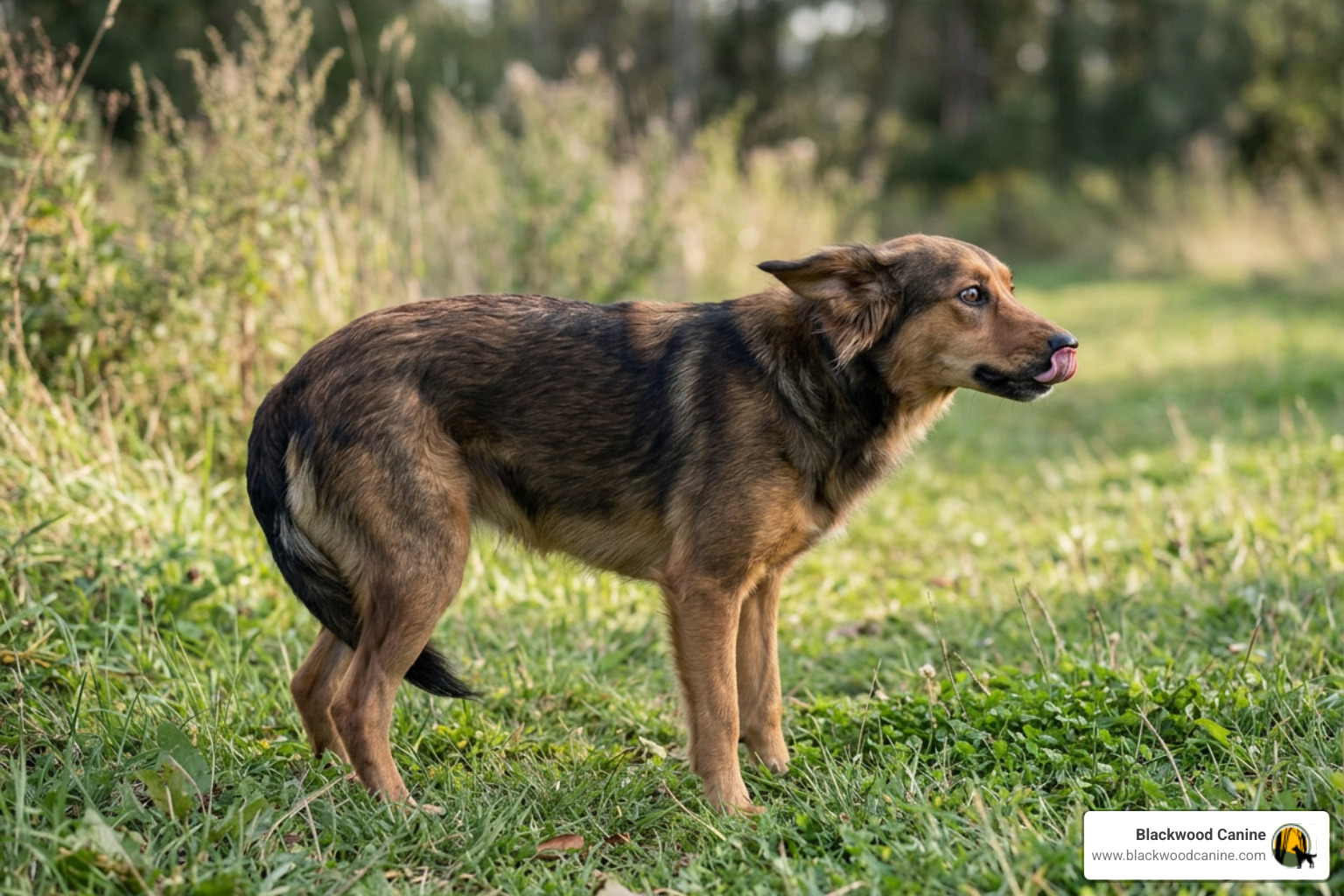
Watch for early signs of stress:
- Lip licking or sudden yawning when no food or tiredness is present
- Facial muscle tension and hard eyes fixed on a specific direction
- Ear position pinned backward or held rigidly forward
- Tail stiffness, slow high tension wags, or a tucked tail
- Sudden cessation of panting or freezing in place
Recognizing these signals helps you implement distance management quickly, preserving your dog's sense of safety.
Step by Step Implementation for Fear, Anxiety, and Reactivity
Fixing severe reactivity requires a systematic, step by step approach. Trying to fast track the process only creates setbacks.
Start by setting up an environmental management plan to prevent your dog from practicing unwanted behaviors. Block window views, avoid peak dog walking hours in your neighborhood, and stop letting your dog react uncontrolled.
Learn more about our dedicated approach on our page covering reactive dog training.
Step by Step Exposure Drills for Reactive Dogs
When you are ready to begin controlled exposure work, follow these sequential steps:
- Find the Safe Trigger Distance: Identify how far away your dog can see a trigger while remaining relaxed and capable of taking food rewards.
- Mark and Reward Neutrality: The moment your dog notices the trigger from a safe distance, use a clear marker word and deliver a high value food reward.
- Build Structured Repetition: Repeat this pairing multiple times. You want the dog to look at the trigger and then look back at you expecting a reward.
- Maintain Handler Calmness: Keep the leash loose. Tightening your grip creates tension and signals to your dog that danger is near.
- Slowly Close Distance: Over weeks, gradually shorten the distance to the trigger in small increments, keeping your dog comfortable.
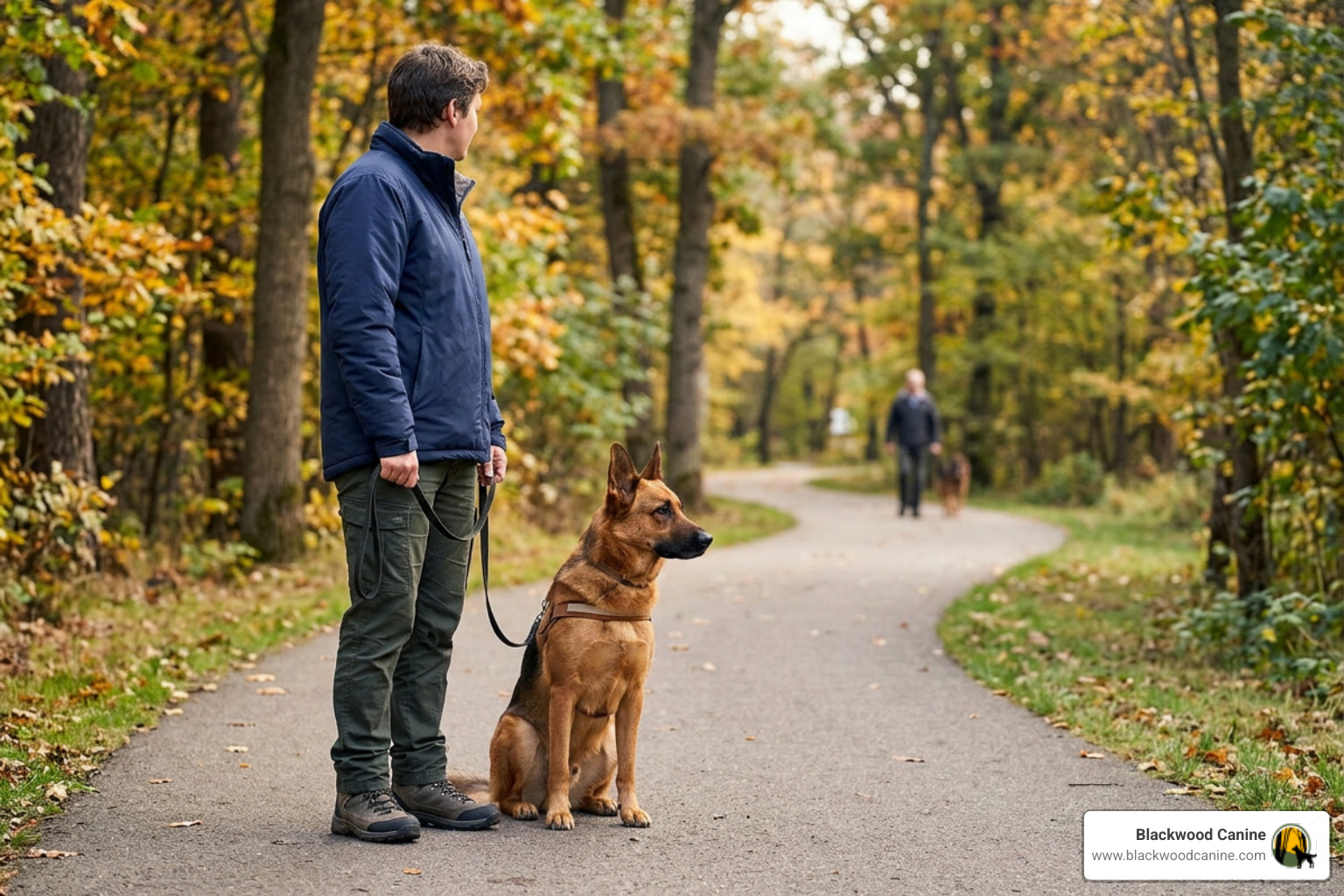
For dogs struggling with deep underlying fear, explore our targeted guide on dog training for fearful dogs.
Avoiding Common Modification Mistakes
Even well intentioned pet owners accidentally undermine their own progress. Watch out for these common errors:
- Inconsistent Rules: Allowing a behavior on some days but correcting it on others creates confusion and frustration.
- Rushing Exposure: Moving closer to triggers before your dog has built emotional stability at wider distances.
- Rewarding Anxiety: Petting and soothing a dog while they are actively trembling or panicking can accidentally reinforce fearful state.
- Accidental Reinforcement: Yielding space or dropping boundaries when the dog throws a tantrum.
Handler failure usually comes down to moving too fast without establishing a solid foundation of daily household boundaries first.
Timeline, Expectations, and the Role of Medication
Behavior modification is a marathon, not a sprint. Rebuilding entrenched neural pathways takes steady repetition and consistent home management.

Every dog moves at their own pace, and set backs are normal. Keeping daily records helps track real progress over weeks and months rather than focusing on day to day fluctuations.
How Long Does a Dog Behavior Modification Program Take?
We do not offer quick fixes or training programs shorter than 4 weeks because genuine behavioral change requires dedicated time.
- 4 Week Minimum: Standard timeline to establish foundational obedience skills and basic clear communication.
- 6 Week Timeline: Typical minimum length for addressing mild to moderate behavior modification, reactivity, and impulse control issues.
- 8 Plus Week Timeline: Essential duration for complex behavior modification involving severe leash aggression, resource guarding, or high fear issues.
Real success relies on owner consistency once formal sessions end. Continued home management ensures long term stability.
When to Involve a Vet or Consider Behavioral Medication
In severe cases, a dog's baseline stress level remains too high for them to learn, even at extended distances. When fear or generalized anxiety dominates their daily existence, consulting a veterinarian or board certified veterinary behaviorist is a wise step.
Targeted pharmaceutical support like SSRIs (such as fluoxetine) can help lower systemic stress and raise the threshold for emotional panic.
Medication is not a magic fix. It acts as a supportive tool to open a window where learning can happen. It must always be combined with active behavior modification and environmental management.
Frequently Asked Questions About Dog Behavior Modification
How do I choose between a certified trainer and a veterinary behaviorist?
Look for trainers with verifiable experience handling severe behavioral issues using clear communication, realistic management, and balanced principles. Be cautious of red flag guarantees that promise 100% fixes within set timeframes. If your dog exhibits unprovoked aggression, sudden severe behavioral shifts, or intense self harm, consult a veterinary behaviorist to evaluate potential neurological or physical causes.
Can an older dog with a bite history still be rehabilitated?
Yes. Age itself is rarely a barrier to learning, though long standing habits take longer to reshape. When dealing with a bite history, safety comes first. Utilizing proper management equipment like muzzles, crate routines, and leash boundaries is essential. Check out our detailed approach to advanced reconditioning to see how deep seated patterns can be addressed safely.
Why did basic command training fail to fix my dog lunging on walks?
Basic commands fail on walks because they target physical compliance rather than underlying emotional arousal levels. When adrenaline spikes, the brain prioritizes survival instincts over learned cues like sit or stay. Until you lower your dog's emotional reactivity and teach them how to handle environmental stress, physical cues will fall apart under pressure.
Taking the Next Step for Your Dog
Dealing with a reactive, anxious, or aggressive dog is exhausting. It strains walks, causes home stress, and makes simple daily activities feel overwhelming.
At Blackwood Canine, we specialize in helping owners move past frustration by using clear communication, structured management, and fair expectations. We support clients across Scappoose, St Helens, Warren, Bethany, Hillsboro, Beaverton, Portland, Vancouver, and nearby communities.
If you are ready to take control, our Behavior Modification Training program provides the roadmap you need. The best place to start is with our Good Dog Game Plan, where we evaluate your dog in person and design a practical, real world path forward. Reach out to us today to get started.

A Practical Guide to Your 3 Month Old Puppy Schedule
Why a Structured 3 Month Old Puppy Schedule Brings Peace to Your Home
Your twelve week old puppy is nipping at your ankles, having accidents on the rug minutes after coming inside, and collapsing into sudden overtired tantrums. Raising a young pup can feel overwhelming when you do not have a predictable rhythm.
A reliable 3 month old puppy schedule follows a simple 1 hour awake, 2 hours asleep cycle designed around your dog's developing bladder and rapid brain growth:
- Sleep: 15 to 18 hours of total daily rest, split between nighttime sleep and 4 to 5 scheduled daytime naps.
- Potty Breaks: Every 2 to 3 hours while awake, plus immediately upon waking, 15 minutes after meals, and right after play (6 to 10 breaks per day).
- Feeding: Three balanced meals daily (morning, noon, and early evening) to maintain steady blood sugar.
- Training & Enrichment: Short 5 to 10 minute learning sessions focused on foundational obedience, name recognition, and positive handling.
- Exercise: Brief 15 minute walks or backyard play sessions that protect growing joints.
I am David Wright, and I have spent over fifteen years helping owners replace frustrating puppy habits with clear structure by establishing an effective 3 month old puppy schedule. Let us look at how you can organize your day to give your puppy the rest, nutrition, and guidance they need.
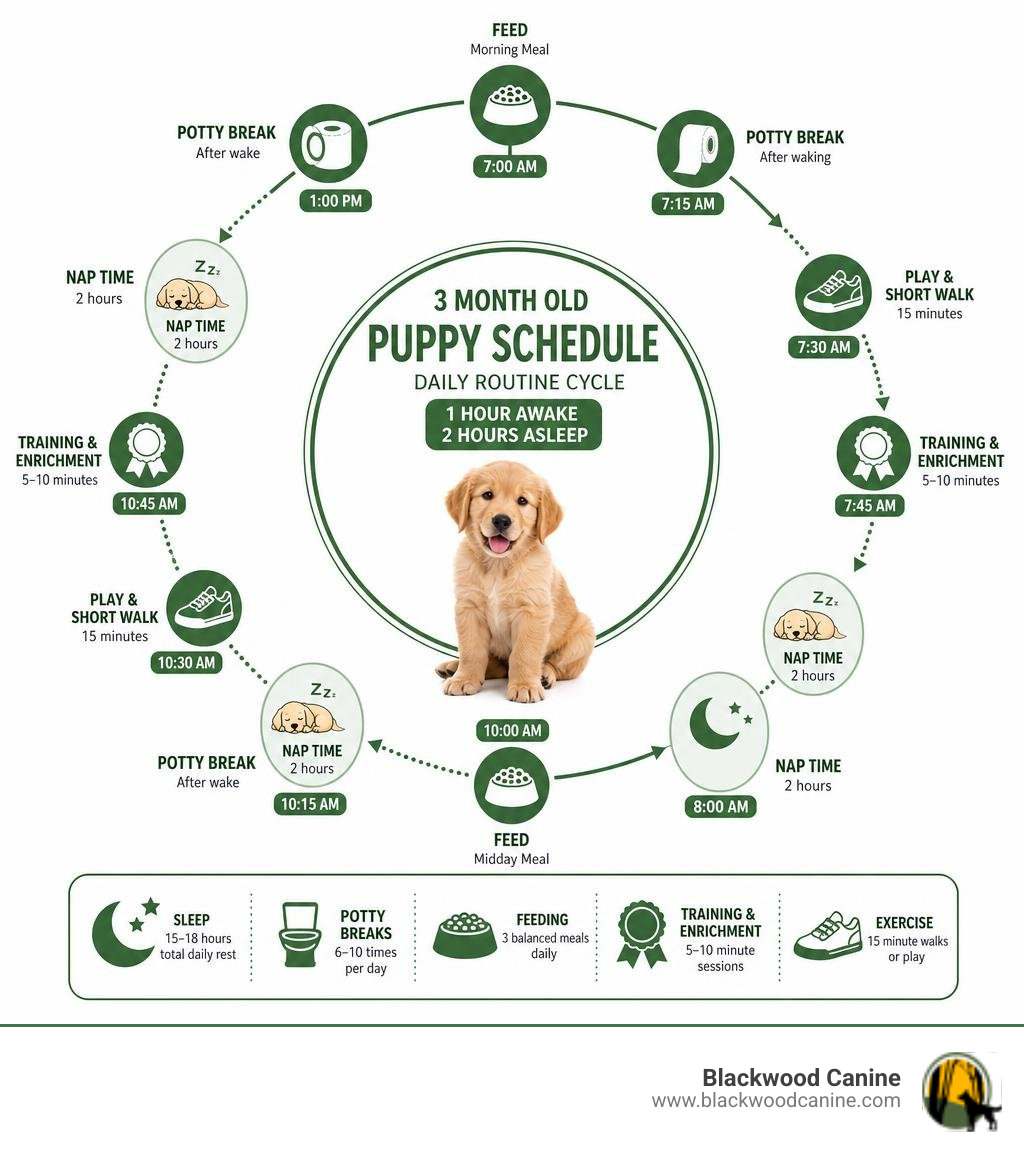
The Master 3 Month Old Puppy Schedule: An Hour-by-Hour Daily Routine
Young dogs thrive when their days follow a consistent pattern. At twelve weeks, ninety percent of your puppy's adult brain mass is already formed, yet their physical stamina and emotional regulation remain limited. When you set up predictable wake, eat, potty, and nap windows, you eliminate guesswork for both yourself and your pup.
| Time Window | Primary Focus | Key Activities & Management |
|---|---|---|
| Morning (6:30 AM – 11:30 AM) | Wake up, breakfast, potty, and nap | Immediate outdoor trip, morning meal, 5 minute foundation training, followed by a quiet 2 hour nap |
| Midday (11:30 AM – 4:30 PM) | Lunch, enrichment, potty, and rest | Midday meal, sniffing game, outdoor potty break, crate or pen nap |
| Evening (4:30 PM – 9:00 PM) | Dinner, gentle play, wind down, bedtime | Evening meal, calm chew session, last outdoor break, lights out |
Morning Routine: Wake Up, Breakfast, and First Potty
The day begins around 6:30 AM. The second your puppy wakes up, lift them out of the crate and take them directly outside to their designated elimination spot. Do not stop to brew coffee or check your phone. At this age, muscle control over the bladder is still developing, so moving straight to the grass avoids immediate accidents.
Once they eliminate outside, offer praise and head indoors for breakfast at 7:00 AM. Ingesting food triggers the gastrocolic reflex, which stimulates the lower digestive tract within fifteen to twenty minutes. Keep your puppy under direct supervision after they finish eating, then take them back outside for their second potty trip around 7:20 AM.
Spend the remaining twenty minutes of the awake window on quiet interaction: fresh water access, gentle handling, and a quick five minute practice of their name and foundational markers. By 7:45 AM or 8:00 AM, place your puppy in their crate or resting area for their morning nap.
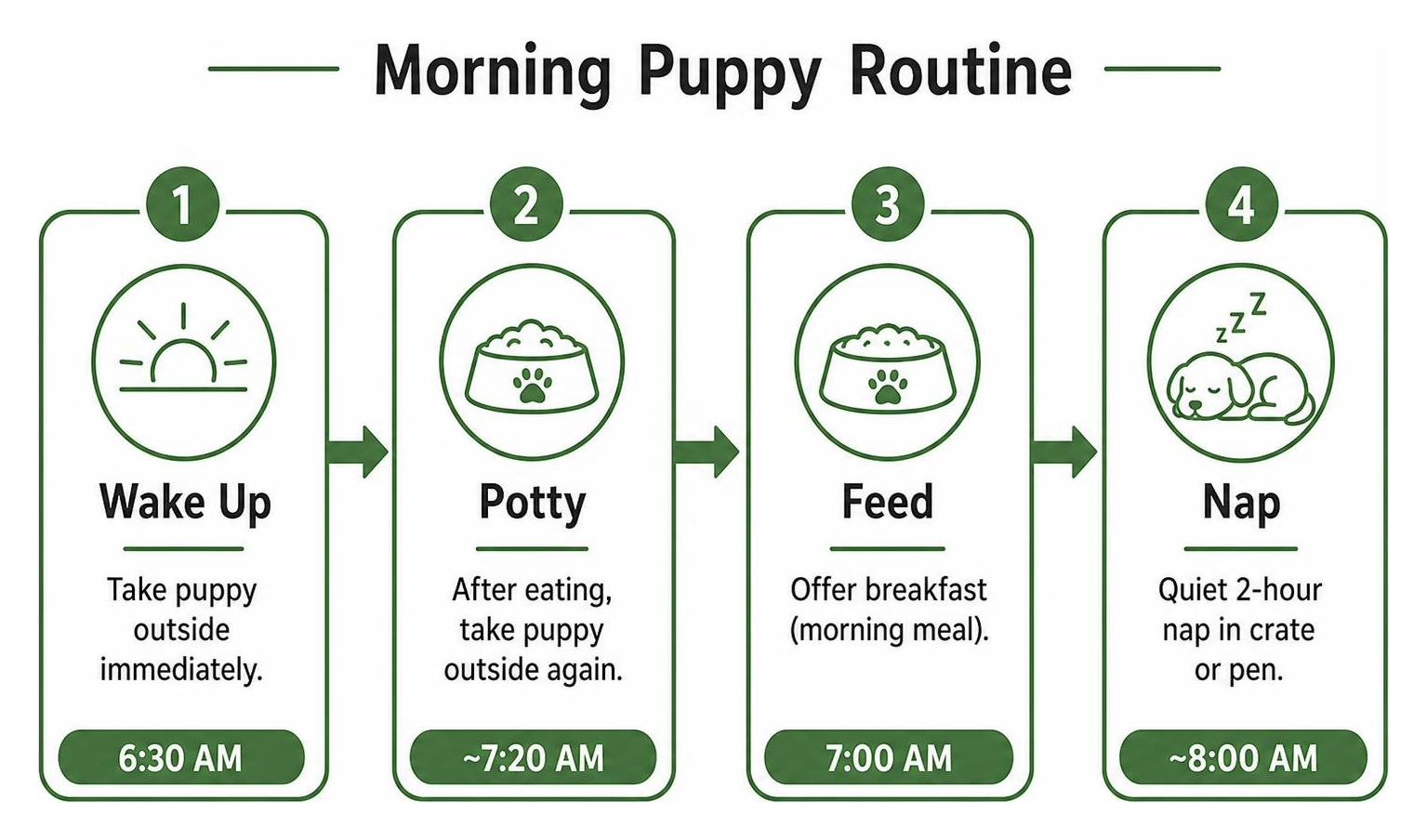
Midday Management: Lunch, Mental Stimulation, and Quiet Rest
At 11:30 AM, wake your puppy for their midday break. Head straight outside to relieve them before serving lunch. Distributing daily calories across multiple meals prevents drops in blood sugar, especially in toy and small breed puppies.
If you are coordinating household routines around work hours, our Housebreaking Schedule Generator helps you calculate precise outdoor intervals based on your dog's age. After eating, let your puppy explore an indoor puzzle toy or snuffle mat for ten minutes. Mental stimulation works their developing mind without stressing fragile growth plates. Finish with an outdoor potty break around 12:15 PM, then return them to their quiet sleep space for a solid midday nap until 2:30 PM or 3:00 PM.
Evening Wind-Down: Dinner, Bonding, and Bedtime
Late afternoon brings the final active blocks of the day. Around 5:00 PM, take your puppy outside, followed by their evening meal. Many puppies experience a burst of frantic energy between 6:00 PM and 7:30 PM, often called the witching hour. This sudden hyperactivity, accompanied by nipping and running, usually signals an overtired brain rather than a need for more intense exercise.
Help them settle by switching to low arousal activities. Practice light grooming with a soft brush, handle their paws and ears, and offer a safe chew. Reviewing proven puppy sleep guidelines can help you spot early fatigue cues before zoomies take over. Offer a final outdoor potty trip between 8:30 PM and 9:00 PM before tucking your puppy into their crate for the night.
Core Pillars of 12-Week Puppy Care: Sleep, Feeding, and Potty Training
Managing a young puppy boils down to three primary biological systems: sleep architecture, digestive pacing, and bladder development. Getting these three pillars aligned prevents the vast majority of common behavioral frustrations.

Structuring Sleep in Your 3 Month Old Puppy Schedule
Puppies at twelve weeks old need between 15 and 18 hours of total sleep every twenty four hours. Without structured rest, puppies become irritable, mouthy, and unable to focus. Following the one hour awake, two hours asleep pattern keeps cortisol levels balanced and supports memory consolidation.
Place the crate in a quiet, temperature controlled room away from foot traffic. Covering the crate with a breathable sheet creates a den environment that limits visual distractions. If your puppy struggles to settle, a consistent wind down routine paired with a safe rubber chew helps them self soothe.
Feeding Frequency and Nutritional Milestones
A twelve week old puppy requires three scheduled meals per day to fuel rapid muscular and skeletal growth. By three months of age, small breed dogs may already reach fifty percent of their adult body weight. Look for high quality puppy formulas balanced with DHA to promote cognitive and retinal health.
Fast eating can cause digestive distress or regurgitation. If your pup eats too fast, transition from standard food bowls to interactive puzzle feeders or use meal portions as training rewards throughout the day.
Potty Training Timelines and Bladder Capacity
At three months old, a puppy can reliably hold their bladder for two to three hours during awake periods, requiring six to ten total potty breaks per day. Accidents happen when owners wait for obvious whining or door scratching signals that a young puppy has not learned to give yet.
Always take your puppy outside immediately after state changes:
- Waking up from any nap
- Finishing a meal or water break
- Ending a session of play or training
- Exiting their crate or pen
When accidents occur indoors, avoid harsh reactions or delayed scolding, which only teaches your pup to hide when eliminating. Clean the area thoroughly with an enzymatic cleaner to remove biological scent markers that invite repeat accidents. For a comprehensive roadmap on house training mechanics, review our Housebreaking Schedule Landing Page.
Training, Teething, and Safe Socialization at 3 Months
Training at twelve weeks is about building engagement, communication systems, and emotional stability. At this age, puppies are eager learners with short attention spans.
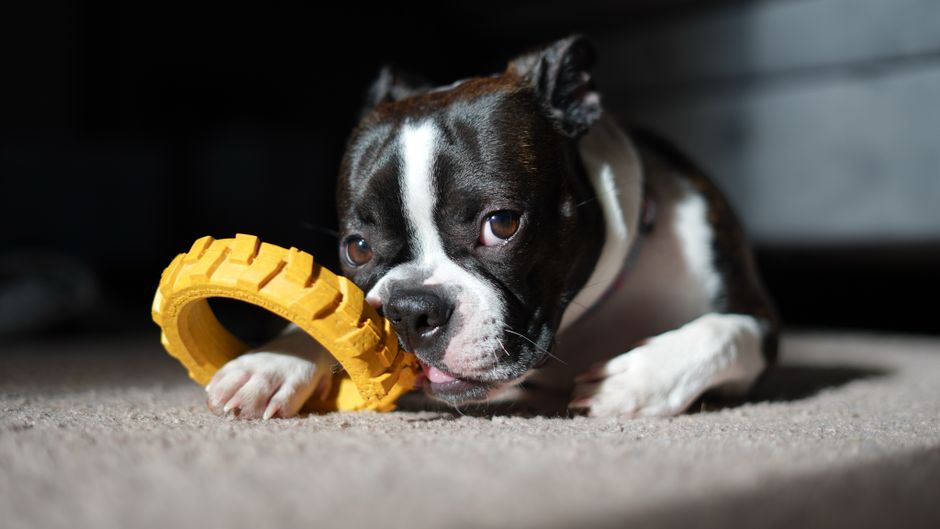
Essential Obedience and Managing Puppy Biting
Keep training sessions to short five to ten minute windows. Focus on fundamental life skills: name response, luring into a sit or down position, and teaching a release marker. Effective training is never about harsh corrections or pure indulgence; it relies on clear expectations, consistent boundaries, fair consequences, and practical management.
Puppies explore the world with their mouths, and twelve week old razor teeth can test any owner's patience. When your puppy bites clothing or skin, immediately withdraw your attention and redirect their teeth onto an appropriate toy. You can find detailed step by step techniques in our guide with puppy trainer tips to stop biting.
Safe Socialization and Navigating Fear Periods
The critical socialization window closes around fourteen weeks of age. Your goal is to introduce your puppy to at least ninety novel, positive experiences by this milestone, as highlighted in veterinary puppy developmental milestones.
Socialization does not mean letting your puppy meet every dog on the street. It means exposing them to diverse surfaces, sounds, sights, and people at a comfortable distance:
- Walking on gravel, wet grass, wood decks, and metal grates
- Hearing vacuum cleaners, delivery trucks, and thunder tracks played at low volume
- Observing people wearing hats, carrying umbrellas, or riding bicycles
Watch for fear responses such as lip licking, tucking the tail, or backing away. If your puppy hesitates, increase distance from the trigger, reward calm curiosity, and never force an interaction.
Teething Relief and Healthcare Milestones
Between twelve and sixteen weeks, baby incisors begin loosening as adult teeth prepare to emerge. Teething causes gum inflammation and an intense desire to chew hard textures. Provide frozen wet washcloths, chilled rubber toys, and edible dental chews to soothe discomfort.
This age also marks vital veterinary care. Your puppy will receive their twelve week core vaccine boosters (such as the second DA2PP dose) and lifestyle vaccines recommended by your vet. Start handling their mouth, paws, and ears daily with gentle rewards so veterinary examinations and future nail trims remain stress free.
Practical Routine Customization and Troubleshooting
Every home operates on a unique rhythm. Adapting your puppy's schedule to your working hours or layout is simple as long as you maintain core sequences: wake, potty, engage, rest.
Adapting the 3 Month Old Puppy Schedule for Working Pet Parents
If you work away from home, an eight hour stretch is too long for a three month old bladder. Set up a long term confinement area using an exercise pen attached to a crate with a wipe clean floor surface.
Arrange for a family member, neighbor, or professional dog walker to provide a midday potty break, short walk, and lunch feeding. Providing appropriate chew items inside the pen builds independent resting habits and helps prevent separation distress.
Solving Nighttime Crying and Early Morning Wake-Ups
Most twelve week old puppies can sleep six to eight hours overnight, but some still require one bathroom trip between 2:00 AM and 4:00 AM.
If your puppy cries during the night:
- Keep the lights dim and avoid talking or playing.
- Clip on a leash and carry them straight to the outdoor potty spot.
- Give them two minutes to eliminate.
- Return them directly to the crate with zero fanfare.
To curb 5:00 AM wake ups, remove water access sixty to ninety minutes before bedtime (unless the weather is hot) and ensure their final evening nap ends early enough to build healthy sleep pressure.
Frequently Asked Questions About 3-Month-Old Puppies
How many hours should a 3-month-old puppy sleep each day?
A three month old puppy should sleep 15 to 18 hours per day. This total includes overnight sleep and four to five daytime naps lasting anywhere from one to two hours each. Hyperactive behavior, frantic pacing, and persistent biting are classic signs that a puppy needs an enforced nap.
How long can a 12-week-old puppy hold their bladder?
During the day, a twelve week old puppy can comfortably hold their bladder for two to three hours while awake. However, bodily state changes like eating, waking, or intense play speed up digestion and require immediate outdoor breaks within minutes.
Can my 3-month-old puppy go on neighborhood walks before full vaccination?
Keep exercise to controlled private areas or clean, low dog traffic paths until your veterinarian clears your puppy after their final booster series. Follow the five minute rule for formal exercise: five minutes of structured walking per month of age, meaning a three month old puppy should walk for no more than fifteen minutes per session.
Building a Lifetime of Good Habits with Your Puppy
Navigating early puppyhood takes patience, structure, and reliable follow through. When you maintain a predictable routine, establish clear boundaries, and communicate expectations early, your puppy learns how to settle into household life with confidence.
If you are a dog owner in Scappoose, St. Helens, Warren, Bethany, Hillsboro, Beaverton, Portland, Vancouver, or surrounding areas feeling overwhelmed by nipping, housebreaking setbacks, or crate training struggles, you do not have to figure it out alone.
Our basic obedience foundation training starts at four weeks of age to give young dogs the clearest start possible. For older dogs requiring complex behavior modification, we utilize dedicated six week and eight plus week programs. Explore our Puppy Jump Start Program to get a clear training roadmap and build a calm, well mannered companion from day one.