
The Ultimate Guide to Immersion Training for Dogs
What Immersion Dog Training Actually Is (And Why So Many Portland Owners Are Trying It)

What is immersion dog training? It's a professional program where your dog lives with a certified trainer — full time — and receives structured training throughout every single day, rather than one short class per week.
Here's the quick answer:
- What it is: Your dog stays with a professional trainer (in their home or facility) for ta series of weeks
- How it works: Every interaction becomes a teaching moment — 100+ repetitions per day vs. the \~10 most owners manage at home
- What it solves: Leash pulling, jumping, door bolting, reactivity, aggression, and more
- What you get back: A dog with a solid foundation plus go-home lessons so you know how to keep the momentum
- What it costs: Roughly $750 - $1,000 per week depending on the program
It's also called board and train.
If your dog pulls you down the street, goes berserk when guests arrive, or ignores every command the moment a squirrel appears, you're not alone. These are exactly the frustrations that lead Portland-area owners to look beyond group classes and YouTube tutorials.
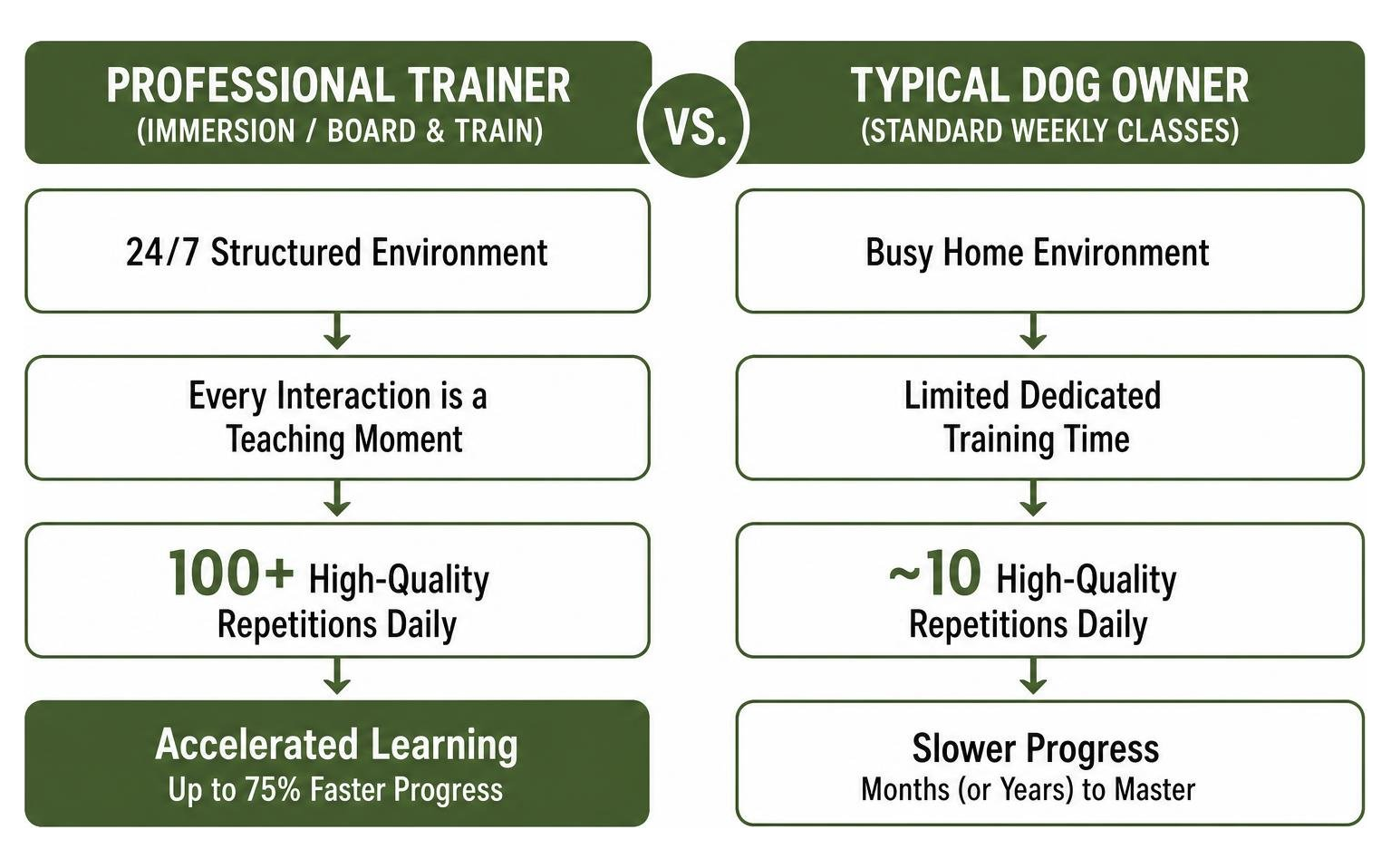
The core idea is simple: a professional trainer can provide the kind of consistent, distraction-rich, round-the-clock learning environment that's nearly impossible to replicate at home. Research suggests immersion training accelerates learning by up to 75% compared to standard weekly classes largely because the repetition gap between a professional setting and a typical home is enormous.
This guide covers everything you need to know: how these programs work, what behaviors they address, what to look for in a trainer, how the transition home works, and whether the investment makes sense for your situation.
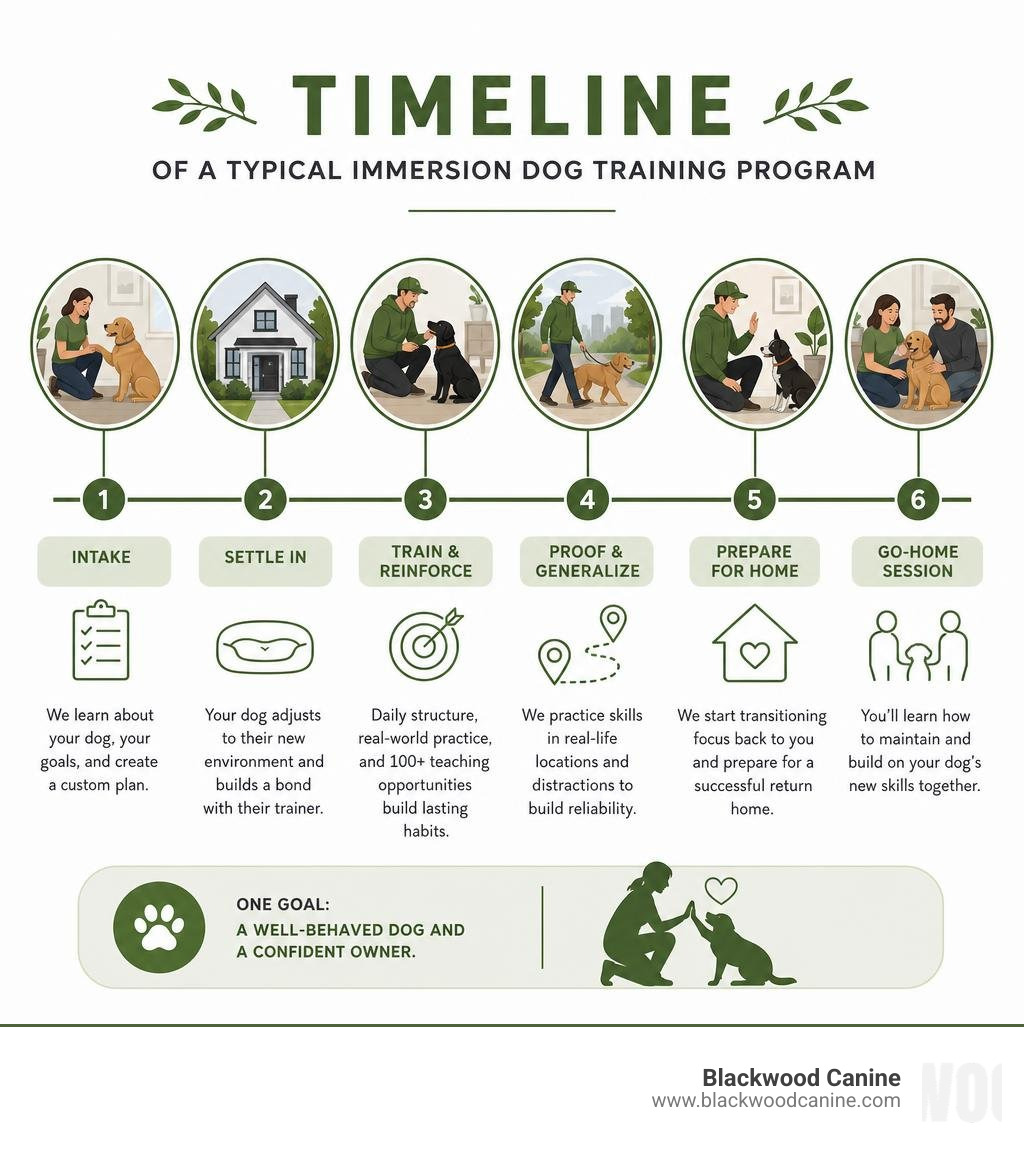
What is Immersion Dog Training?
At its core, what is immersion dog training? Think of it as a study-abroad language program or a high-level athletic residency for your dog. Instead of driving to a sterile training center once a week for a 50-minute class, your dog moves in with a professional trainer.
During this stay, your dog lives in a structured environment where learning never stops. Every single interaction from mealtime and crate entry to backyard playtime and neighborhood walks are treated as a valuable teaching moment.
To help visualize how this compares to traditional training methods, we have broken down the core differences in the table below:
| Feature | Immersion Dog Training (Board & Train) | Standard Weekly Group Classes |
|---|---|---|
| Living Arrangement | Dog lives 24/7 with a professional trainer | Dog lives at home with you |
| Daily Repetitions | 100+ high-quality repetitions daily | ~10 repetitions daily (average owner capacity) |
| Learning Environment | Real-world proofing (parks, stores, streets) | Sterile training facility or quiet room |
| Human Error | Minimized (95% of human training errors eliminated) | High (owners learning along with the dog) |
| Speed of Progress | Accelerated by up to 75% | Slow, incremental weekly updates |
| Handler Focus | Professional builds foundation first | Owner must build foundation and handle behavior |
How What Is Immersion Dog Training Differs from Standard Classes
The absolute biggest difference between immersion training and a weekly group class is the repetition gap.
Consider the daily life of an average dog owner. Between work, family, making dinner, and trying to get some sleep, the average owner manages roughly 10 quality repetitions of a command per day. At that rate, teaching a reliable off-leash recall or a bulletproof "down-stay" can take months, if not years.
In a professional board and train facility, our trainers provide 100 or more repetitions daily. This structured repetition accelerates learning by up to 75% compared to standard weekly classes. Because training is the primary focus of the day, the dog moves past the confusing "what do you want from me?" phase in a fraction of the time.
Additionally, professional immersion training eliminates 95% of the human error that typically stalls progress during home training. When owners try to train their dogs from scratch, they often struggle with split-second timing, inconsistent marker words, or accidentally rewarding the very behaviors they want to stop (like petting a dog that just jumped on them). By handing the foundation work over to a professional, your dog learns the rules of the game with absolute clarity first. Once the dog understands the commands, we train you on how to maintain them, which is a much easier skill to master.
The Science of 24/7 Conditioning and Consistency
Why does 24/7 conditioning work so much better than sporadic training? It all comes down to how dogs learn and generalize behaviors.
Dogs are incredibly situational learners. They might perform a perfect "sit" in a quiet kitchen when you are holding a piece of cheese, but completely ignore you when a guest walks through the front door or a squirrel darts across the sidewalk. This is known as the distraction gap.
Immersion training bridges this gap by systematically teaching and proofing behaviors across 50+ high-value real-world distractions. We don't just train in a quiet room; we take our students on field trips to local parks, bustling streets, and outdoor areas where they must practice focus and impulse control around real-world triggers.
This round-the-clock approach is especially powerful during the critical developmental window of a dog's life. Behavioral research shows that 90% of a dog's permanent temperament is formed by 16 weeks of age. If you can immerse a young puppy in a highly structured, positive environment during this time, you can prevent bad habits—like resource guarding, separation anxiety, and leash reactivity—before they ever have a chance to take root.
Core Benefits and Behaviors Addressed

Immersion dog training isn't just about teaching fancy tricks; it's about building a functional, real-world companion. The three pillars of our training philosophy are engagement, impulse control, and focus. When a dog masters these three things, they gain a level of freedom they never had before. A well-behaved dog is a dog that gets to go to outdoor cafes, join the family on hiking trails, and hang out off-leash without fear.
Currently, 63% of U.S. dog owners invest in structured training to solve behavioral frustrations. They quickly realize that a dog with clear boundaries is a much happier, less anxious pet.
Common Behavioral Issues Solved by Immersion Training
Whether you have a wild young puppy or an older dog with deep-seated habits, an immersive environment is the gold standard for behavior resets. We regularly address a wide range of common behavioral frustrations:
- Leash Pulling: Transforming stressful, arm-wrenching walks into relaxing loose-leash strolls.
- Excessive Jumping: Teaching your dog to keep all four paws on the floor when greeting guests.
- Door Bolting: Creating a reliable boundary at the front door so your dog doesn't run into traffic.
- Severe Reactivity and Aggression: Providing a neutral, emotion-free environment to reset dangerous behaviors. In fact, 15% of our clients come to immersion training as a last resort for reactive behavior. If you are struggling with a dog that lunges, barks, or growls at other dogs, our specialized Reactive Dog Training and Behavior Modification Training programs are designed to restore peace and safety to your walks.
Specialized Skills and Confidence Building
Beyond basic obedience, immersion programs are fantastic for building overall canine confidence. For fearful or anxious dogs, we use gradual desensitization to show them that the world isn't such a scary place.
Socialization in an immersion setting doesn't mean letting your dog run wild with a pack of other dogs. Instead, we focus on social neutrality—teaching your dog to remain calm, relaxed, and focused on their handler even when other dogs are playing nearby.
We also tackle essential lifestyle skills, such as:
- House Training and Crate Manners: Establishing consistent, timed potty breaks and teaching the crate as a safe, peaceful sanctuary.
- Confidence Courses: Introducing dogs to novel surfaces, sounds, and objects to build mental resilience.
- Water Confidence: For owners who want their dogs to enjoy the beautiful Pacific Northwest waterways safely, we can even build foundational water confidence. Introducing a dog to water requires patience to avoid creating a lifelong fear. If you want to see a great example of systematic, positive water introduction, check out eileenanddogs' guide on How I Taught My Dog to Get Into a Swimming Pool - eileenanddogs. For a broader look at introducing water safety, Purina South Africa offers an excellent resource on How to Teach a Dog to Swim | Purina South Africa.
Program Structure, Tools, and Transition Home

A typical board and train program can range anywhere from 10 days to several weeks depending on your dog's age, temperament, and goals.
At Blackwood Canine, we customize our timelines to match your family's needs. For young pups, our Puppy Jump Start Program builds a rock-solid foundation of basic manners during those critical early weeks. For older dogs needing a comprehensive behavioral overhaul, our 5 Week Fix program provides the deep, repetitive conditioning required to break old habits and establish new, positive behaviors.
Common Training Methods and Tools Used
We believe in clear, humane, and highly effective communication. We utilize a balanced approach that pairs positive reinforcement (high-value treats, toy play, and physical praise) with modern, low-level training tools to ensure off-leash reliability.
Some of the tools we commonly use include:
- Positive Reinforcement: Rewarding desired behaviors to keep motivation high and build an eager, happy working dog.
- The Mini Educator Remote Collar: Modern remote collars are incredibly sophisticated communication tools. Unlike the outdated "shock collars" of the past, these devices use a medical-grade micro-stim (similar to a TENS unit used in human physical therapy) to act as a silent, physical "tap on the shoulder" at incredibly low, gentle levels.
- Long Training Lines: Allowing us to practice reliable recall at a distance while keeping your dog completely safe.
- Elevated Beds: Used to teach the "place" command, giving your dog a designated boundary to relax on when guests arrive or during family dinner.
What to Look For in a Reputable Program
Because the dog training industry is largely unregulated—with only a few states, like New Jersey under proposed bill A4206, exploring state licensure—it is vital that you do your homework when choosing an immersion facility.
When vetting a program, look for:
- Certified Professionals: Look for trainers holding voluntary, science-backed certifications from reputable organizations such as the Certification Council for Professional Dog Trainers (CCPDT-KA) or the Association of Professional Dog Trainers (APDT).
- A Family-Style, Home-Like Environment: Dogs trained in sterile, commercial kennels often struggle to adjust to a home environment because they haven't practiced their manners around real-life distractions like kitchen counters, doorbells, and couches.
- Frequent Progress Updates: You should receive regular photos, videos, and report cards during your dog's stay so you can watch their transformation unfold.
- A Lifetime Support Guarantee: A reputable trainer won't just hand your dog back and disappear. Look for programs that offer ongoing support to ensure your long-term success.
The Transition Home and Long-Term Maintenance
We always say that training the human is just as important as training the dog. Your dog can perform like a champion for our trainers, but if you don't know how to maintain the rules when they return home, they will quickly revert to their old habits.
To prevent this, every immersion program includes with an in-depth go-home lessons. During these lessons, we teach you exactly how to deliver commands, time your rewards, and enforce boundaries.
The first month back home is critical. Owners who maintain strict consistency during the first 30 days after immersion training see a 90% higher retention rate of advanced skills.
To set your home up for success, we recommend following these simple rules:
- The House Leash Rule: Keep your dog on a leash inside the house for the for a while. This prevents them from slipping back into old household habits (like counter surfing or sofa jumping) and reminds them that the same rules they learned with the trainer apply in your house.
- Daily Maintenance Reps: Dedicate just 10–15 minutes a day to practicing basic commands. These short, fun sessions keep the training fresh in your dog's mind.
- Strict Boundary Setting: Make your dog sit and wait at every door threshold, and enforce a quiet "place" command when people enter the house.
If you ever need extra help proofing these behaviors in your own space, we offer customized In-Home Private Lessons and focused Private Dog Training Lessons to ensure a seamless transition.
Understanding the Risks and Limitations of What Is Immersion Dog Training
While immersion training is incredibly effective, it's important to have realistic expectations.
First, the physical transition can sometimes cause minor physical stress. For example, sudden diet changes or the excitement of a new environment can cause some dogs to experience temporary stomach upset in early training stays. To prevent this, we always require owners to bring their dog's own familiar food to keep their digestion stable.
Second, an immersion stay is not a "magic pill." It builds an incredible foundation, but it cannot override a complete lack of structure at home. If you let your dog immediately go back to pulling on the leash and sleeping on your face the day they return, the training will regress. Success requires a team effort between our trainers and your family.
Frequently Asked Questions about Immersion Dog Training
Will my dog forget me if I send them away for training?
This is the number one worry for almost every dog owner, and it is completely natural to feel a bit of "parent guilt" when sending your pup away.
However, you can rest easy: your dog will absolutely not forget you. Dogs have incredibly powerful associative memories. They link your unique scent, the sound of your voice, and your visual appearance to safety, love, comfort, and family.
When you reunite at the end of the program, there is 100% instant recognition. In fact, your bond with your dog will likely improve because the daily stress of miscommunication, yelling, and frustration will be replaced by clear, mutual understanding.
Is my dog too old for an immersion board and train program?
There is an old saying that you can't teach an old dog new tricks, but canine science has proven that wrong time and time again. Dogs of any age, breed, or size can benefit from a behavioral reset.
Senior dogs often thrive in structured environments because the mental stimulation keeps their minds sharp and active. Just last year alone, professional trainers successfully transformed the behavior of 45 senior dogs over the age of 9. As long as your dog is healthy enough for moderate exercise, they are the perfect candidate for a program.
How much does professional immersion dog training cost in 2026?
In 2026, professional immersion programs generally range from $700 - $1000 per week, depending on the length of the stay, the severity of the behavioral issues, and the level of customization required.
While this is a significant upfront investment, it is helpful to look at the long-term financial ROI. Consider the potential costs of an untrained dog:
- Property Damage: Replacing scratched hardwood floors or a chewed designer sofa can easily cost thousands of dollars.
- Liability and Medical Bills: Behavioral chaos can carry massive financial risks. The average insurance claim for a dog-related injury hit $64,555 in 2023.
Investing in a solid foundation of safety, control, and off-leash reliability is an insurance policy that pays dividends for the rest of your dog's life.
Conclusion
At Blackwood Canine, we believe that a well-behaved dog is a happy, free dog. Our mission is to provide the clear communication and practical management tools you need to build a reliable, stress-free relationship with your pet.
Whether you are looking for a complete behavior overhaul with our Advanced Re-Conditioning program, want to build the ultimate family pet with our Complete Companion track, or are ready to explore our signature Immersion Dog Training options, we are here to guide you every step of the way.
Ready to see how we can transform your relationship with your dog? Explore our full range of Services and take the first step toward a lifetime of off-leash freedom today!