
Gentle Training Techniques for Timid and Anxious Dogs
When Your Dog Is Scared of the World, Every Walk Feels Like a Crisis

Dog training for fearful dogs is not about pushing your dog harder or waiting for them to "get over it." It is about understanding what is driving the fear and changing it systematically, using methods that actually work.
Here is a quick overview of what that looks like in practice:
- Identify the trigger -- the specific thing, place, or person that causes your dog to react
- Keep your dog below threshold -- work at a distance or intensity where they notice the trigger but stay calm
- Use counterconditioning -- pair the scary thing with something your dog loves, like high value food
- Never force exposure -- flooding a fearful dog makes things worse, not better
- Rule out medical causes -- pain, thyroid issues, and sensory changes can all drive sudden fear
- Be consistent -- management, clear expectations, and repetition matter as much as any single technique
- Get professional help early -- do not wait until things escalate before asking for support
A lot of Portland area dog owners come to us after months of frustrating walks, guests who can never come inside, and training approaches that seemed to make things worse. If your dog cowers, lunges, shuts down, or barks from a place of panic, you are not alone, and your dog is not broken.
Fear is one of the most misunderstood things in dog behavior. It looks like aggression. It looks like stubbornness. Sometimes it looks like a dog who is "fine" right up until they bite. The difference between a manageable fear problem and a serious one often comes down to how early you recognize it and how you respond.
This guide walks you through the science, the practical steps, and the honest expectations for training a fearful dog.
I'm David Wright, and I started iWorkDogs after years of apprenticeship under an experienced K9 coach, including working through real dog aggression challenges with my own Cane Corso. That experience is what drives my approach to dog training for fearful dogs -- I know what it feels like to think you're doing everything right and still be missing something important. The goal here is to give you the clearest, most practical picture possible so you can actually move forward.
What Causes Fear and Anxiety in Dogs?

Fear does not just appear out of nowhere. It is a biological survival mechanism. When a dog reacts to a garbage truck in Hillsboro or a stranger on a path in Beaverton, their brain is trying to keep them alive.
To help a timid dog, we have to stop looking at their behavior as a behavioral problem and start looking at what causes it. There are four main roots of canine fear:
- Genetics: Some dogs are born with a more sensitive nervous system. If a mother dog was highly stressed during pregnancy, her puppies can inherit a highly active stress response.
- Under socialization: If a puppy does not experience a wide variety of sights, sounds, and surfaces in a positive way during their early development, the adult dog will view novelty as a threat.
- Trauma: A single scary event, like being attacked by an off leash dog at a park, can leave a lasting emotional scar.
- Physical pain: Hidden pain is a massive driver of sudden fear. A dog who hurts will naturally protect themselves by keeping others away.
Developmental Fear Periods in Puppies
Puppies naturally go through developmental fear periods where their confidence suddenly drops. These are normal parts of growing up, but they require careful handling.
- The first fear period typically happens between eight and eleven weeks of age.
- The second fear period occurs during adolescence, usually between six and fourteen months of age.
These developmental phases generally last no more than two weeks. However, a single bad experience during these windows can leave a permanent mark on your dog's temperament. If your young dog suddenly acts terrified of a trash can they walked past yesterday, do not force them to approach it. Lower your expectations, keep sessions short, and reward them for showing simple curiosity from a safe distance.
Hidden Pain and Medical Triggers
Many behavioral issues are actually medical issues in disguise. If your dog suddenly starts growling when you touch their lower back, or if they suddenly panic around other dogs on walks in Vancouver, pain is the first thing to rule out.
Conditions like arthritis, hip dysplasia, thyroid imbalances, or dental infections cause constant low level stress. When a dog is in pain, their brain is already close to its limit. They cannot learn new behaviors if they are hurting.
Before starting any intensive training program, schedule a complete checkup with your veterinarian. Let them know about the sudden behavioral shifts. Addressing physical discomfort is always the first step in behavior modification.
Reading the Subtle Signs of Canine Stress

Dogs are constantly talking to us, but we often miss their early whispers. By the time a dog growls, barks, or lunges, they have usually spent minutes trying to tell us they are uncomfortable.
To prevent outbursts on the streets of Scappoose or Warren, you must learn to read the earliest signs of stress.
Early Warning Signs vs Severe Panic
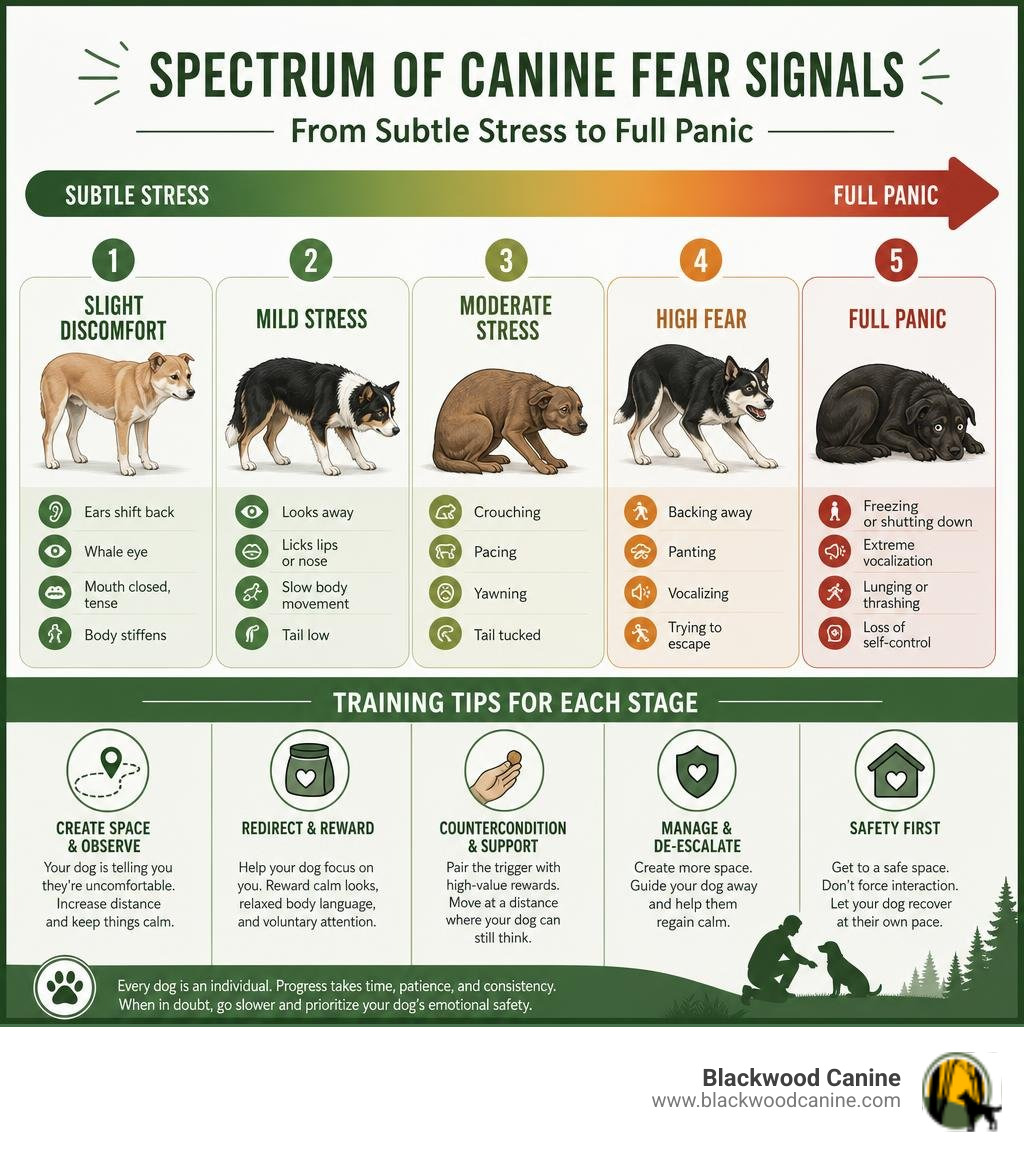
Canine stress signals exist on a wide spectrum. Recognizing the early signs allows you to step in and manage the situation before your dog boils over.
- Subtle signs: Lip licking, yawning when not tired, sniffing the ground suddenly to avoid a threat, or a brief "wet dog shake" to discharge tension after a minor stressor.
- Moderate signs: The "whale eye" where you see the whites of your dog's eyes, ears pinned back, a tucked tail, a rigid body, or a raised paw.
- Severe panic: Trembling, heavy panting when it is not hot, pacing, drooling, or complete freezing.
The freeze response is the most commonly misunderstood signal. Many owners see a dog stand completely still while a stranger pets them and think the dog is being good. In reality, that dog may be shut down, flooded with fear, and unable to move. If you push a shut down dog too far, they may eventually snap.
Another clear sign of high stress is food refusal. If a hungry dog will not eat even the highest value treats like liverwurst or cheese, they are over their emotional limit. Their digestive system has shut down because their body is in fight or flight mode.
Why You Should Never Punish a Growl
It is embarrassing when your dog growls at a neighbor in St. Helens. Your instinct might be to correct them with a sharp "No!" or a leash pop. This is a dangerous mistake.
A growl is a boundary. It is your dog saying, "I am uncomfortable, please step back."
If you punish a growl, you do not fix the fear that caused it. You only teach the dog that their warning system is dangerous to use. If you successfully train a dog not to growl, you end up with a dog who skips the warning and goes straight to biting. Always thank your dog for growling, respect their boundary, and immediately increase the distance between them and the trigger.
The Core Principles of Dog Training for Fearful Dogs
Training a fearful dog requires a shift in how you think about obedience. Standard obedience programs focus on making a dog perform commands. Behavior modification for fearful dogs focuses on changing how the dog feels.
We build confidence through clear expectations, solid boundaries, environmental management, consistent reinforcement, and fair consequences. You can read more about how we balance these concepts in our guide on Dog Training Methods: Positive Reinforcement vs Dominance Training.
Classical Counterconditioning vs Operant Conditioning
To change fear, we use two different types of learning.
- Classical Conditioning: This is about associations. It changes your dog's involuntary emotional response. Think of Pavlov's dogs. If every time a scary stranger appears, your dog gets a piece of roast beef, the stranger eventually predicts roast beef. The underlying emotion shifts from fear to anticipation.
- Operant Conditioning: This is about voluntary behavior. It teaches your dog what to do to get a desired outcome. For example, teaching your dog to look at you when they see another dog, rather than staring and tensing up.
We always start with classical conditioning to change the emotional baseline before we ask the dog to perform specific tasks.
Managing the Threshold in Dog Training for Fearful Dogs
The single most important concept in behavior modification is the threshold.
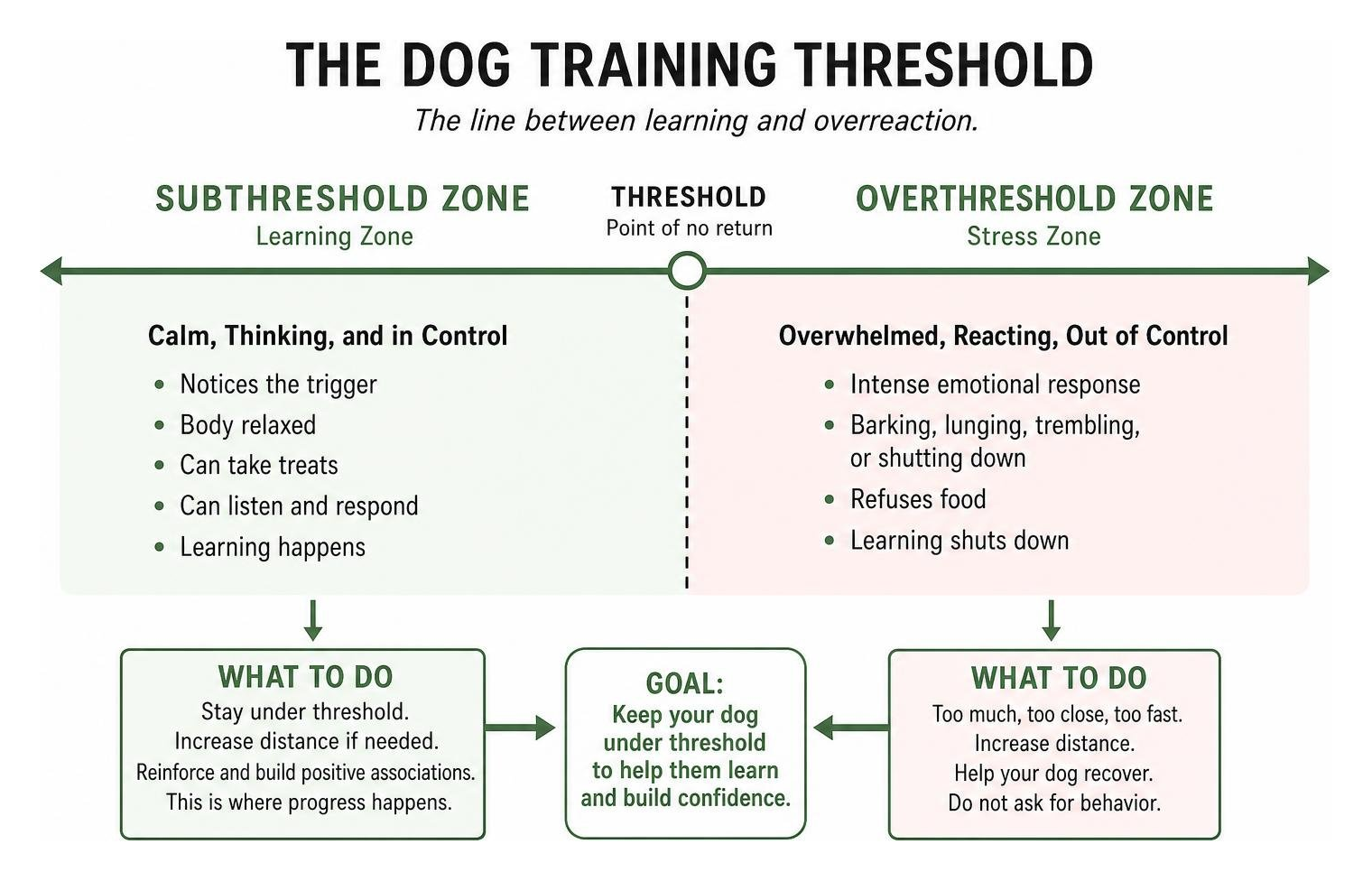
Your dog's threshold is the invisible line where they transition from calm observation to reactive panic.
- Subthreshold zone: The dog notices the trigger but remains relaxed. They can easily take treats, look away, and listen to you. This is the only zone where learning happens.
- Overthreshold zone: The dog has lost control. They are barking, lunging, trembling, or refusing food. Their brain is flooded with cortisol and adrenaline.
If your dog goes over threshold during a walk in Bethany or Hillsboro, stop training immediately. Do not try to feed them or force them to sit. Your only job is to create distance, get them back to safety, and let them decompress.
Step by Step Desensitization and Counterconditioning
To systematically change your dog's emotional response, we use a combination of desensitization (gradual exposure at a low intensity) and counterconditioning (pairing the trigger with high value rewards). This is the foundation of our Behavior Modification Training programs.
Creating a Safe Space and Predictable Routine
A fearful dog cannot learn if they are constantly on edge in their own home. You must create a safe zone where they can fully relax.
- Set up a covered wire crate or a gated room in a quiet part of the house. This area should be completely off limits to guests, children, and other pets.
- Establish a highly predictable daily schedule for feeding, walking, training, and rest. Predictability directly lowers stress hormones.
- Use environmental management. Put frosted window film on street facing windows to block visual triggers, and run a white noise machine to mask sudden outdoor sounds.
Implementing the Open Bar Closed Bar Technique in Dog Training for Fearful Dogs
The "Open Bar, Closed Bar" technique is a simple, highly effective way to execute counterconditioning. The timing must be precise.
- Find the right distance: Stand far enough away from the trigger (like a bicycle or another dog) so your dog is aware of it but remains subthreshold.
- The trigger appears (Bar Opens): The instant your dog sees the trigger, start feeding them exceptionally high value treats (chicken, hot dogs, squeeze cheese) continuously.
- The trigger disappears (Bar Closes): The moment the trigger moves out of sight, stop feeding immediately. No more treats.
This clear contrast teaches your dog a reliable rule: the scary thing makes amazing food appear, and when the scary thing goes away, the good stuff stops. Over time, you can gradually decrease the distance, always keeping your dog below their reactivity threshold.
Why Aversive Tools and Forced Exposure Backfire
When you are frustrated by your dog's behavior, it is tempting to look for quick fixes. Some trainers might recommend prong collars, electronic collars, choke chains, or forced exposure (flooding) to stop the barking and lunging.
With a fearful dog, these tools are highly destructive.
Aversive tools work by introducing pain or discomfort to suppress a behavior. While they might stop the outward barking, they do not change the inward fear. In fact, they usually make it worse. This is known as the second association problem. If your dog is afraid of other dogs, and they feel a painful shock or pinch every time they see one, they will not learn to like other dogs. They will simply associate other dogs with pain.
Furthermore, scientific research on dog training methods shows the welfare costs of these methods:
- Dogs trained with aversive methods score as significantly more pessimistic on cognitive bias tests, showing a chronic negative emotional state.
- Aversive training is associated with significantly more stress behaviors during and after training sessions.
- When head to head studies compare electronic collar training to reward based training, the reward based groups perform just as well, and often better, without the welfare risks.
Forcing your dog to face their fears directly, like dragging a dog who is terrified of strangers into a busy pet store in Beaverton, is called flooding. It does not socialize them. It causes extreme stress, shuts down their learning capacity, and often leads to defensive aggression.
If you are feeling overwhelmed by your dog's behavior, you did not break them, and you do not need to resort to harsh methods to fix things. Take a breath and read our guide on how to Stop Feeling Guilty About Your Reactive Dog.
Frequently Asked Questions About Training Fearful Dogs
How long does it take to help a fearful dog?
There is no single timeline for resolving fear or anxiety. It depends on your dog's genetics, their history, how long they have practiced the behavior, and how consistently you can manage their environment.
Some dogs show significant improvement in a few weeks of structured management and clear boundaries. For others, especially those with deep seated trauma or genetic sound sensitivities, rehabilitation is a lifelong process of gradual progress. No responsible trainer can guarantee a quick fix. Focus on small wins and consistent routines.
Should I comfort my dog when they are scared?
There is a common myth that comforting a scared dog will reinforce their fear. This is not true. Fear is an emotion, not an operant behavior. You cannot reward an involuntary emotional state with love and reassurance.
However, your emotional state matters. If you tense up, gasp, or panic when your dog gets scared, they will feed off your anxious energy. Instead, offer calm, steady support. Speak in a quiet, relaxed voice, keep your leash loose, and move your dog away from the trigger calmly. Be a reliable leader they can trust to handle the situation.
When should I consider behavioral medication?
If your dog is in a constant state of hypervigilance, pacing, panting, and unable to settle even in a quiet home, their brain is too stressed to learn.
In severe cases, behavioral medication prescribed by a veterinarian or a board certified veterinary behaviorist can be a lifesaver. Medication does not cure fear on its own, but it can lower your dog's baseline anxiety enough to bring them below threshold, allowing behavior modification training to actually take hold. Think of it as a tool to open the window of learning, not a shortcut.
Conclusion
Living with a fearful dog can feel isolating, but you do not have to navigate this alone. Pushing through the frustration requires patience, clear communication, and a practical plan that prioritizes your dog's emotional safety.
At Blackwood Canine, we specialize in helping families in Portland, Vancouver, Beaverton, Hillsboro, Scappoose, and surrounding areas build reliable, stress free relationships with their dogs. Whether you need personalized support through our Private Lessons Dog Training or want to fast track progress with our professional Immersion Dog Training programs, we are here to help.
The best way to start is with a clear strategy. Let us help you build a practical management plan and clear communication framework that works for your household.
Ready to help your dog find their confidence? Connect with us today to learn more about our training options and start your path toward a calmer, happier life together.