
Basic Obedience Dog Training 101: Building a Confident and Well-Mannered Pup
Why Basic Obedience Dog Training Is the Foundation Every Dog Needs

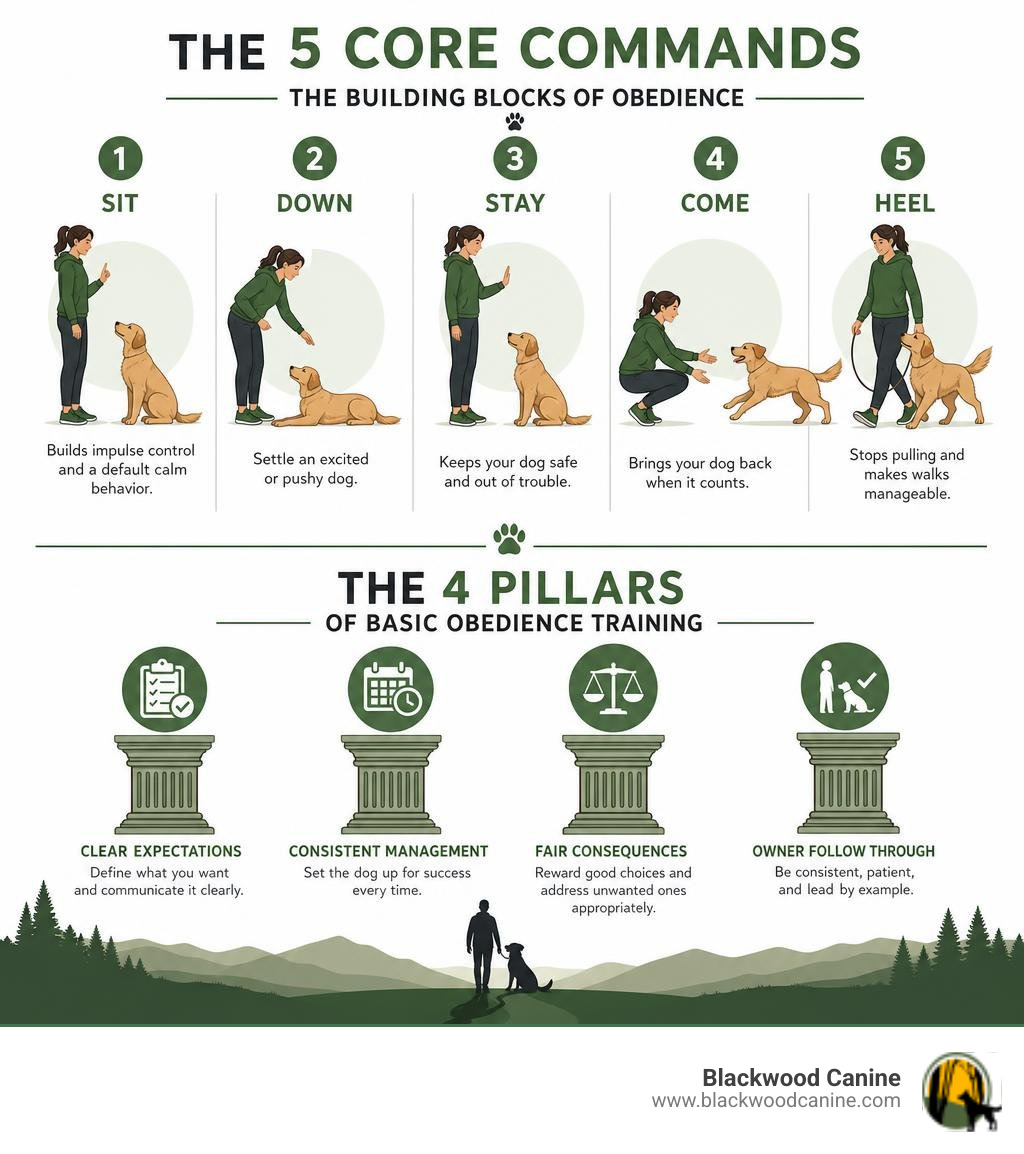
Basic obedience dog training gives your dog the structure to understand what you expect and gives you the tools to actually follow through on it.
Here is what it covers at a glance:
| Command | What It Does |
|---|---|
| Sit | Builds impulse control and a default calm behavior |
| Down | Settle an excited or pushy dog |
| Stay | Keeps your dog safe and out of trouble |
| Come | Brings your dog back when it counts |
| Heel | Stops pulling and makes walks manageable |
But here is the honest part most guides skip: commands are only one piece of the puzzle. Real obedience training is built on clear expectations, consistent management, fair consequences, and owner follow through. Without those, even a dog that knows sit in your kitchen will fall apart at the front door when a guest arrives.
If your dog pulls every walk, ignores you in public, or turns guest visits into an embarrassing mess, you are not alone. Most dog owners in the Portland and Vancouver area hit the same wall: they try training, it works at home, and then it completely falls apart in the real world.
That gap is exactly what this guide addresses.
I am David Wright, a professional dog trainer with over a decade of hands on experience in basic obedience dog training and behavior, apprenticed under an experienced K9 coach before launching my own training practice. I have worked with dogs of all breeds and temperaments, including dog aggressive cases that most group classes would turn away. Everything in this guide is grounded in real training experience, not theory.
The Core Pillars of Basic Obedience Dog Training
Many dog owners in Scappoose, Hillsboro, and Beaverton come to us feeling completely stuck. They have watched dozens of online videos, bought bags of expensive treats, and yet their dog still runs the household. The problem is not the dog. The problem is usually a lack of clear structure.
True obedience is not about tricks. It is about a lifestyle built on clear communication and reliable boundaries.
Why Basic Obedience Dog Training Matters for Your Sanity
A dog without training is a constant source of stress. When you cannot trust your dog to listen, your world shrinks. You stop inviting friends over to your home in St Helens because your dog will jump all over them. You avoid the beautiful parks in Portland because your dog pulls your arm out of its socket.
Proper training restores your freedom. It provides safety and control in emergency situations, like when your dog slips out of the front door toward a busy street. It establishes clear household boundaries, so your dog knows where to settle when you are eating dinner. It builds a reliable relationship where your dog respects your leadership and understands exactly what is expected of them.
Essential Gear for Your Sessions
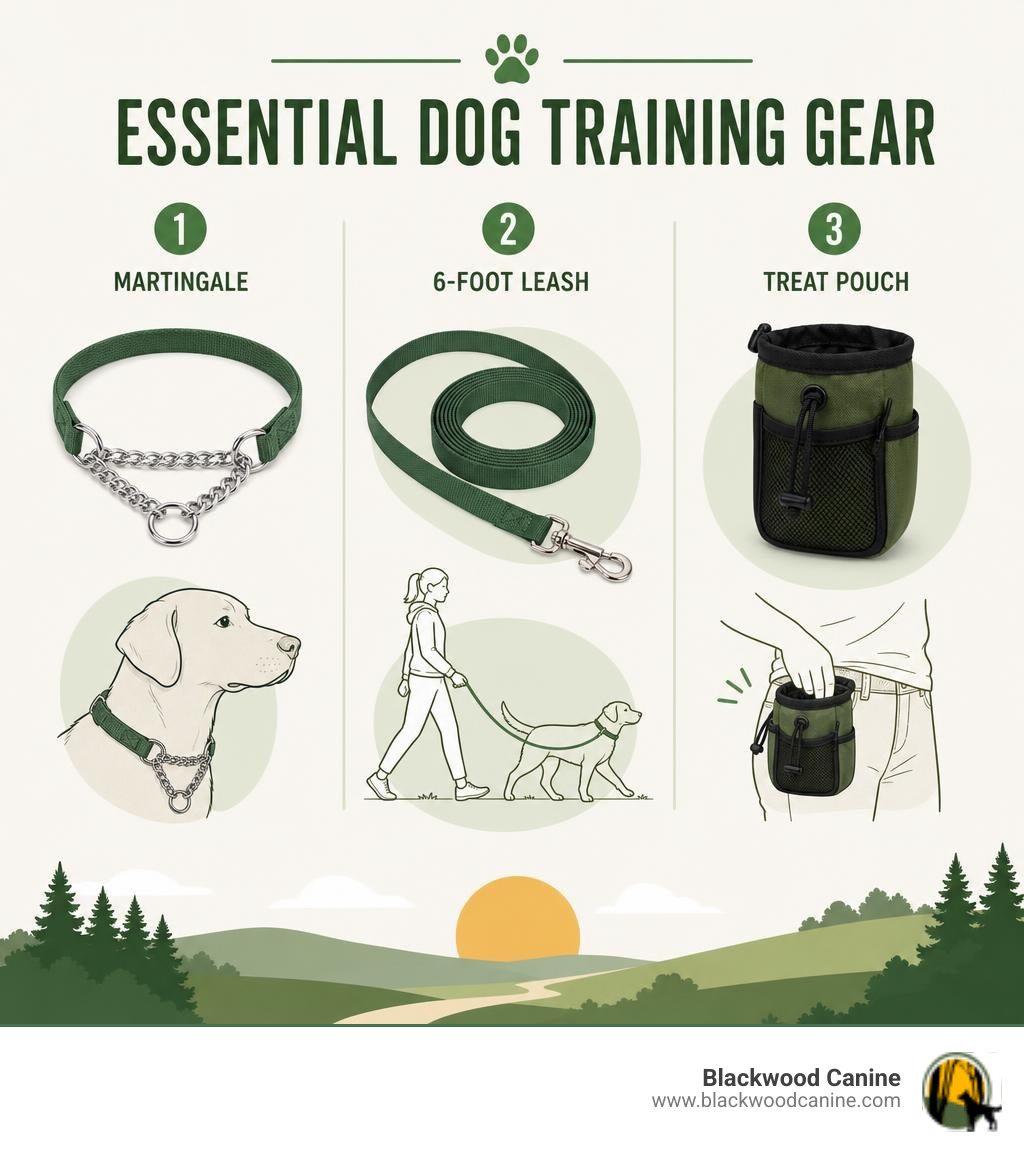
You do not need a closet full of expensive gadgets to train your dog. In fact, keeping your equipment simple makes your training much more effective. Here is the short list of what you actually need:
- A flat collar: A simple, high quality nylon or leather collar. Avoid retractable leashes entirely. They provide inconsistent tension, which actively teaches your dog to pull against the leash.
- A six foot leash: This is the standard length for daily training and loose leash walking. It gives you close control without keeping your dog too cramped.
- A thirty foot long line: This is an essential tool for teaching a reliable recall. It allows your dog to practice coming to you from a distance while you still maintain physical control.
- High value treats: Standard kibble will not cut it when you are competing with the smell of squirrels in Warren or Rainier. Use small, soft treats like cooked chicken, cheese, or freeze dried beef liver.
- A clicker (optional): A clicker is a fantastic tool to mark the exact moment your dog performs the correct behavior. If you want to learn more about how this works, read our guide on Curious About Clicker Training? Dog Trainers Explain the Basics.
Setting Up Your Basic Obedience Dog Training Schedule
One of the biggest mistakes we see owners make in Bethany and Lake Oswego is trying to train their dog for an hour straight. This just exhausts the dog and frustrates the owner.
Dogs learn best in short, highly focused bursts. Your daily training formula should consist of:
- Five to ten minute sessions: Keep it short and fast.
- Two to three times daily: Spread these sessions throughout the day.
- Thirty minutes of total daily practice: This is more than enough time to build incredible obedience.
Before you begin any session, make sure your dog has relieved themselves and is reasonably rested. It is also highly recommended that you do not feed your dog for at least four hours before training. A hungry dog is a motivated dog. Always end every single session on a successful repetition to keep your dog confident and eager for the next session.
The Essential Commands and How to Teach Them
Teaching your dog commands requires patience, consistency, and clear physical mechanics. Let us walk through how to teach the core obedience skills step by step.
Teaching Sit and Down with Luring
Luring is the process of using a piece of food like a guide wire to lead your dog into the correct position. It is incredibly effective because it does not require you to push or pull your dog physically.
To teach the sit command:
- Hold a high value treat right in front of your dog's nose.
- Slowly lift the treat up and back over their head, keeping it close to their snout.
- As your dog's head goes up to follow the food, their rear end will naturally go down.
- The exact second their bottom touches the floor, mark the behavior with a click or a verbal "Yes!" and give them the treat.
To teach the down command:
- Start with your dog in a sitting position.
- Hold a treat in front of their nose and lower it straight down to the floor between their front paws.
- Once your hand is on the floor, slowly pull it forward along the ground in an "L" shape.
- Your dog should slide their body down to follow the treat. Mark and reward the instant their chest touches the floor.
Once your dog is moving into these positions easily, you need to transition away from having food in your hand every time. To learn this crucial step, check out our articles on how to Transform Your Dog's Training with the Power of Luring and Fading the Lure: How to Fade the Food Lure.
Teaching Stay and Heel for Real World Control
The stay command is all about teaching your dog to remain in place until you give them permission to move.
- Ask your dog to sit.
- Show them an open palm hand signal and say "Stay" in a calm, flat voice.
- Take just one step back.
- If your dog remains in place for three seconds, step back to them, mark, reward, and give your release word like "OK" or "Free".
- Gradually increase the time and distance. If your dog breaks the stay, do not repeat the command. Calmly place them back in the exact spot they started and try again with a shorter duration. To prevent them from jumping up when you return, you can gently step on the leash near their collar.
The heel command teaches your dog to walk calmly by your side without pulling. In a proper heel position, your dog should walk on your left side, no more than four inches from your leg.
- Hold your leash in your left hand and a high value treat or a squeaky toy in your right hand.
- Place your right arm across your body so the motivator is near your left hip, guiding your dog's focus.
- Start walking. Every few steps that your dog walks calmly by your side, reward them.
- If they begin to pull ahead, quickly step to the side to redirect them, or stop moving entirely until the leash goes slack.
For more detailed help on these foundational movements, you can read the guide on THE FIVE COMMANDS . If you are specifically struggling with a dog that jumps on visitors when they enter your home, read our guide on Dog Obedience: Teaching Your Dog Not to Jump Up on People.
Building a Reliable Come Command
A reliable recall can save your dog's life. However, many owners accidentally train their dogs to ignore this command. If you call your dog to you only when it is time to leave the park, or if you scold them after they finally return to you, you are actively teaching them that coming to you results in bad things.
To build a rock solid recall:
- Start in a low distraction environment, like your hallway.
- Squat down to your dog's eye level, open your arms wide, and call their name followed by "Come!" in an enthusiastic, high pitched voice.
- When they reach you, throw a mini party. Give them multiple high value treats, praise them warmly, and rub their chest.
- If you are outdoors, always use your thirty foot long line. If they ignore your call, do not yell. Gently use the long line to guide them to you, praising them the entire way so they realize that coming to you is always a positive experience.
For a deeper look into the mechanics of this process, check out How to Train a Dog: The Complete Beginner Guide (2026) DogTrainingHQ.
The Three Stages of Learning and Generalization
Many owners in Vancouver and Tigard get frustrated because their dog is a superstar in the living room but acts like they have never heard a single command when they go outside. This happens because dogs do not generalize behaviors easily. To get a truly reliable dog, you must guide them through the three distinct stages of learning.
Teaching Correction and Proofing
The learning process is broken down into three clear phases:
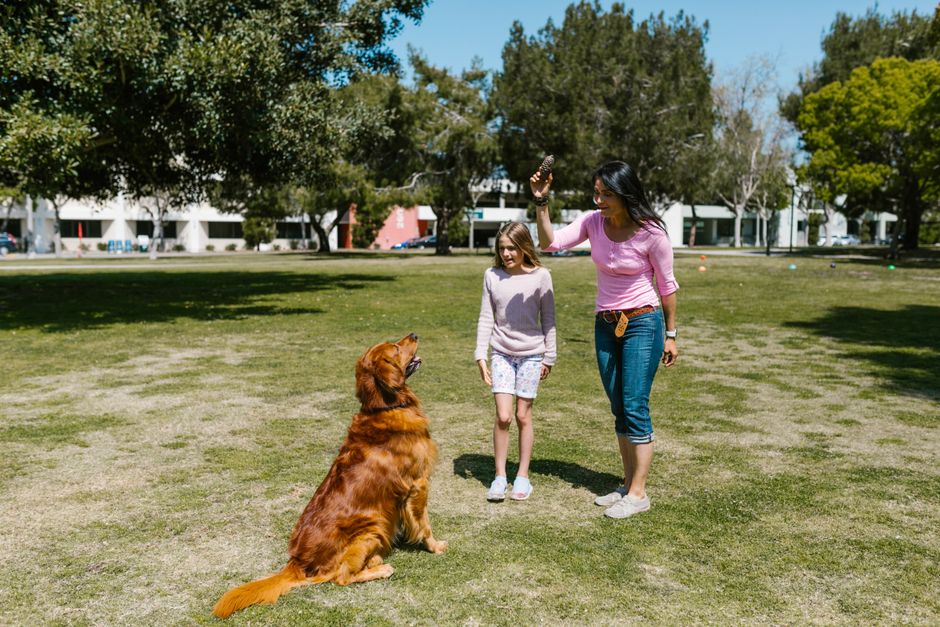
- The Teaching Stage: This is where you use positive reinforcement, luring, and markers to show your dog what behavior you want. You keep the environment quiet and free of distractions.
- The Correction Stage: Once your dog 100% understands a command but chooses to ignore it, you introduce mild, fair corrections. This shows them that obedience is not optional. A correction should be the lightest touch necessary to redirect their attention, and it must always be followed immediately by praise the instant they comply.
- The Proofing Stage: This is where you test your dog's obedience by gradually introducing real world distractions, like moving toys, strange noises, or other animals.
Timing is absolutely critical during all three stages. Your window of opportunity to deliver either praise or a correction is between point five and two seconds. If you wait longer than two seconds, your dog will not connect your reaction to their behavior.
Generalizing Commands Around Distractions
To generalize a command, you must systematically change the environment. If you only train in your kitchen, your dog learns that "Sit" means "Sit in the kitchen."
Once your dog is reliable inside, move your sessions to the backyard. Next, practice on your driveway. Then, move to a quiet sidewalk in your neighborhood. Finally, take your training to busier public spaces like local parks. By slowly increasing the distraction level, you teach your dog that "Sit" means "Sit, no matter what is happening around us."
Common Training Mistakes to Avoid
Even the most well meaning dog owners fall into habits that slow down their dog's progress. Recognizing these mistakes early will save you months of frustration.
| What Owners Do | Why It Fails | What to Do Instead |
|---|---|---|
| Repeating commands | Saying "Sit, sit, sit" teaches your dog to ignore the first cue. | Say the command once. If they ignore it, guide them into position. |
| Delayed consequences | Correcting or rewarding your dog ten seconds after the action. | Act within the point five to two second window. |
| Inconsistent rules | Letting the dog jump on you but scolding them when they jump on guests. | Keep rules identical across all family members. |
| Using retractable leashes | Constant tension teaches the dog to pull to move forward. | Use a standard six foot flat nylon leash. |
| Giving up too early | Stopping training because the dog is distracted. | Lower the distraction level and end on a successful note. |
Frequently Asked Questions About Dog Training
Here are some of the most common questions we hear from dog owners in Sherwood, Cornelius, and Forest Grove.
When should I start training my puppy?
The sooner, the better! You can start teaching basic household manners and simple lures as early as eight weeks old. In fact, it is much easier to build good habits early than to retrain an adult dog with years of practice doing the wrong things.
Standard puppy socialization classes are ideal for dogs between three and five months old. Once your dog reaches five or six months of age, they are ready for structured basic obedience classes. To understand which program fits your dog's current age and development, read our guide on The Ins & Outs of Dog Obedience School.
Where can I find low cost or free obedience resources?
If you are on a tight budget, look into local shelter programs. Many municipal shelters offer free post adoption support and basic obedience classes for dogs adopted from their facilities. You can also find excellent step by step manuals online, such as BASIC OBEDIENCE FOR DOGS or explore competitive pathways through resources like Getting Started in Obedience .
These resources are fantastic for learning the mechanics of training, though they cannot replace the personalized feedback of an experienced professional trainer.
What should I do if my dog is highly reactive?
If your dog lunges, barks, or growls at other dogs or people, a crowded group obedience class is the worst place for them. The high stress environment will only overwhelm your dog and make their behavior worse.
Safety must always come first. For dog reactive behavior, you should seek a professional private assessment. A professional trainer can help you implement a tailored behavior modification plan in a controlled environment where your dog can learn safely without putting themselves or others at risk.
Conclusion
Building a well mannered dog is not about finding a magic trick or a shortcut. It comes down to your willingness to show up every day with clear expectations, consistent boundaries, and fair follow through.
If you are tired of feeling embarrassed by your dog's behavior on walks or when guests visit your home, we are here to help. At Blackwood Canine, we serve busy dog owners across Scappoose, Warren, St. Helens, Hillsboro, Beaverton, Portland, and Vancouver. We do not offer quick fixes or empty promises. Instead, we give you a clear, practical roadmap to build a reliable, stress free relationship with your dog.
Your next step is simple. Let us help you put together a clear plan of action. Explore our Behavior Modification Training to learn about our Good Dog Game Plan and find the right path forward for your family.