
Tips & Tricks for Training Your Dog
Blog
A Quick Start Guide to Overcoming Dog Fear in Hillsboro
When Your Dog Is Scared of Everything in Hillsboro
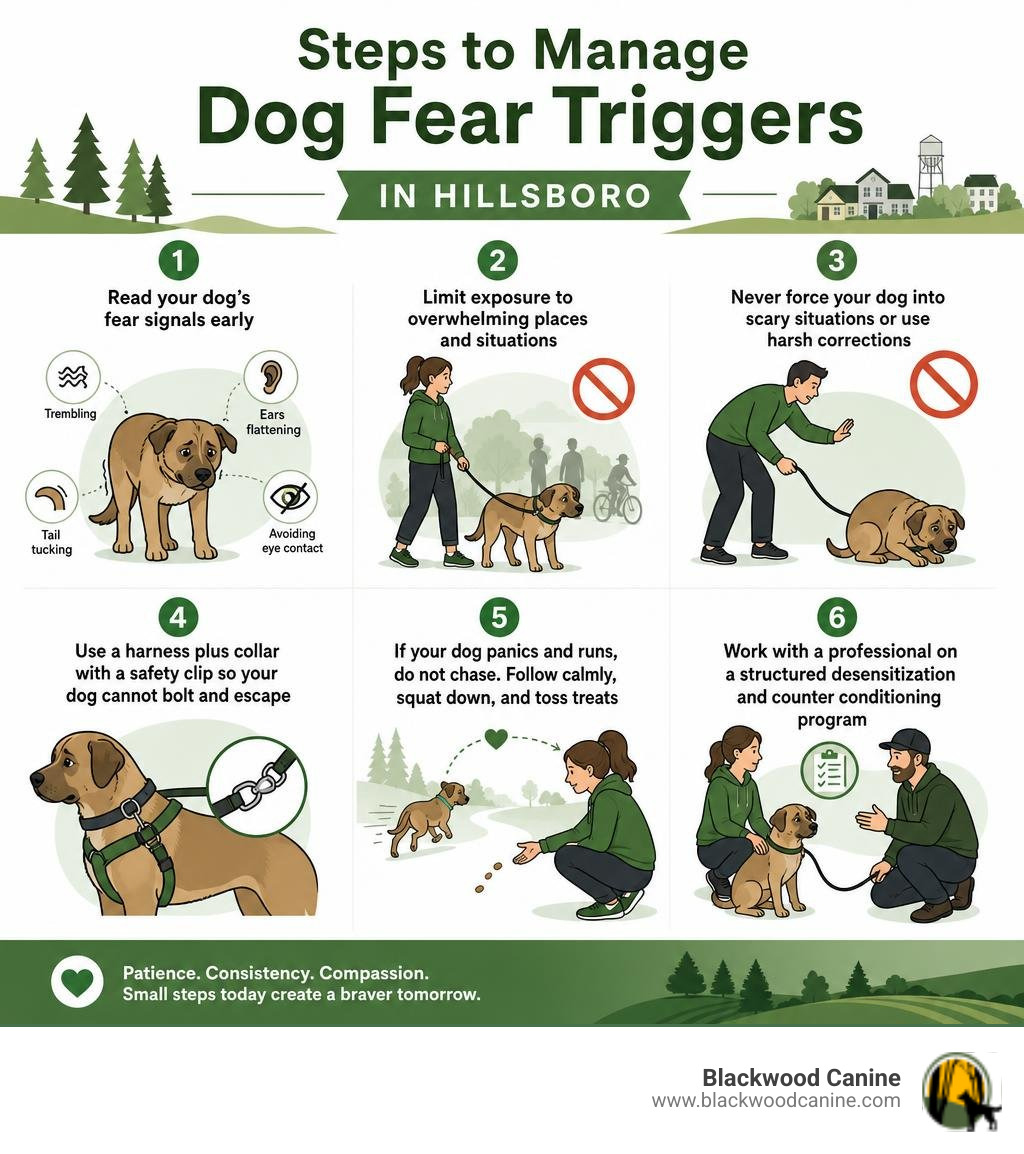
If Hillsboro dog training fear is something you are dealing with right now, here is what you need to know up front:
Quick answer for fearful dogs in Hillsboro:
- Learn to read your dog's fear signals early (trembling, tail tucking, ear flattening, avoiding eye contact)
- Limit exposure to overwhelming places and situations until you have a plan
- Never force your dog into scary situations or use harsh corrections
- Use a harness plus collar with a safety clip so your dog cannot bolt and escape
- If your dog panics and runs, do not chase. Follow calmly, squat down, and toss treats
- Work with a professional on a structured desensitization and counter conditioning program
Living with a fearful dog is exhausting. Walks feel like a gamble. Guests coming over becomes a whole event. And no matter what you try, your dog still freezes, shakes, or tries to bolt at the worst moments.
The hard truth is that fear in dogs is not just a training problem you can fix with a few commands. It takes clear management, consistency, and usually some professional guidance to make real progress.
Knowing where to start makes a big difference. This guide walks you through exactly that.
I'm David Wright, and my work with dogs started after a humbling experience training my own dog aggressive Cane Corso. That moment showed me how much most owners, myself included, do not know about what their dogs are actually communicating. That experience shaped everything I now use when working through Hillsboro dog training fear cases with real families. If you are ready to stop guessing and start making progress, keep reading.
Understanding Hillsboro Dog Training Fear and Stress Signals
Before you can solve fear based behavior, you have to recognize it early. Dogs communicate their discomfort long before they freeze, growl, or bolt down the sidewalk. Most dog owners miss the early warning signs because they are subtle. By learning what your dog is telling you, you can intervene before their panic takes over.
Fear in dogs comes from several root causes. It can stem from genetics, a lack of early exposure during critical development stages, or a single traumatic event. Regardless of how it started, addressing hillsboro dog training fear starts with paying attention to subtle body language cues.
When a dog experiences fear, their physiological system shifts into high alert. You might notice subtle indicators like panting when it is not hot, flattening their ears backward against their skull, or turning their head away to avert eye contact. A tucked tail, trembling muscles, and a rigid stance are classic indicators that your dog feels trapped or unsafe. To read more about how fear displays in different situations, check out our guide on Blog: Dog Training for Fearful Dogs.
Identifying Physical Fear Signs
As fear builds, physical signs become much more extreme. Recognizing these escalations helps you prevent full blown panic.
- Panting and Excessive Salivation: Heavy breathing or drooling when the dog has not had physical exertion.
- Whining and Vocalizing: High pitched vocal stress signals used to communicate distress.
- Crouching and Freezing: Dropping low to the ground or stopping completely in place, unable to take movement cues.
- Loss of Bodily Control: Extreme fear can cause sudden loss of bladder or bowel control.
- Frantic Looking Around: Scanning the environment rapidly to find an escape route.
- Lunging and Barking: When fleeing is not an option, fear turns offensive to create distance from the trigger.
When a dog freezes or lunges, they are no longer in a learning state of mind. Pushing a terrified dog past their threshold damages trust and escalates dangerous behaviors.
How Environment Impacts Hillsboro Dog Training Fear
Where you walk and train matters just as much as what you do. Hillsboro and the surrounding metro area offer great outdoor spaces, but crowded locations like Forest Park or busy outdoor markets can completely overwhelm a fearful dog.
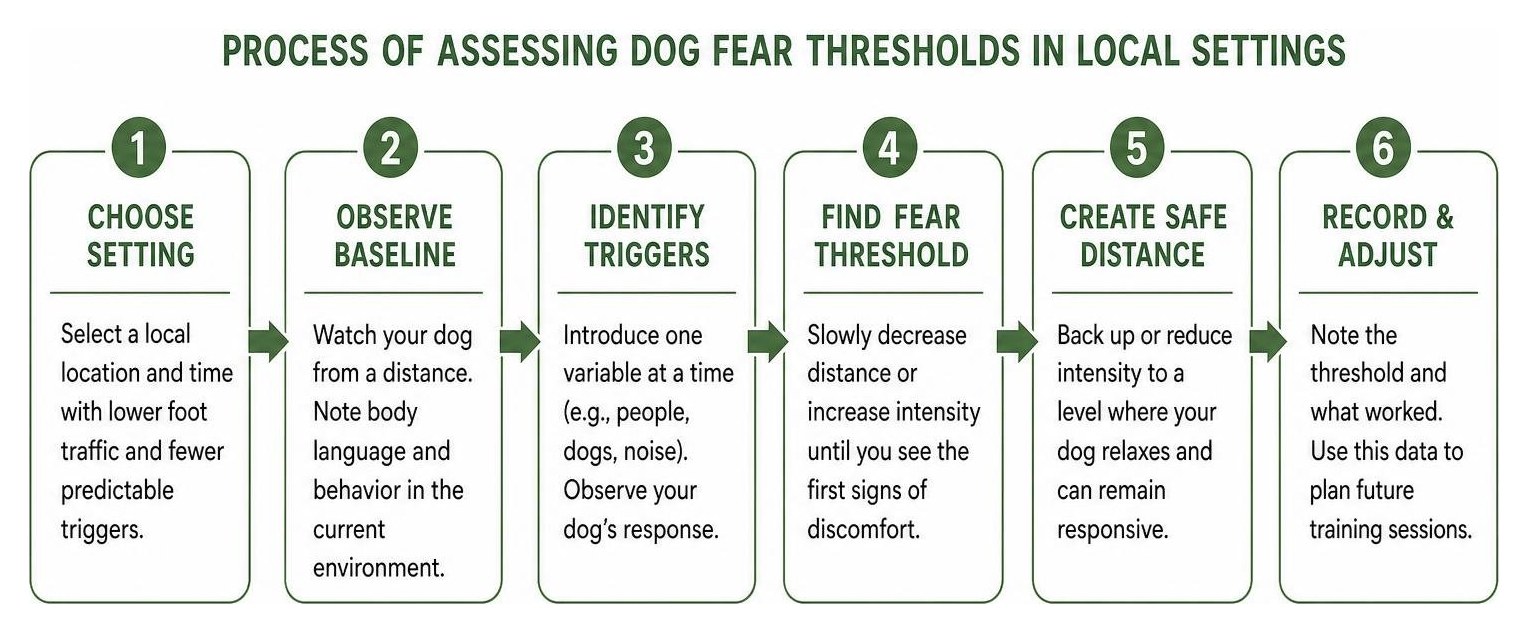
Taking a fearful dog into crowded environments exposes them to unpredictable triggers like fast moving bicycles, loose dogs, loud children, and strange noises. Managing your dog's environment is not quitting; it is giving them the safety buffer they need to learn. If you feel frustrated by your dog's struggles in public, you did not break them. Learn how to let go of guilt in our piece on Blog: Stop Feeling Guilty About Your Reactive Dog.
Practical Steps to Handle Fear Triggers and Emergency Bolting
Managing a nervous dog requires practical equipment and clear emergency protocols. When a dog panics on a walk, their survival instinct is to flee. If your equipment fails or you react incorrectly, a scary moment can quickly turn dangerous.

To prevent escapes, never rely on a single leash attached to a flat collar or standard harness alone. A frightened dog can back out of a harness or slip a collar in seconds. Use a double point connection: a well fitted harness paired with a flat collar, joined together with a safety backup clip. If one piece fails, the backup keeps your dog attached to the leash.
Emergency Escape Protocol
If your dog panics and slips the leash or bolts, your instinct will be to run after them. Doing this usually makes things worse, causing the dog to run faster into traffic or unfamiliar areas.
If your dog escapes, follow these key safety rules:
- Do Not Chase: Running after a panicked dog validates their panic and drives them further away.
- Follow Calmly: Keep your dog in sight while moving at a calm walking speed to track their direction.
- Call for Support: If you have someone with you, ask them to secure the area or watch for traffic ahead.
- Drop Your Center of Gravity: Stop, squat down low to the ground, and turn your body slightly sideways to look non threatening.
- Toss High Value Treats: Gently toss high value treats near the dog without making sudden movements toward them.
- Speak Softly: Use a calm, low tone of voice instead of yelling panic commands.
Setting Boundaries with Strangers
Well meaning strangers often make fearful dogs uncomfortable by staring, reaching out, or approaching quickly. As an owner, your primary job is to advocate for your dog's personal space.
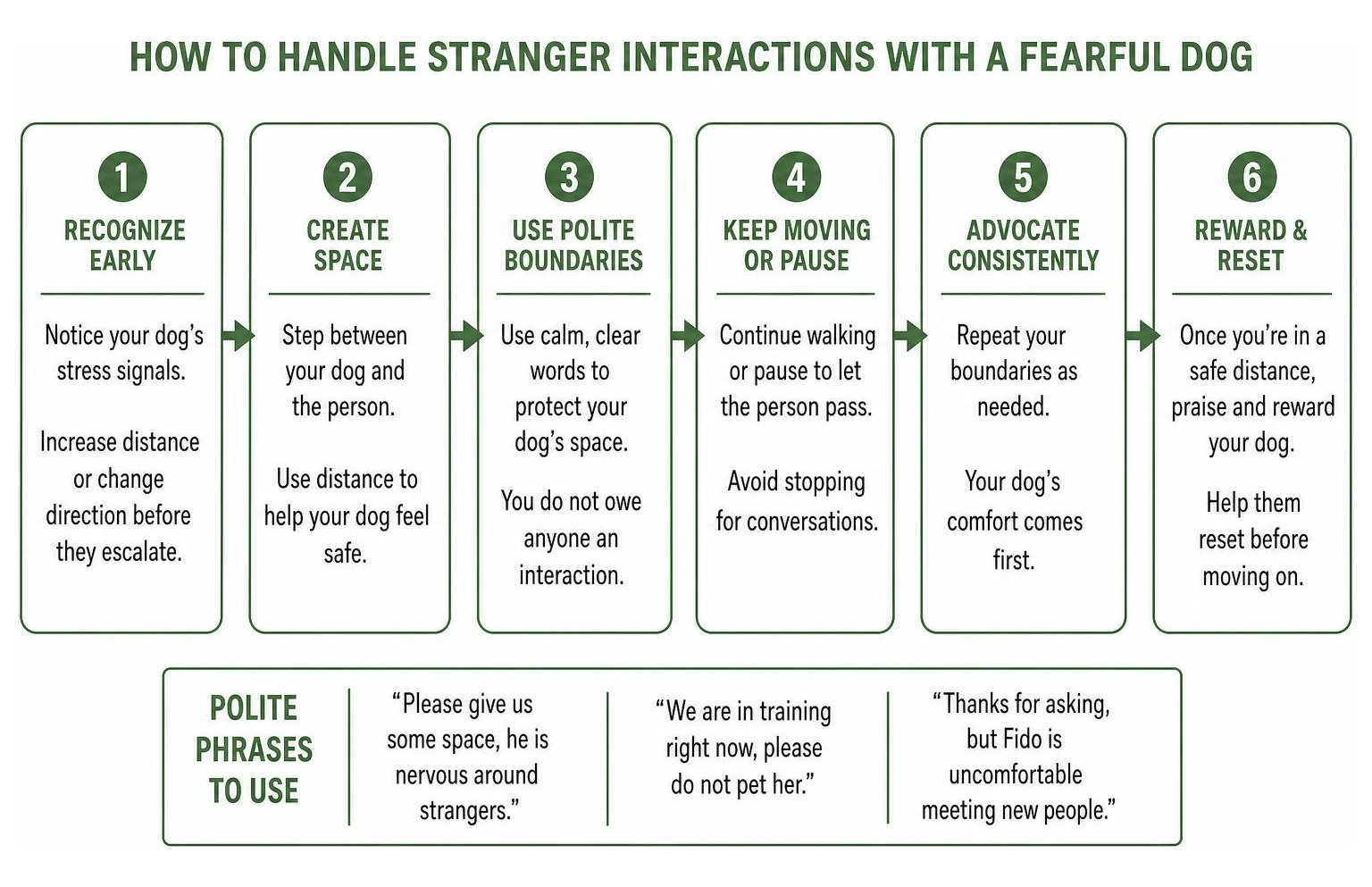
You do not owe anyone an interaction. Practice direct, polite statements to protect your dog's space before a stranger gets close:
- "Please give us some space, he is nervous around strangers."
- "We are in training right now, please do not pet her."
- "Thanks for asking, but Fido is uncomfortable meeting new people."
Creating physical distance gives your dog confidence that you will protect them, reducing their urge to bark or lunge to create space themselves.
Proven Training Methods for Fearful Dogs
Helping a timid dog regain confidence requires structured behavioral modification rather than forced exposure. Flooding, or forcing a dog to endure a scary situation until they stop reacting, increases fear and breaks trust.
The gold standard for overcoming fear includes desensitization and counter conditioning. Desensitization involves exposing the dog to a scary trigger at a low intensity from a safe distance where they feel calm. Counter conditioning pairs that safe exposure with something high value, changing the emotional response from panic to positive expectation.
Building confidence takes time, repetition, and clear structure. If you are looking for local community discussions and guidance on force free approaches, you can check out Positive dog training classes in Vancouver, WA? . To understand the balance between structured guidance and clear expectations, read our breakdown on Blog: Dog Training Methods Positive Reinforcement vs Dominance Training.
When to Seek Professional Hillsboro Dog Training Fear Solutions
If your dog's fear leads to lunging, biting, destructive behavior, or extreme distress, self guided internet tips are not enough. Working with an experienced professional ensures a safe, effective program tailored to your family.
First, always schedule a vet visit to rule out underlying medical issues. Sudden fear or sudden changes in aggression often stem from physical pain, thyroid imbalances, or neurological distress.
Once medical causes are ruled out, professional behavioral training provides the path forward. At Blackwood Canine, our basic obedience foundation training starts at a minimum of 4 weeks to establish clear communication and reliable habits. For complex behavior modification involving deep seated fear or reactivity, we use dedicated 6 week and 8 plus week timelines to build lasting change. We do not offer quick fix training programs shorter than 4 weeks because true behavioral shifts take genuine time and repetition.
Explore our dedicated programs for complex cases:
Frequently Asked Questions About Dog Fear
What should I do if my dog panics and bolts during a walk?
Do not run after your dog. Chasing drives them further away and increases the risk of accidents. Stay calm, track their movement from a distance, squat down low to make yourself look smaller, and toss high value treats near them. Use a safety backup clip linking a harness and collar on future walks to prevent slips.
How do I tell strangers not to pet my nervous dog?
Be direct and advocate for your dog immediately. Say clearly, "Please give us space, my dog is fearful and in training." You can also step in front of your dog to create a physical buffer between the stranger and your dog.
Can sudden fear in dogs be caused by a medical issue?
Yes. Sudden behavioral changes, unprovoked fear, or unexpected aggression can stem from underlying medical problems such as joint pain, ear infections, vision loss, or endocrine disorders. Always consult a veterinarian for a thorough checkup before beginning a behavior modification program.
Helping Your Dog Feel Safe Right Here in Hillsboro
Overcoming severe fear takes patience, clear boundaries, practical management, and expert guidance. You do not have to figure out how to handle unpredictable panics or stressful neighborhood walks on your own.
At Blackwood Canine, we focus on clear communication, structured management, and honest support to help families build reliable, stress free relationships with their dogs across Bethany, Beaverton, Hillsboro, Scappoose, and the wider Portland metro area.
Ready to establish structure and help your dog feel safe? Learn more about our local training solutions at our Hillsboro hub, or reach out to set up your Good Dog Game Plan today.
Windows Up or Down? Solving the Dog Anxiety Car Windows Dilemma
Why Dog Anxiety Car Windows Issues Are More Common Than You Think

Dog anxiety at car windows affects a surprising number of pets. Studies suggest roughly 24 to 25% of US dogs experience some form of car or travel anxiety, and window triggered reactivity is one of the most common complaints dog owners bring to trainers.
Quick answer: What causes dog anxiety at car windows?
- Barrier frustration - the car window blocks a dog's natural urge to flee or investigate, which ramps up stress fast
- Territorial instinct - the car acts like a moving den, and dogs feel compelled to guard it from strangers or other animals
- Sensory overload - fast moving scenery, sudden sounds, and unfamiliar smells all pile up inside a confined space
- Motion sickness - physical nausea from the car's movement can trigger fear and anticipatory anxiety over time
- Learned associations - if past car trips ended somewhere stressful, the whole experience becomes a trigger
The problem is not just annoying. A dog barking and lunging at the window is a distracted, stressed animal, and that stress does not disappear when you park. It builds.
What makes window anxiety tricky is that it looks different from general car anxiety. Your dog might be perfectly calm on an empty road, then erupt the moment a pedestrian walks past the window. That pattern points to something specific: the window itself is the trigger zone.
I'm David Wright, a professional dog trainer and founder of iWorkDogs Dog Training Co., with years of experience helping reactive dogs, including navigating dog anxiety at car windows with my own dogs. In this guide, I'll walk you through exactly what's happening and how to fix it.
The Root Causes of Dog Anxiety Car Windows Reactions
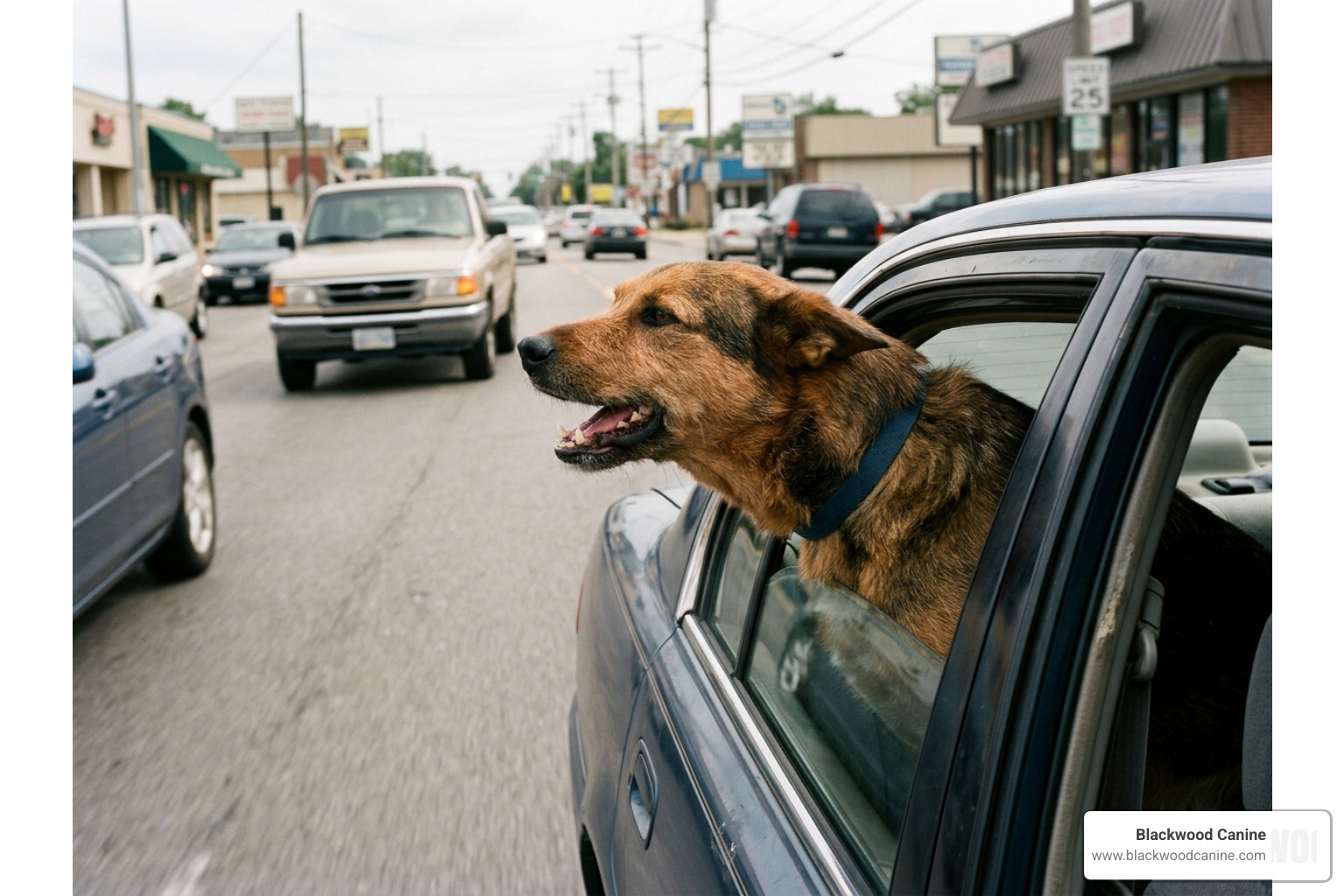
When we see a dog lunging at a car window, it is easy to assume they are just behaving badly. In reality, their brain is being flooded with stress hormones like cortisol and adrenaline. To help them, we must first understand why the window causes such a powerful emotional reaction.
Barrier Frustration and Territorial Instincts
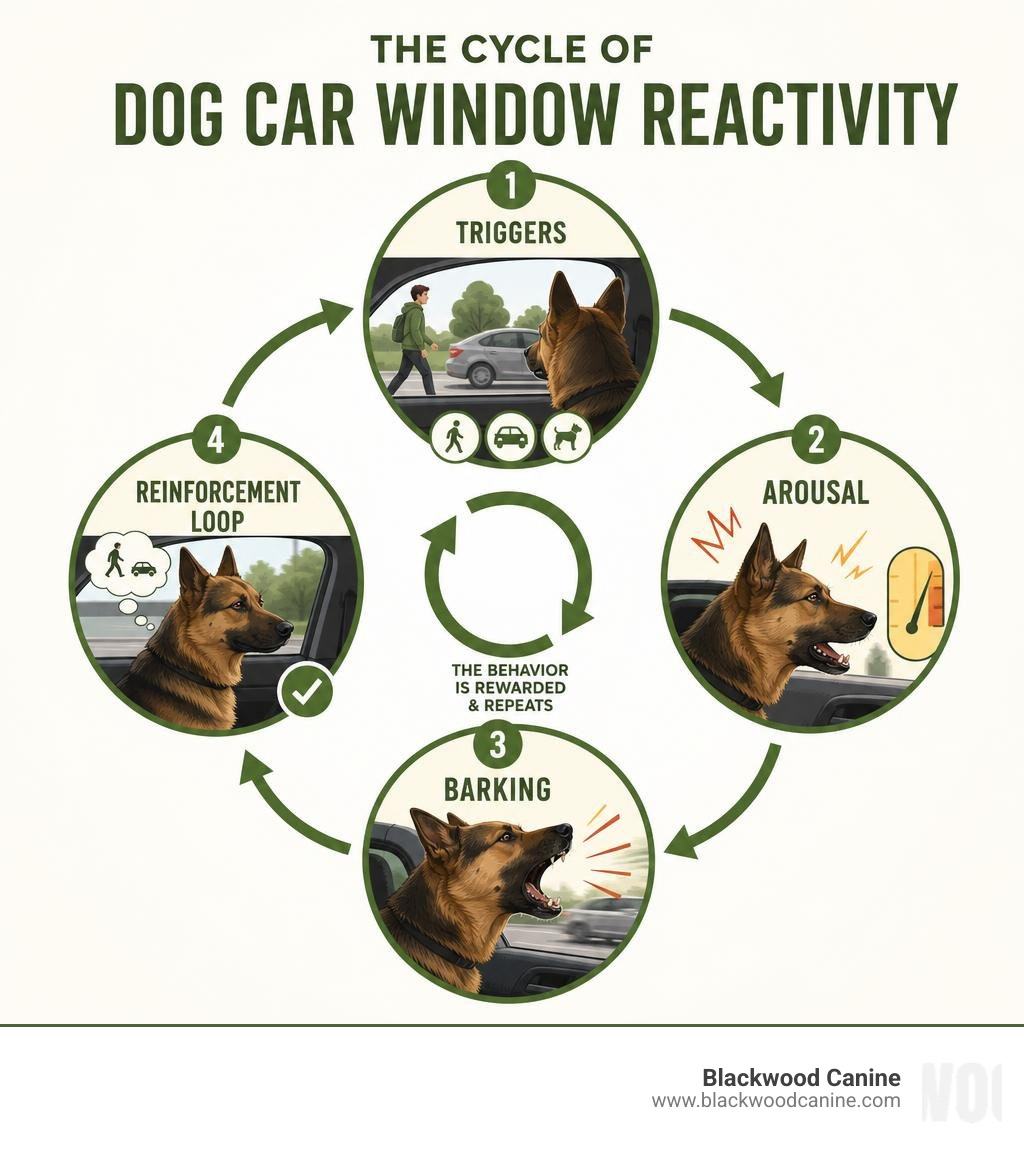
A vehicle is essentially a mobile den. For many dogs, their natural territorial instinct kicks in the moment they enter the cabin. They see the surrounding area as their territory to patrol. When a stranger, another dog, or a cyclist enters this trigger zone, the dog feels a biological drive to warn them away.
This is where barrier frustration enters the picture. In a normal outdoor setting, a dog can walk toward a trigger to investigate or move away to create space. Inside a vehicle, the glass window acts as a physical barrier. The dog is trapped in a confined space, unable to access the outside world. This lack of control causes arousal levels to skyrocket.
Every time a pedestrian walks past the car and continues on their way, classical conditioning occurs. Your dog barks, the person walks away (because they were already going to), and your dog thinks, "Excellent, my barking made that threat disappear." This self rewarding cycle makes the behavior stronger over time. To learn more about how these patterns develop, you can read our guide on Understanding and Transforming Reactive Dog Behavior.
Differentiating Motion Sickness from Dog Anxiety Car Windows Stress
It is incredibly common for pet parents to confuse physical motion sickness with behavioral window anxiety. In many cases, the two issues overlap. A puppy with an underdeveloped vestibular system (the inner ear balance system) gets nauseous on early rides. They quickly learn to associate the visual movement outside the window with feeling physically ill. Even after they grow older and their ears mature, the anticipatory anxiety remains.
To help your dog, you must figure out whether you are dealing with a physical stomach issue, a behavioral fear response, or a combination of both.
| Symptom | Primary Motion Sickness | Primary Window Anxiety |
|---|---|---|
| Trigger | Physical movement of the vehicle | Visual triggers outside the window (dogs, people, cars) |
| Onset | Begins after the car starts moving | Can begin while parked if triggers are visible |
| Physical Signs | Heavy drooling, vomiting, inactive pacing, lip licking | Shaking, hyper vigilance, lunging, high pitch whining |
| Treat Acceptance | Refuses all treats due to physical nausea | May refuse treats only when triggers are nearby |
| Post Ride Recovery | Recovers slowly, may remain lethargic | Recovers quickly once triggers disappear |
Signs of Car Window Distress in Dogs
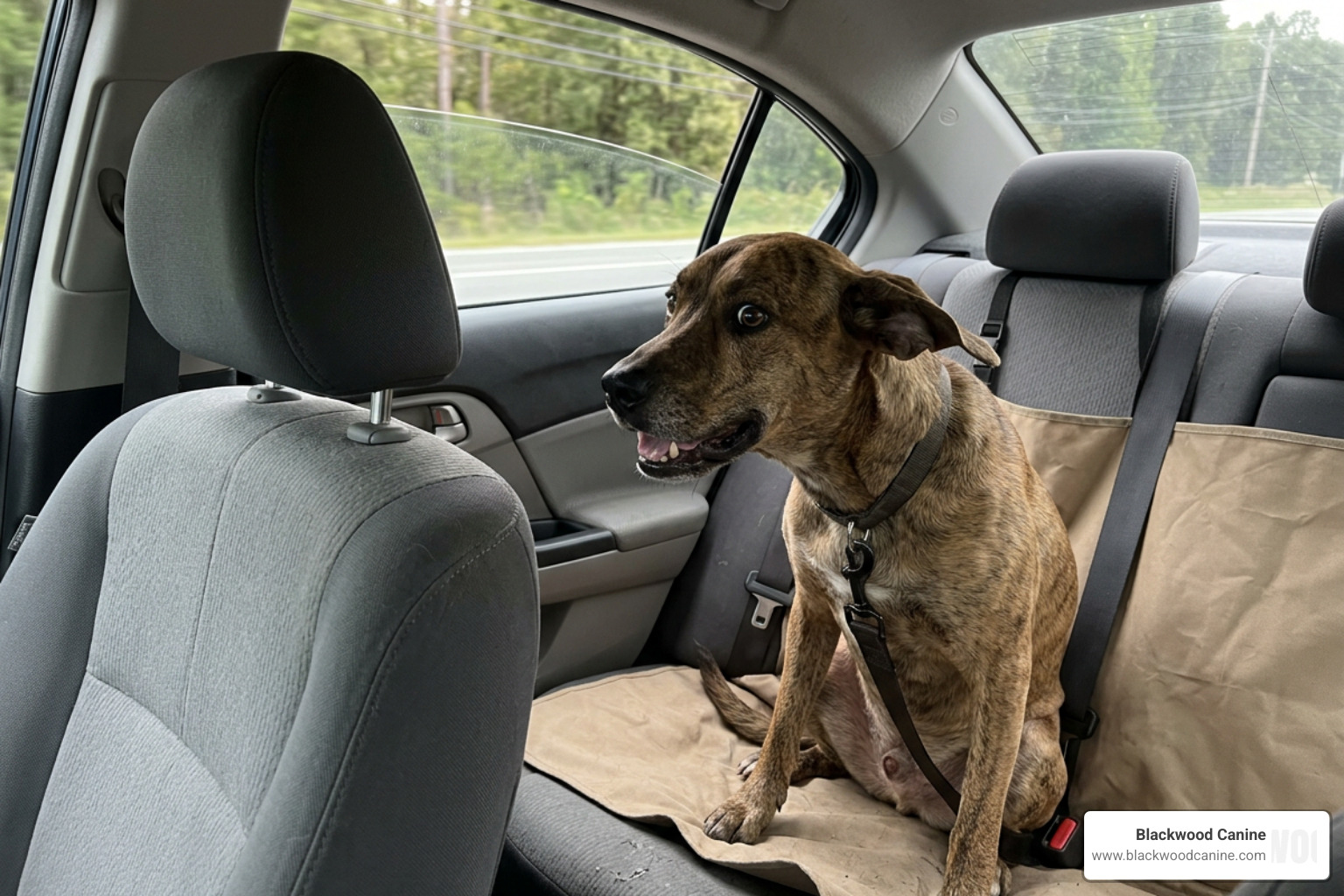
Anxiety does not always look like explosive barking. Many dogs suffer in silence, displaying subtle signs of distress long before they reach their breaking point. If you miss these early warning signals, your dog's stress will continue to stack until they erupt.
When riding in the car, watch for these common signs of travel distress:
- Excessive drooling - This is a classic sign of both nausea and extreme fear. If your dog is not normally a drooler but leaves puddles on your car seats, their stress levels are too high.
- Lip licking and yawning - These are displacement behaviors. Dogs use them to self soothe when they feel conflicted or anxious. A car yawn is not a sign of sleepiness; it is a sign of stress.
- Pacing and restlessness - An anxious dog cannot settle. They will walk back and forth across the seat, scratch at the doors, or try to climb into your lap.
- Whining or high pitch vocalizations - This is a clear expression of distress and barrier frustration.
- Trembling or shaking - This indicates a severe, full body panic response.
- Whale eye - This is when a dog turns their head slightly away but keeps their eyes locked on a trigger, showing the whites of their eyes.
If your dog displays these symptoms, they are telling you that the visual stimulation from the windows is too much for them to handle. You can read more about identifying these signals in this detailed guide on Dog Car Anxiety: Signs, Causes, and Treatment Steps.
How to Desensitize a Dog to Passing Traffic
To resolve dog anxiety car windows reactions, we must change how the dog feels about the things they see outside. This requires systematic desensitization (gradually exposing the dog to triggers at a distance where they remain calm) and counterconditioning (pairing those triggers with wonderful things).
The golden rule of behavior modification is to keep your dog below their stress threshold. If your dog is already barking and lunging, they are over threshold. Their brain is offline, and no learning can take place. We must start in a controlled environment. For professional insights on setting up this process, check out our Dog Trainer Advice on Dealing with Car Anxiety.
A Step by Step Counterconditioning Protocol
Before you begin, gather some high value treats that your dog only gets during car training. Think roasted chicken, hot dogs, or squeeze cheese.
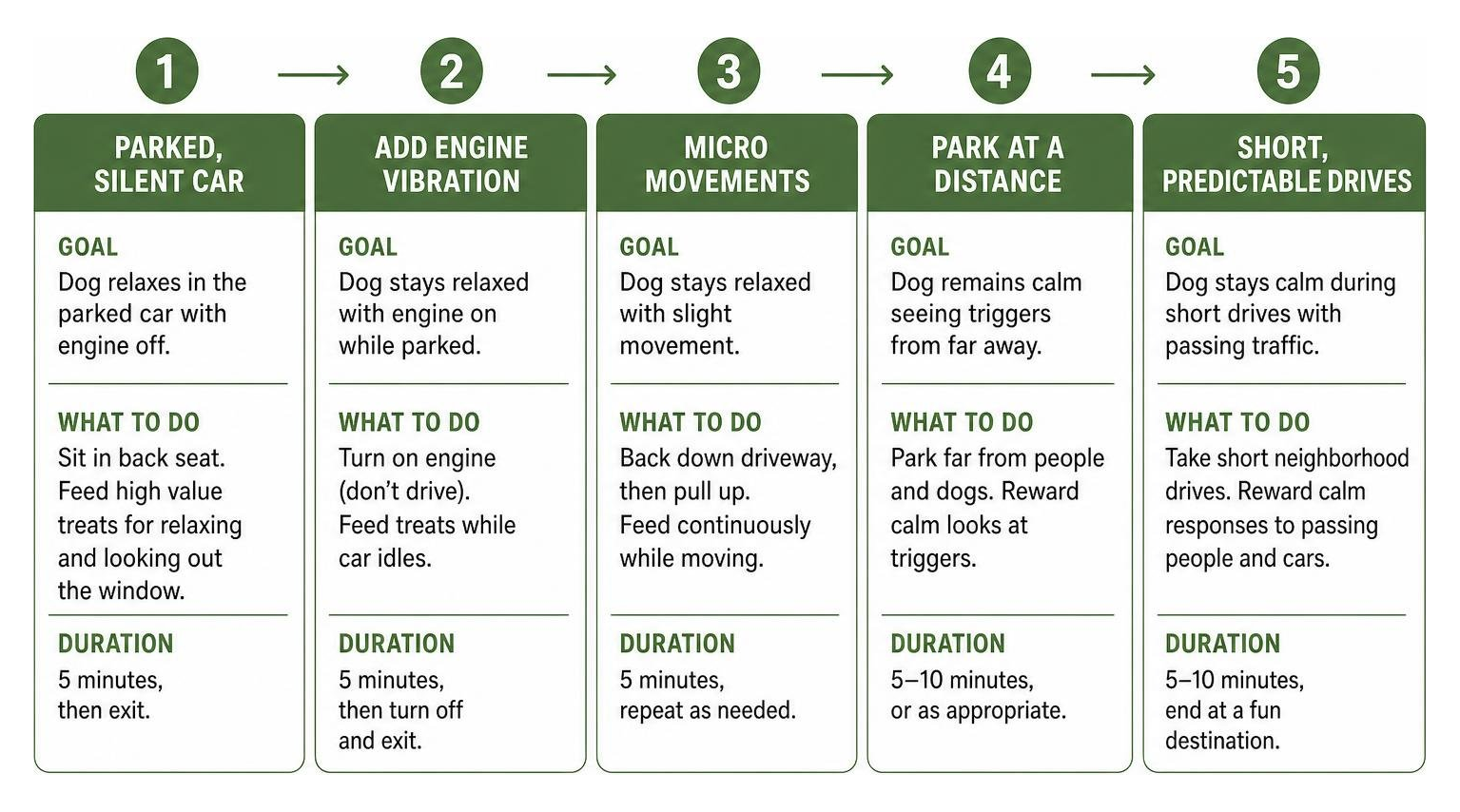
- Step 1: The Parked, Silent Car - Start with the car parked in a quiet area of your driveway, with the engine off. Sit in the back seat with your dog. Feed them high value treats just for relaxing. If they look at a window, give them a treat. Do this for five minutes, then exit.
- Step 2: Add Engine Vibration - Once your dog is happy to hang out in the silent car, turn the engine on. Do not drive anywhere. The sound and vibration can be a trigger for some dogs. Feed them their favorite treats while the car idles, then turn it off and go inside.
- Step 3: Micro Movements - Back up down your driveway, then pull back up. This introduces the visual movement of the scenery changing. Feed your dog continuously while the car is moving.
- Step 4: Park at a Distance - Drive to a quiet corner of a park or a grocery store parking lot in your local area, whether you are in Beaverton, Hillsboro, or Vancouver WA. Park far away from the action where people and dogs are barely visible. Every time your dog looks at a person in the distance and remains calm, click or say "yes," and feed them a treat.
- Step 5: Short, Predictable Drives - Take a five minute drive around your neighborhood. Have a helper sit in the back seat to feed your dog treats every time a car or person passes by. Always end the drive at a fun destination, like a quiet park trail, rather than just the vet or the groomer.
When to Seek Professional Help for Dog Anxiety Car Windows Issues
Some dogs experience such severe panic that they risk injuring themselves or causing an accident by distracting the driver. If your dog is thrashing, biting at the seatbelts, urinating in the vehicle, or showing zero progress after a month of consistent training, it is time to bring in the professionals.
At Blackwood Canine, we specialize in helping families navigate these exact challenges. If you live in Portland, Lake Oswego, Tigard, or any of our surrounding service areas, we can help. We offer Private Dog Training Lessons to teach you the mechanics of behavior modification, In-Home Private Lessons for personalized coaching, and dedicated Behavior Modification Training for severe reactivity and fear. For dogs that are highly reactive to strangers, we can even start with a virtual consultation to keep your pup stress free.
Environmental Tools and Products for Window Anxiety
While you are working through your training protocol, you still need to live your life. Management tools are essential to block visual stimulation and keep your dog from practicing the unwanted behavior on daily trips.
Window Film and Visual Barriers
One of the most effective, budget friendly management tools is temporary window film. You can purchase static cling frosted window film online and apply it to the lower half of your car's rear side windows.
This is a game changer for reactive dogs. It allows natural light into the vehicle but completely blocks your dog's view of passing pedestrians, dogs, and traffic. If they cannot see the trigger, they cannot react to it. This immediately lowers their arousal levels and prevents the self rewarding barking cycle from continuing. It is also highly effective for dogs that struggle with separation anxiety or barrier frustration when left in a parked car for brief moments.
Calming Aids and Veterinary Medications
For dogs with severe travel stress, training alone is often not enough because their brains are too flooded with panic to process new associations. In these cases, situational medication can make behavior modification possible.
A landmark clinical study published in the journal Frontiers | Acute trazodone administration reduces behavioral and physiological indicators of travel-induced anxiety in dogs in a road travel model demonstrated that a single dose of trazodone significantly reduced physiological and behavioral signs of travel stress, including lowering serum cortisol levels, reducing lip licking, and decreasing overall restlessness. Interestingly, the study found that gabapentin did not show the same level of statistical efficacy for acute travel anxiety, highlighting the importance of working with your vet to find the right pharmaceutical support.
If your dog's anxiety is rooted in motion sickness, your vet may prescribe Cerenia (maropitant citrate). Cerenia is an FDA approved antiemetic that blocks the vomiting reflex in the brain without sedating your dog, allowing them to ride comfortably and learn that the car is a safe place.
Preventing Window Anxiety in Puppies and New Dogs
The best way to solve window anxiety is to prevent it from ever developing. If you have a new puppy or a recently adopted dog, you have a golden opportunity to build positive associations with the car from day one.
The primary socialization window for puppies closes around 14 weeks of age. During this time, it is vital to introduce them to the car in a low stress way.
- Keep early trips short - Your puppy's first car rides should be no longer than two to three minutes. Drive around the block, park, feed them a handful of treats, and go back inside.
- Make the destination fun - Do not let their only car rides be to the veterinary clinic. Drive to a friend's house, a quiet park, or a drive thru for a tiny dollop of whipped cream.
- Focus on stability - Puppies easily slide around on leather seats, which can terrify them. Use a secure travel crate or a crash tested harness to keep them stable and secure.
Safety Considerations for Anxious Canine Passengers
When dealing with a dog experiencing dog anxiety car windows issues, safety must be your top priority. An unrestrained, panicked dog is a major distraction to the driver and can easily cause a serious accident.
Crash Tested Restraints and Secure Crates
In a sudden stop at 30 miles per hour, a 30 pound dog generates roughly 600 pounds of impact force. Letting your dog roam freely in the cabin or ride with their head hanging out the window is incredibly dangerous.
Look for restraints that have been certified by the Center for Pet Safety.
Here is our list of essential car safety gear for anxious dogs:
- Crash tested harness - These attach directly to your car's seatbelt system and prevent your dog from being thrown forward in a crash.
- Secured travel crate - A heavy duty, strapped down plastic or aluminum crate provides a safe, den like environment. It naturally limits their view of the windows, reducing visual triggers.
- Dog hammock - If using a harness, a back seat hammock prevents your dog from slipping onto the floorboards, giving them secure footing.
Preventing Escape and Heat Risks
Anxious dogs are flight risks. When stress levels are high, adrenaline tells the dog to run. Many dogs bolt out of the car door the second it is opened, leading to tragic situations on busy roads.
Always leash your dog before opening the car doors. Teach your dog a reliable "wait" cue, meaning they must sit and wait for your permission before exiting the vehicle.
Additionally, never leave an anxious dog unattended in a parked car. Even on mild days, temperatures inside a vehicle can reach dangerous levels in minutes, and a panicked dog will overheat much faster than a calm one. Ensure your pet is microchipped and wears an up to date ID tag at all times.
Frequently Asked Questions about Car Window Reactivity
Why does my dog only bark at people from the car and not on walks?
This is due to barrier frustration and the lack of a flight option. On a walk, your dog has space to move away from a trigger, and they can feel the open air. Inside the car, they are trapped in a tight, confined space. The glass window acts as a barrier, preventing them from investigating, which causes their frustration to boil over into barking and lunging.
Will rolling up the windows completely stop the barking?
No. While rolling up the windows can slightly reduce outside sounds, most dogs react to the visual movement of triggers. A dog will still bark at a person walking past the car even if the window is fully closed, because they can see the movement through the glass. To stop the reaction, you must block the view using tools like frosted window film.
How long does it take to resolve car window anxiety?
With consistent, daily training sessions, most owners see a noticeable improvement within four to eight weeks. However, every dog is an individual. The timeline depends on how long the behavior has been practiced, the severity of the anxiety, and how consistently you can manage their environment to prevent them from practicing the behavior between training sessions.
Let’s Make Car Rides Feel Easier
Solving dog anxiety car windows issues is not about forcing your dog to face their fears. It is about physical comfort, clear communication, and practical management. By blocking visual triggers with window film, using crash tested restraints for stability, and slowly building positive associations, you can transform your stressful car rides into calm, enjoyable adventures.
At Blackwood Canine, we are dedicated to helping families throughout the Portland metro area, Beaverton, Hillsboro, Lake Oswego, and Vancouver WA build reliable, stress free relationships with their dogs. You do not have to navigate this journey alone. Transform your reactive dog behavior with us today, and let us help you and your dog enjoy the open road together.
How to Choose a Dog Behavior Camp That Won't Ruin Your Pup
Is a Dog Behavior Camp Right for Your Dog?

A dog behavior camp is an immersive, residential training program where your dog lives and trains with professional trainers for days or weeks at a time, rather than attending a one hour class once a week.
Here is what you need to know quickly:
- What it is: A live in training program (also called board and train) where dogs receive daily, repeated training sessions with a professional
- Who it is for: Dogs struggling with reactivity, anxiety, destructive behavior, resource guarding, or dogs that simply never learned solid foundational manners
- How long it takes: Programs typically run 2 to 6 weeks depending on the dog's needs and the severity of the behavior issues
- What it costs: Expect to pay anywhere from $1,600 to $8,800 depending on program length and location
- What makes it different from group classes: Immersive repetition every single day, not once a week, and the training follows the dog into real environments, not just a classroom
- The key to lasting results: Owner coaching after camp is just as important as the training itself
If your dog is embarrassing you on walks, blowing up when guests arrive, or has already burned through group classes with little to show for it, behavior camp may be the reset you both need.
Many owners reach this point feeling defeated. You have tried the group class. You have watched the YouTube videos. You have been consistent, mostly. And your dog is still that dog on the street that everyone steps around. That experience is more common than you think, and it is exactly what behavior camp is designed to address.
I'm David Wright, founder of Blackwood Canine and a dog trainer who got his start working through real aggression challenges with his own dog before spending five years in apprenticeship under a seasoned professional. That hands on background is what shapes how I think about dog behavior camp and which programs actually deliver lasting change. In the sections below, I'll walk you through everything you need to evaluate a program with clear eyes.
What is a Dog Behavior Camp and How Does It Work?

At its core, a dog behavior camp is an intensive, residential training program. Instead of you trying to decode dog psychology after a long day at work, your dog lives in a structured environment with professional trainers. In our local Pacific Northwest communities, from Portland and Beaverton to Scappoose and Warren, this format is often referred to as a board and train or an immersion program.
The basic idea is simple: dogs are creatures of habit. When they stay in their normal home environment, they fall back into the same behavioral loops. By placing them in a new, highly structured setting, we can interrupt those unwanted patterns and build reliable new habits much faster. To understand the foundational structure of these programs, you can read more about the Dog Boot Camp Programs that we and other professionals use to design these immersive experiences.
During camp, your dog does not just sit in a kennel waiting for their turn. A reputable program integrates training into every single aspect of the day. From waiting politely at doors to crate manners, loose leash walking, and place training, every interaction is a learning opportunity. The goal is to build a cooperative relationship based on clear communication.
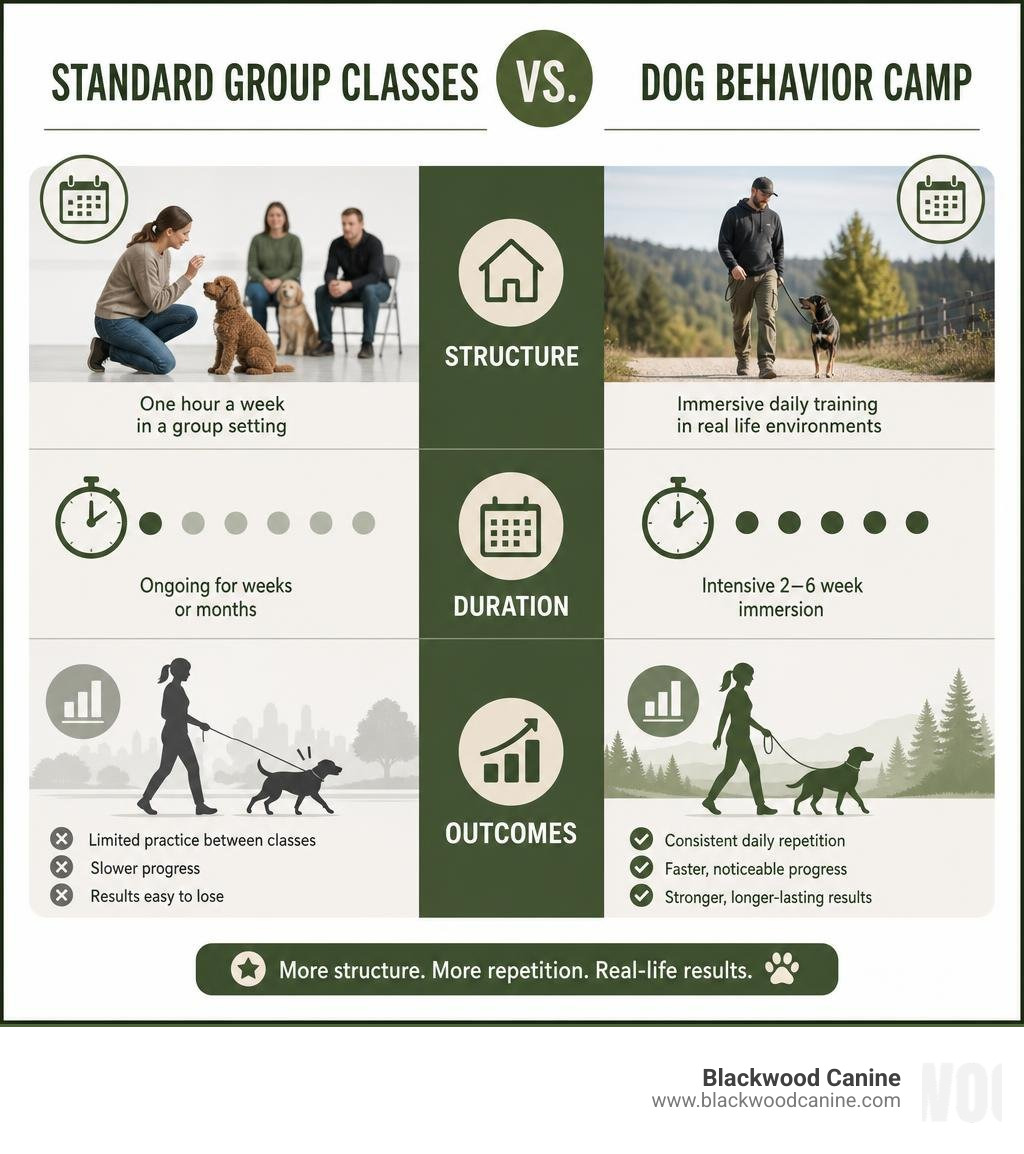
Behavior Camp vs Standard Obedience Classes
The biggest difference between a dog behavior camp and standard obedience classes is the speed, consistency, and depth of the training. Standard group classes, such as those offered by local community organizations like Dog Training , are fantastic for basic socialization and teaching simple commands like sit or down in a controlled, low distraction room.
However, standard classes rely entirely on you doing the heavy lifting at home. If you make a mistake, or if your dog is highly distracted, you might spend weeks trying to fix a single issue. In contrast, an Immersion Dog Training program allows a professional to handle the initial, difficult phase of teaching and proofing behaviors.
Professionals know exactly when to reward, when to guide, and how to read subtle canine body language. We do the hundreds of repetitions needed to make a behavior second nature, so that when your dog returns home, you are simply maintaining a finished product rather than trying to build it from scratch.
Who is the Ideal Candidate for a Dog Behavior Camp?
Not every dog needs a full behavior camp, but for some, it is the only option that moves the needle. The ideal candidates are dogs experiencing:
- Severe leash reactivity (barking, lunging, and growling at other dogs or people)
- Separation anxiety and destructive behavior when left alone
- Resource guarding of food, toys, or sleeping spaces
- Fearfulness and lack of confidence in public spaces
- Adolescent dogs that are simply too strong or high energy for their owners to manage safely
If you are struggling with a dog that lunges at every trigger on the sidewalk, you may need specialized Reactive Dog Training. Behavior camp is particularly helpful for busy families in areas like Hillsboro, Tigard, and Lake Oswego who want a well behaved companion but lack the hours of daily free time required to rehab complex behavior issues on their own. It is also an excellent option for dogs that need a complete behavioral reset before their owners can safely handle them on walks.
Training Philosophies and Safety Standards

When you hand your dog over for several weeks, safety and training philosophy should be your top priorities. The dog training industry is unregulated, which means anyone can call themselves a behaviorist or run a camp. Understanding the methods a camp uses is vital to ensuring your dog returns home confident and happy, rather than shut down or fearful.
Positive Reinforcement and Balanced Approaches
Reputable camps generally fall into two categories: purely positive reinforcement programs and balanced training programs.
Purely positive reinforcement programs focus entirely on rewarding good behavior and ignoring or redirecting unwanted behavior. This is highly effective for building confidence, teaching new skills, and working with sensitive or fearful dogs.
Balanced training programs use all four quadrants of operant conditioning. They use positive motivation (treats, toys, praise) to teach new behaviors, but they also use clear, fair boundaries to interrupt unwanted behaviors like lunging or resource guarding. For off leash reliability, some balanced trainers in the Portland metro area utilize low level e collar stimulation paired with high value rewards.
No matter which philosophy you prefer, the camp should focus on clear communication and practical management. You can learn more about how these philosophies are applied to complex cases by exploring Behavior Modification Training. The best trainers customize their approach to the specific dog in front of them, rather than forcing every dog into a rigid, one size fits all system.
Safety Protocols and Real World Distraction Proofing
A great dog behavior camp does not keep your dog cooped up in a training room for three weeks. To make the training stick, the dog must practice their new skills in the real world. This means taking field trips to local parks, trails, and pet friendly shops in places like Vancouver, Beaverton, and Sherwood.
However, real world training requires strict safety protocols. Reputable camps maintain:
- Low dog to trainer ratios (often 4 to 1 or even lower) to ensure individual attention
- 24 hour supervision and secure, climate controlled sleeping quarters
- Strict stress monitoring policies, ensuring dogs are not pushed past their comfort thresholds
- Double leashing and secure safety harnesses during public outings
This careful exposure is especially important during seasonal transitions. For example, local weather changes can cause unexpected behavioral shifts, as detailed in our guide on Why Portland Dogs Get More Reactive in January. A professional trainer knows how to manage these environmental variables safely so your dog learns to remain neutral and calm, no matter what is happening around them.
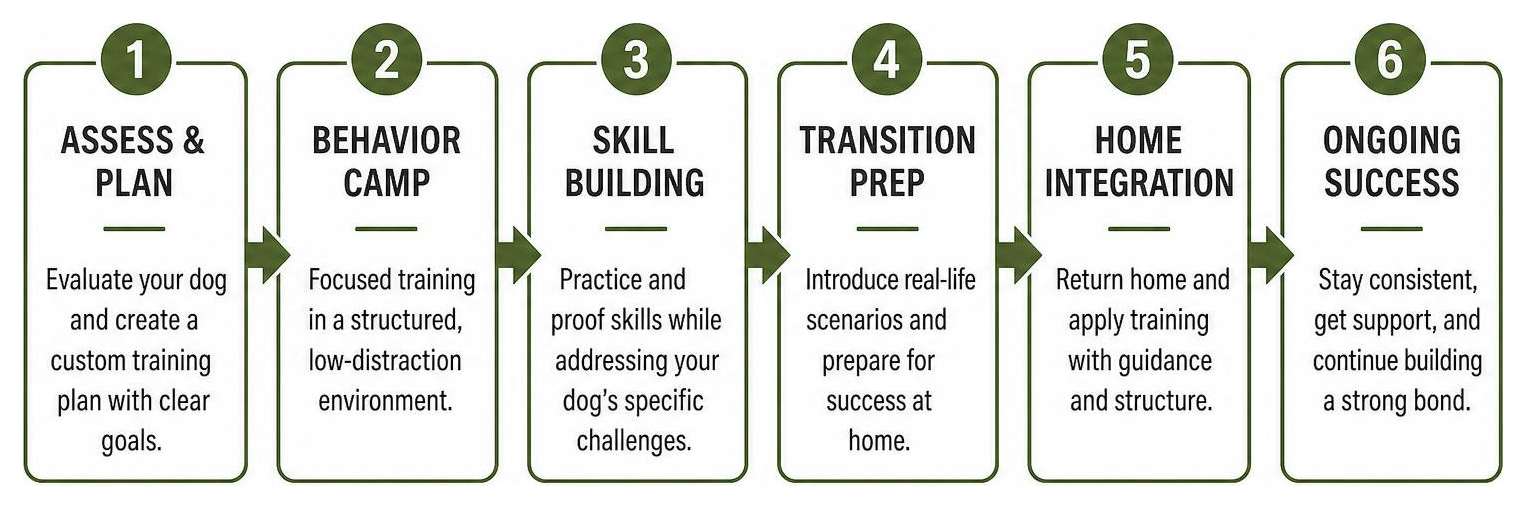
What to Expect During and After the Program
Sending your dog to camp is a big step, and it helps to know exactly what their daily life will look like while they are away from you.
Typical Daily Schedule and Structure
A day at a professional behavior camp is highly structured, balancing physical exercise, focused training, and plenty of rest. Here is what a typical day looks like:
- Morning: Early potty break followed by a structured walk to practice loose leash walking. Breakfast is often worked for, meaning the dog earns their kibble by performing basic commands and focus exercises.
- Midday: Individual active training sessions with a professional trainer. Between sessions, dogs practice settling quietly in a crate on the training floor. This is called modeling, where dogs learn to remain calm while other dogs are being worked around them.
- Evening: Dinner, a final structured walk, and quiet wind down time in a comfortable, climate controlled suite.
This routine builds healthy habits and teaches dogs how to transition from high energy play to a calm, relaxed state of mind. For a deeper look at why this structure is so beneficial, check out our article on 5 Good Reasons to Consider a Portland Dog Board and Train Program.
The Crucial Role of Owner Coaching and Transition Training
Here is a hard truth: a trainer can make your dog perfect, but if you do not change your habits at home, your dog will eventually go back to their old ways. Dogs are highly situational learners. They need to know that the new rules apply to you, not just the trainer.
Because of this, the most important part of any dog behavior camp happens after the dog comes home. A high quality program will include:
- Detailed transition lessons where the trainer teaches you how to use the commands and tools
- Step by step homework and video guides to help you maintain the training
- Ongoing follow up lessons and lifetime support to troubleshoot any new issues that pop up
If you want to understand when this level of commitment is the right choice for your family, read our advice on When is Dog Boot Camp a Good Idea for Portland Pet Parents.
Evaluating Costs and Program Fit
Investing in a behavior camp is a significant financial and emotional commitment. To make sure you are getting the right fit for your budget and your dog, you need to understand how professional camps screen their clients and structure their pricing.
Screening Processes for a Dog Behavior Camp
A reputable camp will never accept a dog without a thorough screening process. This is for the safety of your dog, the other camp guests, and the training staff. The screening process typically includes:
- A Behavior Assessment: A one on one consultation to observe your dog's temperament, assess their triggers, and discuss your specific goals.
- Health and Vaccination Checks: Verification of up to date vaccines, including Rabies, DHPP, and Bordetella, as well as flea and tick preventative.
- Customized Planning: Ensuring that your dog's specific issues (like severe fear or resource guarding) can actually be resolved in a camp environment, or if private, in home lessons are a safer starting point.
If a camp accepts any dog over the phone without asking questions or requiring an assessment, look elsewhere. For more details on what we look for during these initial evaluations, you can view our Immersion Dog Training services.
Program Lengths and Financial Considerations
The cost of a behavior camp varies widely depending on the length of the program and the complexity of the training. In the Portland and Vancouver metro areas, typical programs include:
- 10 Day to 2 Week Foundations: Best for young dogs or puppies needing basic manners and leash skills. Prices generally range from $2,000 to $3,000.
- 3 to 4 Week Behavior Modification: Designed for dogs with moderate reactivity, anxiety, or resource guarding. Prices typically range from $4,000 to $6,000.
- 5 to 6 Week Elite Rehabilitation: For severe behavior cases, including aggression or deep seated fear. Our 5 Week Fix is an example of an intensive program designed to tackle these heavy challenges safely. Prices for these advanced programs can range from $6,500 to $8,800.
Many high quality camps offer financing options or payment plans to help make this essential care accessible. To explore more about the different program levels and their costs, you can browse through our Dog Boot Camp Category.
Frequently Asked Questions about Dog Behavior Camps
How long do behavior camp programs usually last?
Most professional programs run between 2 and 6 weeks. Basic obedience and manners can easily be established in a 2 week program, while complex issues like severe reactivity, separation anxiety, or aggression require 4 to 6 weeks. The extra time is necessary to safely desensitize the dog to their triggers and build lasting, reliable habits.
What happens if my dog does not show progress?
Training is a partnership, and every dog learns at their own pace. Reputable trainers do not force progress. If a dog needs more time to process their training, a professional will adjust the plan. True success depends on the support you receive after the program. Programs like our Complete Companion package are designed to provide the lifetime support and follow up lessons you need to ensure your dog continues to make progress at home.
Are there age or breed restrictions for behavior camp?
Most camps require puppies to be at least 5 or 6 months old so they are fully vaccinated before entering a residential environment. There is no maximum age limit, as long as your dog is in good physical health. All breeds, sizes, and temperaments are welcome, though dogs with a history of severe bites will require a highly specialized evaluation before they can be accepted into a group facility.
Find the Right Reset for Your Dog
Choosing a dog behavior camp is one of the most important decisions you will make for your dog. When done right, an immersion program provides a peaceful, structured reset that can transform a reactive or anxious pup into a calm, reliable companion.
At Blackwood Canine, our focus is always on clear communication, practical management, and helping families build stress free relationships with their dogs. Whether you live in Portland, Vancouver, Hillsboro, or Scappoose, we are here to help you find the fastest, safest route to your training goals.
If you are ready to hand off the hard work to a team of dedicated professionals, take the first step and explore our Immersion Dog Training programs today.

The Science of Changing Habits: An Introduction to Behavior Modification
What Behavior Modification Actually Is (And Why It Matters for Your Dog)
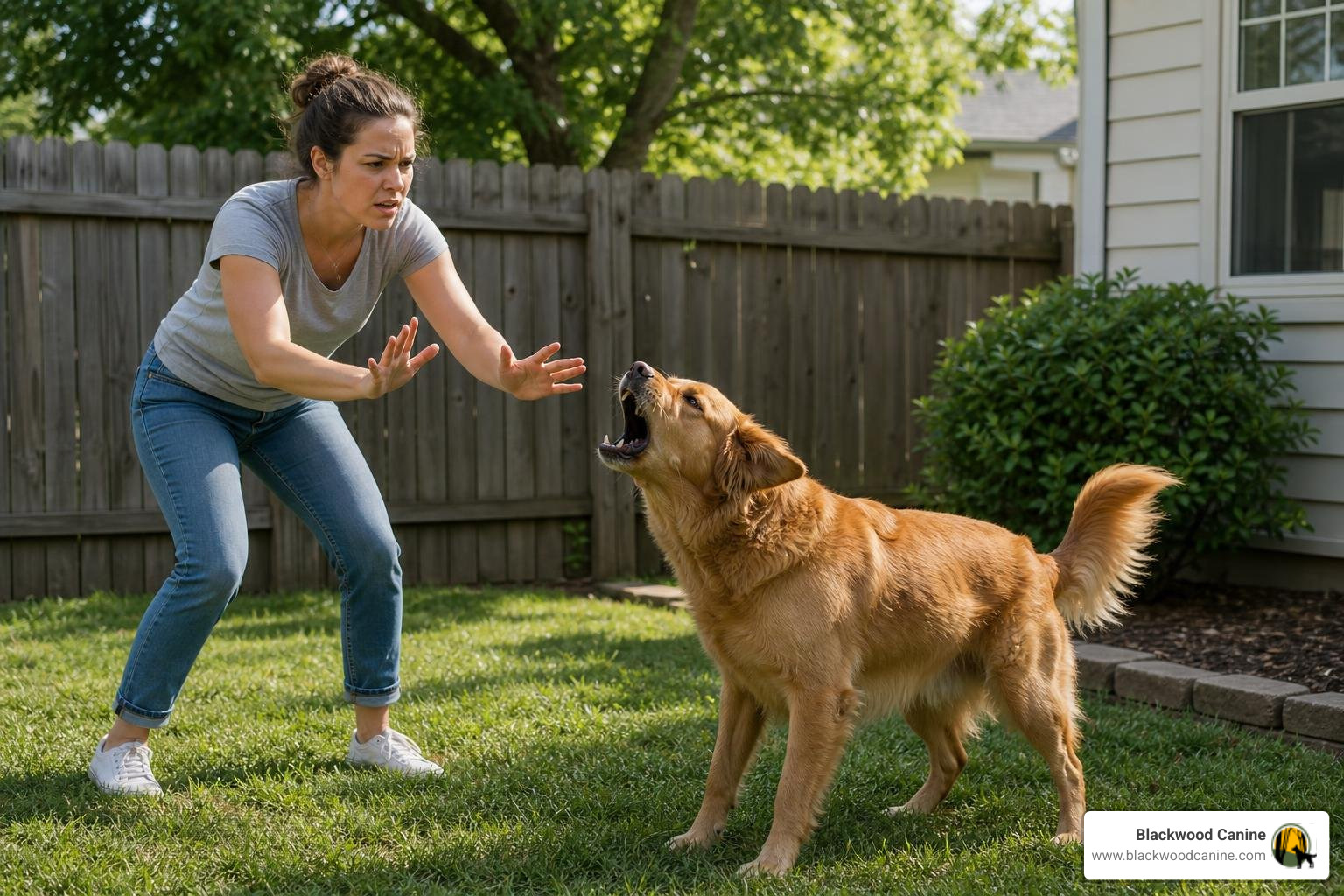
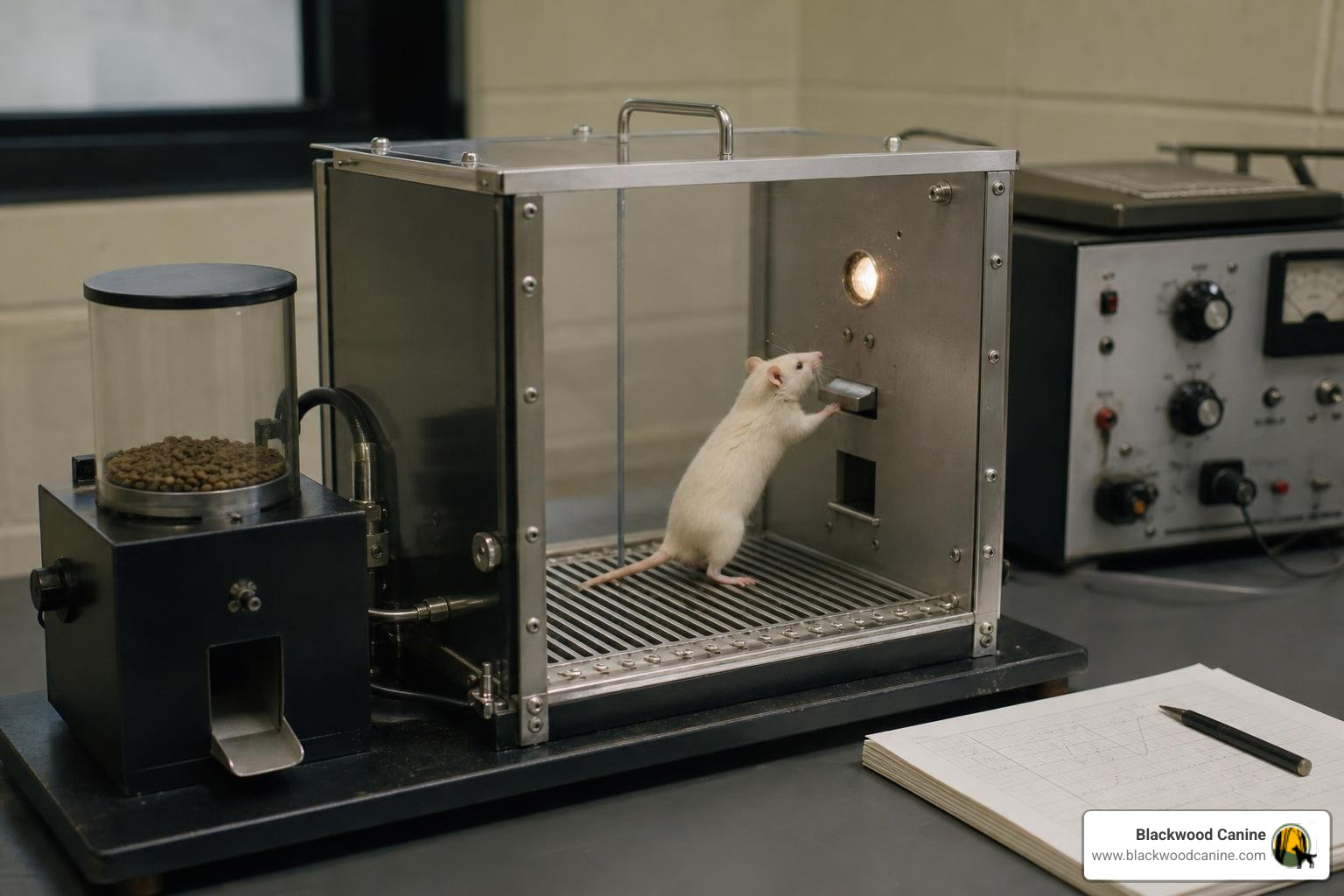
Behavior modification is a science-based approach to changing specific, observable behaviors using consequences like rewards, removal of rewards, and consistent follow-through. It does not focus on feelings or personality. It focuses on what the animal or person does, and what happens right after.
Here is a quick breakdown:
| Term | What It Means |
|---|---|
| Positive reinforcement | Add something good to increase a behavior |
| Negative reinforcement | Remove something unpleasant to increase a behavior |
| Positive punishment | Add something unpleasant to decrease a behavior |
| Negative punishment | Remove something good to decrease a behavior |
| Extinction | Stop reinforcing a behavior until it fades out |
The core idea is simple. Behavior that gets rewarded gets repeated. Behavior that gets no payoff eventually stops. That principle holds whether you are working with a child, an adult trying to change a habit, or a dog that will not stop jumping on your guests.
It sounds straightforward. But most people who struggle with their dog's behavior are not failing because they lack love or effort. They are failing because the system is inconsistent, the timing is off, or the consequences are not clear enough to actually change anything.
Successful behavior change almost always requires more than a command and a treat. It takes clear expectations, smart management of the environment, fair and well-timed consequences, repetition, and real follow-through from everyone involved. Miss one of those pieces consistently, and the plan falls apart.
I'm David Wright, founder of Blackwood Canine, and I have been applying the principles of behavior modification to help dog owners in the Portland and Vancouver area since apprenticing under an experienced trainer for five years. I have seen that the science works when it is applied consistently and with a clear system behind it.
What Is Behavior Modification?
To understand how to change a habit, we have to look at the science of behavior. The term was first used by Edward Thorndike in 1911. Later, psychologist B.F. Skinner expanded the field by studying how consequences shape actions.
Unlike other types of psychology, this approach does not spend time guessing about subconscious thoughts or deepseated emotional histories. It focuses strictly on overt, observable behavior. If we can see it, we can measure it. If we can measure it, we can design a plan to change it. You can read more about the history on this Scientific overview of behavior modification.
There are two main types of learning that drive behavior:
- Respondent conditioning: Also known as classical or Pavlovian conditioning. This is involuntary learning. A dog hears a food bowl clink and automatically starts drooling. The sound of the bowl becomes paired with the food.
- Operant conditioning: This is voluntary learning. The subject performs an action, and the consequence of that action determines whether they will do it again. If a dog sits and gets a piece of real chicken, they are more likely to sit next time. If they touch a hot stove, they will not touch it again.
Core Principles: Reinforcement, Punishment, and Extinction
The entire system of operant conditioning rests on four quadrants and the concept of extinction. In behavioral science, "positive" means adding something, and "negative" means taking something away. It has nothing to do with moral good or bad.
Positive reinforcement adds a desirable reward to increase a behavior. This is the fastest and most effective way to teach a brand new behavior. Negative reinforcement removes an unpleasant stimulus to increase a behavior. For example, a driver buckles their seatbelt to stop the annoying warning chime. The behavior of buckling the seatbelt increases because it removes the noise.
Punishment is designed to decrease a behavior. Positive punishment adds an unpleasant stimulus, such as a verbal correction or a spray bottle, to stop an action immediately. Negative punishment removes a valued item, like taking away a teenager's phone or turning your back on a jumping dog, to stop the behavior. You can learn more about these quadrants in this Guide to behavior change techniques.
Extinction occurs when you completely stop reinforcing a behavior that was previously rewarded. If a puppy barks for attention and you consistently ignore them, the barking will eventually stop. However, before it stops, you will usually experience an extinction burst. This is a temporary, dramatic increase in the intensity and frequency of the unwanted behavior. The puppy will bark louder and faster because they are trying harder to get the reward they used to get. If you give in during an extinction burst, you accidentally reward the extreme behavior, making it even worse.
Once a behavior is extinguished, it can sometimes reappear later out of nowhere. This is called spontaneous recovery. It is a normal part of the learning process, and continuing to ignore the behavior will quickly make it disappear again.
How It Differs from Cognitive Behavioral Therapy
People often confuse behavioral therapy with cognitive behavioral therapy. While they share some roots, they have very different focuses.
Cognitive behavioral therapy is insight oriented. It focuses on identifying internal thoughts, beliefs, and emotions, and then restructuring those thoughts to change how a person feels and acts. It is a highly effective approach for humans who can speak, reflect, and analyze their own minds. You can explore these differences further in this Comparison of behavioral therapies.
In contrast, behavior modification is purely action oriented. It does not require the subject to understand why they behave a certain way. It simply changes the environment and the consequences to reshape the physical actions. Because of this, it is highly effective for young children, individuals with developmental differences, and domestic animals. Your dog cannot sit on a couch and talk about their childhood anxiety, but they can absolutely learn new habits through clear, consistent consequences.
Core Components and Schedules of Reinforcement
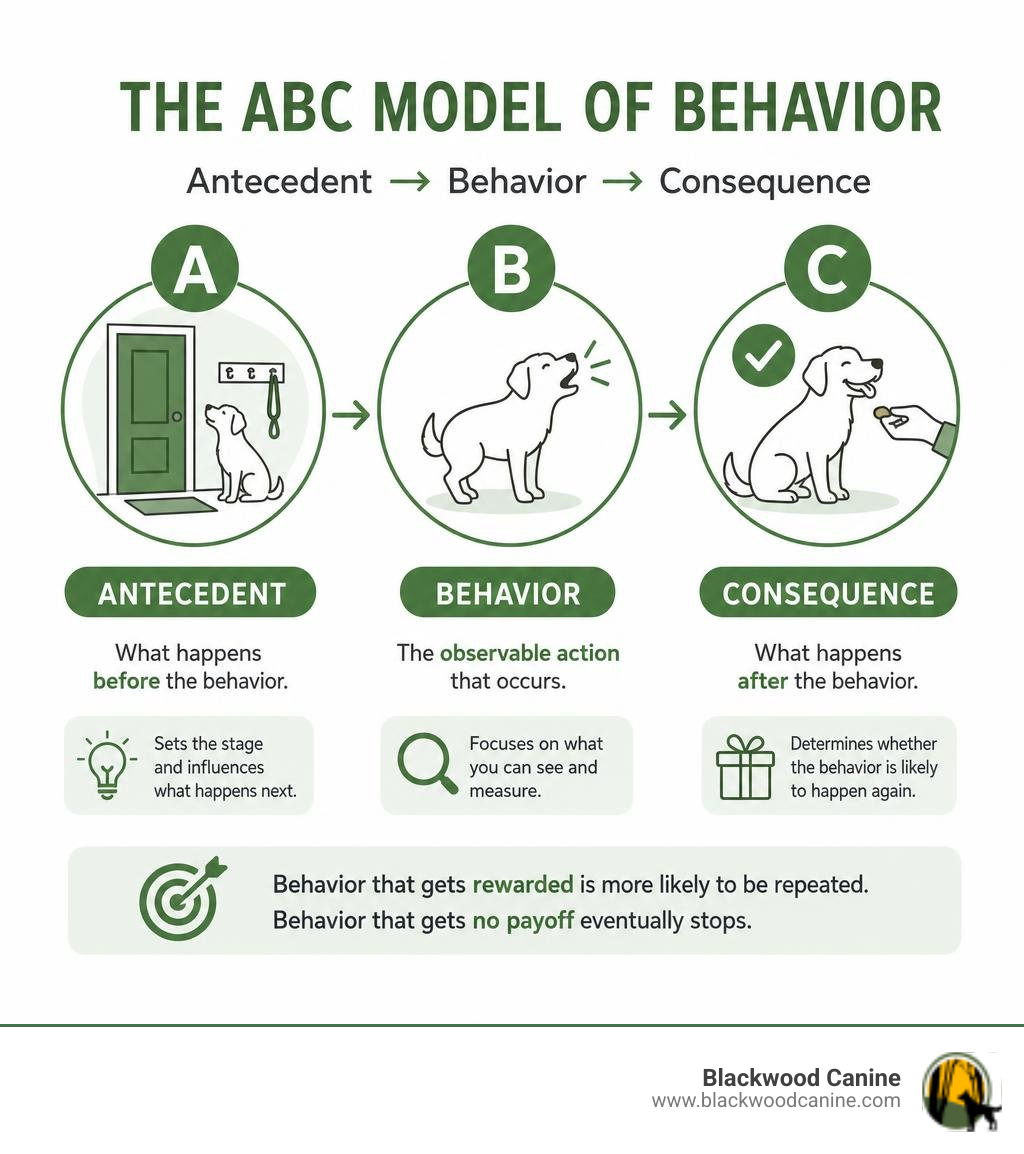
Before you can change a behavior, you have to understand why it is happening. This is where a Functional Behavior Assessment comes in. Instead of just trying to suppress a symptom, we look at the whole picture using the ABC framework:
- Antecedent: The trigger that happens right before the behavior.
- Behavior: The physical, observable action.
- Consequence: What happens immediately after the behavior.
If a dog barks at the window when the mail carrier arrives (antecedent), barks loudly (behavior), and the mail carrier walks away (consequence), the dog believes their barking forced the intruder to leave. The consequence reinforced the behavior.
To build an effective plan, we must balance proactive and reactive strategies:
| Proactive Interventions (Before the behavior occurs) | Reactive Interventions (After the behavior occurs) |
|---|---|
| Modify the environment to prevent the trigger | Apply a consistent, well timed consequence |
| Teach an alternative, acceptable replacement behavior | Use extinction by withholding the expected reward |
| Meet the subject's physical and mental needs first | Redirect the subject to a safe, structured task |
We also use techniques like shaping, which is the process of reinforcing gradual steps toward a final goal. If you are teaching a dog to roll over, you do not wait for them to do the whole thing. You reward them for lying down, then for tilting their head, then for lying on their side, and finally for rolling all the way over.
In human settings, practitioners often use a token economy. This is a system where a person earns physical tokens or points for good behavior and later exchanges them for valued privileges. Research has shown that token systems can cause a ninefold increase in task completion compared to baseline levels.
Designing a Canine Behavior Modification Program
When we design a program for a dog, we focus heavily on clear communication and practical management. Many owners in Scappoose, Warren, and St. Helens feel overwhelmed because they are trying to use mixed signals or outdated training ideas.
We do not believe in using physical dominance or confrontational methods. Science shows that confrontational training actually increases fear, avoidance, and aggression in dogs. At the same time, we do not believe that purely positive, treatonly training is always enough for serious behavior issues. True training requires clear expectations, smart management of the environment, and fair, consistent consequences.
If you want to understand our approach to training, you can read our guide on Dog Training Methods: Positive Reinforcement vs Dominance Training.
If you are dealing with a dog that lunges, barks, or overreacts on walks, you are not alone. Many owners in Bethany, Hillsboro, and Beaverton struggle with this. We have put together a resource on Understanding and Transforming Reactive Dog Behavior to help you make sense of what your dog is going through.
Most importantly, we want you to stop feeling bad. You did not break your dog, and feeling embarrassed or frustrated will not help them learn. You can read our advice on how to Stop Feeling Guilty About Your Reactive Dog to help you get back on track with a clear head.
Establishing vs Maintaining Behaviors with Reinforcement Schedules
How often you deliver a reward changes how quickly a behavior is learned and how long it lasts.
When you are teaching a brand new behavior, you must use continuous reinforcement. This means you reward the behavior every single time it happens. This builds a fast, clear association between the action and the reward.
Once the behavior is established, you must transition to intermittent reinforcement. If you keep rewarding every single time, the behavior will actually become weaker and highly sensitive to extinction the moment you stop carrying treats. By thinning the schedule of reinforcement, you teach the subject to keep trying even if they do not get a reward every time.

There are four types of intermittent schedules:
- Fixed ratio: The reward is delivered after a set number of responses. For example, a factory worker gets paid for every ten items they assemble.
- Variable ratio: The reward is delivered after an unpredictable number of responses. This is the slot machine effect. Because the next pull could be the big winner, the subject keeps trying with high intensity. This is the most powerful schedule for making a behavior highly resistant to extinction.
- Fixed interval: The reward is delivered after a set amount of time has passed, provided the behavior occurs. A student might study hard only in the days leading up to a scheduled monthly exam.
- Variable interval: The reward is delivered after an unpredictable amount of time has passed. This creates slow, steady, and highly consistent behavior because the subject never knows when the payoff will come.
To dive deeper into how these schedules work across different species, you can consult this comprehensive resource on Textbook principles of behavior modification.
Real World Applications and Ethical Considerations
The beauty of behavioral science is that it works across different settings, species, and goals. In humans, lifestyle medicine relies heavily on these principles to help people build healthy habits.
For example, the Trevose Behavior Modification Program has shown incredible, lasting success in helping individuals lose weight and manage binge eating. By using structured support, clear tracking, and environmental management, participants are able to bridge the gap between their healthy intentions and their daily actions. To read more about how these principles are used for human health, check out this Clinical review of lifestyle behavior modification.
Clinical Behavior Modification for ADHD and Autism
In clinical settings, behavior modification is considered a primary, evidence-based intervention for children and adults with Attention Deficit Hyperactivity Disorder (ADHD) and Autism Spectrum Disorder (ASD).
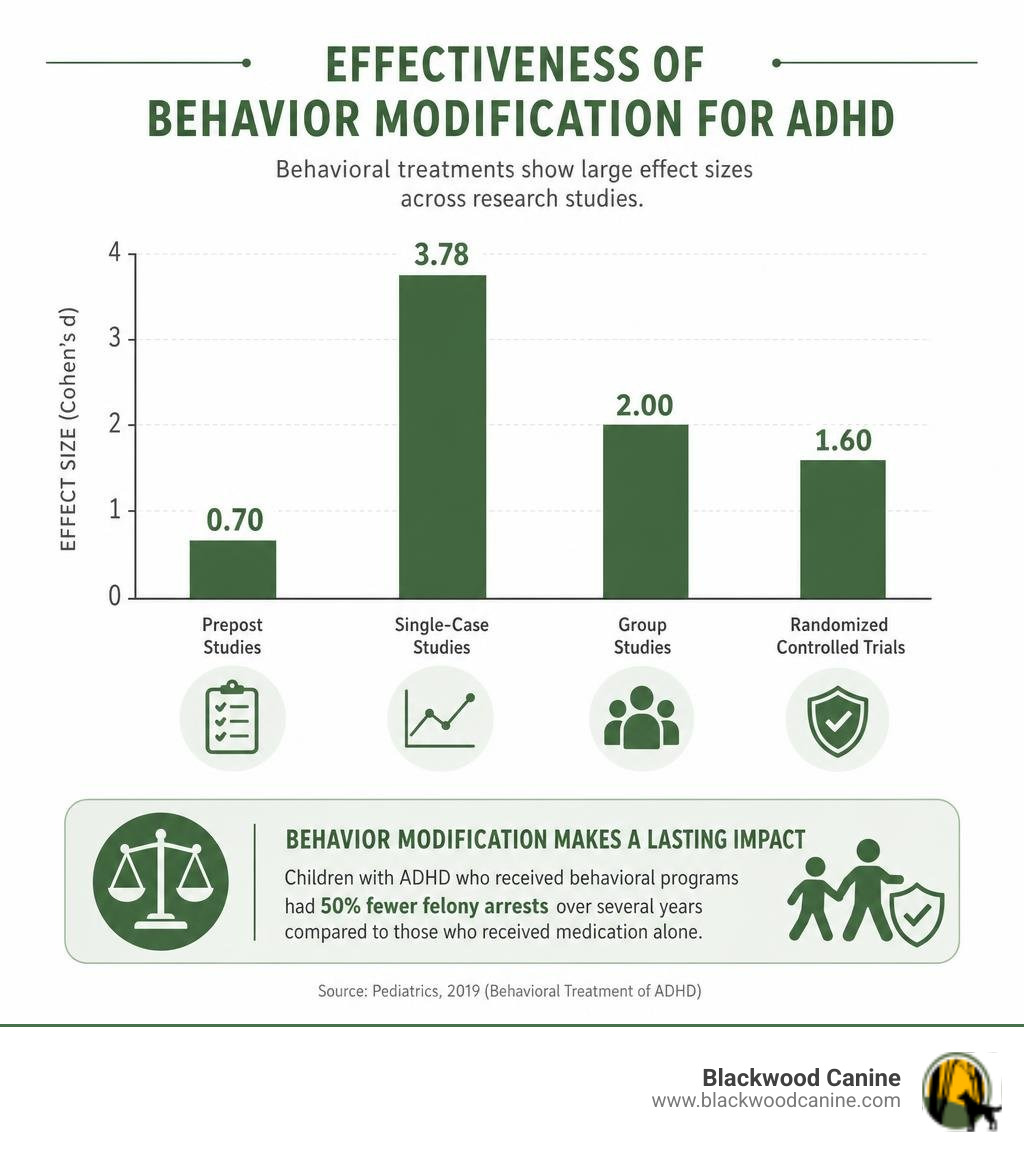
Applied Behavior Analysis is a structured therapy that breaks down complex social and life skills into small, manageable steps. The scientific data supporting these interventions is incredibly strong. For treating ADHD, behavioral treatments have shown massive effect sizes, ranging from 0.70 in prepost studies to 3.78 in singlecase studies.
Even more striking is the long term impact. One study tracked children with ADHD over a several year period. Those who were placed in a behavioral modification program had half the number of felony arrests compared to those who only received medication. This shows that teaching real, functional coping skills and behavioral habits has a profound, lasting impact on a person's life. You can review the clinical guidelines and data in this Pediatric behavior modification guidelines.
Managing Anxiety and Fear in Dogs
For dogs dealing with severe fear, anxiety, or reactivity on leash, we use specialized behavioral techniques to change how they respond to their triggers:
- Desensitization: Slowly exposing the dog to their trigger at a very low intensity. If a dog is terrified of doorbells, we might play a quiet recording of a doorbell from across the room. We only increase the volume and proximity as the dog remains completely relaxed.
- Counterconditioning: Changing the dog's emotional association with a trigger. If every time the dog hears a quiet doorbell they get a piece of hot dog, the sound of the bell stops predicting an intruder and starts predicting delicious food.
- Response substitution: Teaching the dog to perform an active, positive behavior instead of their unwanted reactive behavior. For example, we teach the dog to look at us and sit when they see another dog, rather than lunging and barking.
If you are dealing with a dog that is highly reactive, we offer specialized Reactive Dog Training to help you navigate walks safely. For more intense, deepseated behavior struggles, our Advanced Re-Conditioning programs are designed to help dogs learn how to make better choices in challenging environments.
Ethical Guidelines and Addressing Pitfalls
Whether you are working with humans or animals, ethics must always come first. In human therapy, practitioners must respect individual autonomy and obtain fully informed consent. Some critics, particularly within the neurodiversity movement, argue that early behavioral programs focused too much on forcing outward compliance rather than understanding the individual's needs. Modern behavior analysis has shifted to address this, focusing on functional communication and proactive support rather than just suppressing behaviors.
When we look at dog training, ethical issues usually revolve around misuse, poor timing, unclear goals, or using too much pressure without a real plan. Punishment and training tools are not automatically the problem. Used correctly, and under professional guidance, they can be part of a balanced training plan. The problem is when corrections are too harsh, inconsistent, or applied without teaching the dog what to do instead. That can increase fear, avoidance, and defensive aggression, and it can damage the trust between you and your dog.
We always recommend starting with proactive management and positive reinforcement to teach the desired behavior. However, we also recognize that ignoring a dangerous behavior will not make it go away. If your dog is displaying severe aggression, self injurious behavior, or sudden behavioral changes, it is critical to consult a professional and involve your veterinarian. Some behavior issues are driven by underlying pain or medical conditions that must be addressed first.
To learn more about dog behavior, common struggles, and training tips, you can explore our Blog category: behavior.
Frequently Asked Questions
What is the most effective schedule of reinforcement?
The most effective schedule for maintaining a behavior over the long term is a variable ratio schedule. This is the intermittent schedule where a reward is delivered after an unpredictable number of correct responses. Because the subject never knows which attempt will pay off, they keep trying with high enthusiasm and persistence. It is the same psychological mechanism that makes slot machines and gambling so addictive for humans. However, you should only switch to this schedule after you have used a continuous reinforcement schedule to teach the behavior first.
Can medication be used alongside behavior modification?
Yes. For dogs dealing with severe, chronic anxiety or panic, behavior modifying medications can be incredibly helpful. However, medication should never be used as a standalone solution. Drugs do not teach new, desirable habits; they simply lower the dog's stress levels so they are in a state of mind where they can actually learn. Medication is most effective when it is paired with a structured, active training program under professional guidance.
Why do behavior modification plans fail?
Most plans fail because of a lack of consistency. If one family member rewards a dog for jumping on them, but another family member punishes the dog for the same action, the dog will become confused and stressed. Plans also fail when the timing of the reward or consequence is off, when the rewards being used do not actually hold high value for the dog, or when the owner fails to manage the environment to prevent the dog from practicing the unwanted behavior in the first place.
Ready to Make Behavior Change Stick
At the end of the day, changing a habit comes down to clear communication, smart management, and absolute consistency. Whether you live in Portland, Vancouver, Hillsboro, or Beaverton, we know how frustrating it is to feel stuck with a dog whose behavior is making your life stressful.
Our goal at Blackwood Canine is to help you cut through the confusion and build a reliable, stress-free relationship with your dog. We do not offer quick fixes or magic guarantees. Instead, we give you a practical, science-based plan that actually works.
If you are ready to stop feeling frustrated and start seeing real progress, the best next step is our Good Dog Game Plan. Contact us today to learn more about our Behavior Modification Training and let us help you get back on track.
Basic Obedience Dog Training 101: Building a Confident and Well-Mannered Pup
Why Basic Obedience Dog Training Is the Foundation Every Dog Needs

Basic obedience dog training gives your dog the structure to understand what you expect and gives you the tools to actually follow through on it.
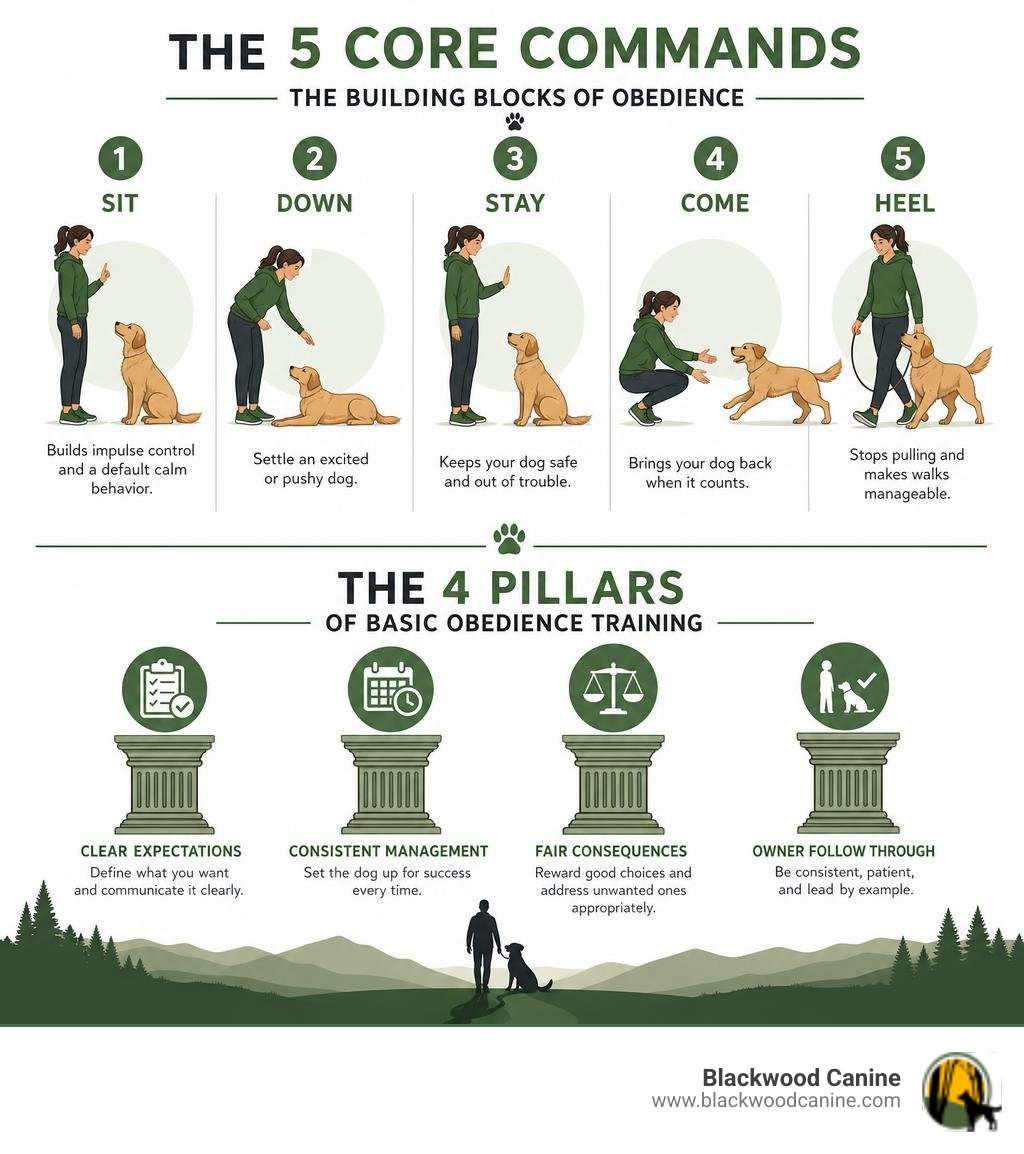
Here is what it covers at a glance:
| Command | What It Does |
|---|---|
| Sit | Builds impulse control and a default calm behavior |
| Down | Settle an excited or pushy dog |
| Stay | Keeps your dog safe and out of trouble |
| Come | Brings your dog back when it counts |
| Heel | Stops pulling and makes walks manageable |
But here is the honest part most guides skip: commands are only one piece of the puzzle. Real obedience training is built on clear expectations, consistent management, fair consequences, and owner follow through. Without those, even a dog that knows sit in your kitchen will fall apart at the front door when a guest arrives.
If your dog pulls every walk, ignores you in public, or turns guest visits into an embarrassing mess, you are not alone. Most dog owners in the Portland and Vancouver area hit the same wall: they try training, it works at home, and then it completely falls apart in the real world.
That gap is exactly what this guide addresses.
I am David Wright, a professional dog trainer with over a decade of hands on experience in basic obedience dog training and behavior, apprenticed under an experienced K9 coach before launching my own training practice. I have worked with dogs of all breeds and temperaments, including dog aggressive cases that most group classes would turn away. Everything in this guide is grounded in real training experience, not theory.
The Core Pillars of Basic Obedience Dog Training
Many dog owners in Scappoose, Hillsboro, and Beaverton come to us feeling completely stuck. They have watched dozens of online videos, bought bags of expensive treats, and yet their dog still runs the household. The problem is not the dog. The problem is usually a lack of clear structure.
True obedience is not about tricks. It is about a lifestyle built on clear communication and reliable boundaries.
Why Basic Obedience Dog Training Matters for Your Sanity
A dog without training is a constant source of stress. When you cannot trust your dog to listen, your world shrinks. You stop inviting friends over to your home in St Helens because your dog will jump all over them. You avoid the beautiful parks in Portland because your dog pulls your arm out of its socket.
Proper training restores your freedom. It provides safety and control in emergency situations, like when your dog slips out of the front door toward a busy street. It establishes clear household boundaries, so your dog knows where to settle when you are eating dinner. It builds a reliable relationship where your dog respects your leadership and understands exactly what is expected of them.
Essential Gear for Your Sessions
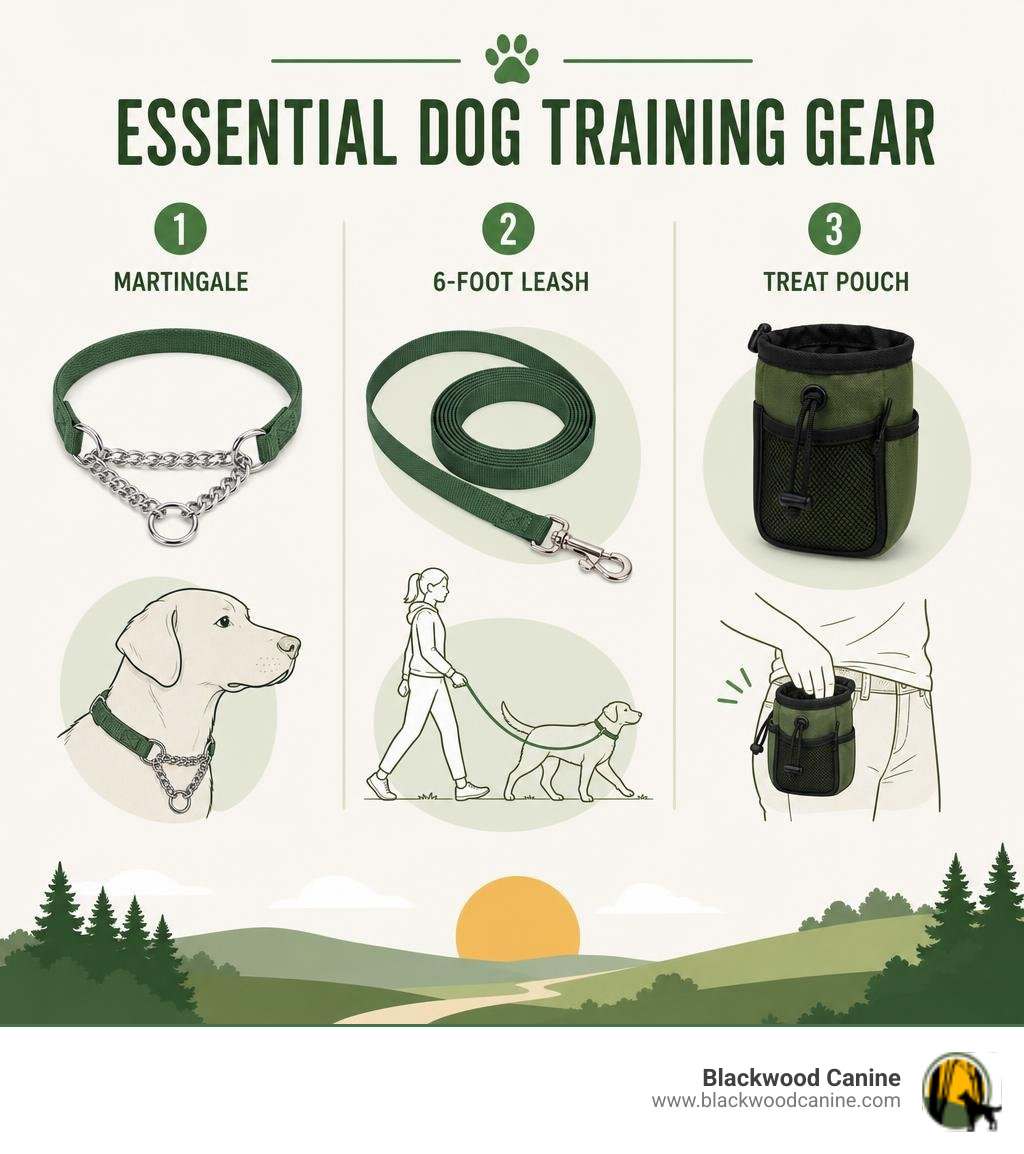
You do not need a closet full of expensive gadgets to train your dog. In fact, keeping your equipment simple makes your training much more effective. Here is the short list of what you actually need:
- A flat collar: A simple, high quality nylon or leather collar. Avoid retractable leashes entirely. They provide inconsistent tension, which actively teaches your dog to pull against the leash.
- A six foot leash: This is the standard length for daily training and loose leash walking. It gives you close control without keeping your dog too cramped.
- A thirty foot long line: This is an essential tool for teaching a reliable recall. It allows your dog to practice coming to you from a distance while you still maintain physical control.
- High value treats: Standard kibble will not cut it when you are competing with the smell of squirrels in Warren or Rainier. Use small, soft treats like cooked chicken, cheese, or freeze dried beef liver.
- A clicker (optional): A clicker is a fantastic tool to mark the exact moment your dog performs the correct behavior. If you want to learn more about how this works, read our guide on Curious About Clicker Training? Dog Trainers Explain the Basics.
Setting Up Your Basic Obedience Dog Training Schedule
One of the biggest mistakes we see owners make in Bethany and Lake Oswego is trying to train their dog for an hour straight. This just exhausts the dog and frustrates the owner.
Dogs learn best in short, highly focused bursts. Your daily training formula should consist of:
- Five to ten minute sessions: Keep it short and fast.
- Two to three times daily: Spread these sessions throughout the day.
- Thirty minutes of total daily practice: This is more than enough time to build incredible obedience.
Before you begin any session, make sure your dog has relieved themselves and is reasonably rested. It is also highly recommended that you do not feed your dog for at least four hours before training. A hungry dog is a motivated dog. Always end every single session on a successful repetition to keep your dog confident and eager for the next session.
The Essential Commands and How to Teach Them
Teaching your dog commands requires patience, consistency, and clear physical mechanics. Let us walk through how to teach the core obedience skills step by step.
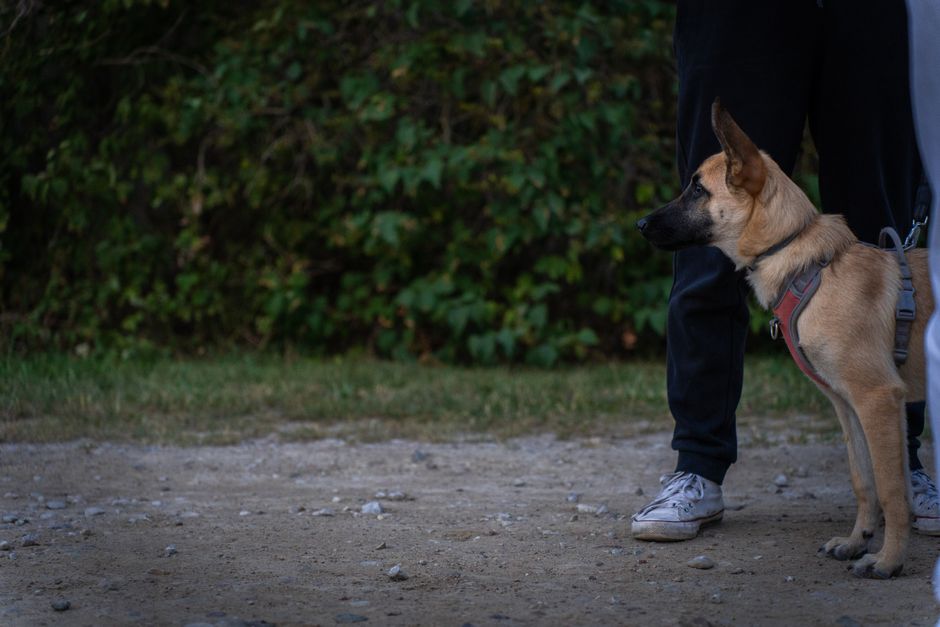
Teaching Sit and Down with Luring
Luring is the process of using a piece of food like a guide wire to lead your dog into the correct position. It is incredibly effective because it does not require you to push or pull your dog physically.
To teach the sit command:
- Hold a high value treat right in front of your dog's nose.
- Slowly lift the treat up and back over their head, keeping it close to their snout.
- As your dog's head goes up to follow the food, their rear end will naturally go down.
- The exact second their bottom touches the floor, mark the behavior with a click or a verbal "Yes!" and give them the treat.
To teach the down command:
- Start with your dog in a sitting position.
- Hold a treat in front of their nose and lower it straight down to the floor between their front paws.
- Once your hand is on the floor, slowly pull it forward along the ground in an "L" shape.
- Your dog should slide their body down to follow the treat. Mark and reward the instant their chest touches the floor.
Once your dog is moving into these positions easily, you need to transition away from having food in your hand every time. To learn this crucial step, check out our articles on how to Transform Your Dog's Training with the Power of Luring and Fading the Lure: How to Fade the Food Lure.
Teaching Stay and Heel for Real World Control
The stay command is all about teaching your dog to remain in place until you give them permission to move.
- Ask your dog to sit.
- Show them an open palm hand signal and say "Stay" in a calm, flat voice.
- Take just one step back.
- If your dog remains in place for three seconds, step back to them, mark, reward, and give your release word like "OK" or "Free".
- Gradually increase the time and distance. If your dog breaks the stay, do not repeat the command. Calmly place them back in the exact spot they started and try again with a shorter duration. To prevent them from jumping up when you return, you can gently step on the leash near their collar.
The heel command teaches your dog to walk calmly by your side without pulling. In a proper heel position, your dog should walk on your left side, no more than four inches from your leg.
- Hold your leash in your left hand and a high value treat or a squeaky toy in your right hand.
- Place your right arm across your body so the motivator is near your left hip, guiding your dog's focus.
- Start walking. Every few steps that your dog walks calmly by your side, reward them.
- If they begin to pull ahead, quickly step to the side to redirect them, or stop moving entirely until the leash goes slack.
For more detailed help on these foundational movements, you can read the guide on THE FIVE COMMANDS . If you are specifically struggling with a dog that jumps on visitors when they enter your home, read our guide on Dog Obedience: Teaching Your Dog Not to Jump Up on People.
Building a Reliable Come Command
A reliable recall can save your dog's life. However, many owners accidentally train their dogs to ignore this command. If you call your dog to you only when it is time to leave the park, or if you scold them after they finally return to you, you are actively teaching them that coming to you results in bad things.
To build a rock solid recall:
- Start in a low distraction environment, like your hallway.
- Squat down to your dog's eye level, open your arms wide, and call their name followed by "Come!" in an enthusiastic, high pitched voice.
- When they reach you, throw a mini party. Give them multiple high value treats, praise them warmly, and rub their chest.
- If you are outdoors, always use your thirty foot long line. If they ignore your call, do not yell. Gently use the long line to guide them to you, praising them the entire way so they realize that coming to you is always a positive experience.
For a deeper look into the mechanics of this process, check out How to Train a Dog: The Complete Beginner Guide (2026) DogTrainingHQ.
The Three Stages of Learning and Generalization
Many owners in Vancouver and Tigard get frustrated because their dog is a superstar in the living room but acts like they have never heard a single command when they go outside. This happens because dogs do not generalize behaviors easily. To get a truly reliable dog, you must guide them through the three distinct stages of learning.
Teaching Correction and Proofing
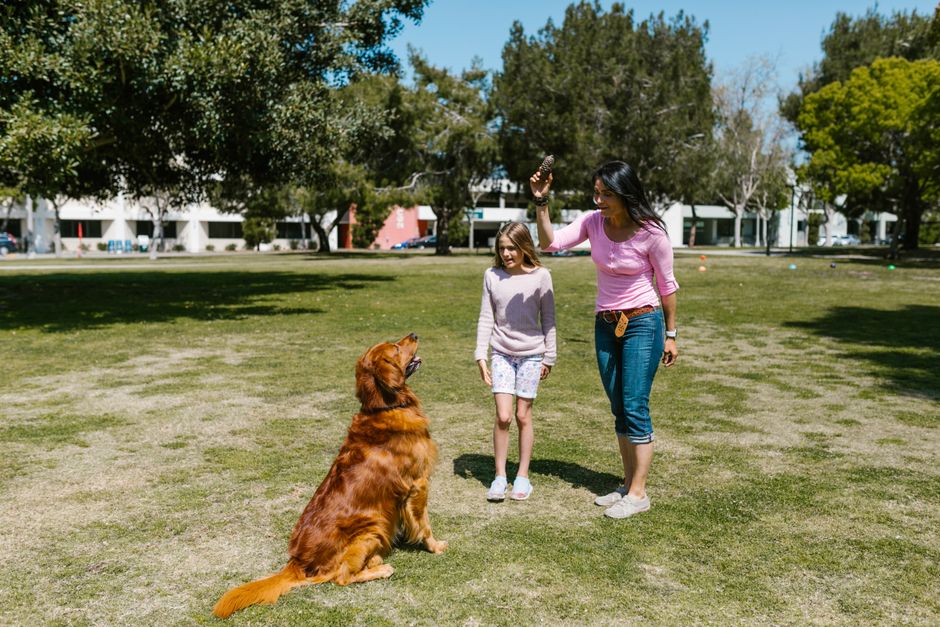
The learning process is broken down into three clear phases:
- The Teaching Stage: This is where you use positive reinforcement, luring, and markers to show your dog what behavior you want. You keep the environment quiet and free of distractions.
- The Correction Stage: Once your dog 100% understands a command but chooses to ignore it, you introduce mild, fair corrections. This shows them that obedience is not optional. A correction should be the lightest touch necessary to redirect their attention, and it must always be followed immediately by praise the instant they comply.
- The Proofing Stage: This is where you test your dog's obedience by gradually introducing real world distractions, like moving toys, strange noises, or other animals.
Timing is absolutely critical during all three stages. Your window of opportunity to deliver either praise or a correction is between point five and two seconds. If you wait longer than two seconds, your dog will not connect your reaction to their behavior.
Generalizing Commands Around Distractions
To generalize a command, you must systematically change the environment. If you only train in your kitchen, your dog learns that "Sit" means "Sit in the kitchen."
Once your dog is reliable inside, move your sessions to the backyard. Next, practice on your driveway. Then, move to a quiet sidewalk in your neighborhood. Finally, take your training to busier public spaces like local parks. By slowly increasing the distraction level, you teach your dog that "Sit" means "Sit, no matter what is happening around us."
Common Training Mistakes to Avoid
Even the most well meaning dog owners fall into habits that slow down their dog's progress. Recognizing these mistakes early will save you months of frustration.
| What Owners Do | Why It Fails | What to Do Instead |
|---|---|---|
| Repeating commands | Saying "Sit, sit, sit" teaches your dog to ignore the first cue. | Say the command once. If they ignore it, guide them into position. |
| Delayed consequences | Correcting or rewarding your dog ten seconds after the action. | Act within the point five to two second window. |
| Inconsistent rules | Letting the dog jump on you but scolding them when they jump on guests. | Keep rules identical across all family members. |
| Using retractable leashes | Constant tension teaches the dog to pull to move forward. | Use a standard six foot flat nylon leash. |
| Giving up too early | Stopping training because the dog is distracted. | Lower the distraction level and end on a successful note. |
Frequently Asked Questions About Dog Training
Here are some of the most common questions we hear from dog owners in Sherwood, Cornelius, and Forest Grove.
When should I start training my puppy?
The sooner, the better! You can start teaching basic household manners and simple lures as early as eight weeks old. In fact, it is much easier to build good habits early than to retrain an adult dog with years of practice doing the wrong things.
Standard puppy socialization classes are ideal for dogs between three and five months old. Once your dog reaches five or six months of age, they are ready for structured basic obedience classes. To understand which program fits your dog's current age and development, read our guide on The Ins & Outs of Dog Obedience School.
Where can I find low cost or free obedience resources?
If you are on a tight budget, look into local shelter programs. Many municipal shelters offer free post adoption support and basic obedience classes for dogs adopted from their facilities. You can also find excellent step by step manuals online, such as BASIC OBEDIENCE FOR DOGS or explore competitive pathways through resources like Getting Started in Obedience .
These resources are fantastic for learning the mechanics of training, though they cannot replace the personalized feedback of an experienced professional trainer.
What should I do if my dog is highly reactive?
If your dog lunges, barks, or growls at other dogs or people, a crowded group obedience class is the worst place for them. The high stress environment will only overwhelm your dog and make their behavior worse.
Safety must always come first. For dog reactive behavior, you should seek a professional private assessment. A professional trainer can help you implement a tailored behavior modification plan in a controlled environment where your dog can learn safely without putting themselves or others at risk.
Conclusion
Building a well mannered dog is not about finding a magic trick or a shortcut. It comes down to your willingness to show up every day with clear expectations, consistent boundaries, and fair follow through.
If you are tired of feeling embarrassed by your dog's behavior on walks or when guests visit your home, we are here to help. At Blackwood Canine, we serve busy dog owners across Scappoose, Warren, St. Helens, Hillsboro, Beaverton, Portland, and Vancouver. We do not offer quick fixes or empty promises. Instead, we give you a clear, practical roadmap to build a reliable, stress free relationship with your dog.
Your next step is simple. Let us help you put together a clear plan of action. Explore our Behavior Modification Training to learn about our Good Dog Game Plan and find the right path forward for your family.

How to Train Your Puppy Without Losing Your Mind
Easy Puppy Training Starts Here (Before You Lose Your Mind)
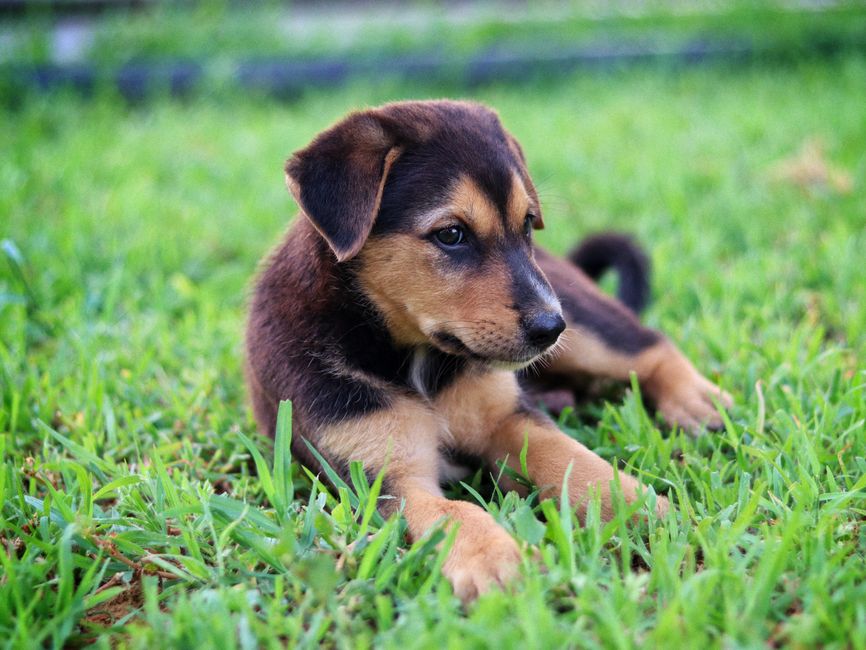
Easy puppy training is possible, but it takes more than treats and good intentions. Here is what actually works:
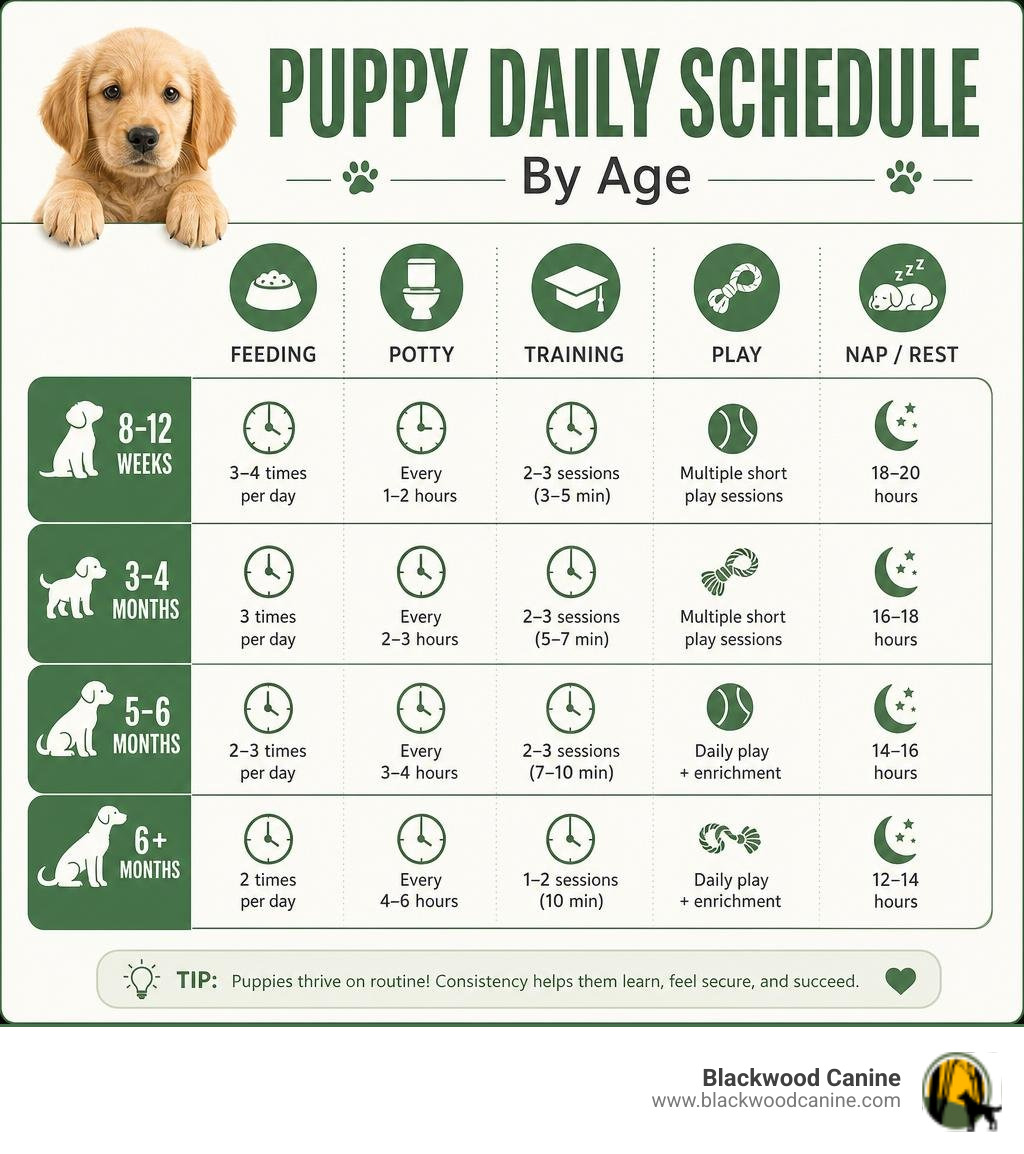
- Start immediately. Puppies can learn basic skills as early as 8 weeks old.
- Keep sessions short. Five to ten minutes, a few times a day. That is it.
- Use rewards that matter. Small, high value treats work best for young puppies.
- Be consistent. Every person in the house needs to follow the same rules.
- Manage the environment. Crates, leashes, and supervision prevent bad habits before they start.
- Socialize early. The window between 7 and 14 weeks is critical for accepting new people, animals, and places.
Look, nobody warns you about the sleep deprivation, the bite marks on your hands, or the puddles on the floor. You pictured a puppy that sits politely and comes when called. What you got is a tiny, sharp toothed chaos machine who has zero interest in your agenda.
That gap between expectation and reality is where most owners start to struggle.
Here is the uncomfortable truth: puppies are not born knowing the rules. They do what works for them, right now, in this moment. Biting gets a reaction. Jumping gets attention. Pulling on the leash gets them to the smell faster. From their perspective, it is all working perfectly.
Training is not magic. It is clear communication, consistent management, and repetition over time. Done right, it builds a relationship your dog actually wants to be part of.
I am David Wright, founder of iWorkDogs Dog Training Co. and a trainer with over fifteen years of hands on experience helping owners get real results through easy puppy training built on play, clear expectations, and practical systems. In this guide, I will walk you through exactly what to do, in what order, so you can stop guessing and start making progress.
The Reality of Easy Puppy Training
Many new pet parents in Portland and Vancouver WA bring home a puppy expecting an easy, intuitive process. They quickly realize that without a clear plan, frustration sets in. The secret to easy puppy training is understanding how your puppy learns and adjusting your expectations to match their developmental stage.
Puppies are capable of learning basic skills as early as eight weeks old. When they first arrive at your home, they are already absorbing information from every single interaction. If you wait until they are older to start training, they will spend those early weeks learning behaviors you do not want, like chewing on your shoes or barking for attention.
If you have a three month old puppy, you are in a prime position to build a strong foundation. At this age, your puppy is like a sponge. However, their attention span is incredibly short. This is why we advocate for five to ten minute training sessions. Trying to train a young puppy for thirty minutes straight will only lead to frustration for both of you. Keep lessons brief, fun, and highly focused.
To set yourself up for success, read our guide on Bringing Home A Puppy Training Tips For New Portland Pet Parents. Understanding what to expect during those first few weeks in your home will save your sanity.
It is also vital to know what mistakes to avoid. Many well meaning owners accidentally reinforce the very behaviors they want to stop. For example, pushing a jumping puppy away often feels like a fun game of wrestling to them. To make sure you are on the right track, review What Dog Trainers Say Not To Do When Training A New Puppy.
Setting Up Your Puppy for Success with Management and Rewards
Before you teach your puppy a single command, you must manage their environment. Management is the unsung hero of puppy training. If your puppy cannot access your shoes, they cannot learn to chew them. If they are always supervised, they cannot sneak off to pee on your rug.
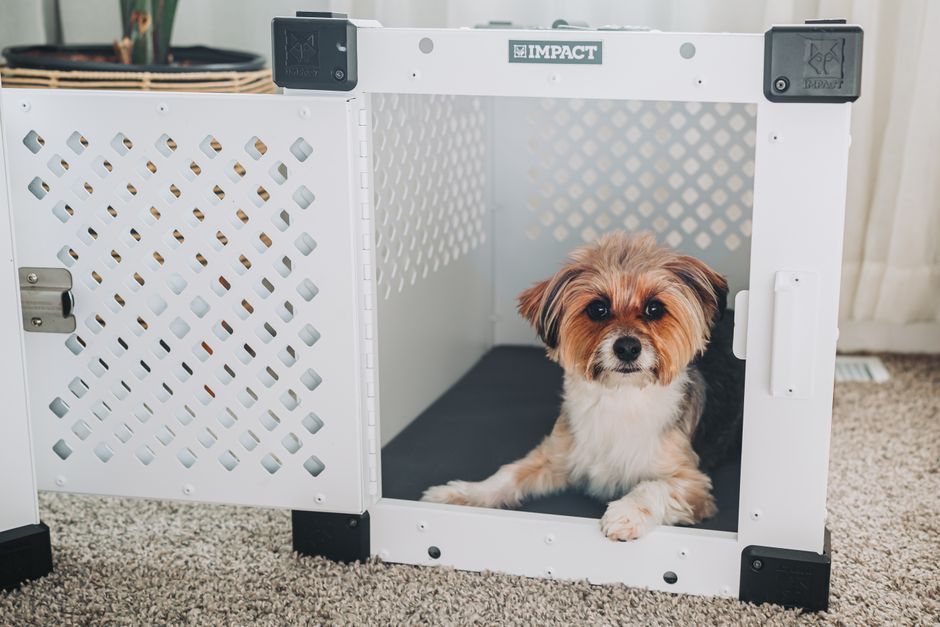
Crate training and potty training go hand in hand. Dogs naturally avoid soiling the area where they sleep. By using a properly sized crate, you utilize this natural instinct to build bladder control.
A great rule of thumb for crating is that a puppy can safely hold their bladder for roughly one hour per month of age. A two month old puppy can handle about two hours in a crate, while a three month old puppy can manage three hours. To make your life much easier, use our Housebreaking Schedule Generator to create a predictable routine for meals, potty breaks, and crate time.
When it comes to teaching new behaviors, your choice of reward is everything. We use high value treats that are small, soft, and smelly. Think of these treats as your puppy's paycheck. The treat should be tiny, roughly the size of a pencil eraser, so your puppy does not get full too quickly or lose focus while chewing.
Using food is about more than just giving out treats. It is about building engagement. Your puppy should learn that paying attention to you is the most rewarding thing they can do. For practical tips on how to use meals to build focus, check out Dog Training Strategies Building Engagement With Food.
If your puppy is highly motivated by food, you might run into a common issue: eating too fast. Puppies that gulp their food can struggle to focus during training. If you have a speed eater, read Does Your Pup Eat Too Fast Puppy Training Methods For Speed Eaters to learn how to slow them down and use their meals to your advantage.
How to Teach the Five Basic Puppy Cues
Teaching your puppy basic cues gives you a way to communicate clearly. In modern dog training, we prefer the word cue over command. A cue is a signal that a reward is available if the puppy performs a specific behavior. A command carries an outdated, punitive tone of do it or else.
By teaching these five basic cues, you build a cooperative relationship based on trust. For a deeper look at behavioral development, you can read about Puppy Behavior and Training Basics | VCA Animal Hospitals .
When teaching these cues, we focus on positive reinforcement rather than physical force. Pushing a puppy's rear down to force a sit can be confusing and frightening. To understand why we avoid physical force, read Dog Training Methods Positive Reinforcement Vs Dominance Training.

Easy puppy training for sit and down
The easiest way to teach sit and down is through a method called luring. Luring involves using a high value treat like a magnet to guide your puppy's nose and body into the correct position.
To teach a sit, hold a treat directly in front of your puppy's nose. Slowly move the treat up and back over their head, toward their tail. As their nose goes up to follow the food, their rear end will naturally go down. The second their rump touches the floor, mark the behavior with a enthusiastic "Yes!" or a click, and deliver the treat.
To teach a down, start with your puppy in a sitting position. Hold the treat at their nose and slowly lower it straight down to the floor between their front paws. Once their chest touches the ground, mark the moment and reward them.
Sometimes, a puppy might get frustrated and walk away from the lure. If this happens, you can use capturing. Capturing means waiting for your puppy to perform the behavior naturally, like lying down to rest, and immediately marking and rewarding it.
To learn more about using food lures effectively, read Transform Your Dogs Training With The Power Of Luring A Guide To Happy And Effective Learning. Once your puppy understands the hand motion, you must learn Fading The Lure How To Fade The Food Lure so they do not rely on seeing food to obey. If you want to make your timing precise, look into Curious About Clicker Training Dog Trainers Explain The Basics.
Easy puppy training for stay and come
A reliable stay and come can save your puppy's life.
To teach stay, you must first introduce a release word, such as "Free" or "Okay." The release word tells your puppy that they are allowed to move. Ask your puppy to sit. Wait one second, say your release word, and toss a treat a step away. Gradually increase the time they must wait before you say the release word. Do not add distance until they can stay in place for ten seconds.
To teach come, use an upbeat, distinct recall word. Avoid using their name as the recall word, as you say their name constantly throughout the day. Say your recall word, clap your hands, and take a few quick steps backward. Puppies naturally love to chase. When they run to you, grab their collar gently with one hand while feeding them a high value treat with the other. This prevents them from learning to dart away when they get close.
Teaching polite loose leash walking
Walking on a loose leash is a skill that takes patience. A perfect competitive heel is unnatural and unnecessary for everyday walks. Your goal should simply be a loose, relaxed leash that allows your puppy to safely explore.
Start by letting your puppy wear their collar and a light leash around the house to get used to the sensation. When you start walking, reward your puppy with a treat whenever they look up at you or walk near your side.
If your puppy begins to pull, stop walking immediately. Do not yank the leash back. Simply become a tree and wait for them to turn around to look at you. When the leash goes slack, praise them and continue walking. You can also use sudden turns to the right or left to keep your puppy engaged and paying attention to your movement.
For more tips on managing polite behavior during walks, including how to handle greeting people, read Dog Obedience Teaching Your Dog Not To Jump Up On People.
Socialization and Puppy Classes
Socialization is not just about letting your puppy play with other dogs. It is about helping them build confidence around new sights, sounds, surfaces, and environments.
The critical socialization period for puppies occurs between 7 and 14 weeks of age. During this developmental window, puppies naturally accept new experiences with minimal fear. Experiences during this phase must be positive, safe, and controlled.
For a step by step guide on how to safely navigate this timeline, check out Basic Puppy Training: When & How to Train Your Puppy | Purina US .
Many owners worry about socializing their puppy before they are fully vaccinated. While you should avoid high risk areas like public dog parks, puppies can safely attend controlled puppy socialization classes as early as seven to eight weeks of age, provided they have received their first round of vaccinations.
What to Do When Your Puppy Does Not Obey
If your puppy ignores a cue, do not panic or get angry. Puppies do not act out of spite. If they do not obey, it is usually because of one of three reasons:
- Too many distractions: A puppy who sits perfectly in your living room might struggle to sit at a busy park in Hillsboro or Beaverton.
- Low value rewards: You might need to upgrade your treats to something more appealing, like small pieces of freeze dried liver or cheese.
- The step is too hard: You may have moved too fast. Go back to a simpler step and build up slowly.
Never repeat a cue over and over if your puppy does not respond. If you say "Sit, sit, sit," your puppy learns that they do not have to listen the first time. Instead, move closer, make the task easier, and guide them with a lure if necessary.
If your puppy's frustration turns into nipping or biting, read Is Your Pup A Nipper Try These Puppy Trainer Tips To Stop Biting for practical ways to redirect that sharp toothed energy.
Frequently Asked Questions About Puppy Training
When should I start training my three month old puppy?
You should start training immediately. If your puppy is three months old, they are in a prime learning window. Focus on basic manners, crate acclimation, potty training, and building positive associations with the world around them.
How long should puppy training sessions be?
Keep training sessions very short, ideally five to ten minutes, repeated two to three times a day. Always end each session on a positive note with a successful repetition and plenty of praise.
Are puppy training pads worth using?
For most owners, training pads are an unnecessary extra step that actually delays outdoor potty training. Unless you live in a high rise building or have severe mobility issues, it is best to teach your puppy to go outside from day one.
Conclusion
Training a puppy is a big commitment, but it does not have to make you lose your mind. By focusing on clear communication, consistent management, and positive reinforcement, you can raise a well mannered companion.
If you want to start off on the right foot, read our advice on 3 Things You Can Do To Have A Well Mannered Puppy.
For hands on professional help in Portland, Beaverton, Hillsboro, Vancouver WA, or the surrounding areas, consider our specialized Puppy Jump Start Program. We are here to help you build a reliable, stress free relationship with your dog.
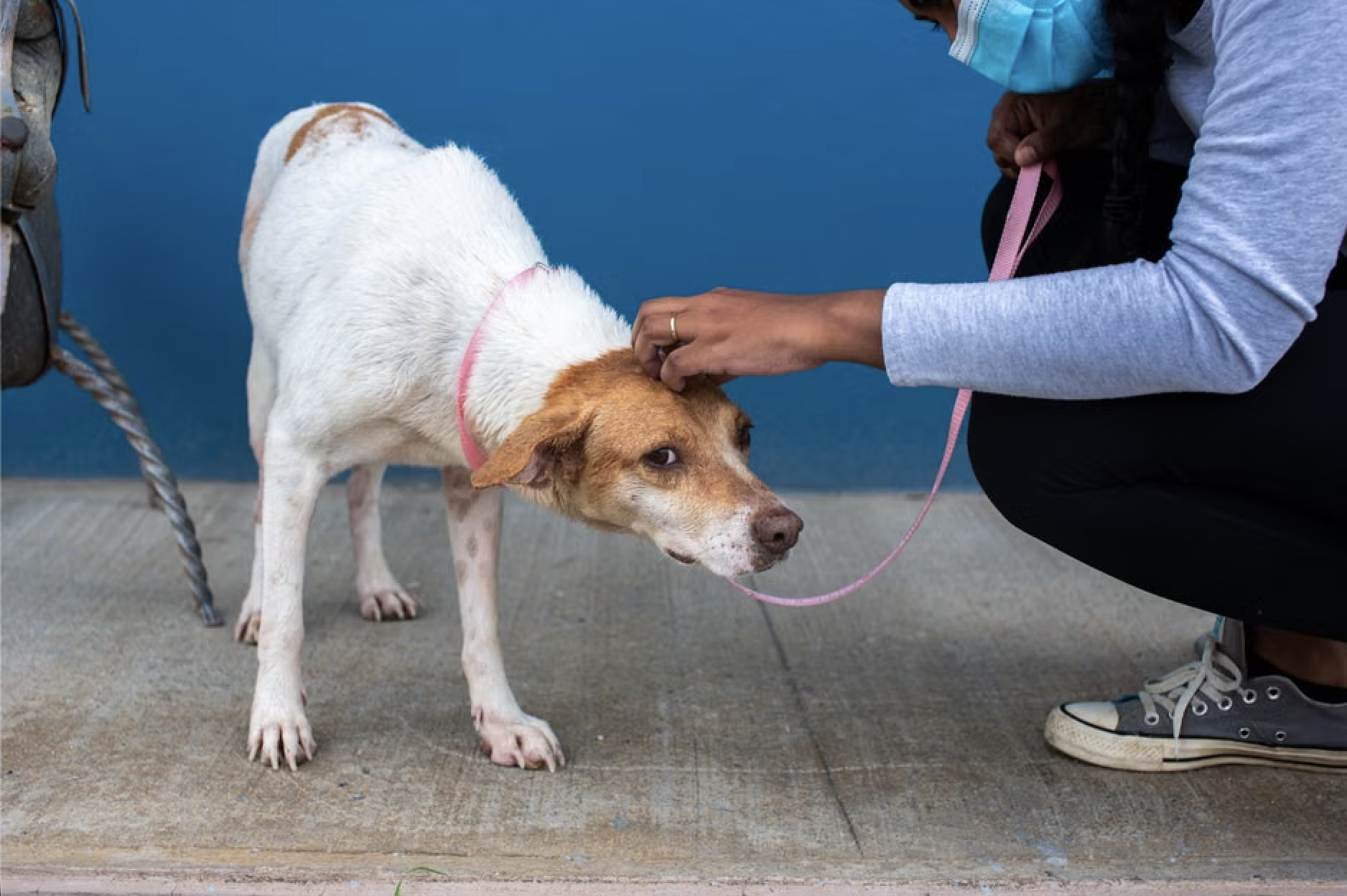
Gentle Training Techniques for Timid and Anxious Dogs
When Your Dog Is Scared of the World, Every Walk Feels Like a Crisis

Dog training for fearful dogs is not about pushing your dog harder or waiting for them to "get over it." It is about understanding what is driving the fear and changing it systematically, using methods that actually work.
Here is a quick overview of what that looks like in practice:
- Identify the trigger -- the specific thing, place, or person that causes your dog to react
- Keep your dog below threshold -- work at a distance or intensity where they notice the trigger but stay calm
- Use counterconditioning -- pair the scary thing with something your dog loves, like high value food
- Never force exposure -- flooding a fearful dog makes things worse, not better
- Rule out medical causes -- pain, thyroid issues, and sensory changes can all drive sudden fear
- Be consistent -- management, clear expectations, and repetition matter as much as any single technique
- Get professional help early -- do not wait until things escalate before asking for support
A lot of Portland area dog owners come to us after months of frustrating walks, guests who can never come inside, and training approaches that seemed to make things worse. If your dog cowers, lunges, shuts down, or barks from a place of panic, you are not alone, and your dog is not broken.
Fear is one of the most misunderstood things in dog behavior. It looks like aggression. It looks like stubbornness. Sometimes it looks like a dog who is "fine" right up until they bite. The difference between a manageable fear problem and a serious one often comes down to how early you recognize it and how you respond.
This guide walks you through the science, the practical steps, and the honest expectations for training a fearful dog.
I'm David Wright, and I started iWorkDogs after years of apprenticeship under an experienced K9 coach, including working through real dog aggression challenges with my own Cane Corso. That experience is what drives my approach to dog training for fearful dogs -- I know what it feels like to think you're doing everything right and still be missing something important. The goal here is to give you the clearest, most practical picture possible so you can actually move forward.
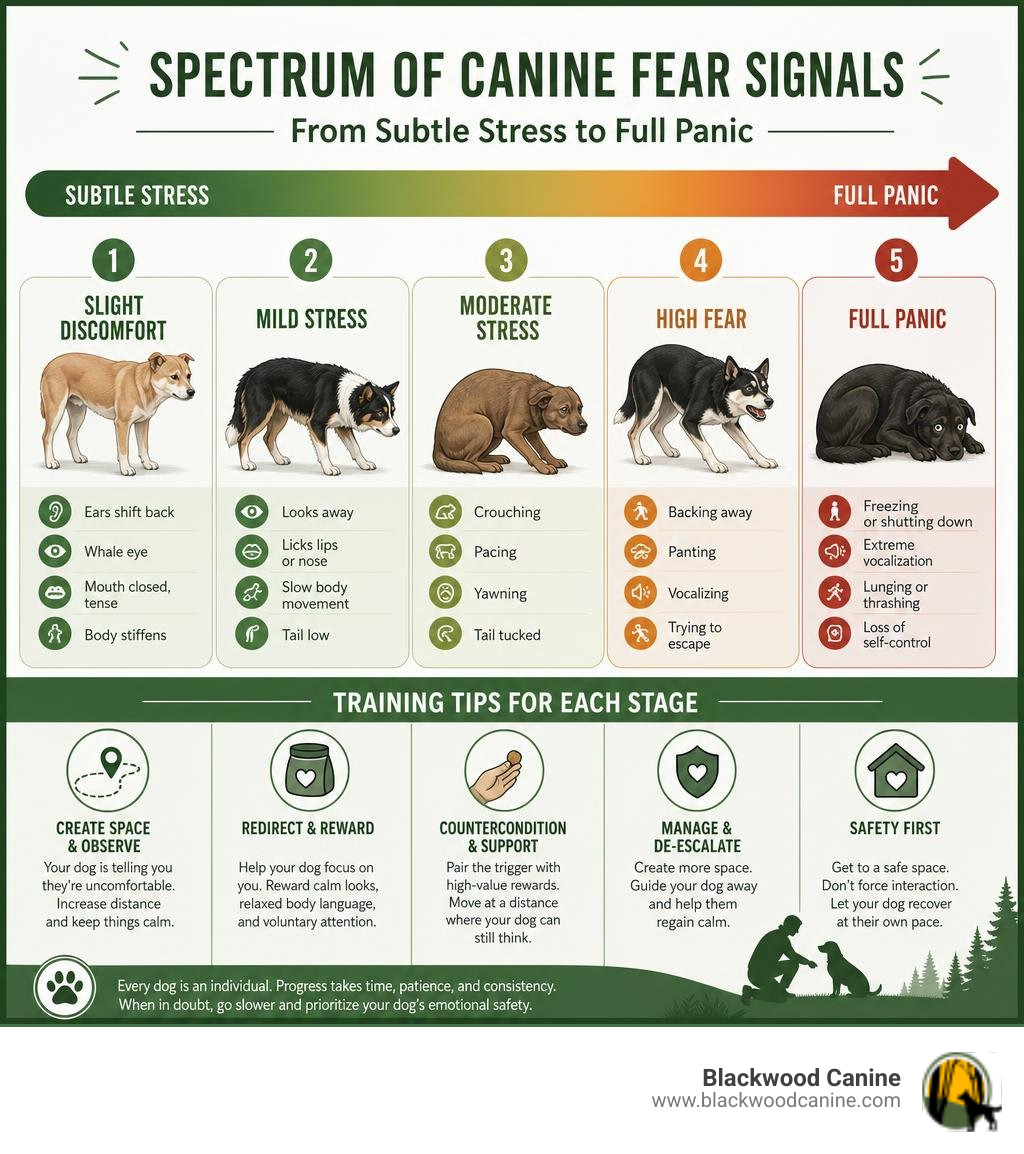
What Causes Fear and Anxiety in Dogs?

Fear does not just appear out of nowhere. It is a biological survival mechanism. When a dog reacts to a garbage truck in Hillsboro or a stranger on a path in Beaverton, their brain is trying to keep them alive.
To help a timid dog, we have to stop looking at their behavior as a behavioral problem and start looking at what causes it. There are four main roots of canine fear:
- Genetics: Some dogs are born with a more sensitive nervous system. If a mother dog was highly stressed during pregnancy, her puppies can inherit a highly active stress response.
- Under socialization: If a puppy does not experience a wide variety of sights, sounds, and surfaces in a positive way during their early development, the adult dog will view novelty as a threat.
- Trauma: A single scary event, like being attacked by an off leash dog at a park, can leave a lasting emotional scar.
- Physical pain: Hidden pain is a massive driver of sudden fear. A dog who hurts will naturally protect themselves by keeping others away.
Developmental Fear Periods in Puppies
Puppies naturally go through developmental fear periods where their confidence suddenly drops. These are normal parts of growing up, but they require careful handling.
- The first fear period typically happens between eight and eleven weeks of age.
- The second fear period occurs during adolescence, usually between six and fourteen months of age.
These developmental phases generally last no more than two weeks. However, a single bad experience during these windows can leave a permanent mark on your dog's temperament. If your young dog suddenly acts terrified of a trash can they walked past yesterday, do not force them to approach it. Lower your expectations, keep sessions short, and reward them for showing simple curiosity from a safe distance.
Hidden Pain and Medical Triggers
Many behavioral issues are actually medical issues in disguise. If your dog suddenly starts growling when you touch their lower back, or if they suddenly panic around other dogs on walks in Vancouver, pain is the first thing to rule out.
Conditions like arthritis, hip dysplasia, thyroid imbalances, or dental infections cause constant low level stress. When a dog is in pain, their brain is already close to its limit. They cannot learn new behaviors if they are hurting.
Before starting any intensive training program, schedule a complete checkup with your veterinarian. Let them know about the sudden behavioral shifts. Addressing physical discomfort is always the first step in behavior modification.
Reading the Subtle Signs of Canine Stress
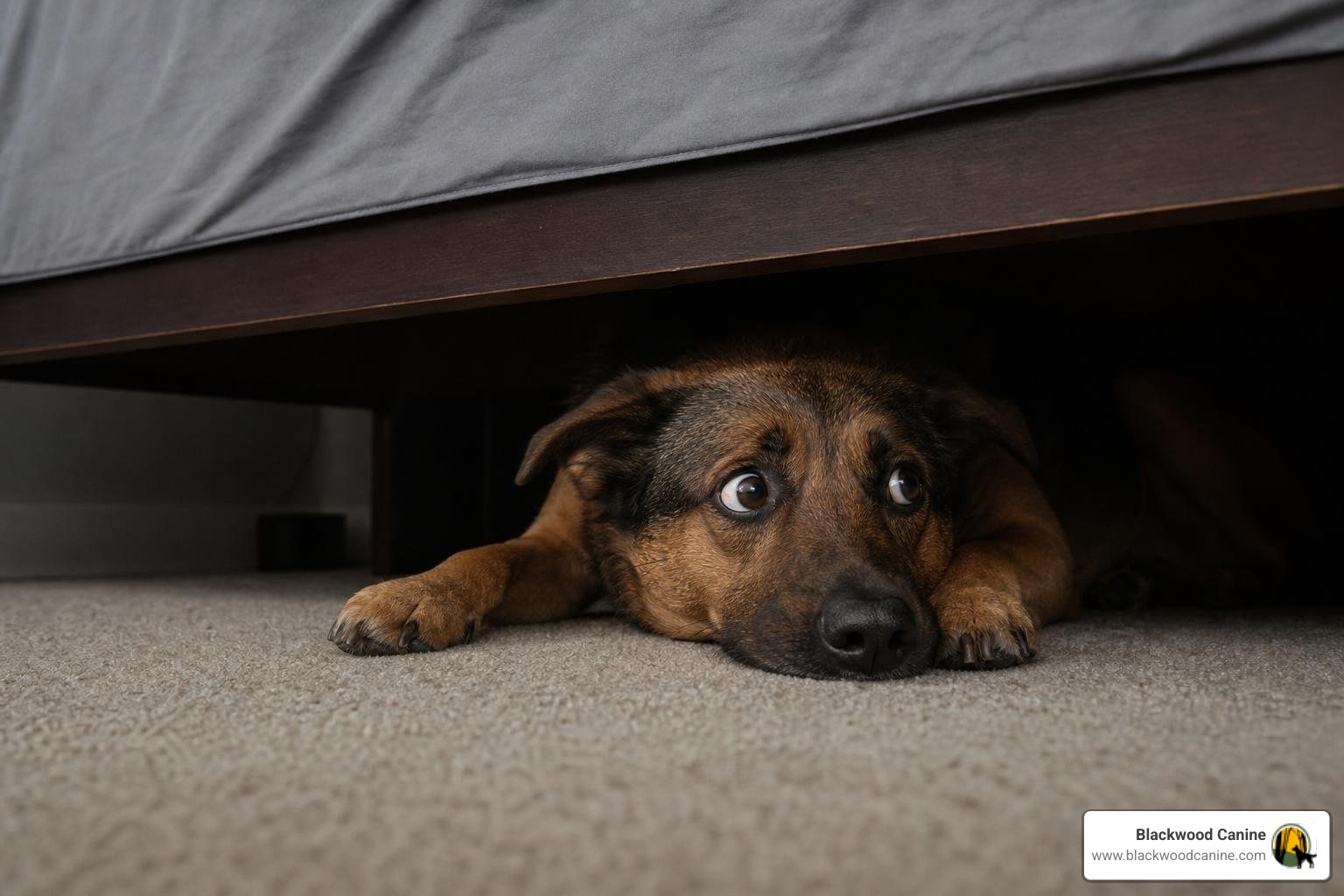
Dogs are constantly talking to us, but we often miss their early whispers. By the time a dog growls, barks, or lunges, they have usually spent minutes trying to tell us they are uncomfortable.
To prevent outbursts on the streets of Scappoose or Warren, you must learn to read the earliest signs of stress.
Early Warning Signs vs Severe Panic
Canine stress signals exist on a wide spectrum. Recognizing the early signs allows you to step in and manage the situation before your dog boils over.
- Subtle signs: Lip licking, yawning when not tired, sniffing the ground suddenly to avoid a threat, or a brief "wet dog shake" to discharge tension after a minor stressor.
- Moderate signs: The "whale eye" where you see the whites of your dog's eyes, ears pinned back, a tucked tail, a rigid body, or a raised paw.
- Severe panic: Trembling, heavy panting when it is not hot, pacing, drooling, or complete freezing.
The freeze response is the most commonly misunderstood signal. Many owners see a dog stand completely still while a stranger pets them and think the dog is being good. In reality, that dog may be shut down, flooded with fear, and unable to move. If you push a shut down dog too far, they may eventually snap.
Another clear sign of high stress is food refusal. If a hungry dog will not eat even the highest value treats like liverwurst or cheese, they are over their emotional limit. Their digestive system has shut down because their body is in fight or flight mode.
Why You Should Never Punish a Growl
It is embarrassing when your dog growls at a neighbor in St. Helens. Your instinct might be to correct them with a sharp "No!" or a leash pop. This is a dangerous mistake.
A growl is a boundary. It is your dog saying, "I am uncomfortable, please step back."
If you punish a growl, you do not fix the fear that caused it. You only teach the dog that their warning system is dangerous to use. If you successfully train a dog not to growl, you end up with a dog who skips the warning and goes straight to biting. Always thank your dog for growling, respect their boundary, and immediately increase the distance between them and the trigger.
The Core Principles of Dog Training for Fearful Dogs
Training a fearful dog requires a shift in how you think about obedience. Standard obedience programs focus on making a dog perform commands. Behavior modification for fearful dogs focuses on changing how the dog feels.
We build confidence through clear expectations, solid boundaries, environmental management, consistent reinforcement, and fair consequences. You can read more about how we balance these concepts in our guide on Dog Training Methods: Positive Reinforcement vs Dominance Training.
Classical Counterconditioning vs Operant Conditioning
To change fear, we use two different types of learning.
- Classical Conditioning: This is about associations. It changes your dog's involuntary emotional response. Think of Pavlov's dogs. If every time a scary stranger appears, your dog gets a piece of roast beef, the stranger eventually predicts roast beef. The underlying emotion shifts from fear to anticipation.
- Operant Conditioning: This is about voluntary behavior. It teaches your dog what to do to get a desired outcome. For example, teaching your dog to look at you when they see another dog, rather than staring and tensing up.
We always start with classical conditioning to change the emotional baseline before we ask the dog to perform specific tasks.
Managing the Threshold in Dog Training for Fearful Dogs
The single most important concept in behavior modification is the threshold.
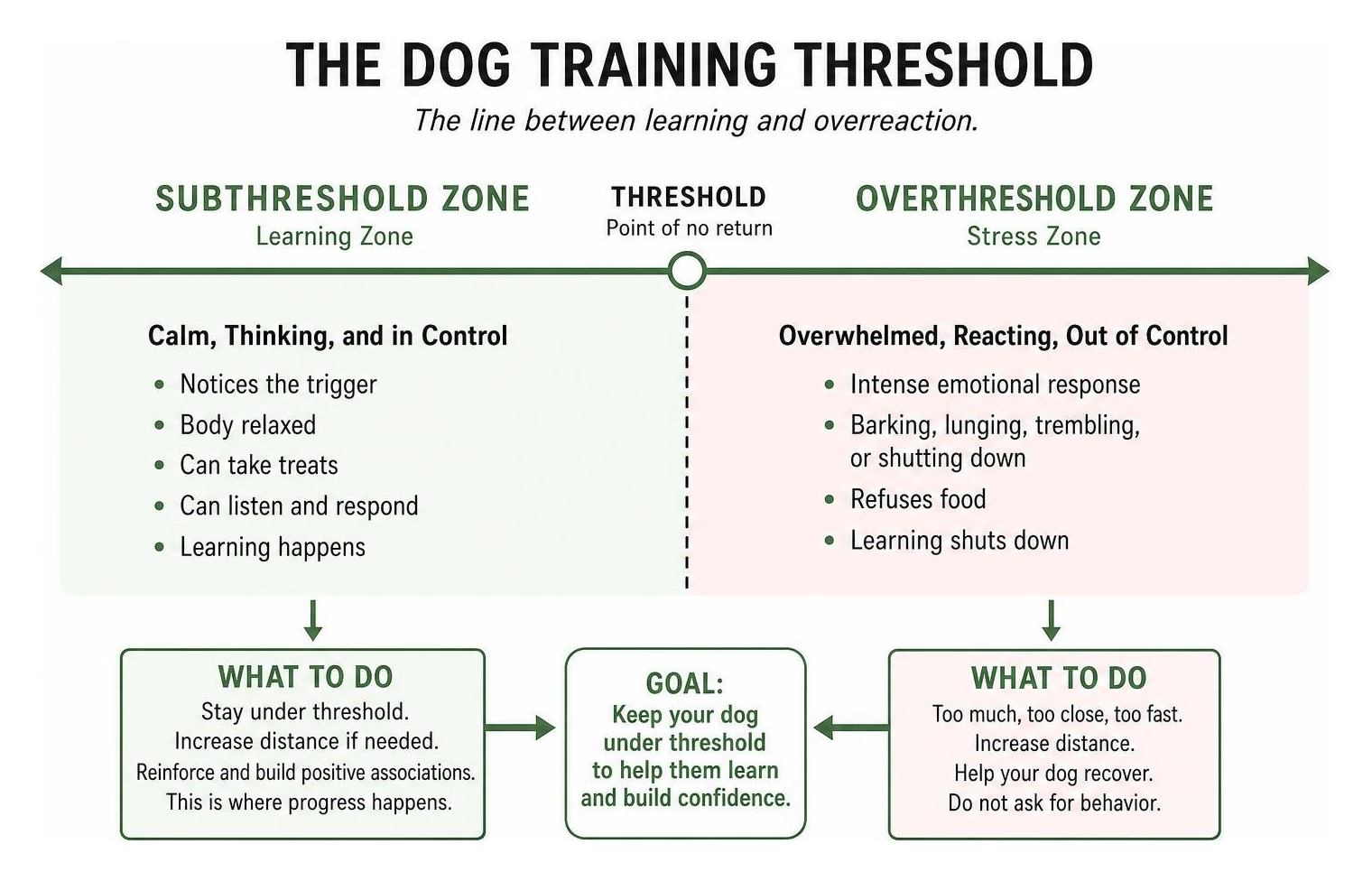
Your dog's threshold is the invisible line where they transition from calm observation to reactive panic.
- Subthreshold zone: The dog notices the trigger but remains relaxed. They can easily take treats, look away, and listen to you. This is the only zone where learning happens.
- Overthreshold zone: The dog has lost control. They are barking, lunging, trembling, or refusing food. Their brain is flooded with cortisol and adrenaline.
If your dog goes over threshold during a walk in Bethany or Hillsboro, stop training immediately. Do not try to feed them or force them to sit. Your only job is to create distance, get them back to safety, and let them decompress.
Step by Step Desensitization and Counterconditioning
To systematically change your dog's emotional response, we use a combination of desensitization (gradual exposure at a low intensity) and counterconditioning (pairing the trigger with high value rewards). This is the foundation of our Behavior Modification Training programs.
Creating a Safe Space and Predictable Routine
A fearful dog cannot learn if they are constantly on edge in their own home. You must create a safe zone where they can fully relax.
- Set up a covered wire crate or a gated room in a quiet part of the house. This area should be completely off limits to guests, children, and other pets.
- Establish a highly predictable daily schedule for feeding, walking, training, and rest. Predictability directly lowers stress hormones.
- Use environmental management. Put frosted window film on street facing windows to block visual triggers, and run a white noise machine to mask sudden outdoor sounds.
Implementing the Open Bar Closed Bar Technique in Dog Training for Fearful Dogs
The "Open Bar, Closed Bar" technique is a simple, highly effective way to execute counterconditioning. The timing must be precise.
- Find the right distance: Stand far enough away from the trigger (like a bicycle or another dog) so your dog is aware of it but remains subthreshold.
- The trigger appears (Bar Opens): The instant your dog sees the trigger, start feeding them exceptionally high value treats (chicken, hot dogs, squeeze cheese) continuously.
- The trigger disappears (Bar Closes): The moment the trigger moves out of sight, stop feeding immediately. No more treats.
This clear contrast teaches your dog a reliable rule: the scary thing makes amazing food appear, and when the scary thing goes away, the good stuff stops. Over time, you can gradually decrease the distance, always keeping your dog below their reactivity threshold.
Why Aversive Tools and Forced Exposure Backfire
When you are frustrated by your dog's behavior, it is tempting to look for quick fixes. Some trainers might recommend prong collars, electronic collars, choke chains, or forced exposure (flooding) to stop the barking and lunging.
With a fearful dog, these tools are highly destructive.
Aversive tools work by introducing pain or discomfort to suppress a behavior. While they might stop the outward barking, they do not change the inward fear. In fact, they usually make it worse. This is known as the second association problem. If your dog is afraid of other dogs, and they feel a painful shock or pinch every time they see one, they will not learn to like other dogs. They will simply associate other dogs with pain.
Furthermore, scientific research on dog training methods shows the welfare costs of these methods:
- Dogs trained with aversive methods score as significantly more pessimistic on cognitive bias tests, showing a chronic negative emotional state.
- Aversive training is associated with significantly more stress behaviors during and after training sessions.
- When head to head studies compare electronic collar training to reward based training, the reward based groups perform just as well, and often better, without the welfare risks.
Forcing your dog to face their fears directly, like dragging a dog who is terrified of strangers into a busy pet store in Beaverton, is called flooding. It does not socialize them. It causes extreme stress, shuts down their learning capacity, and often leads to defensive aggression.
If you are feeling overwhelmed by your dog's behavior, you did not break them, and you do not need to resort to harsh methods to fix things. Take a breath and read our guide on how to Stop Feeling Guilty About Your Reactive Dog.
Frequently Asked Questions About Training Fearful Dogs
How long does it take to help a fearful dog?
There is no single timeline for resolving fear or anxiety. It depends on your dog's genetics, their history, how long they have practiced the behavior, and how consistently you can manage their environment.
Some dogs show significant improvement in a few weeks of structured management and clear boundaries. For others, especially those with deep seated trauma or genetic sound sensitivities, rehabilitation is a lifelong process of gradual progress. No responsible trainer can guarantee a quick fix. Focus on small wins and consistent routines.
Should I comfort my dog when they are scared?
There is a common myth that comforting a scared dog will reinforce their fear. This is not true. Fear is an emotion, not an operant behavior. You cannot reward an involuntary emotional state with love and reassurance.
However, your emotional state matters. If you tense up, gasp, or panic when your dog gets scared, they will feed off your anxious energy. Instead, offer calm, steady support. Speak in a quiet, relaxed voice, keep your leash loose, and move your dog away from the trigger calmly. Be a reliable leader they can trust to handle the situation.
When should I consider behavioral medication?
If your dog is in a constant state of hypervigilance, pacing, panting, and unable to settle even in a quiet home, their brain is too stressed to learn.
In severe cases, behavioral medication prescribed by a veterinarian or a board certified veterinary behaviorist can be a lifesaver. Medication does not cure fear on its own, but it can lower your dog's baseline anxiety enough to bring them below threshold, allowing behavior modification training to actually take hold. Think of it as a tool to open the window of learning, not a shortcut.
Conclusion
Living with a fearful dog can feel isolating, but you do not have to navigate this alone. Pushing through the frustration requires patience, clear communication, and a practical plan that prioritizes your dog's emotional safety.
At Blackwood Canine, we specialize in helping families in Portland, Vancouver, Beaverton, Hillsboro, Scappoose, and surrounding areas build reliable, stress free relationships with their dogs. Whether you need personalized support through our Private Lessons Dog Training or want to fast track progress with our professional Immersion Dog Training programs, we are here to help.
The best way to start is with a clear strategy. Let us help you build a practical management plan and clear communication framework that works for your household.
Ready to help your dog find their confidence? Connect with us today to learn more about our training options and start your path toward a calmer, happier life together.
How to Achieve Calming Car Rides for Dogs Without Losing Your Mind
Why Calming Car Rides for Dogs Is Harder Than It Looks

Calming car rides for dogs is one of those challenges that sounds straightforward on paper, but quickly falls apart when you are standing in your driveway with a shaking, drooling dog who refuses to even look at the backseat.
If your dog pants, whines, paces, or panics the moment they hear your car keys, you are not dealing with a stubborn pet—you are dealing with a dog in a state of genuine distress. Car anxiety is incredibly common, but it is also highly treatable when you stop looking for quick fixes and start addressing the root cause.
Here is a realistic breakdown of what actually works:
| Problem | Solution |
|---|---|
| Dog shakes or trembles in the car | Pheromone spray applied 15 minutes before departure |
| Dog vomits or drools excessively | Withhold food 8 hours before travel; ask your vet about Cerenia |
| Dog panics at the sight of the car | Gradual desensitization starting with a parked, engine-off vehicle |
| Dog cannot settle during the drive | Secured crate or padded car seat with familiar scent items |
| Dog picks up on owner stress | Pre-ride walk plus calm breathing before you get in the car |
| Severe anxiety that does not improve | Consult a veterinarian or professional trainer |
At Blackwood Canine, we look at car anxiety through two lenses: physical discomfort (like motion sickness) and learned fear (often built from a history of only riding in the car to go to the vet). Neither of these issues will resolve on their own, and ignoring them only deepens the behavioral pattern.
Some dogs struggle because their vestibular system has not fully adjusted to the motion of a vehicle. Others have developed a conditioned emotional response, pairing the car with high-stress events. Furthermore, dogs are incredibly sensitive to our own emotional states. A 2024 study from Bristol University confirmed that dogs can detect physiological changes in humans, including elevated cortisol levels, through scent alone. If you are anxious about how the ride will go, your dog already knows.
This guide covers the practical tools, environmental management, and training protocols that actually yield results. No gimmicks, just solid training.
I am David Wright, founder of Blackwood Canine. As a professional dog trainer with over a decade of experience helping owners in the Portland area, I specialize in creating clear communication and building reliable behaviors. I have helped countless clients resolve severe car anxiety, and in this guide, I will walk you through the exact steps we use to achieve calm, stress-free travel.
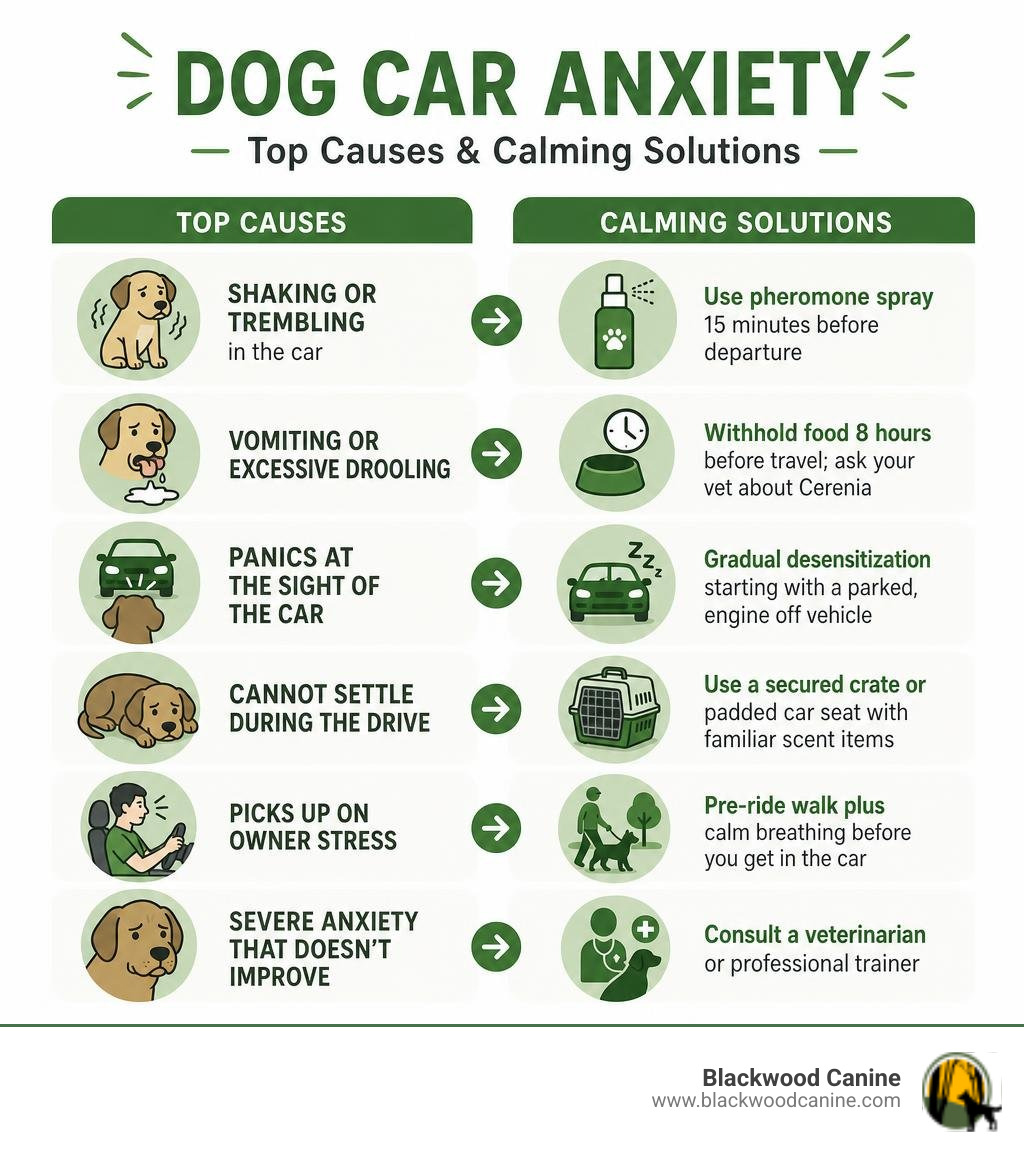
Recognizing the Signs of Car Stress and Anxiety in Dogs
Before you can fix the problem, you have to know what you are looking at. Many owners mistake severe panic for simple excitement or stubbornness. Your dog is not trying to annoy you when they refuse to hop into the backseat. They are communicating in the only way they know how.
When we work with clients in Beaverton, Hillsboro, or Portland, we often see dogs displaying a range of stress signals before the car even leaves the driveway. The most common signs of travel anxiety include:
- Excessive panting and drooling: If the air conditioning is blasting and your dog is dripping saliva or panting heavily, this is a clear physiological stress response, not a temperature issue.
- Whining, barking, or pacing: A dog who cannot sit still or constantly vocalizes is struggling to cope with the environment.
- Yawning and lip licking: These are subtle displacement behaviors that dogs use to try to calm themselves down when they feel uneasy.
- Trembling or shaking: This is a major indicator of fear. If your dog looks like they are freezing in the middle of July, their nervous system is in fight or flight mode.
- Vomiting or sudden accidents: This can be a mix of physical motion sickness and extreme psychological distress.
If you want to dive deeper into how dogs communicate their discomfort, you can read our guide on Understanding and Transforming Reactive Dog Behavior: What You Need to Know. Recognizing these early warning signs is the first step in stopping the cycle of panic.
The Battle of Physics: Motion Sickness vs. Psychological Anxiety
It is crucial to understand whether your dog has a physical issue or a psychological one, though they often feed into each other.
Puppies are incredibly susceptible to motion sickness because their inner ears, which control balance, have not fully developed yet. If a puppy gets nauseous every time they ride in the car, they quickly learn to dread the vehicle. By the time they are an adult dog, the physical motion sickness might have resolved, but the psychological dread remains.
For some adult dogs, a sudden onset of car sickness can point to vestibular disease or other inner ear issues. If your older dog suddenly starts throwing up on short trips, a trip to the vet is in order. If you are in the unfortunate position of dealing with end of life care for a senior dog, services like St Helens Home Euthanasia Services can help prevent stressful final car rides.
To manage physical motion sickness, you must modify the environment:
- Limit meals before travel: Withhold food for at least 8 hours before a long drive. A dog traveling on an empty stomach is far less likely to vomit. Keep them hydrated, but skip the kibble.
- Optimize crate placement: Place small dog crates on the floor of the middle seat. This location experiences the least amount of physical motion and swaying.
- Use veterinarian approved medications: For serious cases, ask your vet about Cerenia (maropitant citrate), which is FDA approved for motion sickness and can be given to puppies over 8 weeks old. It should be administered 2 hours before the ride. Over the counter antihistamines can also help, but always consult your vet first.
Environmental Management: Crates and Dog Car Seats
At Blackwood Canine, we talk a lot about management. Management is not a failure of training; it is the foundation of it. If your dog is loose in the backseat, pacing from window to window, sliding around on slippery leather, and trying to climb into your lap, they cannot settle.
Providing physical stability is one of the fastest ways to help a stressed dog. When a dog has to constantly use their muscles to counterbalance the turns, stops, and accelerations of a vehicle, it increases their physical fatigue and heightens their anxiety.
The Power of a Travel Crate
A secure, size appropriate crate is the gold standard for car safety and comfort. A crate acts as a familiar safe space. To make it even more effective, you can drape a blanket or towel over the sides. This simple trick blocks the visual trigger of scenery whizzing by, which is a massive contributor to both motion sickness and environmental arousal.
Padded Dog Car Seats and Pods
If your dog is too large for a crate or you prefer an alternative, a highly cushioned dog car seat can work wonders. Products like the Travel Dog Pod | Buy The Original Dog Car Bed & Travel Seat For Your Dog – Luther Bennett are designed with high, heavily stuffed walls. These thick cushions absorb the physical movement of the car, allowing your dog to sink in and feel secure instead of sliding around.
For smaller dogs, a premium option like the Luxury Dog Car Seat | The Travel Pawket offers a pillow soft base and built in safety tethers. When using these seats, always attach the safety tether to a properly fitted harness, never to the dog's collar, to prevent severe neck injuries during sudden stops.
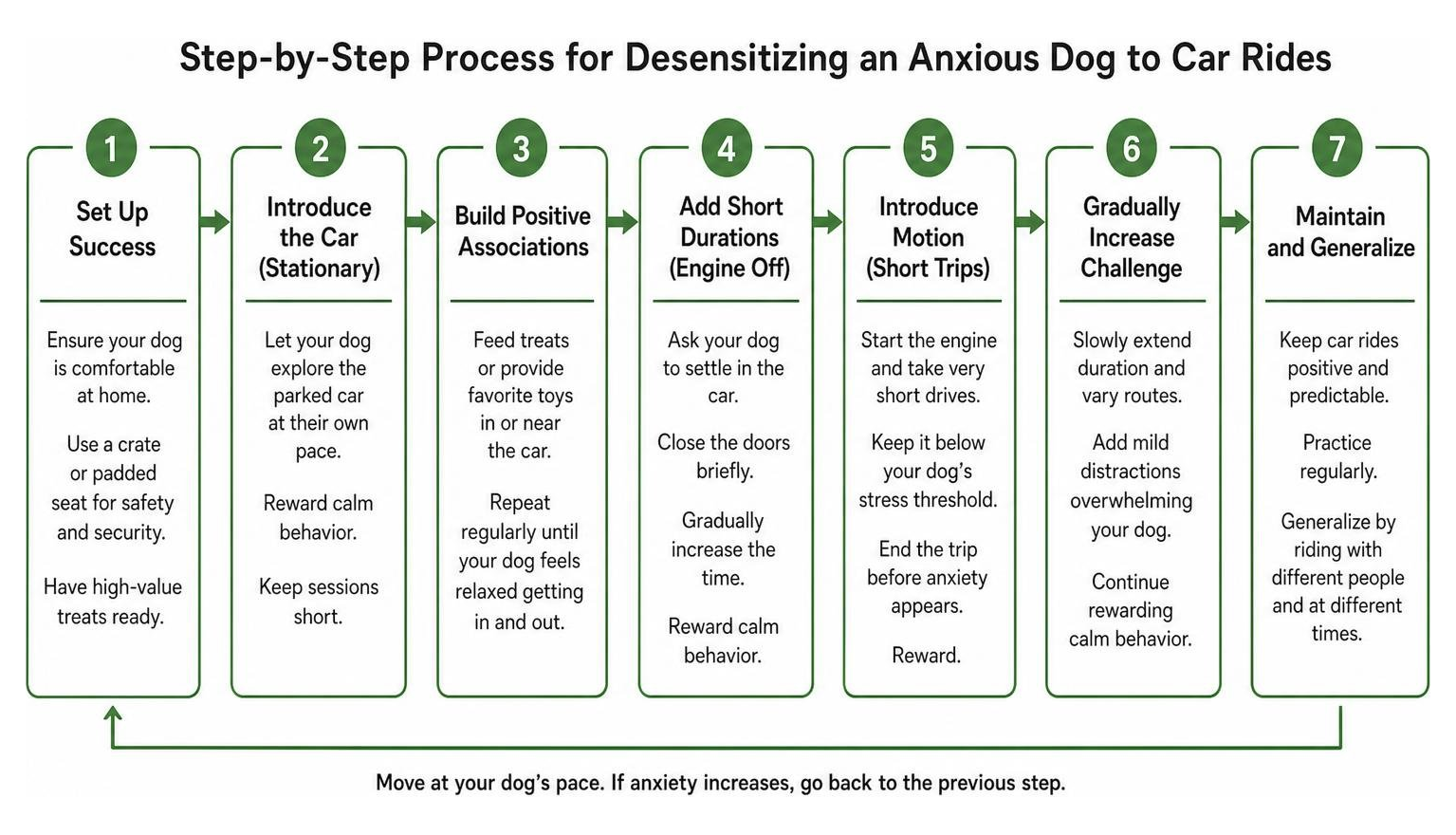
Step-by-Step Desensitization and Counter-Conditioning
You cannot resolve a deep-seated fear of the car by forcing your dog inside and driving from Portland to Seattle. That approach only floods the dog's nervous system and confirms their worst fears. Instead, we must use systematic desensitization (gradually exposing the dog to the car at a level they can easily handle) and counter-conditioning (changing their internal emotional response using high-value rewards).
For a detailed look at how we structure these behavioral shifts, check out our page on Behavior Modification Training.
Here is the step-by-step protocol to implement at home:
Step 1: The Stationary, Engine-Off Car
Do not attempt to go for a drive yet. Walk your dog out to the car on a loose leash. Toss high-value rewards (like freeze-dried liver, hot dogs, or real chicken) near the vehicle. If your dog remains relaxed, open the doors and let them explore the stationary car at their own pace. You can even feed them their regular meals inside the parked car. Your goal is to build a positive association with the physical vehicle itself.
Step 2: Sitting Inside with the Engine Off
Climb into the backseat with your dog, keeping the doors open if they show any hesitation. Sit together quietly, offer calm praise, and feed high-value treats. Keep these sessions incredibly short—one to two minutes max. If your dog displays subtle stress signals like yawning or lip licking, you have pushed past their threshold. Back up a step.
Step 3: Introducing the Engine Sound
Once your dog happily hops into the car expecting a reward, turn the key. Do not put the car in drive. Simply let the engine idle so your dog gets accustomed to the sound and vibration. Deliver high-value rewards, turn the engine off, and exit the vehicle.
Step 4: The Driveway Roll
Back out of the driveway and immediately pull right back in. Park, turn off the engine, and reward your dog. You are building a predictable, low-stress pattern.
Step 5: Short, Successful Trips
Drive around the block, ending the trip on a high note with a jackpot of treats. Gradually increase the distance over several weeks. If you rush this process, you will find yourself back at square one. For professional, hands-on guidance through this protocol, our In-Home Private Lessons are designed to help you execute these steps successfully in your own driveway.
Training Positive Associations and Varying Destinations
One of the biggest mistakes dog owners make is only using the car for things the dog hates. If the only time your dog gets into the backseat is to go to the vet or the groomer, they will quickly learn to dread the car keys.
You must vary your destinations. Take short drives to fun places. Go to a quiet trail in Scappoose, a park in St Helens, or a sniffy walk in Warren. Make sure the vast majority of car rides end in something your dog loves.
Use positive reinforcement strategically. While the car is moving, it is often best to avoid feeding treats to prevent motion sickness. Instead, deliver the high value rewards immediately upon arrival at your destination. This builds positive anticipation for the end of the ride.
If you are dealing with a dog who is also reactive to things they see out the window during these drives, you might find our article on Spring Is Here and So Is Every Dog Your Dog Hates helpful for managing their arousal levels.
For more structured training advice, read our Dog Trainer Advice on Dealing with Car Anxiety.
Natural Calming Aids and Sensory Tools for Travel
While training is the long term solution, natural calming aids can provide excellent temporary support to help your dog stay below their stress threshold during the learning process.
Pheromone Sprays and Wraps
Synthetic pheromone products, such as ADAPTIL Transport Spray, mimic the soothing scents produced by mother dogs to comfort their puppies. Clinical studies show that using ADAPTIL can result in an 85% reduction in shaking and a 71% reduction in panting.
- Pro Tip: Never spray pheromones directly on your dog. Spray the car interior, crate, or bedding 15 minutes before introducing your dog to allow the alcohol carrier to evaporate. You can also apply it to a pressure wrap like a ThunderShirt to combine physical compression with chemical calming.
Calming Supplements and Chews
Fast acting calming chews containing ingredients like L tryptophan, green tea extract, colostrum, and vitamin B1 can help take the edge off. Give these to your dog about 30 to 45 minutes before you plan to leave. Many owners in community forums discuss their success with these tools, as seen in this Facebook Group Thread on Calming Aids.
Auditory Therapy
The canine nervous system is highly sensitive to sound. Playing specialized classical music designed with bioacoustic principles can help soothe an anxious traveler. Products like In the Car (75 min) < iCalmPet use simplified arrangements to calm dogs while keeping the driver alert. You can also find free resources like this 20 Hour Calming Music Playlist on YouTube or this Relaxing Music for Dogs Afraid of Car Journeys.
Managing Your Own Energy: The Scent of Stress
We cannot talk about calming car rides for dogs without addressing the person holding the leash. Dogs are absolute masters at reading our body language, vocal tones, and biochemistry.
As mentioned earlier, the 2024 study from Bristol University proved that dogs can smell the physiological changes associated with human stress, such as elevated cortisol. If you approach the car anticipating a stressful episode—gripping the steering wheel with white knuckles, sighing, or tensing up—your dog receives a clear chemical cue that there is something to fear. At Blackwood Canine, we always emphasize that training the human is just as important as training the dog.
To break this feedback loop:
- Move your body first: Take your dog on a structured 5 to 10-minute walk before getting in the car. This helps burn off excess adrenaline for both of you.
- Practice calm breathing: Before you turn the key, take a moment to regulate your own nervous system. Inhale for 4 seconds, hold for 4 seconds, and exhale for 6 seconds. Lowering your heart rate directly influences your dog's stress levels.
- Keep your communication neutral: Avoid coddling or constantly reassuring your dog in a high-pitched, anxious voice. This often validates their concern. Instead, use a calm, neutral, and confident tone.
To learn more about how our own emotions impact our dogs, read our article Stop Feeling Guilty About Your Reactive Dog: You Didn't Break Them.
Safety First: Restraint and Temperature Management
A calm ride must also be a safe ride. Letting your dog roam free in the vehicle is a safety hazard for them and a massive distraction for you. It is also illegal in many jurisdictions to travel with an unrestrained pet.
Crash Tested Restraints
Always secure your dog using a crash tested harness attached to a seatbelt, a secured travel crate, or a sturdy vehicle barrier. If you are preparing your dog for a long road trip, having the right gear is essential. You can check out this detailed guide on Dog Road Trip Gear: Rhys's Cooling & Calming Kit for Long Drives | Chill-Dogs for ideas on how to set up your vehicle.
Temperature and Airflow
Heat and anxiety are a dangerous combination. An anxious dog pants heavily, which raises their body temperature. A hot dog gets anxious faster, creating a dangerous cycle.
According to the AKC, a parked car can reach 100°F in under 20 minutes on a 70°F day. Never leave your dog unattended in a vehicle, and ensure the back of the car has active airflow. Car AC units hit the front seats first, often leaving the cargo area or backseat significantly warmer. Use passive cooling tools like magnetic window shades and active tools like clip on fans to keep fresh air moving over your dog.
When to Seek Professional Training or Veterinary Help
If you have tried gradual desensitization, minimized meals, used calming wraps, and your dog is still screaming, thrashing, or injuring themselves trying to escape the car, it is time to stop guessing.
Severe car anxiety is a major welfare issue. You do not have to suffer through it alone, and neither does your dog. A professional trainer can help you identify exactly where the communication is breaking down and build a customized management plan. At Blackwood Canine, we specialize in helping families navigate these exact challenges through our Private Lessons Dog Training.
In some cases, behavioral training must be paired with situational veterinary medication to help the dog remain calm enough to learn. Do not hesitate to consult your veterinarian if your dog's panic is severe.
Schedule Your Good Dog Game Plan Today
You do not need another random internet tip or a miracle cure that does not work. You need a clear, consistent plan tailored to your dog, your lifestyle, and your vehicle.
If car rides have become a source of dread for you and your dog, let us help you build a reliable communication system and a practical management routine. Whether you are in Scappoose, Beaverton, Portland, or Vancouver, the first step is scheduling a Good Dog Game Plan.
We will assess your dog's behavior, look at what you have already tried, and create a realistic path forward so you can finally enjoy stress free travel together.
Schedule Your Good Dog Game Plan with Blackwood Canine Today
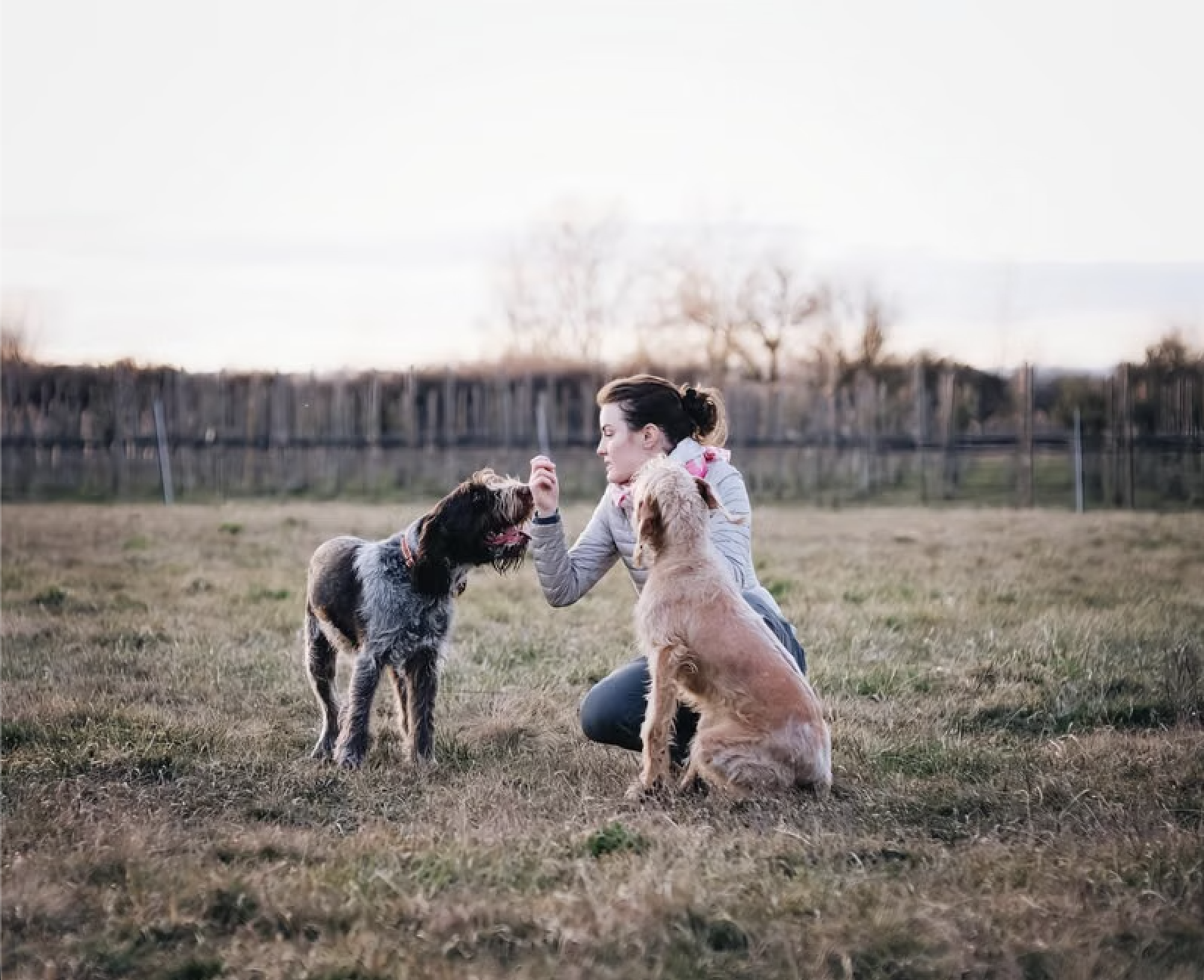
The Complete Guide to Retraining and Obedience for Older Dogs
The Truth About Dog Training for Adult Dogs (And Why Most People Get It Wrong)
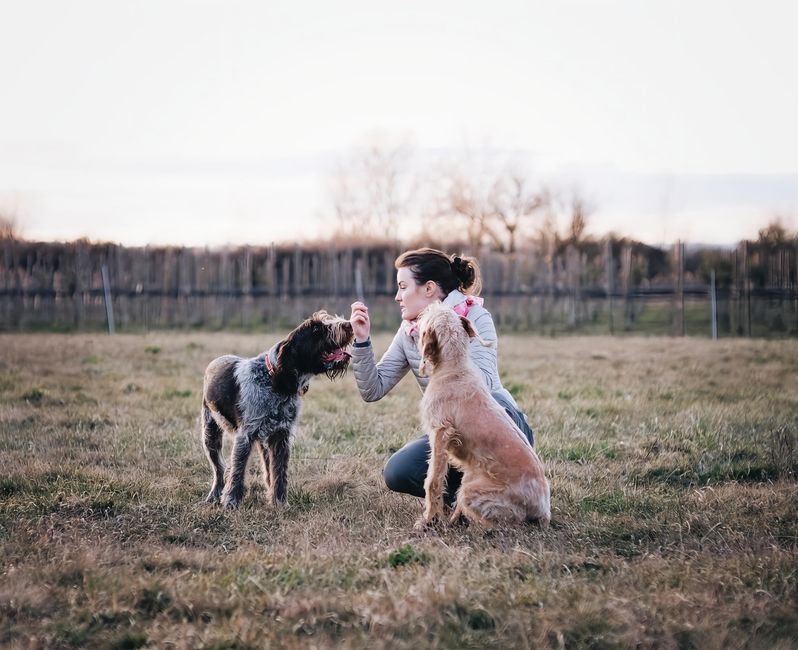
Dog training for adult dogs works. Full stop. But there's a good chance you've already tried something and it didn't stick, which is exactly why you're here.
Here's a quick answer before we go any further:
Can you train an adult dog?
- Yes, dogs can learn new behaviors at any age
- Adult dogs actually have better focus and impulse control than puppies
- The real challenge is not the dog's age, it's using an approach built for mature dogs
- Most failed attempts come down to inconsistency, unclear expectations, or a method designed for puppies
- Positive reinforcement matters, but so do clear rules, management, and follow through
Most people assume the window for training closed somewhere around six months. It didn't. Adult dogs (typically 2 years and older) have stable hormones, stronger attention spans, and more self control than puppies or adolescent dogs. That's actually an advantage.
What works against you is not your dog's age. It's habits. An adult dog has had months or years to practice the behavior you're now trying to change. Pulling on leash, jumping on guests, ignoring you at the park. Those patterns are grooved in. They don't disappear with a few treat repetitions.
That's the honest truth most articles skip over.
Good training for an adult dog isn't just about teaching "sit." It's about setting clear expectations, managing the environment so bad habits stop getting reinforced, being consistent across every person in your household, and following through every single time. That combination is what actually moves the needle.
I'm David Wright, founder of Blackwood Canine, and dog training for adult dogs is something I've worked on directly since apprenticing under a professional trainer in 2009, starting with my own dog aggressive Cane Corso. This guide covers everything I've learned about what actually works with mature dogs, and what tends to waste your time.
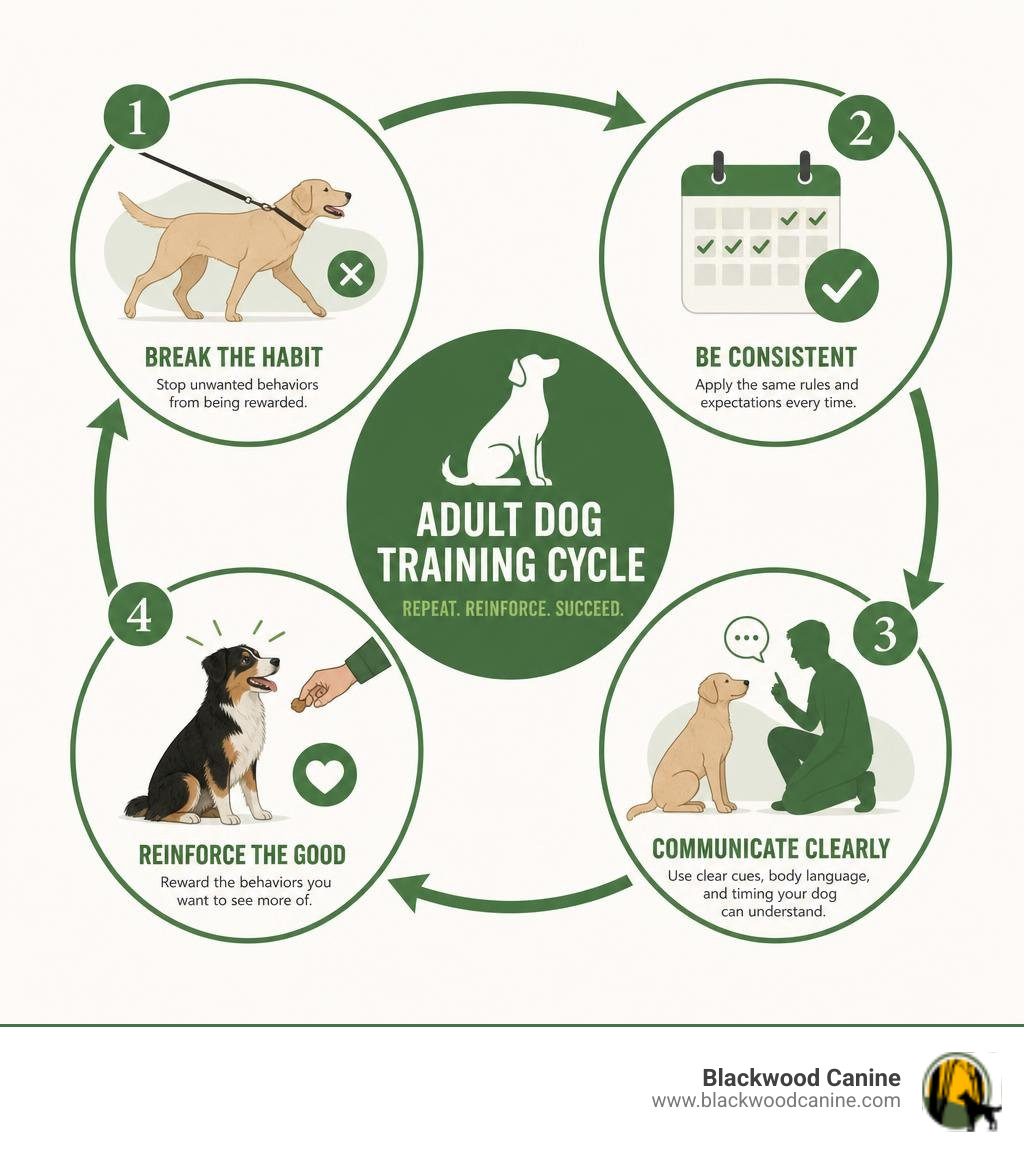
Why Dog Training for Adult Dogs is Highly Effective
Many dog owners in Scappoose, Warren, and Portland feel discouraged because they think they missed the boat. They assume that if they did not get their dog into a class during puppyhood, they are stuck with behavioral issues forever. This is scientifically inaccurate.
Adult dogs possess several cognitive advantages over puppies:
- Stable Hormones: Unlike rowdy adolescents testing boundaries or puppies with short attention spans, adult dogs have mature brains. Their hormones are stable, which makes their behavior far more predictable.
- Stronger Impulse Control: An adult dog has a natural capacity for self control that a puppy simply has not developed yet.
- Longer Attention Spans: A puppy can focus for maybe one to three minutes before their brain wanders. An adult dog can easily handle five to ten minute training sessions, and they can focus through distractions much better.
The challenge with adult dogs is not their ability to learn. It is their history. If your dog has spent three years pulling you down the street in Hillsboro, that behavior has become a default habit. To change it, we have to teach a new habit while stopping the old one from being rewarded.
When you look at Dog Training for Adult Dogs: Complete Obedience - Paw And Breeds, you see that older dogs are highly capable of learning complete obedience. But to get there, you need a system designed for mature dogs. Standard puppy training methods that rely entirely on holding a treat in front of a dog's nose often fail with adults. If the dog decides they do not want the treat, or if a passing squirrel in Beaverton is more interesting than a piece of kibble, they will simply ignore you.
We explain this dynamic in our post on Blog Dog Training Methods Positive Reinforcement vs Dominance Training. Effective training is not about dominating your dog, nor is it about bribing them with treats forever. It is about clear communication, consistent rules, and reliable follow through.
Key Differences Between Training a Puppy and an Older Dog

Training an older dog requires a different mindset than raising a puppy. Puppies are blank slates. With a puppy, you are focused on prevention, basic socialization, and house training. With an adult dog, you are often working on rehabilitation, habit breaking, and building engagement.
Physical limitations are another critical factor. If you ask an older dog to sit and they hesitate or resist, it might not be stubbornness. Joint pain, hip discomfort, or arthritis can make certain physical positions uncomfortable. Always have a veterinarian check an older dog to rule out physical pain before starting a new training routine.
Here is a quick look at how puppy training compares to training an adult dog:
| Training Aspect | Puppy Training | Adult Dog Training |
|---|---|---|
| Primary Focus | Prevention, socialization, house training | Habit breaking, focus, clear boundaries |
| Attention Span | Very short (1 to 3 minutes) | Longer and more stable (5 to 10 minutes) |
| Hormone Levels | Constantly changing | Stable and predictable |
| Physical Limits | Developing joints, high energy | Potential joint pain, arthritis, lower stamina |
| Habit History | None (blank slate) | Deeply grooved default behaviors |
How to Start Training an Adult Dog with No Prior Experience
If your dog has never had formal training, do not panic. Start by shifting how you interact with them daily. Successful training is not just a ten minute session on Saturday morning. It is a daily practice of clear communication, management, consistency, and follow through.
You must establish clear expectations and boundaries. If you do not want your dog on the couch, that rule must apply every single day, to every person in the house. When rules change based on who is home, the dog gets confused and stops listening.
We use a simple framework to build reliable behaviors:
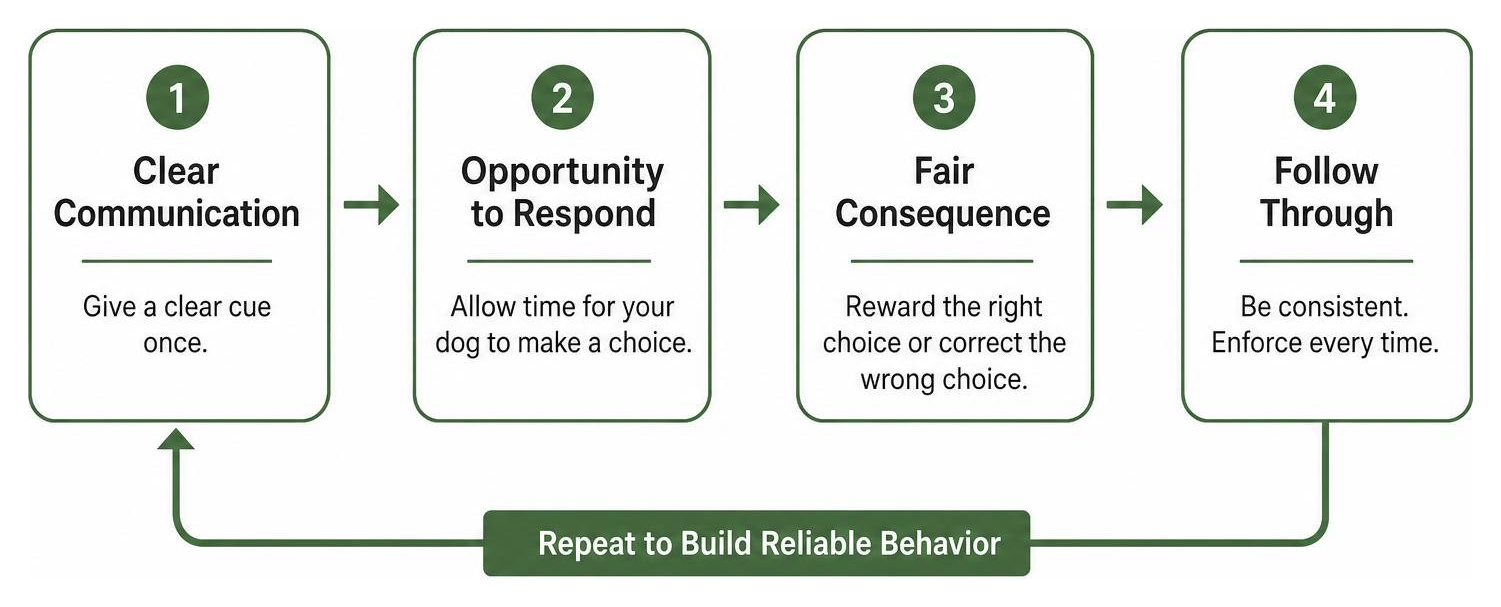
Setting Up Your Home for Dog Training for Adult Dogs
Before you teach commands, you need to manage your dog's environment. If your dog has free run of your house in St. Helens or Vancouver while they are still practicing bad behaviors, you are fighting an uphill battle.
- Crate Training: A crate is not a punishment. It is a valuable management tool that keeps your dog safe, prevents destructive habits when you cannot supervise, and teaches them how to settle calmly.
- The Place Command: Teach your dog to go to a designated cot or mat and stay there until released. This is an incredible tool for managing excitement when guests arrive or when you are eating dinner.
- Food Engagement: Stop feeding your dog out of a bowl for free. Use their daily meals to build motivation and focus. When your dog learns that their food comes from cooperating with you, their attention span will skyrocket. Learn more about this approach in our guide on Blog Dog Training Strategies Building Engagement with Food.
Step by Step Guide to Core Obedience Commands
When teaching commands to an untrained adult dog, start in a quiet room inside your house where there are zero distractions.
- Sit: Hold a piece of food directly in front of your dog's nose. Slowly move your hand back over their head. As their nose goes up to follow the food, their rear end will naturally go down. The moment their rear hits the floor, mark the behavior with a clear word like "Yes!" and give them the food.
- Down: Start with your dog in a sit. Hold a treat to their nose and slowly draw it straight down to the floor between their front paws. Once their chest touches the ground, mark with "Yes!" and reward.
- Stay: Ask your dog to sit or down. Wait one second, mark, and reward. Gradually increase the duration before you reward. Do not step away yet. Build duration first, then slowly add distance, one step at a time.
- Recall (Come): Start indoors. Say your dog's name followed by "Come" in an enthusiastic tone. Back away quickly. When they move toward you, mark and reward. Never call your dog to you to punish them, or they will learn that coming to you leads to bad things. For outdoor practice around distractions, always use a long line leash to ensure safety, as recommended by resources like Train Your Pet.
- Leave It: Hold a low value treat in a closed fist. Let your dog sniff and lick your hand. Ignore the behavior. The second they pull their nose away and stop trying to get the food, mark and reward them with a different, higher value treat from your other hand. They learn that ignoring the item leads to a better reward.
- Heel: Keep your dog on your left side. Walk forward. If they walk calmly next to your leg, mark and reward. If they pull, stop walking immediately.
Keep these daily sessions short, limiting them to 5 to 10 minutes to avoid mental fatigue.
Addressing Common Behavior Issues in Mature Dogs
Many adult dogs end up in our programs because of specific, frustrating behaviors that make daily life stressful. Whether you live in Bethany, Hillsboro, or downtown Portland, these issues usually stem from a lack of clear boundaries and consistent management.
Managing Leash Pulling and Jumping Up
Walking your dog should not feel like getting dragged by a freight train. Leash pulling is not an instinctual behavior, but dogs do it because it works. If they pull and you keep walking, they learn that pulling gets them where they want to go.
To fix leash pulling, you must stop moving when the leash is tight. Use a standard six foot flat leash (never a retractable leash) and practice loose leash walking in low distraction areas first. Turn and walk in the opposite direction the moment your dog starts to pull. They must learn that a loose leash is the only way the walk continues.
Jumping up on people is another common issue. Dogs jump to greet us because they want attention, and even pushing them away or yelling can feel like a reward to an excited dog.
To stop this, practice boundary training and calm greetings. Ask your dog to go to their place bed when guests arrive. Do not let guests pet or interact with your dog until they are completely calm. We break down these steps in detail in our post on Blog Dog Obedience Teaching Your Dog Not to Jump Up on People.
Handling Reactivity and Fear in Dog Training for Adult Dogs
If your dog lunges, barks, or growls at other dogs or people during walks in Beaverton or Vancouver, they are likely dealing with reactivity. Reactivity is often driven by fear, frustration, or overexcitement.
Forcing a reactive dog into a crowded group class is counterproductive and unsafe. Instead, we use systematic desensitization and counter conditioning. This means finding your dog's "threshold distance" the distance at which they can see another dog without reacting.
We reward calm behavior at this safe distance, gradually moving closer as the dog builds confidence. You can read more about our specialized approach on our Reactive Dog Training page.
When to Hire a Professional Dog Trainer
Many owners try to fix behavioral issues on their own but hit a plateau. You should consider hiring a professional dog trainer if:
- Your dog shows signs of aggression toward people or other dogs.
- Your dog has severe separation anxiety that leads to self injury or home destruction.
- You feel overwhelmed, frustrated, or unsafe handling your dog.
- You simply do not have the time to build the foundation training yourself.
Private Lessons Versus Immersion Programs
If you decide to get professional help, you have two primary options: private lessons or immersion programs (often called board and train).
Private Lessons are great for owners who want to be hands on throughout the entire process. A trainer works with you and your dog in your home or at a training facility, teaching you how to handle your dog. This requires a significant time commitment from you to practice the homework between sessions. To see if this is right for you, read Blog Is Private Dog Training Worth the Investment.
Immersion Programs (Board and Train) are highly structured boot camp programs where your dog stays with a professional trainer for several weeks. This is incredibly effective for busy owners or for dogs dealing with deeply ingrained behavioral issues. The trainer does the heavy lifting to build the foundation manners, then teaches you how to maintain the training at home. For local parents, we discuss this option in Blog When Is Dog Boot Camp a Good Idea for Portland Pet Parents.
Frequently Asked Questions About Training Older Dogs
Is it really possible to train an adult dog or is it too late?
It is absolutely possible. The idea that you cannot teach an old dog new tricks is a complete myth. Thanks to neuroplasticity, a dog's brain can form new neural connections and learn new behaviors at any age. While older dogs may have established habits that take time to break, their superior focus and impulse control often make them easier to train than distracted puppies.
How long does it take to see results when training an older dog?
You will often see initial changes in focus and cooperation within the first week of establishing clear boundaries and using daily food engagement. However, solidifying new habits and breaking long standing bad behaviors typically takes four to six weeks of daily, consistent practice. Real change is about repetition and follow through over time.
Should I use treats or other rewards for training an adult dog?
Yes, rewards are highly effective for teaching new behaviors. However, you must avoid the trap of only having your dog listen when a treat is visible. Use food luring to guide them into the position initially, but quickly phase out the physical lure so they respond to your verbal cue or hand signal first. Over time, transition to real life rewards, like opening the back door, going for a walk, or throwing a toy, so they learn that cooperation leads to good things.
Conclusion
Training an adult dog is one of the most rewarding things you can do. It builds a deeper bond, reduces daily household stress, and gives your dog the structure they need to navigate the world safely.
At Blackwood Canine, we serve dog owners across Scappoose, Warren, St. Helens, Bethany, Hillsboro, Beaverton, Portland, and Vancouver. We do not offer quick fixes or empty promises. We focus on clear communication, practical management, and consistent follow through to help you build a reliable relationship with your dog.
If you are ready to stop feeling frustrated and start making real progress, the best next step is our Good Dog Game Plan. We will assess your dog, discuss your goals, and build a clear path forward.
Explore our Immersion Dog Training programs today to learn how we can help you and your dog succeed.

The Ultimate Guide to Immersion Training for Dogs
What Immersion Dog Training Actually Is (And Why So Many Portland Owners Are Trying It)

What is immersion dog training? It's a professional program where your dog lives with a certified trainer — full time — and receives structured training throughout every single day, rather than one short class per week.
Here's the quick answer:
- What it is: Your dog stays with a professional trainer (in their home or facility) for ta series of weeks
- How it works: Every interaction becomes a teaching moment — 100+ repetitions per day vs. the \~10 most owners manage at home
- What it solves: Leash pulling, jumping, door bolting, reactivity, aggression, and more
- What you get back: A dog with a solid foundation plus go-home lessons so you know how to keep the momentum
- What it costs: Roughly $750 - $1,000 per week depending on the program
It's also called board and train.
If your dog pulls you down the street, goes berserk when guests arrive, or ignores every command the moment a squirrel appears, you're not alone. These are exactly the frustrations that lead Portland-area owners to look beyond group classes and YouTube tutorials.
The core idea is simple: a professional trainer can provide the kind of consistent, distraction-rich, round-the-clock learning environment that's nearly impossible to replicate at home. Research suggests immersion training accelerates learning by up to 75% compared to standard weekly classes largely because the repetition gap between a professional setting and a typical home is enormous.
This guide covers everything you need to know: how these programs work, what behaviors they address, what to look for in a trainer, how the transition home works, and whether the investment makes sense for your situation.
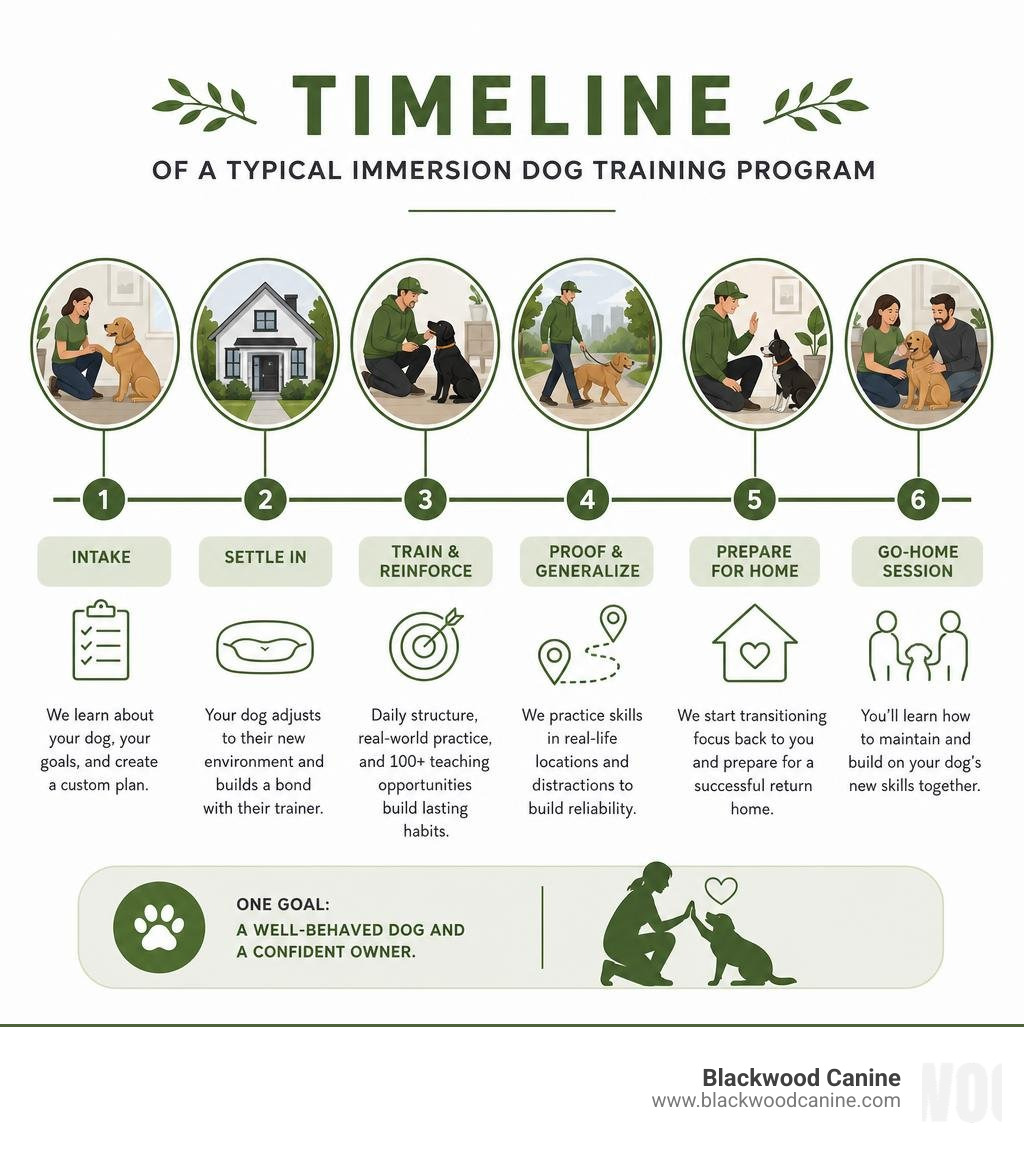
What is Immersion Dog Training?
At its core, what is immersion dog training? Think of it as a study-abroad language program or a high-level athletic residency for your dog. Instead of driving to a sterile training center once a week for a 50-minute class, your dog moves in with a professional trainer.
During this stay, your dog lives in a structured environment where learning never stops. Every single interaction from mealtime and crate entry to backyard playtime and neighborhood walks are treated as a valuable teaching moment.
To help visualize how this compares to traditional training methods, we have broken down the core differences in the table below:
| Feature | Immersion Dog Training (Board & Train) | Standard Weekly Group Classes |
|---|---|---|
| Living Arrangement | Dog lives 24/7 with a professional trainer | Dog lives at home with you |
| Daily Repetitions | 100+ high-quality repetitions daily | ~10 repetitions daily (average owner capacity) |
| Learning Environment | Real-world proofing (parks, stores, streets) | Sterile training facility or quiet room |
| Human Error | Minimized (95% of human training errors eliminated) | High (owners learning along with the dog) |
| Speed of Progress | Accelerated by up to 75% | Slow, incremental weekly updates |
| Handler Focus | Professional builds foundation first | Owner must build foundation and handle behavior |
How What Is Immersion Dog Training Differs from Standard Classes
The absolute biggest difference between immersion training and a weekly group class is the repetition gap.
Consider the daily life of an average dog owner. Between work, family, making dinner, and trying to get some sleep, the average owner manages roughly 10 quality repetitions of a command per day. At that rate, teaching a reliable off-leash recall or a bulletproof "down-stay" can take months, if not years.
In a professional board and train facility, our trainers provide 100 or more repetitions daily. This structured repetition accelerates learning by up to 75% compared to standard weekly classes. Because training is the primary focus of the day, the dog moves past the confusing "what do you want from me?" phase in a fraction of the time.
Additionally, professional immersion training eliminates 95% of the human error that typically stalls progress during home training. When owners try to train their dogs from scratch, they often struggle with split-second timing, inconsistent marker words, or accidentally rewarding the very behaviors they want to stop (like petting a dog that just jumped on them). By handing the foundation work over to a professional, your dog learns the rules of the game with absolute clarity first. Once the dog understands the commands, we train you on how to maintain them, which is a much easier skill to master.
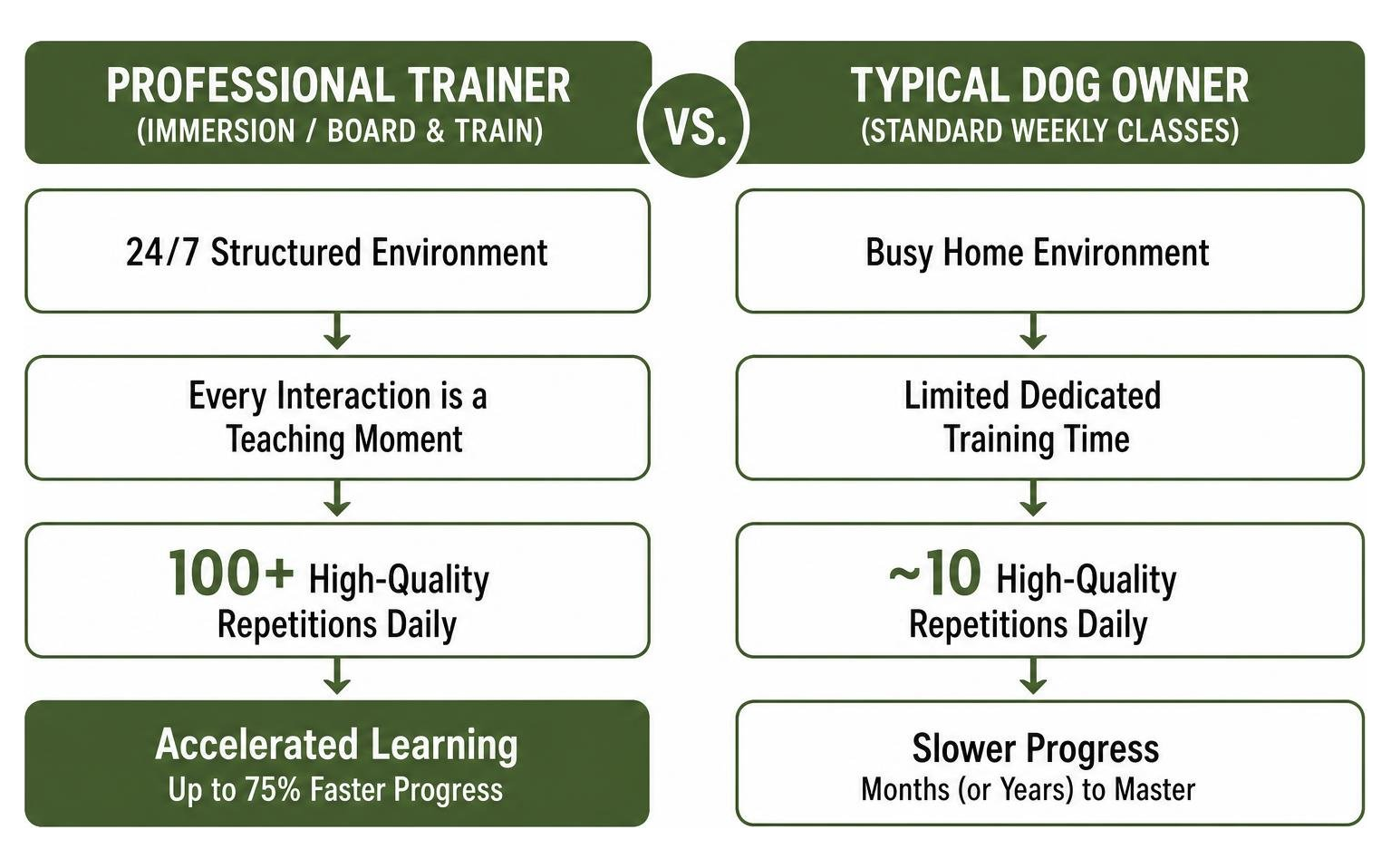
The Science of 24/7 Conditioning and Consistency
Why does 24/7 conditioning work so much better than sporadic training? It all comes down to how dogs learn and generalize behaviors.
Dogs are incredibly situational learners. They might perform a perfect "sit" in a quiet kitchen when you are holding a piece of cheese, but completely ignore you when a guest walks through the front door or a squirrel darts across the sidewalk. This is known as the distraction gap.
Immersion training bridges this gap by systematically teaching and proofing behaviors across 50+ high-value real-world distractions. We don't just train in a quiet room; we take our students on field trips to local parks, bustling streets, and outdoor areas where they must practice focus and impulse control around real-world triggers.
This round-the-clock approach is especially powerful during the critical developmental window of a dog's life. Behavioral research shows that 90% of a dog's permanent temperament is formed by 16 weeks of age. If you can immerse a young puppy in a highly structured, positive environment during this time, you can prevent bad habits—like resource guarding, separation anxiety, and leash reactivity—before they ever have a chance to take root.
Core Benefits and Behaviors Addressed

Immersion dog training isn't just about teaching fancy tricks; it's about building a functional, real-world companion. The three pillars of our training philosophy are engagement, impulse control, and focus. When a dog masters these three things, they gain a level of freedom they never had before. A well-behaved dog is a dog that gets to go to outdoor cafes, join the family on hiking trails, and hang out off-leash without fear.
Currently, 63% of U.S. dog owners invest in structured training to solve behavioral frustrations. They quickly realize that a dog with clear boundaries is a much happier, less anxious pet.
Common Behavioral Issues Solved by Immersion Training
Whether you have a wild young puppy or an older dog with deep-seated habits, an immersive environment is the gold standard for behavior resets. We regularly address a wide range of common behavioral frustrations:
- Leash Pulling: Transforming stressful, arm-wrenching walks into relaxing loose-leash strolls.
- Excessive Jumping: Teaching your dog to keep all four paws on the floor when greeting guests.
- Door Bolting: Creating a reliable boundary at the front door so your dog doesn't run into traffic.
- Severe Reactivity and Aggression: Providing a neutral, emotion-free environment to reset dangerous behaviors. In fact, 15% of our clients come to immersion training as a last resort for reactive behavior. If you are struggling with a dog that lunges, barks, or growls at other dogs, our specialized Reactive Dog Training and Behavior Modification Training programs are designed to restore peace and safety to your walks.
Specialized Skills and Confidence Building
Beyond basic obedience, immersion programs are fantastic for building overall canine confidence. For fearful or anxious dogs, we use gradual desensitization to show them that the world isn't such a scary place.
Socialization in an immersion setting doesn't mean letting your dog run wild with a pack of other dogs. Instead, we focus on social neutrality—teaching your dog to remain calm, relaxed, and focused on their handler even when other dogs are playing nearby.
We also tackle essential lifestyle skills, such as:
- House Training and Crate Manners: Establishing consistent, timed potty breaks and teaching the crate as a safe, peaceful sanctuary.
- Confidence Courses: Introducing dogs to novel surfaces, sounds, and objects to build mental resilience.
- Water Confidence: For owners who want their dogs to enjoy the beautiful Pacific Northwest waterways safely, we can even build foundational water confidence. Introducing a dog to water requires patience to avoid creating a lifelong fear. If you want to see a great example of systematic, positive water introduction, check out eileenanddogs' guide on How I Taught My Dog to Get Into a Swimming Pool - eileenanddogs. For a broader look at introducing water safety, Purina South Africa offers an excellent resource on How to Teach a Dog to Swim | Purina South Africa.
Program Structure, Tools, and Transition Home

A typical board and train program can range anywhere from 10 days to several weeks depending on your dog's age, temperament, and goals.
At Blackwood Canine, we customize our timelines to match your family's needs. For young pups, our Puppy Jump Start Program builds a rock-solid foundation of basic manners during those critical early weeks. For older dogs needing a comprehensive behavioral overhaul, our 5 Week Fix program provides the deep, repetitive conditioning required to break old habits and establish new, positive behaviors.
Common Training Methods and Tools Used
We believe in clear, humane, and highly effective communication. We utilize a balanced approach that pairs positive reinforcement (high-value treats, toy play, and physical praise) with modern, low-level training tools to ensure off-leash reliability.
Some of the tools we commonly use include:
- Positive Reinforcement: Rewarding desired behaviors to keep motivation high and build an eager, happy working dog.
- The Mini Educator Remote Collar: Modern remote collars are incredibly sophisticated communication tools. Unlike the outdated "shock collars" of the past, these devices use a medical-grade micro-stim (similar to a TENS unit used in human physical therapy) to act as a silent, physical "tap on the shoulder" at incredibly low, gentle levels.
- Long Training Lines: Allowing us to practice reliable recall at a distance while keeping your dog completely safe.
- Elevated Beds: Used to teach the "place" command, giving your dog a designated boundary to relax on when guests arrive or during family dinner.
What to Look For in a Reputable Program
Because the dog training industry is largely unregulated—with only a few states, like New Jersey under proposed bill A4206, exploring state licensure—it is vital that you do your homework when choosing an immersion facility.
When vetting a program, look for:
- Certified Professionals: Look for trainers holding voluntary, science-backed certifications from reputable organizations such as the Certification Council for Professional Dog Trainers (CCPDT-KA) or the Association of Professional Dog Trainers (APDT).
- A Family-Style, Home-Like Environment: Dogs trained in sterile, commercial kennels often struggle to adjust to a home environment because they haven't practiced their manners around real-life distractions like kitchen counters, doorbells, and couches.
- Frequent Progress Updates: You should receive regular photos, videos, and report cards during your dog's stay so you can watch their transformation unfold.
- A Lifetime Support Guarantee: A reputable trainer won't just hand your dog back and disappear. Look for programs that offer ongoing support to ensure your long-term success.
The Transition Home and Long-Term Maintenance
We always say that training the human is just as important as training the dog. Your dog can perform like a champion for our trainers, but if you don't know how to maintain the rules when they return home, they will quickly revert to their old habits.
To prevent this, every immersion program includes with an in-depth go-home lessons. During these lessons, we teach you exactly how to deliver commands, time your rewards, and enforce boundaries.
The first month back home is critical. Owners who maintain strict consistency during the first 30 days after immersion training see a 90% higher retention rate of advanced skills.
To set your home up for success, we recommend following these simple rules:
- The House Leash Rule: Keep your dog on a leash inside the house for the for a while. This prevents them from slipping back into old household habits (like counter surfing or sofa jumping) and reminds them that the same rules they learned with the trainer apply in your house.
- Daily Maintenance Reps: Dedicate just 10–15 minutes a day to practicing basic commands. These short, fun sessions keep the training fresh in your dog's mind.
- Strict Boundary Setting: Make your dog sit and wait at every door threshold, and enforce a quiet "place" command when people enter the house.
If you ever need extra help proofing these behaviors in your own space, we offer customized In-Home Private Lessons and focused Private Dog Training Lessons to ensure a seamless transition.
Understanding the Risks and Limitations of What Is Immersion Dog Training
While immersion training is incredibly effective, it's important to have realistic expectations.
First, the physical transition can sometimes cause minor physical stress. For example, sudden diet changes or the excitement of a new environment can cause some dogs to experience temporary stomach upset in early training stays. To prevent this, we always require owners to bring their dog's own familiar food to keep their digestion stable.
Second, an immersion stay is not a "magic pill." It builds an incredible foundation, but it cannot override a complete lack of structure at home. If you let your dog immediately go back to pulling on the leash and sleeping on your face the day they return, the training will regress. Success requires a team effort between our trainers and your family.
Frequently Asked Questions about Immersion Dog Training
Will my dog forget me if I send them away for training?
This is the number one worry for almost every dog owner, and it is completely natural to feel a bit of "parent guilt" when sending your pup away.
However, you can rest easy: your dog will absolutely not forget you. Dogs have incredibly powerful associative memories. They link your unique scent, the sound of your voice, and your visual appearance to safety, love, comfort, and family.
When you reunite at the end of the program, there is 100% instant recognition. In fact, your bond with your dog will likely improve because the daily stress of miscommunication, yelling, and frustration will be replaced by clear, mutual understanding.
Is my dog too old for an immersion board and train program?
There is an old saying that you can't teach an old dog new tricks, but canine science has proven that wrong time and time again. Dogs of any age, breed, or size can benefit from a behavioral reset.
Senior dogs often thrive in structured environments because the mental stimulation keeps their minds sharp and active. Just last year alone, professional trainers successfully transformed the behavior of 45 senior dogs over the age of 9. As long as your dog is healthy enough for moderate exercise, they are the perfect candidate for a program.
How much does professional immersion dog training cost in 2026?
In 2026, professional immersion programs generally range from $700 - $1000 per week, depending on the length of the stay, the severity of the behavioral issues, and the level of customization required.
While this is a significant upfront investment, it is helpful to look at the long-term financial ROI. Consider the potential costs of an untrained dog:
- Property Damage: Replacing scratched hardwood floors or a chewed designer sofa can easily cost thousands of dollars.
- Liability and Medical Bills: Behavioral chaos can carry massive financial risks. The average insurance claim for a dog-related injury hit $64,555 in 2023.
Investing in a solid foundation of safety, control, and off-leash reliability is an insurance policy that pays dividends for the rest of your dog's life.
Conclusion
At Blackwood Canine, we believe that a well-behaved dog is a happy, free dog. Our mission is to provide the clear communication and practical management tools you need to build a reliable, stress-free relationship with your pet.
Whether you are looking for a complete behavior overhaul with our Advanced Re-Conditioning program, want to build the ultimate family pet with our Complete Companion track, or are ready to explore our signature Immersion Dog Training options, we are here to guide you every step of the way.
Ready to see how we can transform your relationship with your dog? Explore our full range of Services and take the first step toward a lifetime of off-leash freedom today!

Training a Stubborn Dog with Patience and Irresistible Treats
Your Dog Is Not Broken, Just Misunderstood
Dog training for stubborn dogs starts with one uncomfortable truth: most dogs labeled "stubborn" are not being defiant. They are confused, under motivated, or working from instincts that were literally bred into them over hundreds of years.
Here is a quick answer if you are short on time:
How to train a stubborn dog:
- Stop repeating commands. Say it once, then follow through.
- Use high-value rewards your dog actually cares about, like chicken, cheese, or freeze-dried liver.
- Keep sessions short: 3 to 5 minutes, several times a day.
- Train in low-distraction environments first, then build up gradually.
- Be consistent. Every family member, every time, same rules.
- Rule out fear, pain, or confusion before assuming your dog is being difficult.
If your dog ignores "come" at Pier Park in Portland or tunes you out completely on a walk through Hillsboro, it does not mean they are a lost cause. It usually means there is a gap between what you are asking and what your dog understands, or a mismatch between the reward you are offering and the distraction in front of them.
That gap is fixable. But it takes more than a bag of treats and good intentions. Real progress comes from clear expectations, consistent follow-through, smart management, and training your dog actually finds worthwhile.
David Wright and Blackwood Canine, have spent years helping dog owners in the greater Portland and Vancouver area work through exactly these kinds of challenges, including dog training for stubborn dogs who their owners were convinced could never be taught. If that sounds like your dog right now, keep reading.
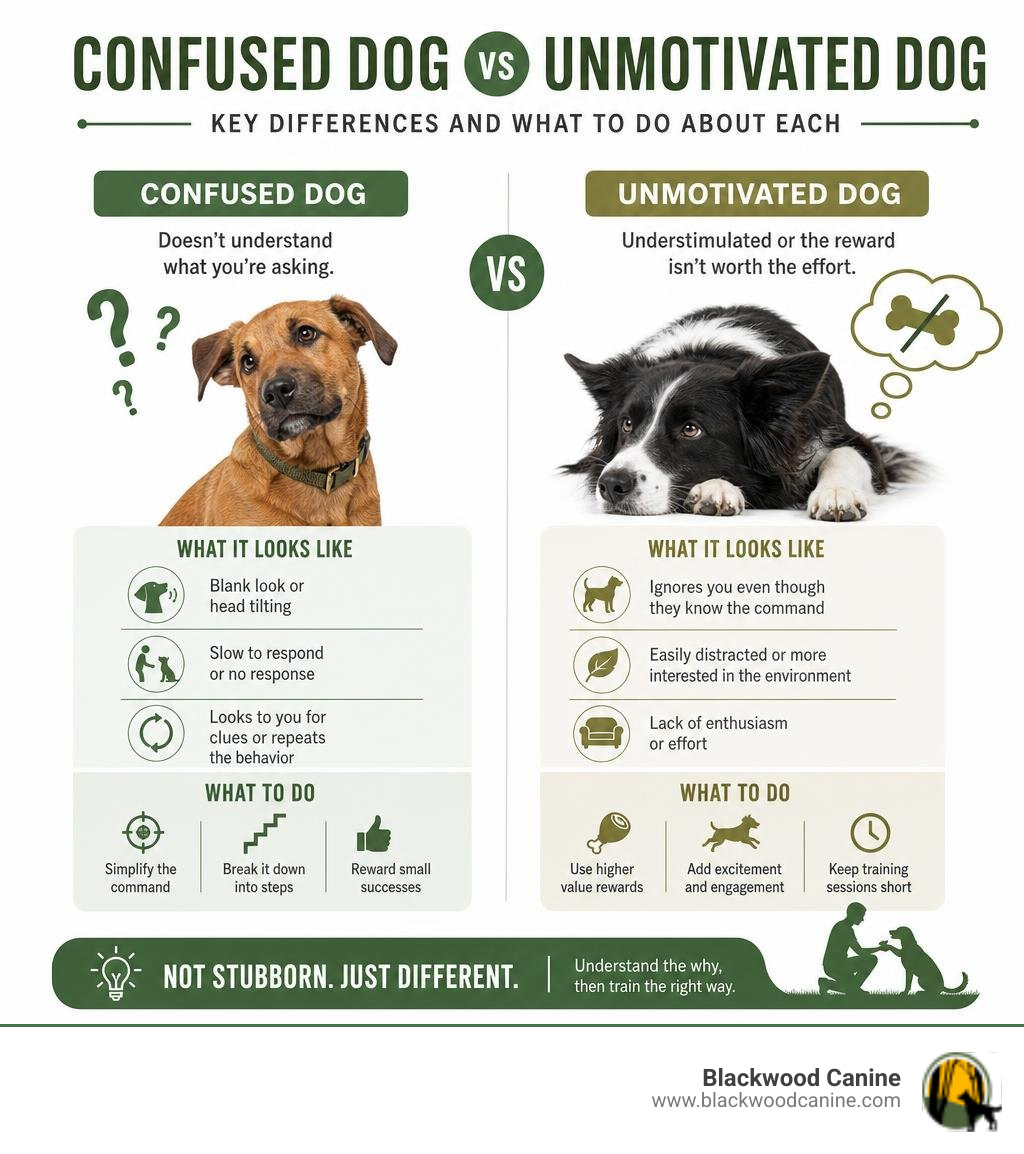
The Myth of the Stubborn Dog: What Is Really Happening?
When a dog ignores a command, our human brain quickly jumps to labels like stubborn, spiteful, or dominant. We assume the dog knows exactly what we want and is actively choosing to blow us off. This is almost never the case.
Dogs are highly rational creatures. They do what works for them based on immediate consequences. If ignoring you pays off better than listening to you, they will choose to ignore you. It is not a personality flaw. It is simple math.
To understand why your dog is resisting your cues, we have to look at the underlying genetic and physical factors at play.
Genetic Independence and Breed Traits
A landmark scientific study published in the journal Cell showed that trainability is a highly heritable trait linked to breed ancestry. Herding and sporting breeds were developed to work in close partnership with humans, meaning they are genetically wired to look to us for direction.
On the other hand, breeds like hounds, terriers, and livestock guardians were bred for independent decision making. A Beagle tracking a scent or a Siberian Husky pulling a sled had to make split second choices without human input. When these dogs ignore a cue, they are simply acting on centuries of genetic programming.
You can read more about this in the Scientific research on breed trainability. Working with these independent thinkers requires us to adjust our expectations and find what truly motivates them.
Medical Issues and Pain Responses
Before you assume your dog is being difficult, you must rule out physical discomfort. A sudden refusal to perform a known behavior is often a cry for help.
For example, a dog with undiagnosed hip dysplasia or arthritis may refuse a "sit" or "down" cue because transitioning to those positions causes physical pain. An older dog might ignore your recall simply because age related hearing loss prevents them from hearing your voice. If your dog suddenly starts resisting basic commands, a thorough veterinary exam is always the best first step.
Fear, Anxiety, and Environmental Stress
When a dog is in a state of high arousal, fear, or anxiety, their nervous system goes into survival mode. In these moments, the brain is physically incapable of processing auditory commands.
If your dog freezes or ignores you when a loud truck passes in Beaverton, they are not being stubborn. They are terrified. For dogs struggling with deep seated fear or reactivity, traditional obedience training must take a backseat to specialized behavior plans. You can learn more about managing these complex emotional states by reading our guide on Reactive Dog Training.
Why Traditional Dog Training for Stubborn Dogs Often Fails
Many well meaning owners in Scappoose and St. Helens try to solve their training struggles by using methods that actually make the problem worse. If your current approach is not working, it is likely due to one of these common training traps.
Command Nagging and Repeating Cues
We have all done it. We say "sit, sit, sit, sit" until the dog finally lowers their rear. This is called command nagging, and it actively trains your dog to ignore you.
When you repeat a cue, you teach your dog that the command is not the single word "sit" but rather the entire repeated sequence. They learn that they do not need to respond to the first prompt, only to the fifth or sixth one when your tone becomes visibly frustrated.
Poisoned Cues
A poisoned cue occurs when a command becomes associated with an unpleasant outcome or high stress.
If you only call your dog to "come" when it is time to leave the fun at the dog park, take a bath, or get locked in a crate, they will quickly learn that responding to that word brings an end to their fun. Eventually, they will actively avoid you when they hear that cue.
Treat Bribes and Transactional Listening
There is a massive difference between rewarding a behavior and bribing your dog. If you have to show your dog a piece of cheese before they will agree to lie down, you are bribing them.
This creates transactional listening, where your dog constantly calculates the cost benefit ratio of the interaction. If the distraction in front of them is more exciting than the treat in your hand, they will choose the distraction.
To break this cycle, we must use balanced training systems that establish clear boundaries and reliable follow through. For a deeper look at finding this balance, explore our article on Blog: Dog Training Methods Positive Reinforcement vs Dominance Training.
Core Principles of Dog Training for Stubborn Dogs
To successfully train an independent dog, we have to move away from conflict and focus on clear communication, smart management, and consistent follow through.

Successful training is built on a simple framework: establish clear expectations, manage the environment to prevent self rewarding mistakes, and always follow through with fair consequences and consistent repetition.
| Training Element | Traditional Training | Short Burst Training |
|---|---|---|
| Session Length | 30 to 45 minutes | 3 to 5 minutes |
| Daily Frequency | Once a day (or less) | 2 to 5 times a day |
| Reward Delivery | Low value kibble, predictable | High value, variable |
| Distraction Level | Rushed into busy parks | Gradual, systematic exposure |
| Focus Level | High mental fatigue | Sharp, game like engagement |
Finding the Right Currency for Your Independent Thinker
If you want your independent dog to work with you, you have to find what actually motivates them. We call this a motivation audit.
Start by testing different rewards to see what your dog values most. For food motivated dogs, standard dry kibble rarely works in high distraction environments. You need to upgrade to high value rewards like freeze-dried liver, hot dogs, or string cheese.
If your dog is not food motivated, look for other outlets. A high energy terrier might work enthusiastically for a quick game of tug or a throw of their favorite tennis ball.
Once you identify their favorite rewards, use them strategically. Save your highest value "jackpot" treats exclusively for teaching difficult commands or working in challenging outdoor spaces. As the behavior becomes reliable, transition to a variable reinforcement schedule, rewarding only the best responses so your dog learns to perform even when they cannot see the food first.
For more hands on tips, you can read The Ultimate Guide to Dog Training for Stubborn Dogs to help refine your reward system.
Structuring Short Sessions for Maximum Focus
Independent dogs have a very low tolerance for boring, repetitive drills. If you try to force them through a traditional thirty minute training session, they will quickly tune you out, sniff the ground, or walk away.
Instead, keep your training sessions incredibly short. We recommend micro sessions that last only 3 to 5 minutes, repeated 5 to 8 times throughout the day.
Keep the energy high and the pace fast. A typical session should look like this:
- 30 Second Warm Up: A quick, easy behavior your dog knows well to build immediate focus.
- 2 Minutes of New Challenge: Working on a specific skill or adding a small distraction.
- 30 Second Success Ending: Reverting to an easy command to ensure the session ends on a positive, successful note.
By keeping sessions short, you prevent mental fatigue and leave your dog wanting more. If you want to learn how to transition these quick wins into daily habits, check out our 5 Week Fix program.
Step by Step Guide to Building Real World Reliability
Reliability is not built overnight. It is the result of systematic practice that gradually prepares your dog to listen when the world is busy around them.
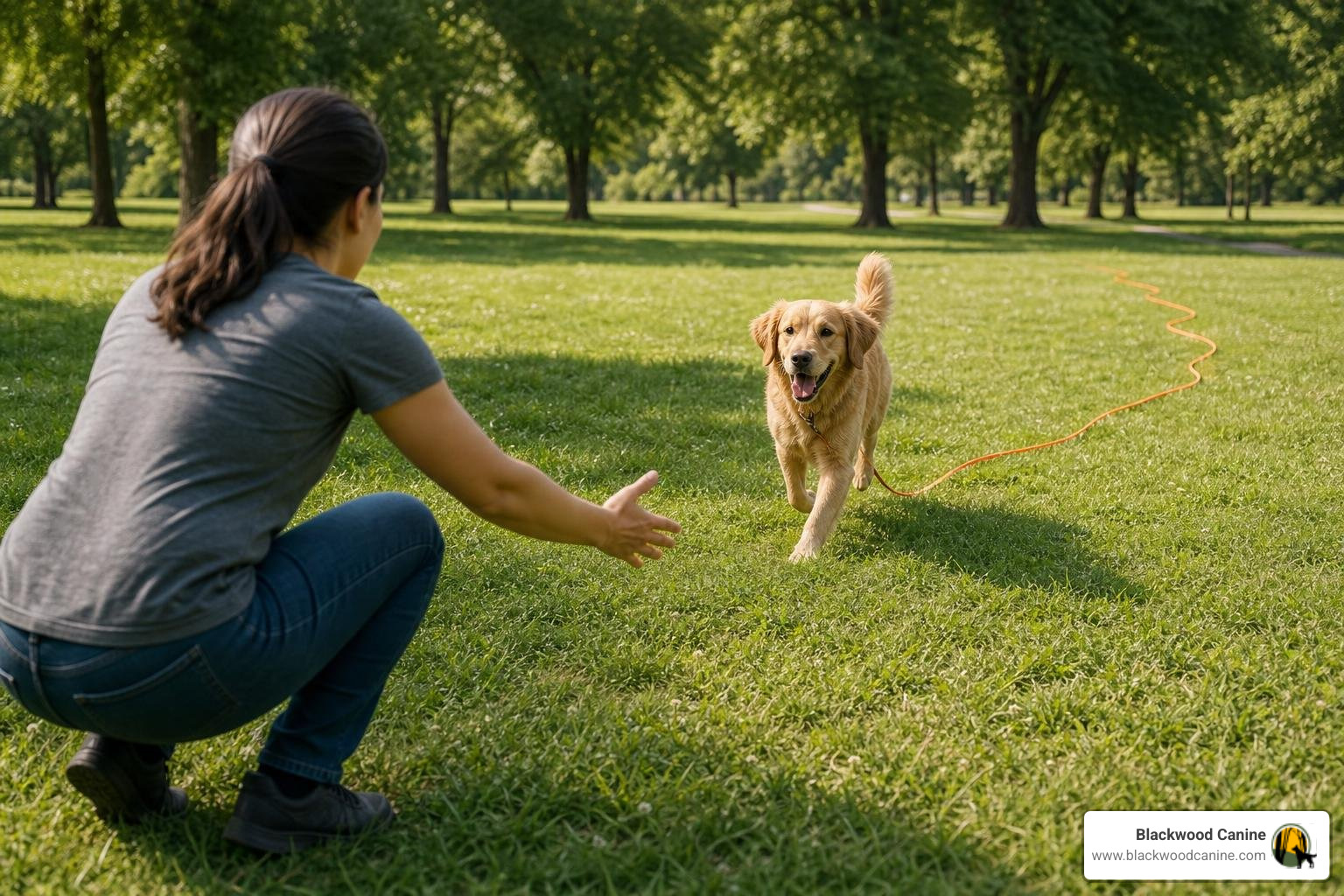
To build a solid foundation, we use a systematic step by step approach.
Step 1: Start in a Low Distraction Environment
Begin training in the quietest room of your house, like your hallway or kitchen. There should be no other pets, active kids, or toys around. Practice your basic cues here until your dog can perform them perfectly ten times in a row.
Step 2: Introduce the Three Ds Gradually
Once a behavior is mastered indoors, you can begin proofing it using the Three Ds:
- Duration: Ask your dog to hold a position (like a stay) for a few seconds longer before delivering the reward.
- Distance: Take one small step away from your dog before rewarding them, gradually building up the distance.
- Distraction: Introduce very mild distractions, like bouncing a ball nearby or turning on the television, while keeping your rate of reinforcement high.
Crucial rule: Only increase one of these variables at a time. If you increase the distance, keep the duration short and the distractions low. If you push too fast and your dog fails, take a step back to the last successful level.
Step 3: Use the Tree Method for Leash Pulling
Leash pulling is a classic self rewarding behavior. Every time your dog pulls and you move forward, they learn that pulling gets them where they want to go.
To stop this, use the tree method. The exact second the leash goes tight, stop walking immediately. Stand completely still like a tree. Do not pull back or jerk the leash.
Wait for your dog to make the choice to look back at you or step back to create slack in the line. The moment the leash goes loose, mark it with an enthusiastic "Yes!" and reward them by walking forward again. This teaches them that a loose leash is the only thing that unlocks forward movement.
Step 4: Apply the 80/20 Rule for Recall
To prevent your recall cue from becoming poisoned, apply the 80/20 rule.
80% of the time you call your dog to you, reward them with a high value treat and immediately release them back to whatever fun activity they were doing. Only 20% of the time should the recall result in a negative outcome like leaving the park, going inside, or putting them in their crate. This ensures your dog always views coming to you as a highly rewarding choice.
For more helpful foundational strategies, you can explore the Humane society training tips.
How to Apply Dog Training for Stubborn Dogs in Public Spaces
It is easy to have a well behaved dog in your living room. The real challenge is maintaining that focus when you step out onto the streets of Portland or visit a busy park in Vancouver.
The key to success in public is generalization. Dogs do not naturally generalize behaviors. A "sit" in your living room does not automatically mean "sit" when there is a squirrel running up a tree at a park in Hillsboro. You have to retrain the behavior in each new environment, starting with very close proximity and high value rewards.
When training in public spaces, management is your best friend. Always use a long line leash (15 to 30 feet) to practice recall in open areas. This allows your dog to experience freedom while preventing them from self rewarding by running off to greet other dogs or chase birds.
If your dog ignores a cue, do not let them ignore you. Use your long line to gently guide them to complete the behavior, ensuring they learn that compliance is always non negotiable.
If you are struggling to bridge the gap between home training and public obedience, our professional team can help. Take a look at our In-Home Private Lessons to see how we build real world focus right in your neighborhood.
Frequently Asked Questions about Independent Dogs
Why does my dog only listen when I have treats visible?
This is one of the most common issues dog owners face, and it happens because the treat has become a bribe rather than a reward. If your dog has to see the food before they will cooperate, you have accidentally trained them to only work when they can verify the payoff beforehand.
To fix this, you need to hide your treats. Keep them in a treat pouch behind your back, in your pocket, or placed on a high counter nearby. Ask your dog for the command with empty hands.
Use your normal hand signal, and the moment they comply, mark the behavior with your success word (like "Yes!") and then reach for the hidden treat. This teaches your dog that even if they cannot see the reward, it is still coming if they choose to cooperate.
Once they understand this concept, transition to a variable reinforcement schedule. Start rewarding every second or third correct response instead of every single one, keeping your dog guessing and highly engaged.
You can also find useful tips on using markers effectively in this guide on Clicker Training Stubborn Dogs: a Step-by-Step Guide That Works.
How do I fix a command that my dog has learned to ignore?
If your dog has learned to tune out a specific word like "come" or "down" because of command nagging or negative associations, that cue is officially poisoned. Trying to force your dog to respect that specific word is an uphill battle that usually leads to more frustration.
The easiest solution is to retire that word completely. Throw it in the trash and start over from scratch with a brand new cue.
For example, if your recall word "come" is broken, switch to "here" or "close." When you introduce the new word, follow these strict rules:
- Never say the word unless you are 100% sure your dog will comply or you have a leash to gently enforce it.
- Reward every single correct response with a high value jackpot treat for the first few weeks.
- Never use the new word to summon your dog for something they dislike, like a bath or nail trim.
By starting fresh, you bypass all the old, resistant habits and build a clean, reliable association from day one.
When should I seek professional help for my independent dog?
While many stubborn behaviors can be managed with consistent practice at home, there are times when professional guidance is the safest and most efficient path forward.
You should consider seeking expert help if:
- Your dog shows any signs of aggression, resource guarding, or severe leash reactivity.
- Your training progress has completely stalled despite weeks of consistent effort.
- You feel so frustrated, embarrassed, or overwhelmed that you are avoiding walks or interactions with your dog.
- You are struggling to manage your dog's high energy or independent drive safely in public spaces.
When looking for professional help, avoid programs that promise instant, effortless results or rely on harsh, punitive methods that damage your bond with your dog. Look for experienced trainers who focus on clear communication, practical management, and customized plans that fit your lifestyle.
For dogs struggling with more complex behavioral challenges, our specialized Behavior Modification Training is designed to help you rebuild trust and restore peace to your home.
Conclusion
Training an independent, strong willed dog can certainly test your patience, but it is also one of the most rewarding challenges you can take on. By shifting your mindset from a battle of wills to a system of clear communication, consistent management, and fair follow through, you can build a reliable relationship with your dog.
At Blackwood Canine, we specialize in helping busy families in Scappoose, Hillsboro, Beaverton, Portland, and Vancouver turn frustrating resistance into steady reliability. We do not offer magic tricks or one size fits all promises. Instead, we give you practical management tools, clear communication strategies, and the hands on support you need to succeed.
If you are ready to stop struggling and start seeing real progress, the best next step is our Good Dog Game Plan. We will assess your dog's unique temperament, identify their true motivators, and build a clear roadmap tailored to your home and lifestyle.
Whether you prefer the personalized focus of our private lessons or want to fast track your progress, we are here to guide you every step of the way. Explore our Services page to find the perfect fit for your family, or Get started with our immersion dog training programs today.
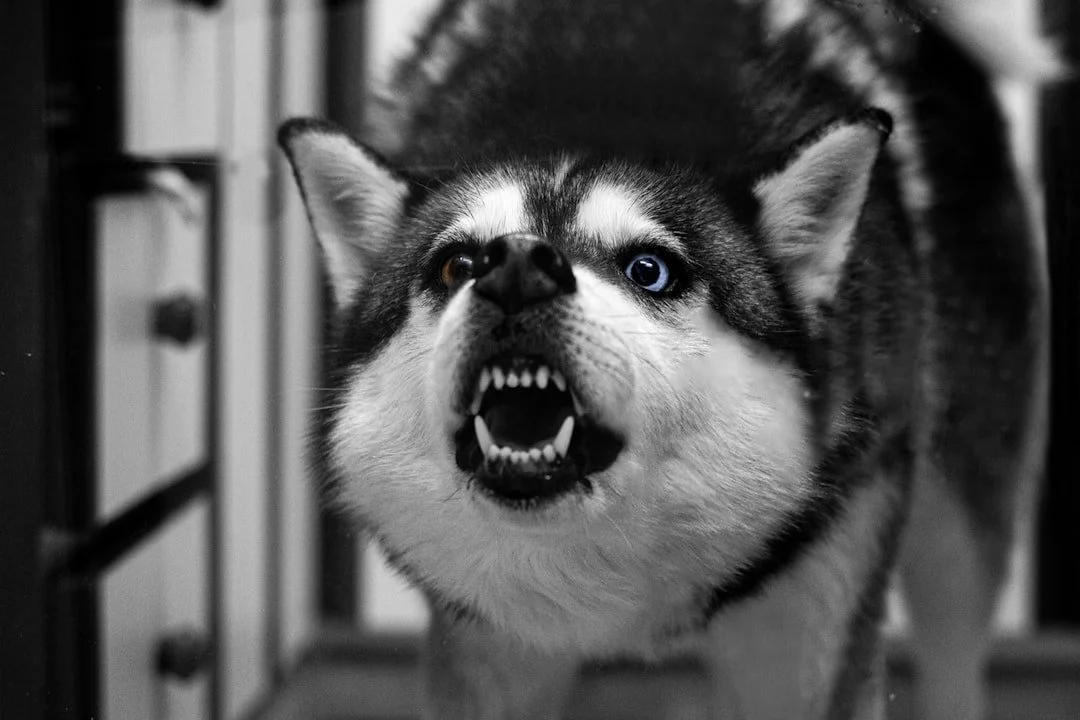
The Truth About Sending Your Aggressive Dog to Boot Camp
Is a Reactive Dog Boot Camp Actually Worth It?

A reactive dog boot camp is an intensive training program designed specifically to address behaviors like lunging, barking, and overreacting to triggers such as other dogs, strangers, or bikes. Unlike standard obedience classes, these programs focus on behavior modification, not just commands.
Here is a quick breakdown of what to know before you enroll:
| Question | Quick Answer |
|---|---|
| What does it address? | Lunging, barking, leash reactivity, fear based responses |
| Who runs it? | Specialized trainers with behavior modification experience |
| Main formats | Board and train, day program, group class, private lessons |
| Average cost | $4,000 to $7,000 for a board and train program |
| Duration | Typically 30 to 60 days for immersive programs |
| Biggest risk | Training does not transfer if the owner is not involved |
| Best outcome | Dog builds new habits and owner learns how to maintain them |
Most owners searching for a reactive boot camp are exhausted. The walks are stressful. Guests coming over feels like a hostage situation. You have watched the YouTube videos, bought the harness, tried the treats, and your dog still loses it the moment another dog appears down the street.
You are not imagining it. This is genuinely hard. And the promise of dropping your dog off somewhere for a few weeks and getting a calmer version back is very appealing.
But before you write a check, you need to understand exactly what these programs can and cannot deliver, how they differ from each other, and what your role is in making the results stick.
David Wright, founder of Blackwood Canine, experience with reactive dog boot camp style training started back in 2009 when I was working through dog to dog aggression with my own cane corso. That experience, followed by five years of apprenticeship under a seasoned professional, gave me a clear picture of where intensive programs work and where they fall apart. I will walk you through everything you need to evaluate your options honestly.
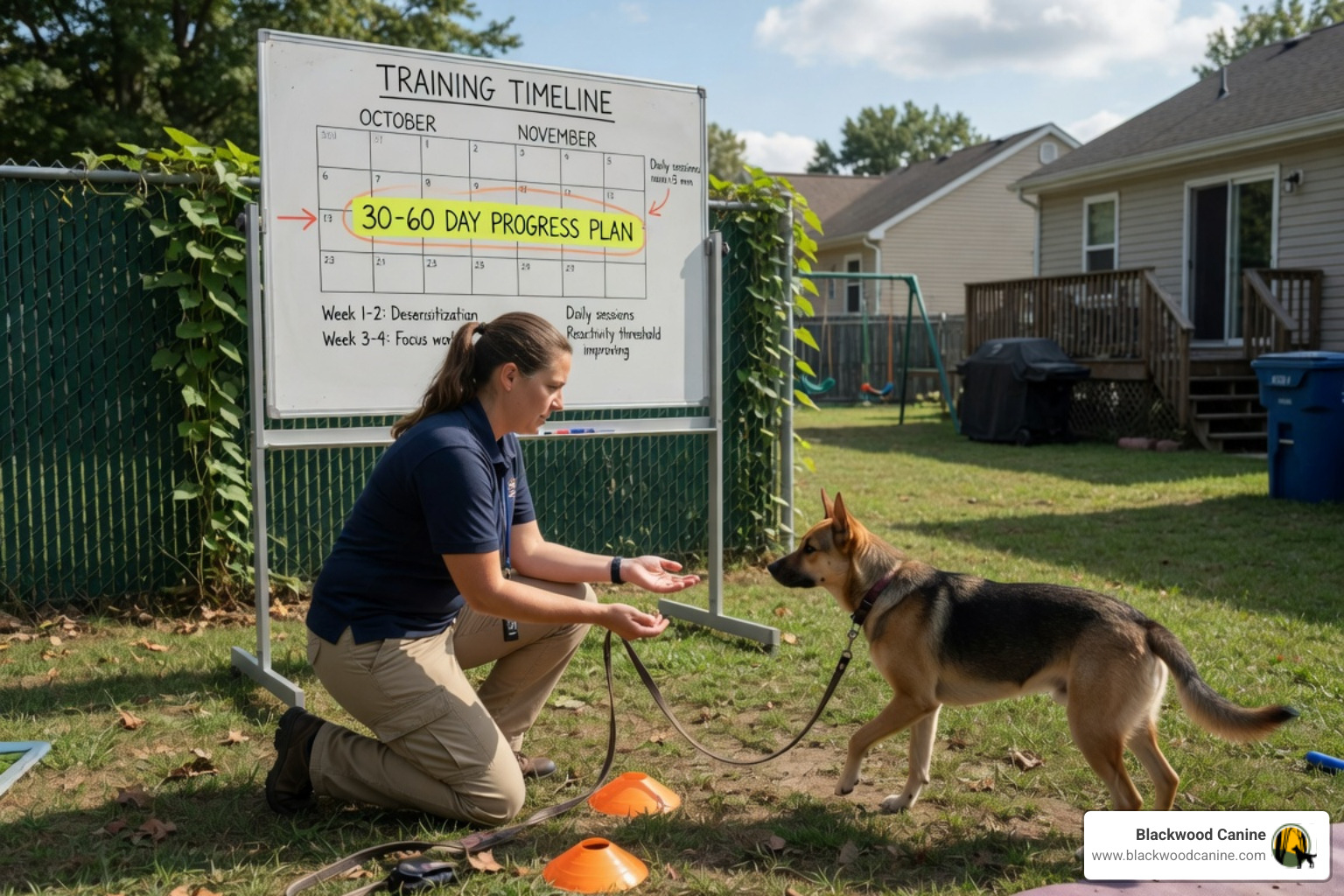
What Is a Reactive Dog Boot Camp and How Does It Differ From Obedience School?
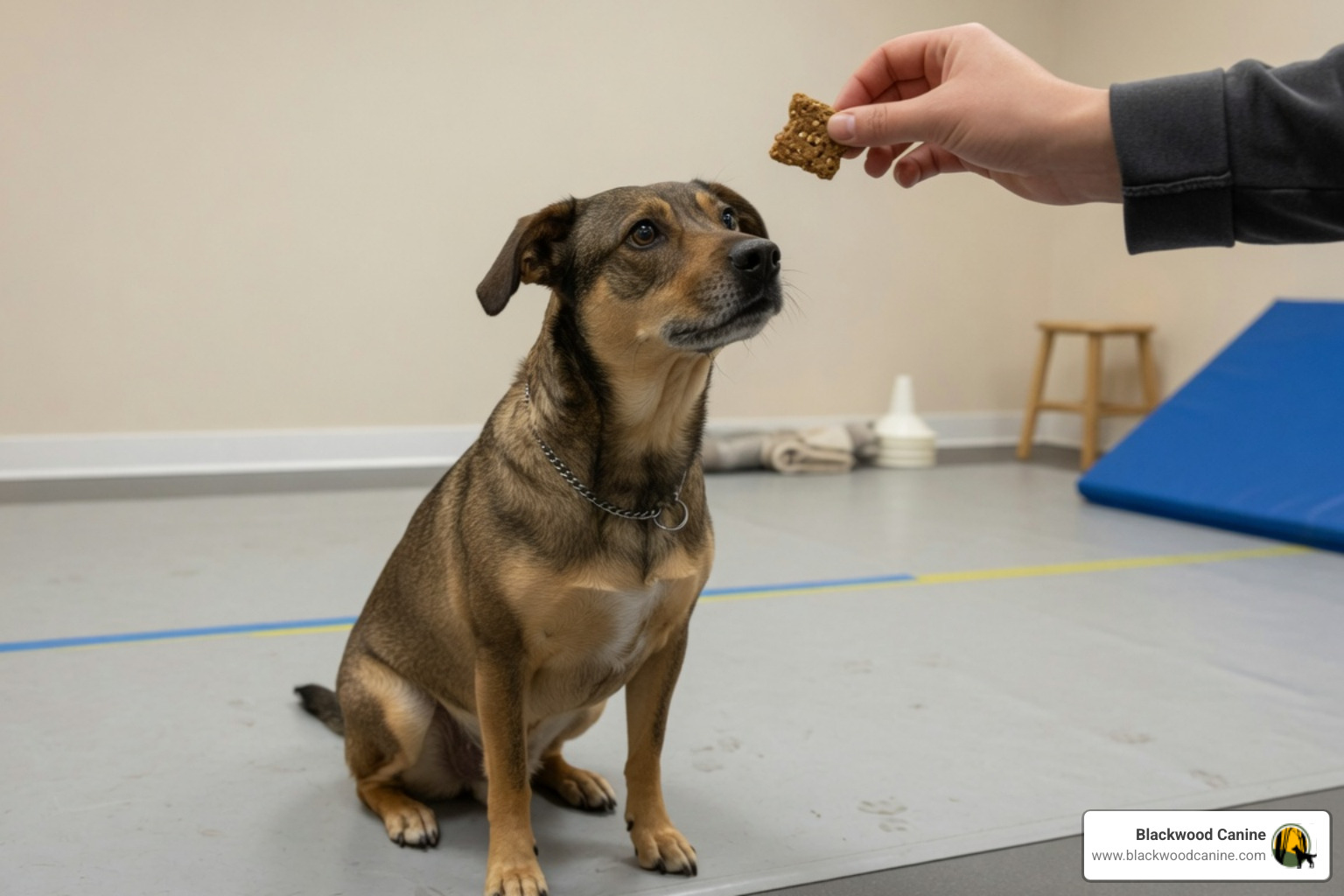
When your dog is barking and lunging at everything that moves, it is easy to assume they just need more obedience. You might think; if they only knew how to heel or sit on command, they would stop acting crazy.
But there is a massive difference between teaching a dog to perform a physical task and changing how that dog feels about its environment. A standard obedience school is designed to teach commands. A reactive dog boot camp is designed for behavior modification.
If you are looking for a deeper look at how immersive environments work, check out our guide on immersion dog training.
The Core Differences in Training Focus
Standard obedience programs focus on commands like sit, down, stay, and come. They operate under the assumption that the dog is in a calm, receptive state of mind.
A specialized program for reactive dogs focuses on the dog's emotional state and impulse control. We are not just teaching the dog to sit; we are teaching the dog how to exist in the presence of a trigger without exploding. This requires managing their arousal levels and building a communication system that works even when the dog is highly distracted.
For a detailed breakdown of what standard programs cover, read The Basics on Dog Boot Camp Programs.
Why Standard Obedience Camps Fail Reactive Dogs
Standard day school programs and basic obedience camps often exclude reactive dogs entirely. There is a good reason for this. In a standard camp, dogs are often trained in high energy, highly social environments. For a reactive dog, this is a recipe for overstimulation and trigger stacking.
Trigger stacking happens when a dog is exposed to multiple stressors in a short period. The dog might tolerate a barking dog, a passing car, and a stranger individually. But when they experience all three at once, their stress levels spill over, leading to an explosive reaction.
Standard obedience camps lack the structured management needed to keep a reactive dog under their threshold. Without clear communication and individual pacing, these environments can actually make reactivity worse.
To understand why standard setups are not built for behavioral issues, see The Ins & Outs of Dog Obedience School.
Evaluating the Formats: Board and Train vs. Day Programs vs. Private Lessons

If you live in Portland, Beaverton, Hillsboro, or the surrounding areas, you have a few different options for tackling your dog's reactivity. Let us look at how these training formats compare.
If you are considering an immersive option, you can read about 5 Good Reasons to Consider a Portland Dog Board and Train Program.
The Pros and Cons of a Board and Train Reactive Dog Boot Camp
A board and train program is the most intensive option. Your dog lives with a professional trainer for several weeks, receiving daily, structured training sessions in a controlled, neutral environment.
- Pros: The trainer can establish a strong behavioral foundation and set new habits quickly. They can control the environment, manage triggers precisely, and prevent the dog from practicing bad habits. This gives you a fresh slate when the dog returns home.
- Cons: These programs require a significant financial investment, typically costing between $3,000 and $5,000. Additionally, if the program is not paired with extensive owner education, the dog may behave perfectly for the trainer but return to their old habits the moment they step back into your living room.
For more help deciding if this path is right for your family, check out When Is Dog Boot Camp a Good Idea for Portland Pet Parents.
Why Group Classes and Daycare Environments Can Worsen Reactivity
Many owners think that because their dog is reactive to other dogs, they need more socialization. They sign up for a group class or drop their dog off at a local pet daycare.
This is a mistake. Socialization is a critical developmental window that occurs between 3 and 12 weeks of age. Once a dog is an adult, forcing them into close proximity with their triggers in a busy parking lot or a chaotic daycare room is not socializing them; it is flooding them.
Group classes often fail reactive dogs because the dogs never have a chance to decompress. They spend the entire hour reacting, which only rehearses the unwanted behavior.
To learn more about how reactivity develops and why standard environments fail, read Understanding and Transforming Reactive Dog Behavior.
The Power of Private Lessons for Handler Confidence
Private lessons offer absolute environmental control. Instead of sending your dog away, a trainer works with you one on one, teaching you the handling skills and mechanics needed to guide your dog through real world triggers in your own neighborhood.
This approach builds your confidence as a handler. You learn how to read your dog's subtle body language, how to use food and leash pressure clearly, and how to advocate for your dog when off leash dogs approach.
To see why many local families choose this route, read about the Top 6 Benefits of Private Dog Training Lessons.
How Reputable Camps Handle Stress and Overstimulation in a Reactive Dog Boot Camp
A high quality reactive dog boot camp does not just throw a dog into a room with other dogs and hope for the best. Reputable programs prioritize stress management, decompression, and threshold management.
For a deeper look at managing a reactive dog's stress levels, refer to our blog post on Understanding and Transforming Reactive Dog Behavior.
Structured Decompression and Crate Breaks
When a reactive dog enters a training facility, their cortisol levels; the hormone associated with stress; are incredibly high. A dog in a high state of arousal cannot learn effectively.
Reputable programs use structured decompression to lower these stress levels. This includes crate training and scheduled crate breaks throughout the day. The crate is not a punishment; it is a safe space where the dog can rest, process what they learned, and develop an off switch.
Between active training sessions, dogs need quiet down time to lower their heart rate and clear stress hormones from their system.
Controlled Exposure and Leash Neutrality
Training a reactive dog requires gradual, controlled exposure. We start in low stimulus environments, like a quiet indoor room with visual barriers.
We use distance management to keep the dog under their threshold; the point at which they lose control and react. If your dog reacts to another dog at fifty feet, we start training at sixty feet.
We also utilize neutral helper dogs. These are highly trained, calm dogs that ignore your dog's outbursts, allowing us to build leash neutrality safely.
You can learn more about how we structure these steps on our Behavior Modification Training page.
Training Methodologies: What Actually Works for Behavior Modification?
There is a lot of noise on the internet about dog training methods. Some advocate for purely positive reinforcement, while others promote dominance based training. The truth is, resolving severe reactivity requires a practical, balanced approach tailored to the individual dog.
We discuss these differences openly in Dog Training Methods: Positive Reinforcement vs Dominance Training.
The Role of Counter Conditioning and De Sensitization
The gold standard for changing a dog's emotional response is counter conditioning and de sensitization.
- De sensitization means gradually exposing the dog to their trigger at a distance where they do not react.
- Counter conditioning means pairing that trigger with something the dog loves, like high value food or structured play.
Over time, the dog learns that the appearance of a trigger predicts good things, shifting their emotional response from fear or frustration to calm anticipation.
To learn how to build this focus, see Building Engagement with Food.
Why Treats Only Redirection Is Insufficient for Severe Reactivity
While food is an incredible tool for building engagement, treats only redirection often fails when a dog's arousal levels spike.
If your dog is already lunging, barking, and spinning at the end of the leash, waving a piece of hot dog in front of their nose will not work. Their brain is in a fight or flight state, and they cannot process the reward.
True behavior modification requires a balanced approach that combines positive reinforcement with clear boundaries and fair consequences. At Blackwood Canine, we use a balanced training methodology. This means we pair high-value rewards with clear, humane communication tools—such as slip leads, prong collars, or electronic collars (e-collars)—to help the dog understand exactly what is expected of them. These tools are not used to punish, but to provide clear, low-level physical communication that cuts through the mental noise of a high-arousal state. The dog must learn that while calm behavior earns access to rewards, explosive behavior is not allowed. Practical management; like leashes, crates, and structured routines; ensures safety and consistency throughout this process.
The Importance of Veterinary Check Ups Before Training
Before you enroll your dog in any intensive behavior program, you must rule out physical pain or clinical anxiety.
Many sudden behavioral changes are fueled by undiagnosed health problems. If a dog is in pain, their threshold for stress is much lower, and their brain is not in a state to learn new coping skills. A comprehensive veterinary check up, or a consultation with a veterinary behaviorist, is a critical first step.
Generalization and Owner Transfer: Ensuring Success After a Reactive Dog Boot Camp
The biggest secret in dog training is simple: we train people, not just dogs. A dog can behave perfectly for a professional trainer at a facility, but if the owner does not change how they live with the dog at home, the behavior will regress.
If you are feeling overwhelmed by your dog's behavior, take a moment to read Stop Feeling Guilty About Your Reactive Dog.
Why Dogs Behave for the Trainer but Not the Family
Dogs are highly situational learners. They associate behaviors with specific people, environments, and cues.
A professional trainer has precise handler mechanics, consistent follow through, and calm body language. The dog quickly learns the patterns that work with the trainer.
When the dog returns home, they often fall back into old relationship dynamics with their owners. If the owner is nervous, inconsistent, or lacks clear communication, the dog will pick up on those cues and resume their reactive habits.
To understand the value of investing in your own education, read Is Private Dog Training Worth the Investment.
The Multi Step Transfer Process
A reputable boot camp must include a structured transfer process to transition the training to you.
This process should begin with owner coaching sessions where you learn the mechanics without your dog present. Next, you should practice in low pressure environments with the trainer guiding you. Finally, you should test your skills in real world settings, like a local park, to ensure you can handle triggers confidently.
You can read more about how we handle this transition on our Behavior Modification Training page.
Long Term Management and Consistency at Home
When your dog returns home, you must maintain a consistent routine. This includes:
- Establishing predictable feeding, sleeping, and training schedules.
- Setting clear boundaries, like keeping the dog off the furniture or crate training.
- Preventing the rehearsal of bad habits by blocking window views or using a leash indoors.
- Ensuring that freedom is earned through reliable behavior, not given unconditionally.
Consistency is not about being harsh; it is about making your expectations predictable so your dog feels safe and clear.
To learn more about building these long term habits, see our page on Advanced Re conditioning.
Program Logistics: Costs, Durations, and What to Look For
When evaluating a reactive dog boot camp, you need to understand the logistics and how to screen for a safe, reputable program.
Typical Costs and Durations of Reactive Programs
Behavior modification is a long term process; there are no quick fixes.
| Program Type | Typical Duration | Average Cost |
|---|---|---|
| Immersive Board and Train | 21 to 30 Days | $3,000 to $5,000 |
| Private Lesson Package | 6 to 12 Weeks | $800 to $1,800 |
| Specialized Group Class | 4 to 6 Weeks | $165 to $250 |
While a group class is the most affordable option, it offers the least amount of individual coaching and can be highly stressful for truly reactive dogs. Immersive programs offer the highest rate of initial success but require a larger financial investment and significant owner commitment during the transfer phase.
To help weigh these costs, read Is Private Dog Training Worth the Investment.
How to Evaluate a Reputable and Safe Boot Camp
Do not trust your dog's safety to just anyone. When screening potential training facilities in the Portland metro area, use the following checklist:
- Licensing and Insurance: Ensure the business is fully licensed, insured, and operating legally.
- Safety Protocols: Ask how they manage dog to dog interactions. Reputable facilities have strict double leashing policies, visual barriers, and do not allow uncontrolled group play for reactive dogs.
- Virtual Consultations: For dogs with human directed reactivity or a bite history, the initial consultation should be held virtually. This protects the trainer, the owner, and the dog from unnecessary stress and immediate trigger stacking.
- Trainer Credentials: Look for trainers with experience in behavior modification, canine ethology, and learning theory.
For more tips on finding a qualified professional, read How to Find the Right Portland Dog Trainer.
Frequently Asked Questions About Reactive Dog Boot Camp Programs
Can a boot camp fix severe leash reactivity or aggression?
A boot camp can establish a strong behavioral foundation, teach your dog healthier coping mechanisms, and lower their overall stress levels. However, it cannot permanently cure aggression or reactivity.
True behavior modification is a lifelong practice. The program gives you a fresh slate, but you must maintain the training, manage the environment, and follow through consistently at home to preserve those results.
Learn more about managing expectations on our Behavior Modification Training page.
Do reactive boot camps work with dogs that have a bite history?
Yes, many intensive programs work with dogs that have a bite history. However, these cases require strict safety protocols, including muzzle training and virtual assessments, before any hands on work begins.
If your dog has a history of severe human directed aggression, a standard boot camp is not appropriate; you will need a highly customized, specialist led program.
What happens if my dog regresses after returning home?
Regression is common if the home environment is inconsistent or if the owner stops practicing the daily routines.
Reputable programs offer follow up coaching, ongoing support, and clear guidance to help you get back on track. Consistency and clear communication are the keys to reversing regression quickly.
Ready to Reclaim Your Walks?
Living with a reactive dog is exhausting, but you do not have to navigate this alone. A reactive dog boot camp can be an incredibly powerful tool, provided you choose a program that prioritizes stress management, clear communication, and structured owner education.
At Blackwood Canine, we serve families across Portland, Beaverton, Hillsboro, Sherwood, Scappoose, St. Helens, and Vancouver, WA. We do not offer quick fixes or empty promises. Instead, we focus on clear communication, practical management, and consistent follow through to help you build a reliable, stress free relationship with your dog.
If you are tired of guessing and ready to build a clear plan for your dog, your next step is simple. Schedule a Good Dog Game Plan with us. We will look at your dog's behavior, your home environment, and what you have already tried, and help you decide what training approach actually makes sense for your family.
Your Dog Has More Drive Than Your Current Training Is Using
Blackwood Canine in Scappoose offers board and train programs and bitework sports intro for high-drive dogs. Serving Portland, Beaverton, Hillsboro and St. Helens.
Most dogs in the greater Portland area are getting walked, maybe thrown a ball, and called good. And for a lot of dogs, that actually is good enough. But some dogs are not most dogs.
If you have a dog that is constantly scanning the environment, that gets amped up fast and takes a while to come back down, that has a focus and intensity that makes other dog owners a little nervous at the park, that dog is not a problem. That dog is an asset. The question is whether you are giving them anything worth doing with it.
Blackwood Canine is based in Scappoose and draws clients from Scappoose, St. Helens, Portland, Beaverton, and Hillsboro. This summer, two programs are worth knowing about: board and train, and an introduction to bitework sports including MondioRing, French Ring, and PSA K9. Both are built for people who take their dogs seriously.
What "Enrichment" Actually Means for a High-Drive Dog
The enrichment conversation has gotten a lot of traction in mainstream dog training circles lately, and most of it is aimed at the average pet dog. Puzzle feeders, sniff walks, lick mats. Good tools. Not what we are talking about here.
For dogs with real working drive, enrichment means something different. It means giving the dog a job that is actually hard enough to satisfy them. Something that requires focus, physical engagement, environmental confidence, and the kind of mental output that leaves them genuinely spent at the end of it. Not just tired. Done.
The dogs that end up in protection sports are not there because their owners wanted a scary dog. They are there because their owners figured out that their dog needed a real outlet and a regular one, and that obedience class was not going to cut it. The sport is the enrichment. It is just a much more sophisticated version of it.
Board and Train: What It Is and Why It Works
If you have been on the fence about board and train, here is the honest version of what it is and what it is not.
It is not a magic fix. Your dog does not go away broken and come back perfect. What it is, is an intensive period of focused work with an experienced trainer who is working with your dog every single day, in a variety of contexts and environments, building skills through repetition and consistency at a pace that weekly lessons cannot replicate. The progress in two or three weeks of board and train typically represents months of work in any other format.
For dogs with working drive, board and train does something specific that is hard to achieve otherwise. It establishes a training foundation under real distraction and pressure. A high-drive dog needs to learn to work through arousal, to hold obedience when things get interesting, to come down from a heightened state and still be functional. That takes time and repetition and the kind of daily immersion that a board and train provides.
It is also a practical fit for a lot of the households that come to Blackwood. If you are working, you are coaching your kid's summer sports, you have a trip coming up and need boarding anyway, board and train uses that window productively. Your dog is working while you are living your life, and you come back to a dog that is measurably further along.
fBitework Sports: MondioRing, French Ring, and PSA K9
This is the part that people who have not seen these sports tend to have questions about, which is fair. Protection sports have a reputation in some circles that does not match what the sports actually are. So here is a straight explanation.
MondioRing, French Ring, and PSA K9 are competitive dog sports that combine obedience, agility, and protection work. The dog works through a series of exercises that are judged on precision, control, and the dog's overall character. The protection component involves trained bitework on a decoy wearing a bite suit. This is not aggression. It is a highly controlled, drive-based game that the dog finds intrinsically rewarding. The out, the recall, the control through the exercise, all of that is what the sport is actually testing.
MondioRing is the broadest and arguably the most demanding. It draws from French Ring, Belgian Ring, and Schutzhund, and no two trials look the same. The judge sets the scenario and the dog is expected to work through it cleanly, off leash, under significant distraction. The obedience and control required at the upper levels is genuinely impressive to watch.
French Ring is the older discipline, originating in France in the early 20th century. The protection exercises at the higher levels are technically demanding and favor dogs with real courage and handler connection. The decoy in French Ring is actively working to make the dog miss. It is not a cooperative exercise.
PSA K9 is perhaps the most scenario-based of the three. Protection Sports Association trials incorporate real-world contexts, multiple decoys, and environments that change from event to event. The obedience foundation required to pass even the early levels is substantial.
What these sports have in common is that they require a dog with genuine character: sound temperament, high drive, and the ability to be controlled under significant stimulation. They also require a handler who is willing to put in the work. These are not casual hobbies. They are serious commitments that produce dogs with serious capabilities and a handler-dog relationship built on genuine trust and communication.
If your dog has drive and you have been wondering what to do with it, this is the answer.
Who This Is For
The people who tend to find Blackwood Canine are not looking for a pet obedience class. They are people who want a capable dog. A dog that is reliable off leash, that has real impulse control under pressure, that can be taken anywhere and trusted. A dog that reflects the work that went into them.
Some of those people are current or former law enforcement or military. Some are just dog people who ended up with a working breed and realized they needed to actually work it. Some are competitive by nature and the sport aspect is part of the draw. Most of them share a certain respect for what dogs are actually capable of when given a real framework to operate in.
If that sounds like you, you are in the right place.
Making Summer Count
The summer window is a real one. Longer days mean more training time. If you are already planning to travel and need somewhere for your dog to go, that window is a board and train waiting to happen. If you are local all summer and your high-drive dog has been running you ragged, now is a good time to start building something.
Blackwood Canine works with clients from Scappoose, St. Helens, Portland, Beaverton, and Hillsboro. If you have questions about whether your dog is a good fit for the board and train program or the bitework sports intro, schedule an evaluation. The first conversation is just a conversation.
Your dog has the drive. Give it somewhere to go.

Spring Is Here, and So Is Every Dog Your Dog Hates
Spring brings out every dog in the neighborhood, and yours has feelings about it. Here's why reactivity spikes in spring and what to actually do about it.
The weather in Beaverton finally breaks, the sun comes out, and suddenly the whole neighborhood remembers they have dogs. Kids are back outside. Neighbors are on their front porches. The guy down the street with the off-leash Lab is back in full effect.
And your dog? Your dog has opinions about all of it.
Spring is one of the hardest times of year for dogs with reactivity issues, and it is not a coincidence. After a winter of limited exposure, low-stimulation walks, and a neighborhood that was almost a ghost town, the world just got loud again, literally overnight. Here is what is actually going on and what you can do about it.
Why Spring Makes Reactivity Worse
Your dog did not forget how to be reactive over the winter. If anything, the quiet probably made it worse.
Reactivity is largely a stress response. When dogs are not regularly exposed to the things that trigger them in a manageable way, their threshold gets lower. That means a dog who was doing okay in October might come out in April ready to lose their mind over a Golden Retriever from 50 feet away.
Add in the fact that spring brings a genuine increase in environmental chaos - more people, more dogs, more excited kids, more unpredictable movement - and you have a dog whose nervous system is genuinely overwhelmed. The season is not giving them any time to adjust.
It also does not help that after months of mostly low-key walks, you are probably excited to finally be outside again too. That energy is real, and dogs pick up on it. If you are amped, your dog is amped.
Your Dog Is Not Being Bad. But You Still Have to Manage It.
Let's just say this plainly: a reactive dog is not a bad dog. They are usually a stressed dog, an under-socialized dog, or a dog that learned at some point that barking and lunging is a great way to make scary things go away. That is a training and management problem, not a character flaw.
That said, "my dog is not bad" does not mean you get to stop managing the situation. A 60-pound dog having a meltdown on leash is stressful for you, stressful for your dog, and genuinely unpleasant for the people around you.
Spring is a good time to reset your expectations and your routine. Your dog may need some warm-up time before they are ready to handle a busy trail or a crowded park. That is okay. Start small and work up.
Practical Things to Do Right Now
You do not need to overhaul your entire training program to get through the next few weeks. Start here.
Go back to easier environments first. If you spent the winter walking the neighborhood, try a quieter route, an empty parking lot, or a side street with less foot traffic. Let your dog decompress and remember that the world is ok before you throw them back into the deep end.
Increase your distance from triggers. Reactivity almost always has a threshold distance - the point at which your dog can no longer handle it. Right now, that distance is probably bigger than it was six months ago. Respect it. It’s fine. You can always close the gap later but you cannot un-ring the bell once they have already blown up.
Watch your own body language. When you see a trigger coming, most people tighten the leash, shorten their stride, and hold their breath. Your dog is watching all of that. Practice staying loose with a slightly draped leash, normal pace, calm breathing. It sounds simple but it is surprisingly hard to do.
Reward heavily for check-ins. Any time your dog looks at something stressful and then looks back at you, that is a big deal. Mark it and pay for it generously. That behavior, engaging with you instead of fixating on the trigger, is the foundation of almost all reactivity work. The more you reward it, the more you get it.
Do not wait for the meltdown to intervene. Most people let a reactive dog escalate until they are already barking and lunging before they do anything. At that point, it is too late for the walk to be productive. Learn to read your dog's early stress signals, including stiffening, hard stare, tail change, ears forward, hackles up, etc. and redirect before they hit the wall.
What to Do When It Goes Wrong Anyway
Sometimes you turn a corner and there is a dog fight happening right in front of you, or a kid comes sprinting out of nowhere, or someone's off-leash dog comes barreling over before you can do anything. It happens. Here is how to handle it without making things worse.
First, get out. Your only job in that moment is to create distance. Turn around, cross the street, duck into a driveway. Do not stand there trying to manage the situation from ten feet away. Move first.
Second, do not emotionally punish the reaction. Yelling at your dog, popping the leash unfairly, or doing anything out of anger while they are already in a stress response does not teach them anything useful. It just adds to the overall chaos and makes them more likely to react next time, because now the trigger plus the thing that scared them is a package deal.
Third, take a beat before continuing the walk. If your dog has a big reaction, do not immediately try to resume. Let them settle. Give them a chance to come back down before you keep going.
And yes, sometimes the right call is to just go home. A short walk that ends before it becomes a disaster is more productive than a long walk that ends in a meltdown.
When to Call a Professional
If your dog's reactivity is making walks genuinely unmanageable, or if the behavior is escalating rather than staying steady or improving, it is time to get help. Not because something is wrong with you or your dog, but because reactivity is one of those things that really does respond well to professional training and really does not respond well to just thoughts and prayers.
Look for a trainer who is experienced with reactivity specifically and who uses science-based methods.
If you are in the Beaverton area and looking for support, we’re here for you. We work with reactive dogs regularly and we can help you build a realistic plan that actually fits your life.
Spring is a season your dog can learn to handle. It just takes some patience, some management, and a willingness to meet them where they are right now, not where you wish they were. The good news is that most reactive dogs make real progress when they get consistent support. Yours can too.

Why Portland Dogs Get More Reactive in January and How to Reset Your Walks Fast
If your dog’s reactivity spiked after the holidays, you’re not alone. It’s one of the most common issues Portland dog owners face in January. At Blackwood Canine, we specialize in reactive dog training that reduces barking, lunging, and anxiety using clear structure and proven methods. Serving NE Portland, SE Portland, and the greater metro area. Schedule a reactive dog assessment today.
If your dog has been extra reactive since the holidays, you’re not imagining it. January is the peak season in Portland for leash reactivity, barking, lunging, pulling, and general “my dog is losing it” behavior.
At Blackwood Canine, we see the pattern every year, especially in shepherds, pitties, doodles, heelers, and rescue mixes. The holidays throw your dog’s nervous system out of balance, and the reactivity that follows isn’t stubbornness… it’s physiology.
The good news: reactive behavior can be reset.
The even better news: it happens faster than most owners expect.
Why Portland Dogs Become More Reactive After the Holidays
Reactivity isn’t a personality flaw, it’s a stress response. And the holiday season loads up stress from every direction:
1. Routines Get Destroyed
Walk times change.
Bedtimes shift.
Guests come and go.
Energy in the home spikes.
Dogs lose predictability and predictable patterns = emotional stability.
2. Environmental Stress Adds Up (Especially in Portland Winter)
Rainy days → fewer walks.
Crowded sidewalks → less space.
Early darkness → jumpier dogs.
Staying indoors more → pent-up energy.
Reactive dogs need structure more, not less, in winter.
3. Holiday Social Overload → Delayed Fallout
New people, new dogs, new houses, kids on break, noise, excitement, nervous systems often react after the chaos dies down.
This is called delayed sensitization, and it’s incredibly common with reactive dogs.
4. Accidental Reinforcement Happens Constantly
It’s not your fault but it matters:
Someone let your dog rush the front door.
A guest “comforted” anxious barking.
The kids played chase in the house.
A relative laughed at the lunging on leash.
One or two slip-ups can undo weeks of progress.
5. Less Exercise + More Cortisol = Shorter Fuse
When physical and mental outlets drop, stress hormones rise, which lowers threshold and increases reactivity.
How to Reset a Reactive Dog in January (Portland Edition)
This is the exact formula we use with reactive dogs at Blackwood Canine to bring them back into balance fast.
1. Rebuild Predictable Structure Immediately
Reactivity thrives in chaos.
Confidence thrives in structure.
Re-establish:
consistent walk schedule
crate or rest time
food routines
obedience before privileges
clear household rules
The nervous system calms through repetition.
2. Switch to Decompression Walks for 3–5 Days
Not hikes.
Not dog parks.
Not busy neighborhoods.
Choose:
quiet streets
wide paths
lower foot traffic
calmer environments
A decompressed brain is a trainable brain.
3. Limit Exposure to Triggers Temporarily
This isn’t avoidance, it’s recovery.
If your dog is already flooded with stress, throwing them into “practice reps” too soon only makes reactivity worse.
Give the system room to settle.
4. Re-Establish Leash Rules
Reactivity starts at home before you ever hit the sidewalk.
Focus on:
slow threshold exits
calm door routines
zero rushing to windows
heel or structured walk patterns
reduced freedom until they’re stable again
Your walk begins the moment the leash comes out, not when you step outside.
5. Rebuild Engagement & Handler Focus
Reactive dogs don’t need “more corrections,” they need more clarity and more orientation to you.
Use:
food engagement
marker training
simple drills
pattern games
movement-based rewards
Reactivity fades when your dog trusts the direction you’re giving.
6. Call in a Professional If Reactivity Jumped Suddenly
Any major spike, barking harder, lunging faster, reacting sooner, means your dog needs support now, before it cements into a habit.
Blackwood Canine specializes in reactive dog training across Portland.
We focus on:
emotional regulation
handler-dog communication
nervous system stabilization
building confidence
teaching dogs to make calmer decisions
Your dog isn’t “aggressive.”
They’re overwhelmed.
And that is fixable.
Reactivity Is Not Who Your Dog Is, It’s How They’re Coping
Holiday regression feels dramatic, but it’s temporary and solvable.
A few smart adjustments now can change your dog’s behavior for the rest of the year.
You don’t need perfect walks, just better ones.
And that starts with a clear reset.
If your dog is more reactive, anxious, or unpredictable on walks since the holidays, we can help. Blackwood Canine works with reactive dogs all over Portland, offering clear, structured, proven training that rebuilds calm and reduces reactivity fast.
Schedule a reactive dog assessment and start your dog’s reset today.

Stop Feeling Guilty About Your Reactive Dog (You Didn’t Break Them)
Reactive dog? You didn’t cause it, and you can fix it. Learn why dog reactivity and dog aggression aren’t your fault, and how Blackwood Canine’s training gives you solutions, not shame. conveniently located dog trainers in Scappoose, offering best dog training in Beaverton, dog training in Hillsboro and most experienced and best dog trainer in Portland for your dog reactivity and dog aggression cases.
If your dog loses their mind at the sight of another dog, lunges on leash like they’re auditioning for a Marvel stunt double role, or seems to carry an extra suitcase of “big feelings,” you’ve probably heard it before: “You must have done something to cause this.”
Let’s stop that right here. Dog reactivity is not a scarlet letter for bad ownership.
Dog Reactivity Happens. Full Stop.
Some dogs are just wired differently. Genetics, early environment, lack of proper socialization, or even one bad experience can flip the switch on reactivity or aggression. You didn’t create that wiring any more than you created your own genetic make up and childhood.
And here’s an important reminder, dogs don’t live in the land of blame. They live in the land of right now. That’s the beauty of dogs. Understanding that knee jerk reactivity is a learned behavior, a literal reaction, and most usually not a calculated choice, is helpful in moving forward towards a solution and management plan.
You’re Not Responsible for Your Dog’s Emotions
This is the part many owners struggle with. Your job is not to manage your dog’s feelings like a canine therapist. It’s to provide structure, leadership, and training so your dog learns new behaviors to replace the chaotic ones.
You can’t stop your dog from feeling anxious about the Labrador across the street. But you can absolutely train them to control the behavior that follows. That’s where training dog reactivity stops being about shame and starts being about skill.
Habits can be reinforced.
Habits are created from repetition.
That’s it.
That’s the secret sauce.
Training Dog Reactivity Is About Solutions, Not Blame
At Blackwood Canine, we specialize in working with dog reactive dogs and dogs showing early signs of aggression. We’ve seen the whole spectrum: from leash drama that looks like WWE Smackdown (hi, 90’s kids here…) to the subtle growler who “just needs space.”
Our approach isn’t about coddling or guilt-tripping. It’s about building confidence, for you and your dog, through proven training methods that get results.
Let’s Rewrite the Story
Dog aggression or reactivity doesn’t mean your dog is broken, and it sure as hell doesn’t mean you failed. It means you have an opportunity to step up, learn the skills, and give your dog the structure they need to thrive.
So the next time someone tries to tell you that your dog’s reactivity is your fault? Smile politely and know better. Because you’re already on the road to fixing it. With us.
Ready to move past the guilt and into real training? Contact Blackwood Canine today. Let’s get you and your dog unstuck. We provide dog training in Beaverton, dog training in Hillsboro, and dog training in Portland area, while we are dog trainers in Scappoose, OR. A beautiful scenic drive to our property for training or we can come to you.
Looking for referrals?
We got you.
For Virtual Lessons anywhere, check out The Driven Dog.
For our Denver area friends, our dog training friends at Synergetic Canine is your answer.
For Detroit and Ann Arbor area dog training needs, we have Joey Luke’s Dog Training.
In the SF Bay Area, check out new and upcoming SF dog trainer Grimm & Co.
In the San Diego Area, we’ve got Howlcraft K9.
and for our LA dog trainer needs, we always recommend iWorkDogs.
Blog post written by So Fetch Consulting.


If I Can’t Be a Dog Trainer, Count Me Out
If I can’t be a dog trainer, I don’t want to be anything else. Discover why dog training for dogs in Beaverton, ORis my one true calling.
Let’s be clear. If I can’t spend my days knee deep in dog training, especially training Belgian malinois, training German shepherds, or just dog training dogs, then what’s the point? Seriously. Some people dream of corner offices, others fantasize about being influencers with discount codes for teeth whitener. Me? I’d rather be in a big green grass field in Beaverton, OR, teaching dogs (and their humans) how to live their best, least-chaotic lives, ever.
Because here’s the thing - dog training isn’t just “sit, stay, roll over.” It’s art, science, and a little bit of intuitive magic rolled into one. Dog training for dogs is about giving families deeper understanding and respect for their dogs, peace in their homes, helping dogs thrive with structure, and saving sanity one leash pull at a time.
I love it so much that the thought of doing anything else makes me break out in hives (not like, literally though, don’t worry). Filing paperwork all day? Nope. Staring at spreadsheets that don’t involve a training schedule? Hard pass. Explaining quarterly reports in some fluorescent-lit conference room? I’d rather wrestle an 80 lb malinois in my bite suit. It’s SO fun!
In my local Columbia County, people ask me all the time, “Why dogs?” My answer: Why not dogs? Dogs don’t lie. Dogs don’t ghost you. Dogs don’t send passive-aggressive emails. They show up, tail wagging, ready to learn and when you nail the training, they give you the best kind of feedback. A calm, balanced, happy life by your side, ready to go.
So yes, dog training for dogs is my hill to die on. If I can’t do this, I don’t want to do anything else. Because once you’ve seen the transformation - once you’ve turned chaos into calm - you’ll get it. And you’ll never settle for less, either.


Understanding and Transforming Reactive Dog Behavior: What You Need to Know
Dog Behavior Modification for dog reactive dogs, leash reactivity, and anxious dog training programs.
If you have a reactive or anxious dog, you already know how overwhelming and emotionally draining daily life can feel. Walks become high-stress events. Visitors at the door - a stress ball of a nightmare. Even simple outings like vet visits or car rides can spiral into barking, lunging, and full-blown panic. That anxiety tensing up in your chest - not pleasant at all.
You’re not alone, and your dog isn’t broken. At Blackwood Canine, we believe behavior issues are a communication breakdown, not a lost cause. With the right dog behavior modification plan, reactivity training, and expert guidance, you CAN help your dog feel more confident and in control.
What Is Dog Reactivity, Really?
Reactivity isn’t “bad behavior.” It’s a symptom of underlying stress, fear, or frustration. Some dogs bark and lunge because they’re trying to protect themselves. Others are overexcited, overstimulatd and don’t know how to regulate. Regardless of the cause, the result is the same: a dog that’s difficult to manage, and an owner left feeling helpless, judged, and even isolated. There’s also the genetic component, that we’ll touch on another time (because complicated!).
We hear these pain points every day:
“I’m embarrassed to walk my dog.”
“People think I’m a bad owner.”
“I’ve tried training before, but nothing worked.”
“I just want to enjoy my dog again.”
This is where a structured approach to dog behavior modification makes all the difference.
What Effective Reactivity Training Looks Like
It’s not about slapping a tool on and praying for the best. It’s about building trust, reducing stress, and reshaping patterns of behavior through consistency, timing, and clear communication.
At its core, reactivity training helps your dog:
Process triggers without panicking
Build focus under pressure
Learn self-regulation skills
Rebuild confidence through calm exposure and rewards
Whether it’s leash reactivity, barrier frustration, or generalized anxiety, we target the WHY behind the behaviors, not just the what. We don’t believe in band aid fixes here.
Why "Stop Barking" Isn’t the Whole Story
We get it, if you’ve Googled ‘how to stop dog reactive barking’, you’re desperate for results. You’ll find a whole lot of bucket of confusing and conflicting answers and they’re all correct, and yet they’re also all wrong. But stopping the noise doesn’t fix the root problem, anyway. In fact, quick fixes that suppress barking without addressing fear or over-arousal can actually make things worse longterm.
Our approach to anxious dog training doesn’t just manage symptoms, it transforms behavior from the inside out, giving your dog tools to handle the world more calmly and giving YOU the tools to guide them through it.
The Blackwood Canine Difference
While this blog isn’t about pitching our services, we will say this: our results-driven, reality based methods are designed with real life in mind. We meet you where you’re at, whether that’s your first time working with a trainer or your tenth, frustrated attempt after being ghosted by yet another program.
Reactive dog owners need more than obedience, they need understanding, strategy, and a support system that won’t sugarcoat things. That’s where we come in. If you know us, you know and trust our honesty.
Struggling with your dog’s behavior doesn’t make you a bad owner, it makes you human. And if you’re ready to move beyond management and toward transformation, you’re already one step ahead. Pat yourself on the back and take the next steps.
If you’re searching for a sustainable path forward with dog behavior modification or reactivity training, start by working with someone who sees the whole picture.
We’re here when you’re ready.


Chaos & Cuteness Incoming: This Portland Dog Trainer is Getting a New Puppy!
We’re getting a puppy! And yes, even professional dog trainers can feel nervous about it. Even with all our experience and know how, a lack of energy and time is a lack of energy and time, and no amount of experience can control a puppy’s bladder!
It’s (mostly) official. This seasoned Portland dog trainer, who has helped more puppies than I can count to become model canine good citizens, am about to get another puppy of my own. Again. And yes, I’m equal parts excited and terrified.
First. This is going to be a puppy for Eamon, who tragically lost his best friend last year. We have waited and feel this is the right time for him to have a new best buddy. We will be getting another Miniature American Shepherd from Rebel Souls Minis. The pressure felt by this mama, of selecting not only the PERFECT puppy (spoiler: doesn’t exist) for my kid, that will bond with him the way our previous Peach did, BUT without feeling like a replacement, so to speak… is high.
So, if you’re a dog lover in Beaverton (hey neighbor!) or a woman with a packed calendar, a Pinterest board full of puppy cute and a vague sense of “wtf, can I even do this right now??” - Welcome! Come send me a message, because you’re my people and no one wants to feel alone in their worries!
The Puppy Fever is REAL.
You know. You’re minding your business, sipping your coffee, and then boom. Your breeder friend posts a litter photo. You start smelling the puppy breath, the adorable nose twitches, the soft snores, a new cuddle buddy when you’re staying up watching The Last of Us…
Of course, as a new puppy training expert, I knew better. That “dream” includes 3 am potty breaks, surprise puddles on the floor, and a teething gremlin to terrorize the kids and their favorite toys that can’t be picked up quick enough.
I’m still doing it.
Puppy Housebreaking: The Sweet and the Sour.
Let’s talk about puppy housebreaking. Because that’s what everyone really wants to know about. Will it be easy for me because I’m a dog trainer? Yes and No.
Sure, I’ve got the know how. But housebreaking isn’t about magical skills. It’s about consistency, patience, a schedule and a crap ton of paper towels and who has paper towel money these days!? Even the best trainer can’t out schedule the baby bladder.
If you’re in Beaverton or Portland and staring down a new puppy purchase (or an impulse one - we see you too!), remember this: Accidents aren’t a failure. They’re a phase. One you’ll look back on fondly… eventually. And we have a great puppy housebreaking resource for you! Just don’t ask me if I plan on taking my own advice...
Hopeful Chaos: Why It’s All Worth It
Despite knowing what’s ahead - the lost sleep, the puppy biting, the early training sessions in the rain - I’m giddy. There’s something undeniably magical about watching a young dog learn, grow and bond with you. And exceptionally joyful watching it happen with your kid.
And for my clients, especially the mamas juggling jobs, kids, errands - I get it. Adding a puppy to the mix can feel like adopting chaos with intention. But it’s a beautiful kind of chaos. The kind that pulls you outside in the morning dew when it’s quiet and smells like sunrise. That makes you laugh when your dog runs zooms around your kids and the uncontrollable giggles fill the house. That reminds you to slow down and just be…
Ready, Set, Puppy
So yes, this Portland dog trainer is gearing up. I’ve got the crate ready, treats picked out, a plan in place and zero delusions. It’s going to suck for a hot minute. My life will be messier and louder. But also. A whole lot sweeter.
If you’re considering a new puppy and you’re in Portland or Beaverton area, know this - you’re not alone. We can help. You can do this.
Bring Back the Classics!
Thrilled to welcome the trend of returning to the classic good boy breeds, like labradors, golden retrievers and shih tzus! Makes our dog training lives so much easier to help folks with their family companions truly be the best furry best friend around.
For a while there, “rare” and “exotic” breeds of dogs, like the Chinese Red Dog, the Thai Ridgeback, the Coton de Tulear, Lagottos, Malinois (wait are they even rare anymore?), Tibetan Mastiffs, Ovcharkas and Gamprs… they were all turning into too much of a known breed name. They’re rare for a reason! They don’t always make easy pets in our normal chaotic, busy lifestyles. They could be naturally defensive, need a lot of space, or just a lot more structured breed specific work than the average dog lover could reasonably offer. And it was causing chaos. A lot of grief to these well intentioned homes, and the humans and dogs were suffering.
What we as dog trainers are LOVING right now, is the trend to return to classics! Bring back the super common, but for great reason, family friendly breeds! The fat chunky labradors, the ever happy golden retrievers, the absolutely delicious companion shih tzus. Bred for generations to be loyal, loving companions - they’re totally tried and true!
These classic breeds are the total “Yes, Chef” dogs. They’re eager to please, motivated by a lot, and don’t hold grudges. Their issues are typically annoying or naughty at best, but not usually unsafe to the general public or dangerous. Pair them with some private lesson training or a full immersion training and you’ve got a rock star that everyone is enamored by and jealous of!
One of the biggest problems of the rare breed trend was simply that most people chose them for the rarity, or wow factor alone, without knowing full well what they were truly getting into. The truth is, some of those breeds were never meant to be pets. They were meant to guard country borders, hunt lions or protect large castles. Which - those tasks just aren’t that common here in Portland?! So folks are getting these rare, exotic breeds and thinking if they just raise them right, as a puppy, they’ll be just fine. Spoiler alert - no.
Go with a good ol’ classic breed from a reputable dog breeder, and you’ve got it made. I’m not saying Labrador puppies aren’t going to test your patience, they will. But they are predisposed to want to work with you. Not the other way around. A golden retriever puppy started in private puppy training lessons or enrolled in our Puppy Jumpstart Program will have learned sit, down and shake before you can finish hand grinding your local sourced coffee beans for your pour over.
If you’ve recently welcomed one of these classic breeds into your home and need help with puppy training, basic manners, or just making sure they don’t develop a taste for your dirty socks, we’re here to help. Our immersion board and train program and private lessons are tailored to set you and your dog up for success.
Because at the end of the day, I’m just glad we’re all back to appreciating the OG good boys and girls. Truly, it’s way easier to make a Good Dog Gooder than a Bad Dog Less Terrible.
Blog Post by Karin at So Fetch Consulting.