
Why Your Dog Loses It (And How Counter Conditioning Fixes That)
Dog training counter conditioning is the process of pairing a scary trigger with something your dog loves, like chicken or cheese, until their gut reaction flips from fear to anticipation. Instead of suppressing the panic, it rewires the emotional response underneath it. That is the short version. Here is why it works.
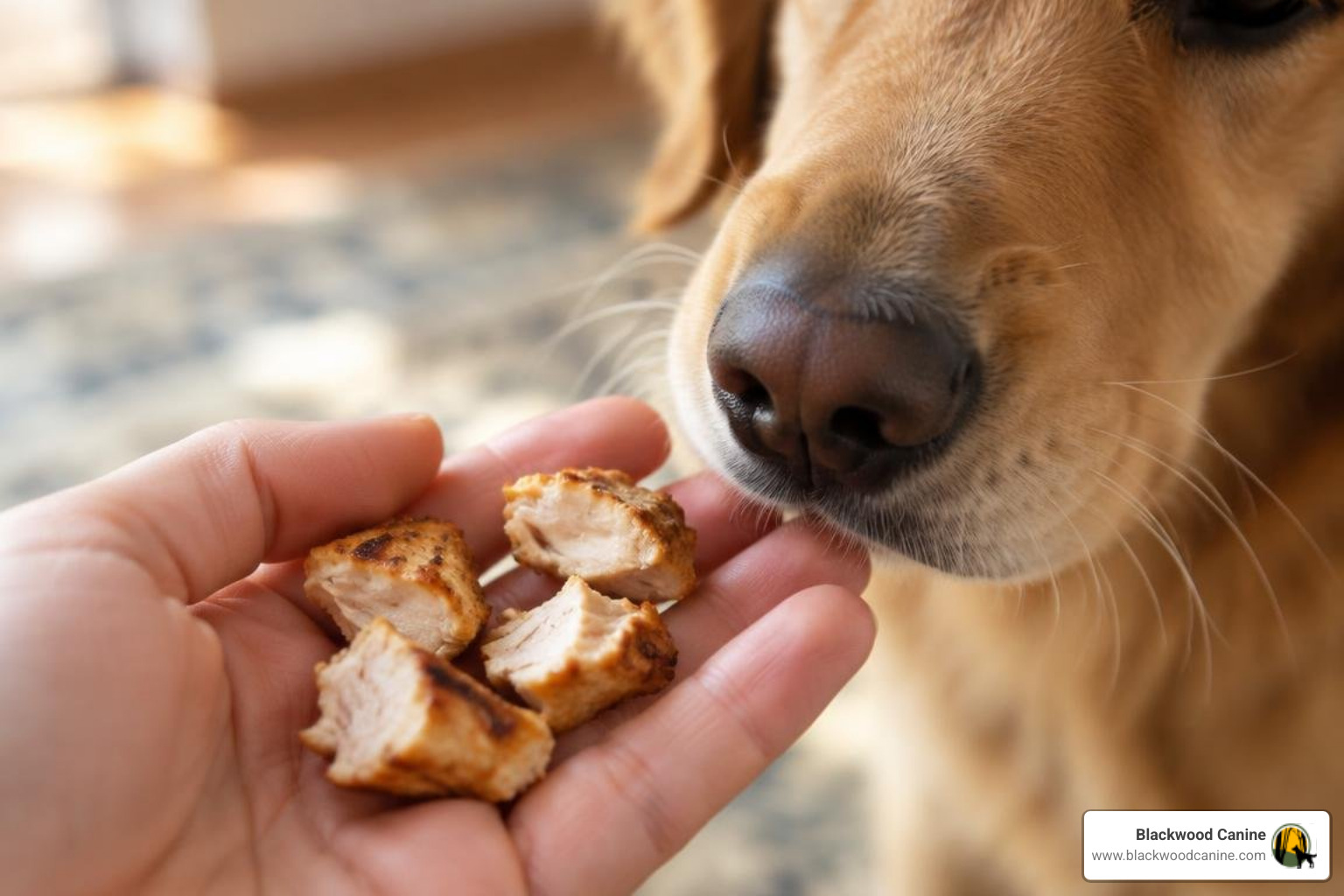
When a dog loses their cool at the sight of a postal truck, another dog, or a stranger wearing a bulky winter coat, they are not sitting down plotting how to ruin your neighborhood stroll. That explosive reaction is an involuntary physiological event. The brain perceives a threat, the amygdala fires, stress hormones flood the system, and your dog enters a fight or flight state before their thinking brain can even weigh in.
This is where Pavlovian associative learning comes to the rescue. In practical application, dog training counter conditioning is the intentional process of pairing an established negative trigger with a positive outcome. Over time and repeated repetitions, this shifts the internal emotional reflex. Instead of feeling sudden dread or defensive panic, your dog begins to anticipate safety and reward.
The goal is not simply to suppress an outward symptom. The goal is creating a genuine conditioned emotional response where your dog sees the trigger and immediately thinks that great things are about to happen.
| Feature | Systematic Counter Conditioning | Flooding Technique |
|---|---|---|
| Exposure Level | Controlled, gradual, and strictly sub threshold | Full force, sudden, and high intensity |
| Stress Response | Kept minimal so learning can happen | Floods system with adrenaline and cortisol |
| Dog's Emotional State | Relaxed, engaged, and actively learning | Terrified, overwhelmed, or shut down |
| Risk Profile | Extremely low risk; builds trust and resilience | High risk of trauma, fear biting, or shutdown |
| Long Term Result | Genuine neurological change and lasting calm | Temporary suppression or escalated reactivity |
Why Flooding Fails and Harms Emotional Health
Some old school approaches suggest throwing a dog into the deep end of their fears to show them nothing bad will happen. This process is called flooding. Imagine having a crippling terror of spiders and being locked inside a closet full of tarantulas until you stop screaming. You have not cured your fear. You have experienced trauma, your cortisol has spiked through the roof, and your nervous system has likely entered learned helplessness.
Flooding a fearful dog by dragging them into crowded dog parks or forcing them to endure terrifying stimuli often results in severe psychological shutdown, loss of bladder control, or sudden defensive bites. It does not teach emotional regulation. It simply exhausts the animal while eroding their trust in you as their handler. That said, tools and structured corrections are not the enemy either. Punishment and training tools have a place in balanced training when used fairly and under professional guidance. The problem is never the tool itself, it is misuse without a plan.
Classical Versus Operant Conditioning in Behavior Modification
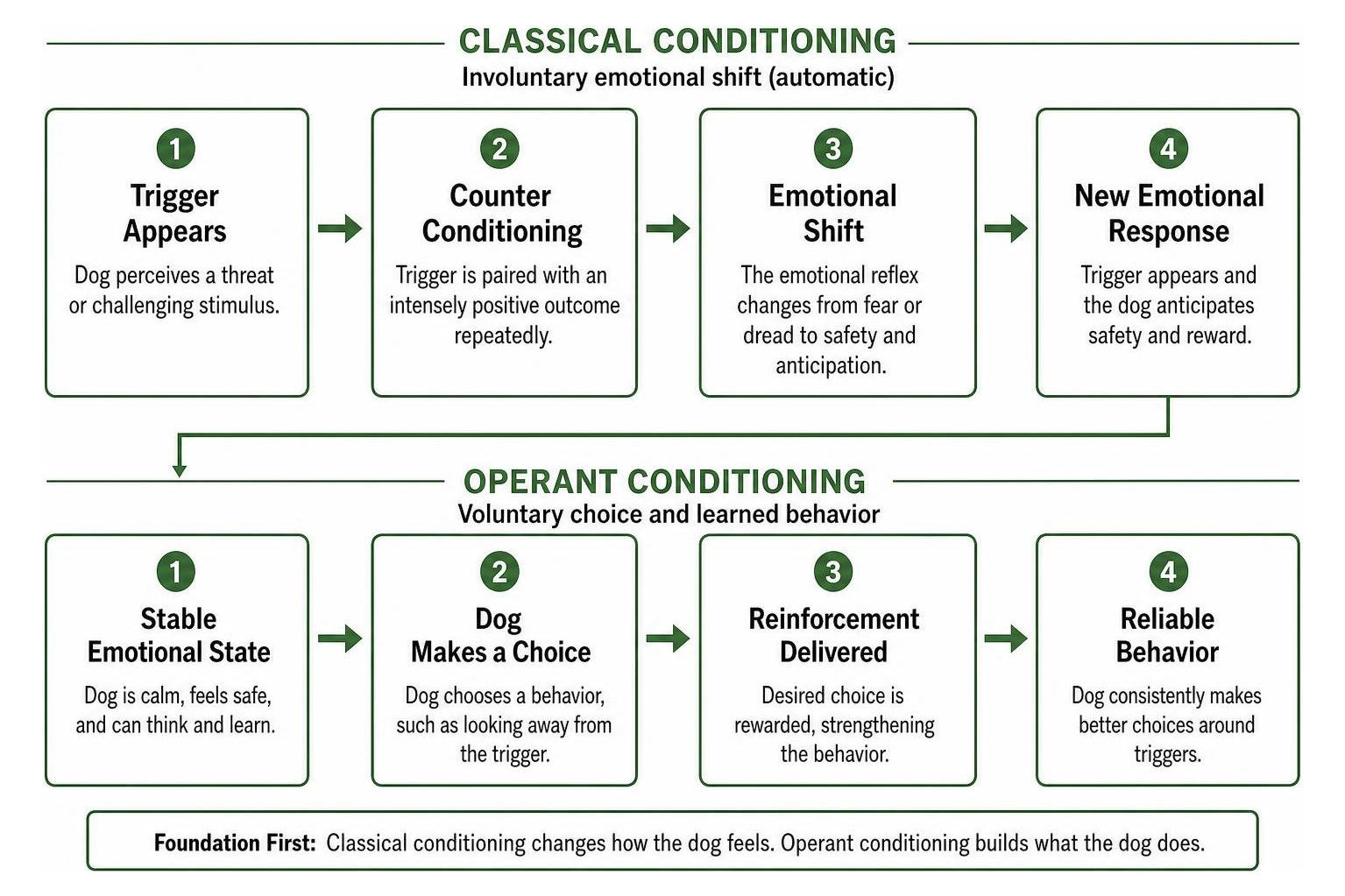
To fix behavioral challenges, we must understand how classical conditioning and operant conditioning work together.
- Classical Conditioning addresses the involuntary emotional response. Trigger appears, reward happens, regardless of what the dog does. We are conditioning an internal feeling.
- Operant Conditioning deals with voluntary choices and learned behaviors. The dog chooses an action, such as looking away from a distraction, and receives reinforcement for making that good choice.
In practical behavior modification, classical conditioning must come first. You cannot expect a dog in a state of blind panic to perform crisp obedience cues. Once their emotional state stabilizes and they feel safe, we layer in clear communication and operant skills. Training is not a purely positive, treat only process either. Lasting results need clear expectations, fair boundaries, and consistent follow through from the handler, alongside the rewards. Reviewing scientific research on desensitization and counter conditioning shows that systematically changing underlying emotions is the bedrock of reliable behavior.
The Core Foundations: Thresholds, Timing, and High Value Rewards
Successful training rests on three pillars: clear communication, smart management, and rock solid consistency. When implementing counter conditioning, success depends heavily on the value of your reinforcer and how precisely you manage the learning environment.
You cannot bring dry kibble to a high stakes emotional negotiation. When your dog sees something that triggers their survival instincts, a piece of standard biscuit is not going to tip the dopamine scales. You need high value rewards like diced roast chicken, real cheese, or freeze dried meats that your dog never gets during standard mealtimes. Learning practical strategies for building engagement with food ensures your dog stays dialed in on you during training sessions.
The Science: Combining Desensitization with Dog Training Counter Conditioning
Counter conditioning works best when paired with systematic desensitization. Desensitization means introducing the trigger at a very low intensity, usually by controlling distance, volume, or movement.
Scientific studies continue to confirm the power of this combined approach:
- In a clinical study of 37 dogs undergoing a mock veterinary exam, fear scores were statistically lower for dogs that completed a four week counter conditioning and desensitization protocol compared to control groups (p=0.046).
- A remarkable 86.7% of owners who complied with that four week protocol reported measurable reductions in their dogs' fear levels.
- Large scale surveys reveal that over 70% of owners using counter conditioning for firework fears saw marked improvement, making it the single most effective owner reported technique for noise phobias. In fact, providing food or play during firework events was the only management strategy statistically linked to clear improvement in fear responses.
Finding and Managing Your Dog's Stress Threshold
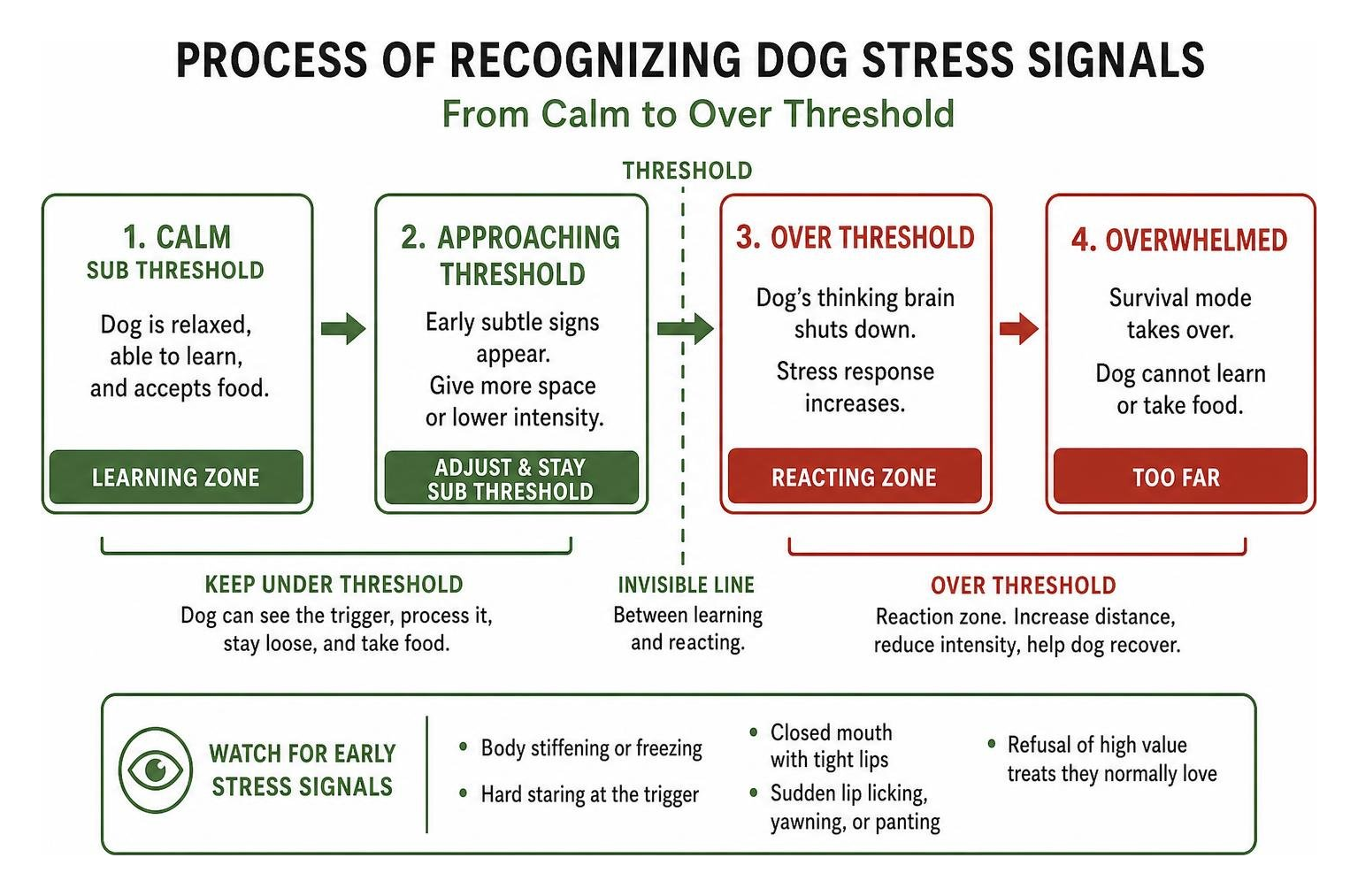
Your dog's threshold is the invisible line between learning and reacting. When your dog is sub threshold, they can see the trigger, process it, remain physically loose, and readily take food. Once they cross over threshold, their thinking brain turns off and survival mode takes over.
Watch for subtle early signs that your dog is approaching threshold:
- Body stiffening or freezing
- Hard staring at the trigger
- Closed mouth with tight lips
- Sudden lip licking, yawning, or panting
- Refusal of high value treats they normally love
Keeping your dog under threshold is critical. For dog owners across Portland, Beaverton, Hillsboro, and Vancouver dealing with crowded sidewalks, understanding and transforming reactive dog behavior starts with giving your dog enough physical space to succeed.
How to Implement Counterconditioning: A Step by Step Protocol
Modifying deep seated fears requires a clear system. Understanding three concepts every dog guardian should know helps you avoid confusing your dog during setup sessions.
Training is never about relying purely on treats or pretending bad choices do not matter. Lasting stability requires clear boundaries, thoughtful environmental management, fair consequences, and consistent handler follow through. But when you are running a counter conditioning drill, the order of events must be clean and predictable.
Step by Step Dog Training Counter Conditioning in Action
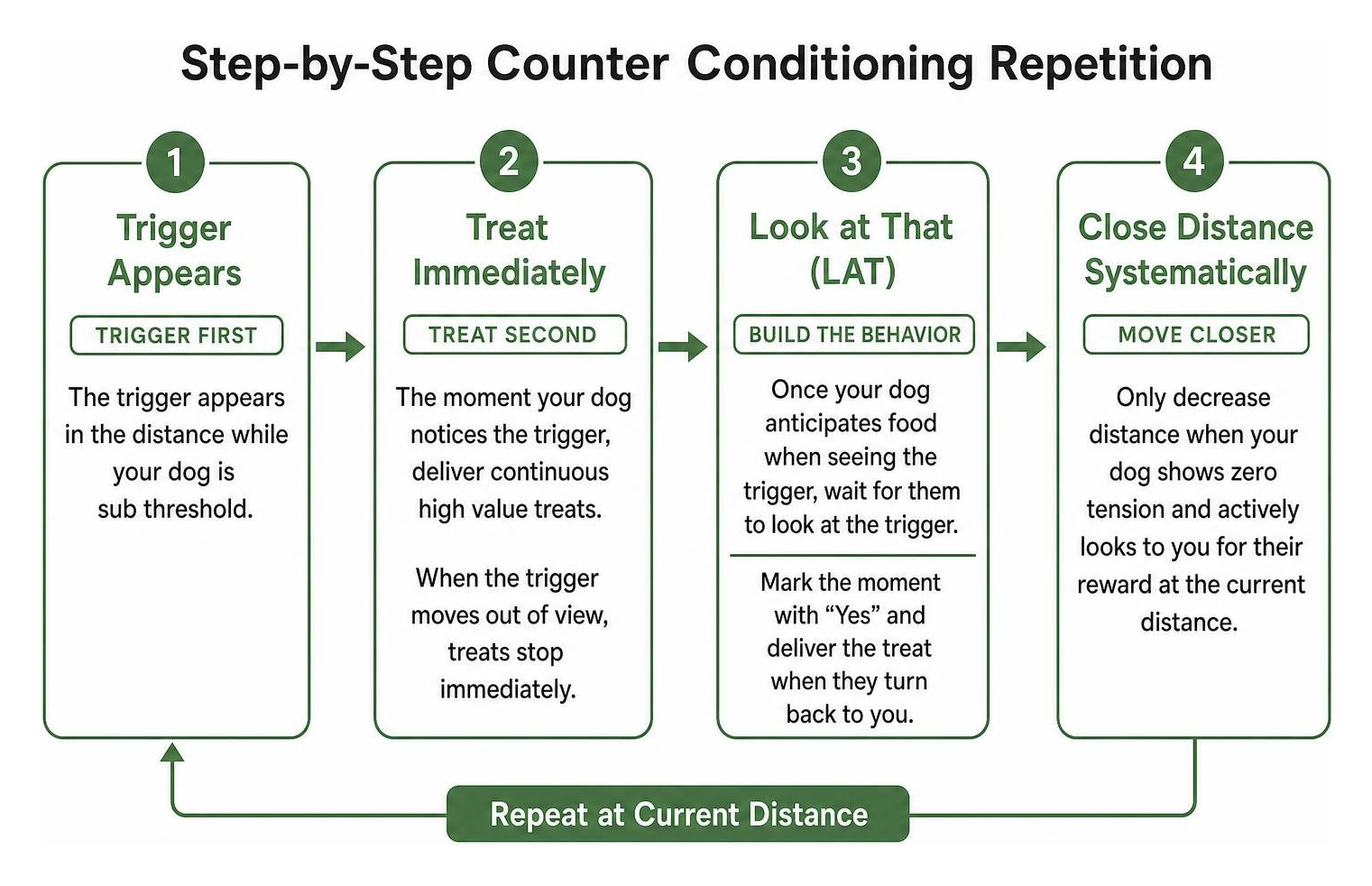
Here is the exact protocol to run with your dog:
- Set the Stage: Find an open space, such as a quiet park in Scappoose, St. Helens, or Warren, where you can control your distance from passing triggers.
- The Core Rep (Trigger First, Treat Second):
- The trigger appears in the distance while your dog is sub threshold.
- The split second your dog notices the trigger, deliver continuous high value treats.
- When the trigger moves out of view, the treats stop immediately.
- The trigger becomes the predictor of the reward.
- Introduce Look at That (LAT): Once your dog anticipates food upon seeing the trigger, wait for them to look at the trigger, mark the moment with a verbal cue like "Yes", and deliver the treat when they turn back to you.
- Close Distance Systematically: Only decrease distance when your dog shows zero tension and actively looks to you for their reward at the current distance.
For structured guidance in a controlled setting, our dedicated reactive dog training programs help owners master these mechanics without the stress of random neighborhood surprises.
Common Protocol Mistakes and How to Troubleshoot Them
Even dedicated handlers run into snags. Here are the most frequent mistakes and how to fix them:
- Feeding Before the Trigger Appears: If you wave a piece of hot dog in front of your dog's nose to distract them before they see the other dog, you are merely bribing them. The trigger must always appear first so it acts as the cue for the good stuff.
- Trigger Stacking: Multiple minor stressors throughout the day, such as a loud delivery driver, a fence fight, and a missed nap, can lower your dog's threshold. Keep training sessions short, around five to ten minutes, and give your dog rest between reps.
- Pushing Distance Too Fast: Progress is not a straight line. If your dog reacts, you moved too close too soon. Execute a smooth U turn, add distance, reset, and resume at a comfortable range.
Scientific Evidence, Expected Timelines, and When to Seek Help
Modifying behavior takes time because you are physically changing neural pathways. In a randomized controlled trial of 63 dogs, reward based training produced faster, more reliable obedience responses than aversive focused methods, with zero efficiency advantage for harsh corrections. Furthermore, puppies exposed to multiple unguided aversive methods by six months showed significantly higher odds of developing separation related issues later in life.
Tools and corrections have their place in balanced training when used properly, fairly, and under professional guidance to set boundaries. However, using blind punishment on a terrified, reactive dog only masks warning signals without solving the underlying panic.

Real behavior modification follows realistic timelines:
- 4 Weeks: Foundation obedience, marker clarity, and handler mechanics.
- 6 Weeks: Moderate reactivity, mild environmental fears, and baseline desensitization.
- 8 Plus Weeks: Complex fear, long standing leash reactivity, and entrenched aggression cases.
If your dog cannot remain under threshold at any reasonable distance, exhibits severe panic, or poses a bite risk to people or animals, it is time for professional support. Our specialized training for fearful dogs provides the structured framework needed to navigate complex behavioral challenges safely.
Frequently Asked Questions About Counterconditioning
How long does counterconditioning take to work?
Small improvements in focus and recovery time usually show up within two to three weeks of consistent practice. Meaningful, lasting behavior modification for reactive dogs typically takes between 6 and 8 plus weeks. True brain rewiring requires hundreds of successful, sub threshold repetitions alongside clear household management and routine consistency.
What should I do if my dog refuses treats near a trigger?
If your dog normally loves chicken but refuses it when a trigger appears, your dog is over threshold. Food refusal is an immediate physiological sign that the sympathetic nervous system has taken over. Do not shove the treat into their mouth. Calmly turn around, increase the distance until your dog relaxes, and resume your repetitions from further away.
How is counterconditioning different from basic distraction?
Distraction simply pulls your dog's attention away temporarily, hoping they do not notice the scary thing. Counter conditioning requires your dog to actively perceive the trigger so their brain can associate that specific stimulus with a positive outcome. Distraction manages the moment; counter conditioning resolves the underlying emotion.
Building Real Confidence Through Structured Training
Living with a reactive or fearful dog can make everyday walks around Bethany, Lake Oswego, or Vancouver feel like navigating a minefield. You do not have to feel embarrassed, frustrated, or stuck. Fear is not a personal failure, but resolving it does require clear communication, fair boundaries, consistent management, and realistic expectations.
At Blackwood Canine, we act as your guide to help you build a reliable relationship with your dog. We offer comprehensive programs starting at 4 weeks for foundational obedience, and 6 to 8 plus week timelines for complex behavior modification. We do not offer quick fix shortcuts shorter than 4 weeks because genuine, lasting behavioral change takes time, structure, and professional follow through.
If you are ready to stop managing crises and start building real confidence, taking the next step with our behavior modification training program will give you a clear, personalized path forward.